



© 2020, Прохорова Анастасия Юрьевна 296 2


СДЕЛАЙТЕ СВОИ УРОКИ ЕЩЁ ЭФФЕКТИВНЕЕ, А ЖИЗНЬ СВОБОДНЕЕ
Благодаря готовым учебным материалам для работы в классе и дистанционно
Скидки до 50 % на комплекты
только до
Готовые ключевые этапы урока всегда будут у вас под рукой
Организационный момент
Проверка знаний
Объяснение материала
Закрепление изученного
Итоги урока
Была в сети 17.12.2020 07:19

Прохорова Анастасия Юрьевна
Преподаватель английского языка
 1 684
1 684
 41 927
Специализация
631; 10.04.2020
Категория:
Английский язык
09.04.2020 21:20

Просмотр содержимого документа
«631; 10.04.2020»
Переведите текст: Numerical control
Study vocabulary:
numerical control (NC) - числовое программное управление, ЧПУ
augment - усиливать; повышать, поднимать, увеличивать, расширять
computer numerical controlled (CNC) machine tool - многоцелевой станок с ЧПУ типа CNC
CAD/CAM program - программа из системы CAD (computer-aided design система автоматизированного проектирования) /CAM (computer-aided manufacturing автоматизированное производство)
punch tape - перфолента редко используемый ныне носитель для хранения программ и данных
mylar - майлар (искусственная пленка, напр., для магнитных лент или дисков)
mylar tape - майларовая перфолента
robust - трудный, трудоемкий, требующий затрат сил и энергии
floppy disk - гибкий магнитный диск, дискета
USB (Universal Serial Bus) - универсальная последовательная шина, шина USB стандарт, предложенный в 1995 г. консорциумом из семи ведущих компьютерных и телекоммуникационных фирм ( Compaq, IBM, Intel, NEC, Micrisoft, Digital, Northern Telecom) для обмена данными по недорогой шине между ПК и среднескоростными периферийными устройствами.
flash drive - флэш-память
local area networking = local area network = LAN - локальная [вычислительная] сеть.
encumber - 1) а) загромождать б) усложнять 2) задерживать, затруднять, мешать, препятствовать, стеснять
APT automatically programmed tool - станок с автоматическим программным управлением
EIA ( Electronics Industries Alliance) - Альянс отраслей электронной промышленности, альянс EIA до октября 1997 г. называлась Electronics Industries Association. Расположенная в США профессиональная организация, разрабатывающая электрические и функциональные стандарты с идентификатором RS (Recommended Standards). Самый известный из её стандартов - RS-232C)
diesinking - нарезание ручьев штампов
engraving - изготовление клише
2.5D surface - 2.5 мерная организация поверхности
relief sculpture - рельефная скульптура
Text: Numerical control
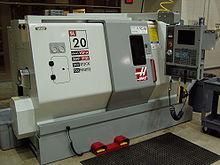

A CNC Turning Center. Siemens CNC panel.
Numerical control (NC) refers to the automation of machine tools that are operated by abstractly programmed commands encoded on a storage medium, as opposed to manually controlled via handwheels or levers or mechanically automated via cams alone. The first NC machines were built in the 1940s and 50s, based on existing tools that were modified with motors that moved the controls to follow points fed into the system on paper tape. These early servomechanisms were rapidly augmented with analog and digital computers, creating the modern computer numerical controlled (CNC) machine tools that have revolutionized the design process.
In modern CNC systems, end-to-end component design is highly automated using CAD/CAM programs. The programs produce a computer file that is interpreted to extract the commands needed to operate a particular machine, and then loaded into the CNC machines for production. Since any particular component might require the use of a number of different tools - drills, saws, etc. - modern machines often combine multiple tools into a single ";cell";. In other cases, a number of different machines are used with an external controller and human or robotic operators that move the component from machine to machine. In either case the complex series of steps needed to produce any part is highly automated and produces a part that closely matches the original CAD design.
Today
Although modern data storage techniques have moved on from punch tape in almost every other role, tapes are still relatively common in CNC systems. This is because it was often easier to add a punch tape reader to a microprocessor controller than it was to re-write large libraries of tapes into a new format. One change that was implemented fairly widely was the switch from paper to mylar tapes, which are much more mechanically robust. Floppy disks, USB flash drives and local area networking have replaced the tapes to some degree, especially in larger environments that are highly integrated.
The proliferation of CNC led to the need for new CNC standards that were not encumbered by licensing or particular design concepts, like APT. A number of different ";standards"; proliferated for a time, often based around vector graphics markup languages supported by plotters. One such standard has since become very common, the ";G-code"; that was originally used on Gerber Scientific plotters and then adapted for CNC use. The file format became so widely used that it has been embodied in an EIA standard. In turn, G-code was supplanted by STEP-NC, a system that was deliberately designed for CNC, rather than grown from an existing plotter standard.
A more recent advancement in CNC interpreters is support of logical commands, known as parametric programming. Parametric programs include both device commands as well as a control language similar to BASIC. The programmer can make if/then/else statements, loops, subprogram calls, perform various arithmetic, and manipulate variables to create a large degree of freedom within one program. An entire product line of different sizes can be programmed using logic and simple math to create and scale an entire range of parts, or create a stock part that can be scaled to any size a customer demands.
As digital electronics has spread, CNC has fallen in price to the point where hobbyists can purchase any number of small CNC systems for home use. It is even possible to build your own.
Вебинар для учителей

Свидетельство об участии БЕСПЛАТНО!



