Армения, Ереван


СДЕЛАЙТЕ СВОИ УРОКИ ЕЩЁ ЭФФЕКТИВНЕЕ, А ЖИЗНЬ СВОБОДНЕЕ
Благодаря готовым учебным материалам для работы в классе и дистанционно
Скидки до 50 % на комплекты
только до
Готовые ключевые этапы урока всегда будут у вас под рукой
Организационный момент
Проверка знаний
Объяснение материала
Закрепление изученного
Итоги урока

Была в сети 17.08.2023 11:48

---♤ Phantom Thief ♤---
17 лет
 192
192
 177 158
Местоположение
Անգլերեն 8 ջազային նախագիծ
Категория:
Английский язык
02.04.2023 14:16

Просмотр содержимого документа
«Անգլերեն 8 ջազային նախագիծ»

World of Jazz
8a, Janna Dolmazyan

INTRODUCTION
In our time, when a person, armed with the achievement of science and technology, has learned to spread information around the globe with the lightness of a wind chasing leaves across a lawn, it is difficult to surprise anyone that the ideas of a particular culture are suddenly found in another, far from it, area of the world. And the ubiquity of such a unique phenomenon as jazz in some sixty-seventy years is perhaps the most striking fact of modern times.
INTRODUCTION
The history of jazz goes back many decades. During this time, jazz in its homeland in the United States has repeatedly died, revived, experienced crisis processes, the causes and development of which are unexpected, sometimes not clear, not always studied and disclosed with sufficient completeness. Today, as in the beginning of the century, jazz causes great enthusiasm for some and rejection of others. It is clear, however, that the number of adherents of this art is rapidly growing today, especially among young people.

ORIGIN OF JAZZ
Slave traders, who in several centuries brought thousands of Negroes out of Africa, could not, of course, foresee that the music created by the descendants of these slaves, with its beauty and originality, would conquer the world and spread to almost all continents. This music is jazz.
What did these Negroes devote their rare hours of rest to? Music. Negroes have a highly developed musical instinct and a special sense of rhythm. Singing is the little that remains of a people deprived of material, physical and moral freedom. Having finished the working day, the Negroes gathered in the field or on the banks of the river and began to sing, rhythmically accompanying themselves with blows of sticks on boxes, empty cans, on everything that was at hand, or even simply clapping their hands.

ORIGIN OF JAZZ
In My New Orleans, Louis Armstrong, speaking of his youth, often mentions such trips and describes competitions between two orchestras that met by chance. “When musicians Kid Ory and Joe Oliver,” writes Armstrong, “appeared in their truck, announcing a ball or other event, and collided with another similar street orchestra, Joe and Kid played so inspired and beautifully that passers-by from their music literally crazy." New Orleans trombonist Kid Ory recounts that when he won such a musical battle, the crowd tied his truck to the vanquished's truck to keep him from slipping away too quickly.

FAMOUS JAZZ PERFORMERS
Louis Armstrong is an African-American jazz musician, trumpeter, and singer. Armstrong is often referred to as the "Father of Jazz". Born in New Orleans, from where in 1922 he went to play in Chicago in Joe Oliver's orchestra. The most significant and revolutionary recordings were made by Armstrong in 1927 and 1928 and are known as "Louis Armstrong and His Hot Fives". These records became a model for the coming "era of swing". Until the late 1940s, Armstrong remained the most imitated improviser among jazz musicians.

FAMOUS JAZZ PERFORMERS
Armstrong's childhood, like that of many other black jazz geniuses, was not easy. He never knew his father, and his mother, the servant, paid no attention to him. Louis was raised by his grandmother, who still remembered the days of slavery. From childhood, the boy worked, delivered coal, sang for pennies at crossroads.
He received his first musical education in a reformatory for colored teenagers, where he got for shooting a scarecrow in the street on New Year's Day. At the age of 18, the highly respected trombonist Kid Ory took him into his ensemble. But Louis Armstrong himself considered cornetist Joe "King" Oliver to be his real teacher.
As part of Oliver's Creole Jazz Band in Chicago, Armstrong made his first recordings. In 1924, at the urging of his wife Lil Hardin, he began an independent career. In 1925, Louis Armstrong organized his "Hot Five" - the first jazz improvisational ensemble. Recordings made during these years are considered to be the first pages of the golden book of jazz classics. Then the trumpeter Louis began to sing.
FAMOUS JAZZ PERFORMERS
In the 1930s, Louis Armstrong toured extensively, performing with famous big bands, but due to a lip injury (which gave him the nickname Satchmo), he performed more and more as a vocalist. In the 1940s, he assembled the All Stars ensemble, a brilliant jazz team.
In the 1960s Armstrong works almost exclusively as a vocalist, recording both new versions of traditional gospel songs and new songs. Together with Barbra Streisand, he took part in the musical Hello, Dolly!; released as a separate single, the song "Hello, Dolly!" in his performance reached the first place in the American charts of sales. Armstrong's last hit was the life-affirming song "What a Wonderful World" (#1 in the UK).
The greatest jazzman in New York died on July 6, 1971. Heart failure led to kidney failure.

FAMOUS JAZZ PERFORMERS
Billie Holiday, real name Eleanor Fagan (April 7, 1915 - July 17, 1959) was an American singer whose work is an era in the history of jazz.
Eleanor was born in Philadelphia, spent her childhood in extreme poverty, the identity of her father is not exactly established. In the early 1930s, trying to get at least some legal income, she began performing in those nightclubs where alcohol was sold illegally during the era of Prohibition.
FAMOUS JAZZ PERFORMERS
Very soon, Holiday gained a significant reputation in the world of jazz and moved to the most prestigious nightclubs in New York, where she performed slow songs on romantic themes with great force. Her fame was reinforced by the film Symphony in Black (1935), in which she co-starred with Duke Ellington. She has also worked with the big bands of Artie Shaw and Count Basie, with the ensemble of saxophonist Lester Young. In 1939, she recorded a piercing song “Strange Fruit”, which became her hallmark for many years.
The most ordinary songs that have already gone through dozens of recordings, "Lady Day" (that's what the fans called the singer) seemed to reinvent, giving them a novelty of originality and unique brilliance in their performances.

FAMOUS JAZZ PERFORMERS
After thirty years, Holiday began to have chronic health problems. She drank a lot, which negatively affected her voice."Lady Day" died from cirrhosis of the liver at the age of 44 years.
After Holiday's death, there was no shortage of books and films based on various episodes of her biography. So, in the film "Lady Sings the Blues" (1972), the role of the singer was played by Diana Ross. In 1987, Holiday was awarded a posthumous Grammy for Lifetime Achievement. Two years later, U2 dedicated the song "Angel of Harlem" to her memory. Her relaxed, lazy style of performance is recognizable by many modern jazz performers - for example, Norah Jones.
FAMOUS JAZZ PERFORMERS
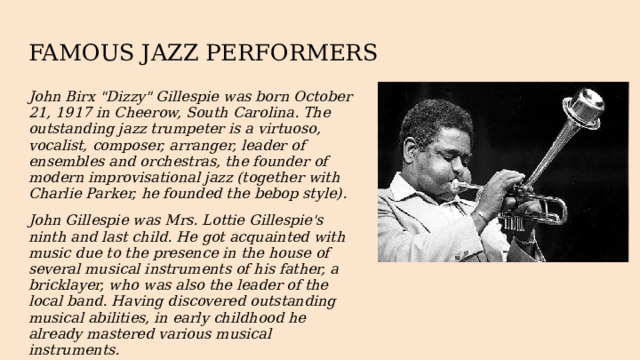
John Birx "Dizzy" Gillespie was born October 21, 1917 in Cheerow, South Carolina. The outstanding jazz trumpeter is a virtuoso, vocalist, composer, arranger, leader of ensembles and orchestras, the founder of modern improvisational jazz (together with Charlie Parker, he founded the bebop style).
John Gillespie was Mrs. Lottie Gillespie's ninth and last child. He got acquainted with music due to the presence in the house of several musical instruments of his father, a bricklayer, who was also the leader of the local band. Having discovered outstanding musical abilities, in early childhood he already mastered various musical instruments.

FAMOUS JAZZ PERFORMERS
He begins his professional career in Philadelphia clubs. There, he begins to work in the local band of Frank Fairfax as 3rd trumpeter (along with Charlie Shavers and Carl "Bama" Warwick), imitating his idol Roy Eldridge. In 1937, he moved to New York and, having successfully passed the audition, despite his original behavior (he appeared dressed in a coat, gloves and at the same time masterfully improvised), he entered the Teddy Hill Harlem Orchestra, which worked at the Savoy Ballroom. In this orchestra, Gillespie just becomes the successor to Roy Eldridge, who shortly before that went over to the Fletcher Henderson orchestra. His clownish behavior (on the eve of the upcoming summer European tour) quickly turns the orchestra members against him and they demand his dismissal. Hill manages to resolve the conflict and Gillespie successfully tours with the orchestra in England. In a fairly short time, he begins to play some parts of the first trumpet, and already teaches other musicians more than he studies himself. Cooperation with Teddy Hill continued until the dissolution of the orchestra in 1939.

FAMOUS JAZZ PERFORMERS
Upon returning to the United States, he participates in the cultural program of the World Exhibition in New York (1939), collaborates with pianist Edgar Hayes for 2 months.
From the end of 1939 to September 1941 he played in the orchestra of the singer Cab Calloway. During this period (May 9, 1940) - shortly before the tour in Canada - he marries the dancer Lorraine Willis, who then performed at the Harlem Apollo Theater.In 1990, he performed in the USSR for the only time in his life (in the Moscow Variety Theater).
Dizzy Gillespie died of pancreatic cancer on the night of January 6, 1993 and was buried at Flushing Cemetery in Queens, New York. According to his will, there were two funeral ceremonies: one - according to the Baha'i rite, the other, open to the general public - in the Cathedral of St. John the Evangelist belonging to the Episcopal Church.

So, the interaction of the Negro and European traditions, as a result of which jazz arose, was so complex and diverse that it makes sense to repeat the above. In 1890-1910, the three above-mentioned areas merged into one. As a result, jazz emerged - a new kind of music that began to spread throughout the country, first among blacks, and then among white Americans.
In the development of jazz, an important role was played by: the ensemble “Original Dixieland Jazz Band”, which was the first to release a jazz record that was very popular; Sydney Bechet, Joseph "King" Oliver, Jelly Roll Morton, Bix Beiderbeck, Frank Teschemacher, Pee Wee Russell, Benny Goodman, and of course Louis Armstrong, who in my opinion was the biggest contributor.








Вебинар для учителей
Свидетельство об участии БЕСПЛАТНО!