ДНР, Донецк

СДЕЛАЙТЕ СВОИ УРОКИ ЕЩЁ ЭФФЕКТИВНЕЕ, А ЖИЗНЬ СВОБОДНЕЕ
Благодаря готовым учебным материалам для работы в классе и дистанционно
Скидки до 50 % на комплекты
только до
Готовые ключевые этапы урока всегда будут у вас под рукой
Организационный момент
Проверка знаний
Объяснение материала
Закрепление изученного
Итоги урока

Была в сети 20.01.2019 10:06

Мами Елена Даниловна
учитель английского языка
 2 586
2 586
 27 398
Местоположение
Специализация
Art: types and functions
Категория:
Английский язык
11.06.2017 22:32

Просмотр содержимого документа
«Art: types and functions»
|
|
Art: types and functions
Level: pre-intermediate
Number of students: 12-15
Time: 45 min.
Objectives:
to develop students’ speaking and listening skills;
to get students involved in a group discussion on describing paintings and artists;
to extend students’ knowledge in the field of art;
to get students interested in the role of Art for mankind;
to develop students’ creative and presentation skills.
Equipment needed: a presentation, a computer, a projector.
Material needed: handouts, pictures
Procedure:
INTRODUCTION
Teacher: Some days ago I went to Art-Donbass, the art gallery, where you can see a lot of works of talented people. Today we are going to know some of artists and their works. Have you ever visited any museums? Do you like looking at the paintings, monuments, ancient temples or palaces and enjoying them? What word expresses all the items?
MAIN PART OF THE LESSON
Lead-in
Teacher:
Now I want to know what associations do you have when you read the word “Art”.
 Make up the mind-map, please.
ART


READING
Pre-reading activity
T.: Scan the texts and answer the questions:
What is Art?
What functions has Art got?
What types of Art do you know?
What characteristics of Art can you name?
Art refers to a diverse range of human activities in creating visual, auditory or performing artifacts. These artworks express the author's imaginative or technical skill. Art is intended to be appreciated for its beauty or emotional power. In their most general form these activities include the production of works of art, the criticism of art, the study of the history of art, and the aesthetic dissemination of art.
Art has had a great number of different functions throughout its history, making its purpose difficult to abstract or quantify to any single concept. This does not imply that the purpose of Art is "vague", but that it has had many unique, different reasons for being created.
Art can have a personal function, it is an expression of basic human instinct for harmony, balance, rhythm. Art at this level is not an action or an object, but an internal appreciation of balance and harmony (beauty), and therefore an aspect of being human beyond utility. Art also provides a way to experience one's self in relation to the universe. This experience may often come unmotivated, as one appreciates art, music or poetry.
On the other hand art may have a social function. At its simplest, art is a form of communication. It seeks to entertain and bring about a particular emotion or mood, for the purpose of relaxing or entertaining the viewer. Art may also be an expression of social protest, seeking to question aspects of society.
The oldest form of art are visual arts, which include creation of images or objects in fields including painting, sculpture, printmaking, photography, and other visual media. Architecture is often included as one of the visual arts; however, like the decorative arts, it involves the creation of objects where the practical considerations of use are essential, in a way that they usually are not in a painting, for example.
Music, theater, film, dance, and other performing arts, as well as literature and other media such as interactive media, are included in a broader definition of art or the arts.
Until the 17th century, art referred to any skill or mastery and was not differentiated from crafts or sciences. In modern usage after the 17th century, where aesthetic considerations are paramount, the fine arts are separated and distinguished from acquired skills in general, such as the decorative or applied arts.
Art may be characterized in terms of mimesis (i.e. its representation of reality), expression, communication of emotion, or other qualities. During the Romantic period, art came to be seen as "a special faculty of the human mind to be classified with religion and science". Though the definition of what constitutes art is disputed and has changed over time, general descriptions mention an idea of imaginative or technical skill stemming from human agency and creation.
The nature of art, and related concepts such as creativity and interpretation, are explored in a branch of philosophy known as aesthetics.
Post-reading activity
T (True) or F (False):
Art has a limited set of functions.
Architecture may be considered to be part of visual art.
In modern usage acquired skills are not considered part of fine arts.
SPEAKING & READING
Description of paintings
Aivazovsky's best and most famous pictures, The Ninth Wave
This is clearly seen in one of Aivazovsky's best and most famous pictures, The Ninth Wave. A group of shipwrecked survivors is about to be engulfed by an enormous wave. The merciless pounding of the elements is brilliantly conveyed as the waves roll, rise up and crash down with full force, having revealed for a moment the deep chasm below. The restless movement of clouds and sprays of foam strengthen the impression of a raging hurricane. Despite this the people clinging to a broken mast still struggle for life—the sun has just risen and its rays pierce the watery chaos, increasing just a little their chance of survival. The essential tragedy of the picture is outweighed by the vividness of the impression it makes: the spectator understands the horror of the storm but his feelings are won over by its beauty.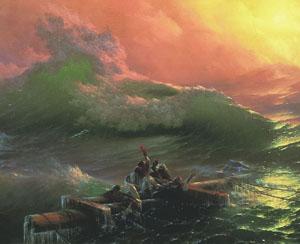
SPEAKING The plan of Description
Make up the cluster using the information of the text.
The subject of a painting (what is depicted in it
The plan of description
The impression made by the picture


The composition (how space is arranged) and the colours


The impression made by the picture


B. USE THE TOPICAL VOCABULARY:
1. To begin with, you should say that the painting belongs to a particular genre. It can be
the portrait
the landscape (seascape, townscape)
the still life
the genre scene
the historical/ mythological painting
To begin with, this painting is a portrait which belongs to the brush of (…. the name of the painter)
1.1. If you remember some information about the painter, say it then.
This artist lived in the ……century and worked in the style known as Classicism, Romanticism, Realism, Impressionism, Surrealism, Cubism, Expressionism, Abstract Art.
1.2. Give your opinion about the painting. Use adjectives:
lifelike = true to life
dreamlike = work of imagination
confusing
colourful
romantic
lyrical
powerful
outstanding
heart-breaking
impressive
To my mind, it is a … picture, which shows (….say what you see)
2. Mention the colours and the composition
2.1. Colours can be:
warm/ cold colours
bold colours
oppressive colours
bright colours
deep colours
light colours
soft and delicate colours
The picture is painted in …… colours. These colours contrast very well.
The dominating colours are ….
The colours contrast with each other.
2.2. Mention the composition/ the space:
The space of the picture is symmetrically/ asymmetrically divided.
2.3. Try to describe what you can see in general
In the centre/middle of the painting we can see a ….
In the foreground there is a….
In the background there are….
In the far distance we can make out the outline of a…
On the left/ right stands/ sits…
Use we can use the following structures in turn:
there is/there are/ there stands/ sits/ lies/
Use participle clauses:
a woman wearing a white dress
a man dressed as a monk
3. Give some details
At first glance, it looks strange/ confusing/ depressing/ …
But if you look closely, you can see…
It looks like ….
The artists managed to capture the sitter’s impression/ the atmosphere of a…../ the mood of the moment, etc.
3.1. Make guesses about the situation:
They might be talking about…
She may have just woken up…
It looks as if …
4. In the end, give your impression. Use the words and phrases:
Well, I feel that I am unable to put into words what I feel looking at the painting.
To my mind, it is a masterpiece that could stand the test of time.
Well, it seems to me that I couldn’t put into words the impression made on me by this painting.
I feel extremely impressed by this painting.
It is brilliant, amazing. It is a real masterpiece by (….. the painter).
T. : Using the vocabulary above and the plan of description describe the paintings of famous artists below.
Joseph Mallord William Turner
Fishermen At Sea, 1796

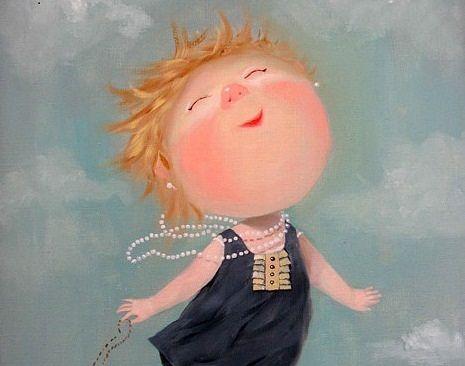
Evgenia Gapchinskaia
The Spring

B Конец формы
Thomas Kinkade
Nature landscape
Shishkin Ivan
Morning in a Pine Forest
III. CONCLUSION
Hometask: describe the picture you want;
Assessment of students’ work.


Вебинар для учителей
Свидетельство об участии БЕСПЛАТНО!