Россия, Ярославль


СДЕЛАЙТЕ СВОИ УРОКИ ЕЩЁ ЭФФЕКТИВНЕЕ, А ЖИЗНЬ СВОБОДНЕЕ
Благодаря готовым учебным материалам для работы в классе и дистанционно
Скидки до 50 % на комплекты
только до
Готовые ключевые этапы урока всегда будут у вас под рукой
Организационный момент
Проверка знаний
Объяснение материала
Закрепление изученного
Итоги урока

Была в сети 14.04.2026 22:46

Забелина Ольга Юрьевна
Учитель английского языка
52 года
 2 292
2 292
 30 404
Местоположение
Специализация
Australian National Parks
Категория:
Английский язык
26.02.2019 13:33

Просмотр содержимого документа
«Australian National Parks»
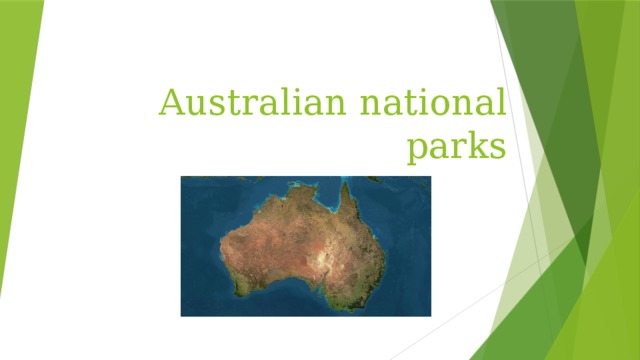
Australian national parks
Greatest Australian national parks
- There are many national park in Australia. Such as: National Park Kanangra-Boyd, Woolley national Park, Yengo national Park and others. But the most famous of them are: Kakadu national Park, Blue Mountains national Park.
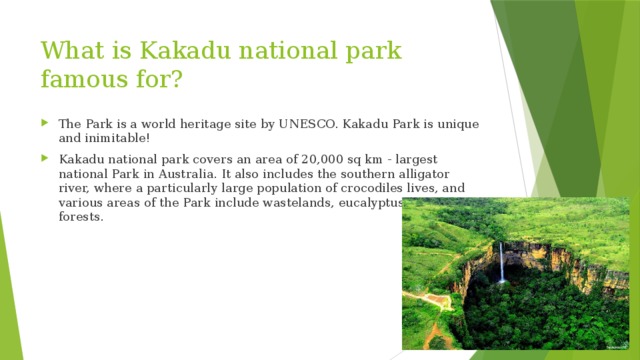
What is Kakadu national park famous for?
- The Park is a world heritage site by UNESCO. Kakadu Park is unique and inimitable!
- Kakadu national park covers an area of 20,000 sq km - largest national Park in Australia. It also includes the southern alligator river, where a particularly large population of crocodiles lives, and various areas of the Park include wastelands, eucalyptus and rain forests.
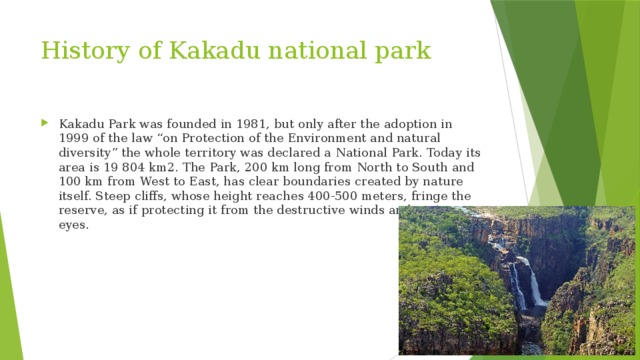
History of Kakadu national park
- Kakadu Park was founded in 1981, but only after the adoption in 1999 of the law “on Protection of the Environment and natural diversity” the whole territory was declared a National Park. Today its area is 19 804 km2. The Park, 200 km long from North to South and 100 km from West to East, has clear boundaries created by nature itself. Steep cliffs, whose height reaches 400-500 meters, fringe the reserve, as if protecting it from the destructive winds and prying eyes.

What is Blue Mountains national Park famous for?
- Blue mountains is a huge national Park with an area of 2481 km2 with high eucalyptus trees, ferns, swamps, waterfalls, rocks and caves, located in the mountains of the same name.The Park's flora includes typical species of Australian rainforest trees: blue eucalyptus, tree ferns, acacia, and mint tree. The fauna is represented: grey kangaroo, the mountain kangaroo (wallaroo), swamp Wallaby, categoty and ring-tailed possums, and other marsupials. There are a lot of exotic birds (red-haired fan-tail, pigeon Wong, climbed Crimson, yellow flycatchers, living only in the Blue mountains cave Warbler and others).
History of Blue Mountain national park
- When the first colonists arrived in Sydney, the Blue mountains were considered impassable after several unsuccessful attempts to cross the area. In 1813 Wentworth, facilities in blaxland and Lawson were able to find a passage by opening, thus, for the settlement of the Western plains.
- In 1932, the conservationist miles Dunphy first proposed the idea of its creation. The Park was established in 1959, and then it covered an area of approximately 630 km2.
- In 2000, the Blue mountains national Park was listed as a UNESCO world heritage site. The blue mountains are protected, and downhill from the Three sisters, the most famous peaks that have undergone massive erosion, is prohibited.
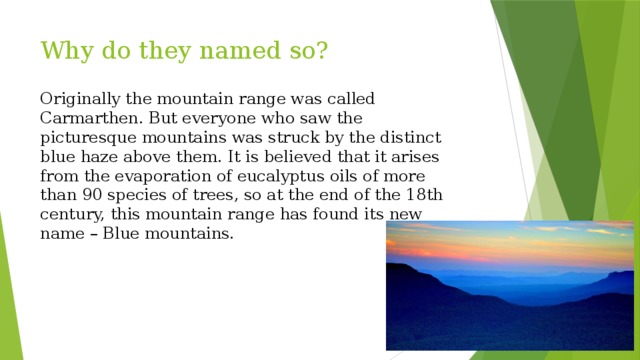
Why do they named so?
Originally the mountain range was called Carmarthen. But everyone who saw the picturesque mountains was struck by the distinct blue haze above them. It is believed that it arises from the evaporation of eucalyptus oils of more than 90 species of trees, so at the end of the 18th century, this mountain range has found its new name – Blue mountains.
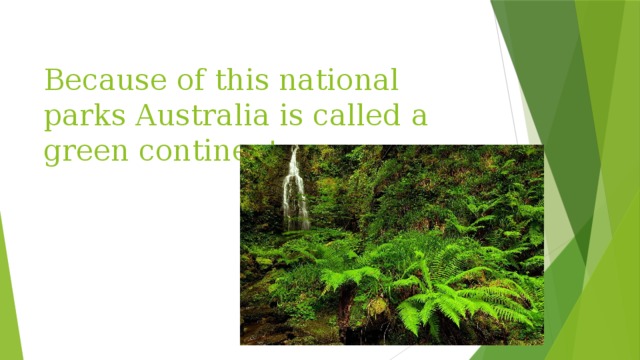
Because of this national parks Australia is called a green continent.

Thank you for watching








Вебинар для учителей

Свидетельство об участии БЕСПЛАТНО!