Россия, Дятьково

СДЕЛАЙТЕ СВОИ УРОКИ ЕЩЁ ЭФФЕКТИВНЕЕ, А ЖИЗНЬ СВОБОДНЕЕ
Благодаря готовым учебным материалам для работы в классе и дистанционно
Скидки до 50 % на комплекты
только до
Готовые ключевые этапы урока всегда будут у вас под рукой
Организационный момент
Проверка знаний
Объяснение материала
Закрепление изученного
Итоги урока
Была в сети 04.05.2019 21:24

Жигалкина Ирина Ивановна
учитель английского языка
65 лет
 603
603
 94 801
Местоположение
Bulling Дедовщина
Категория:
Английский язык
19.02.2019 20:45

Просмотр содержимого документа
«Bulling Дедовщина»
Конкурс исследовательских и творческих работ учащихся МАОУ ДСОШ №5
NO BULLING («Нет» - дедовщине в школе)
Выполнили: Евстратенко К. – 8а
Коршкова Ю. – 8а
Мачехина А. – 8б
Маркина Е. - 8б Руководители: Жигалкина И.И.
Булимова А.А.
февраль 2016г.
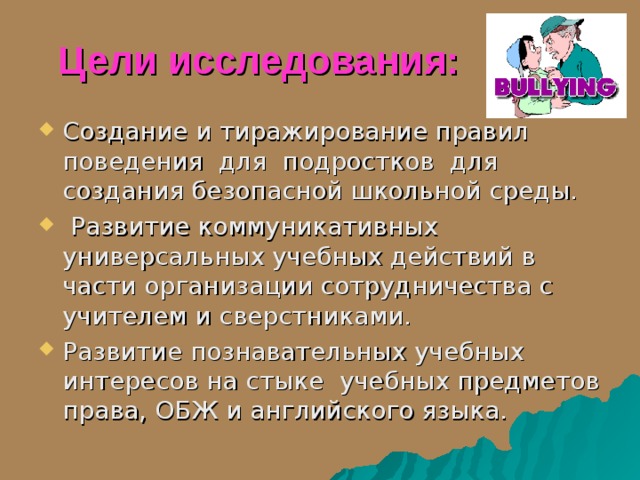
Цели исследования:
- Создание и тиражирование правил поведения для подростков для создания безопасной школьной среды.
- Развитие коммуникативных универсальных учебных действий в части организации сотрудничества с учителем и сверстниками.
- Развитие познавательных учебных интересов на стыке учебных предметов права, ОБЖ и английского языка.
Задачи исследования:
- Выбрать предмет исследования.
- Изучить и перевести английскую и американскую литературу по проблеме исследования.
- Проанализировать основные точки зрения по вопросу.
- Определить личную позицию по проблеме.
- Провести собственное мини-исследование по изучаемому вопросу.
- Сформулировать , обосновать, создать презентацию с правилами безопасного поведения в школе и классе.
- Научиться самим и научить своих друзей давать отпор нападающим.
- Научиться проводить исследование в метапредметном контексте.
.
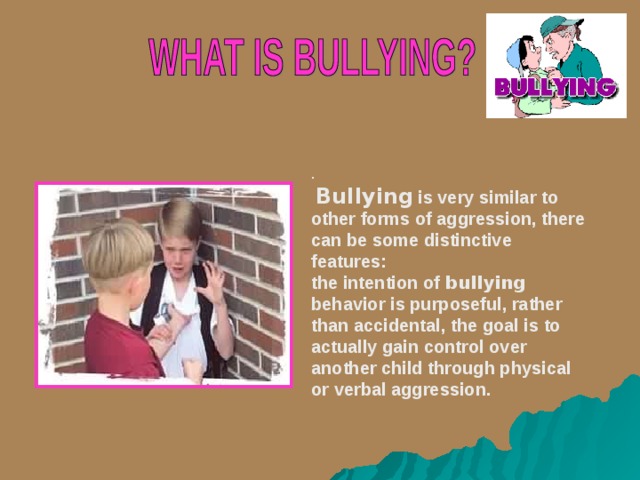
B ullying is very similar to other forms of aggression, there can be some distinctive features:
t he intention of bullying behavior is purposeful, rather than accidental , t he goal is to actually gain control over another child through physical or verbal aggression.
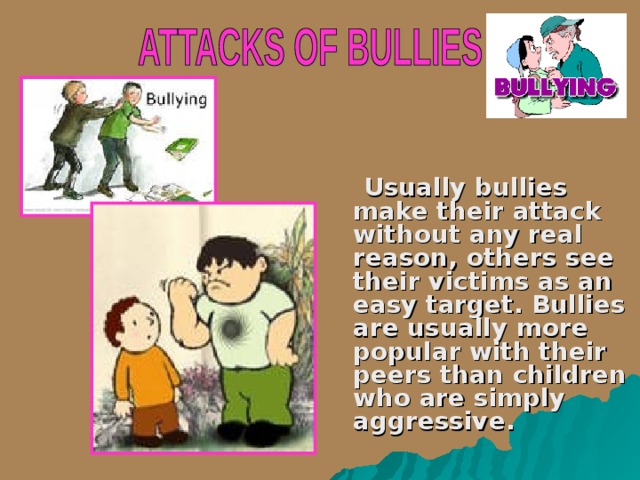
Usually bullies make their attack without any real reason, other s see their victim s as an easy target. Bullies are usually more popular with their peers than children who are simply aggressive.
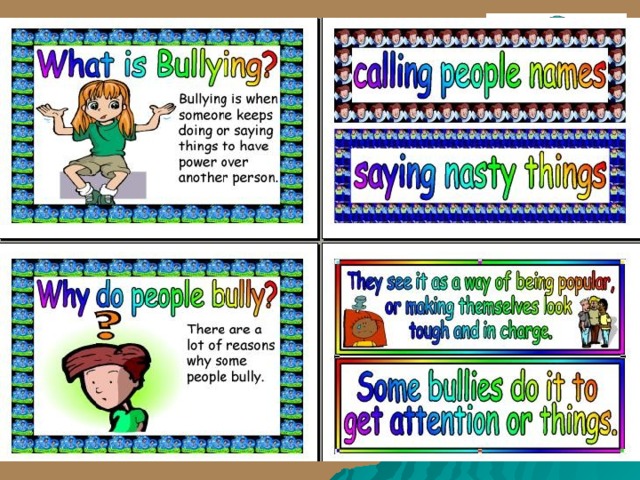
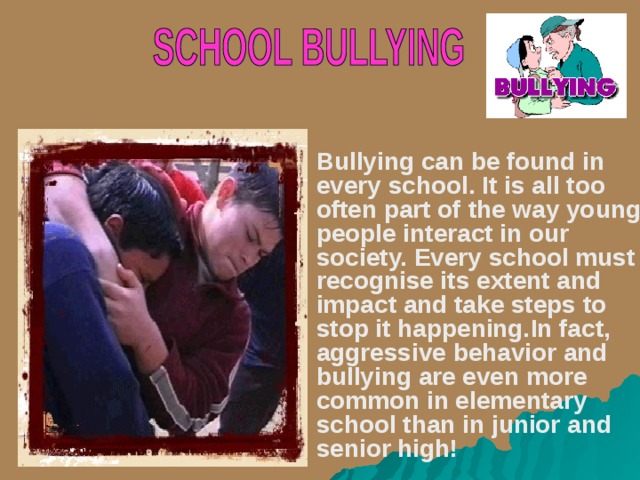
Bullying can be found in every school. It is all too often part of the way young people interact in our society. Every school must recognise its extent and impact and take steps to stop it happening. In fact, aggressive behavior and bullying are even more common in elementary school than in junior and senior high!
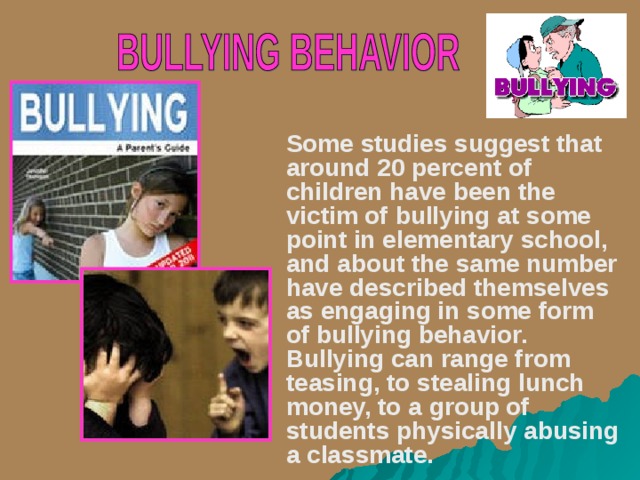
Some studies suggest that around 20 percent of children have been the victim of bullying at some point in elementary school, and about the same number have described themselves as engaging in some form of bullying behavior. Bullying can range from teasing, to stealing lunch money, to a group of students physically abusing a classmate.
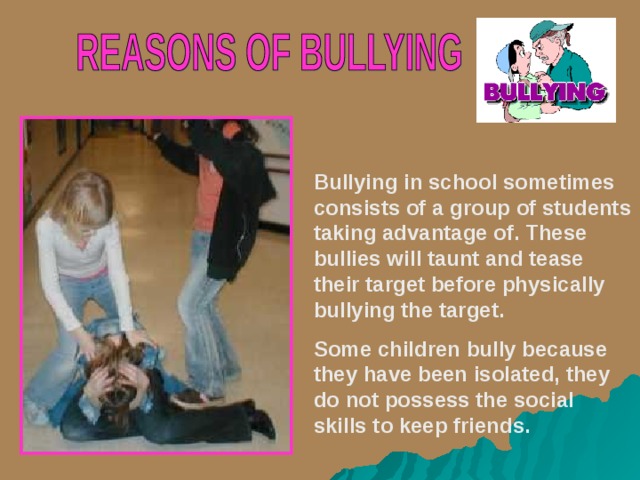
Bullying in school sometimes consists of a group of students taking advantage of. These bullies will taunt and tease their target before physically bullying the target.
Some children bully because they have been isolated, they do not possess the social skills to keep friends.
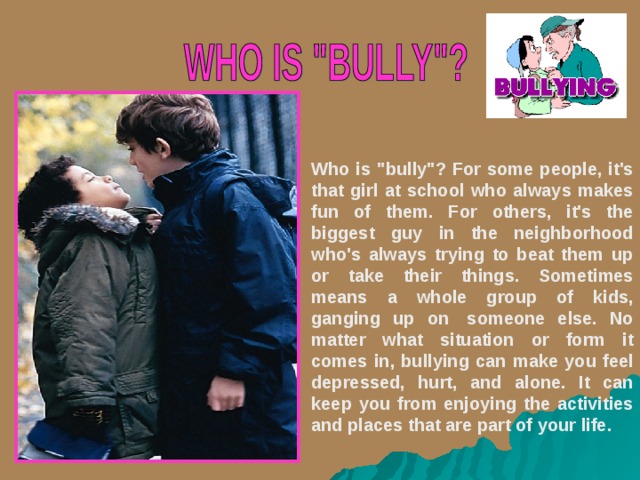
Who is "bully"? For some people, it's that girl at school who always makes fun of them. For others, it's the biggest guy in the neighborhood who's always trying to beat them up or take their things. Sometimes means a whole group of kids, ganging up on someone else. No matter what situation or form it comes in, bullying can make you feel depressed, hurt, and alone. It can keep you from enjoying the activities and places that are part of your life.
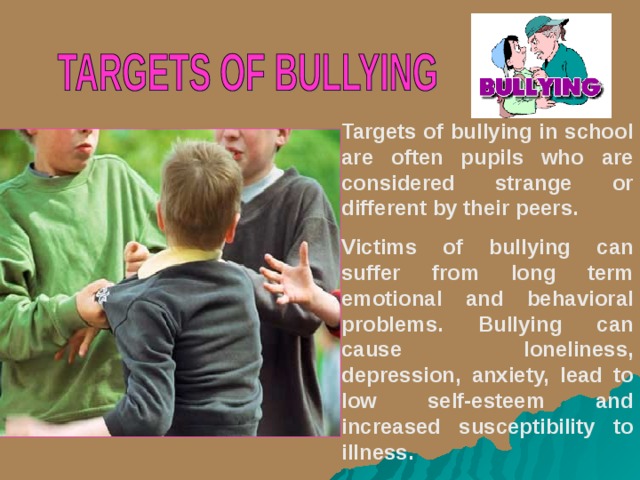
Targets of bullying in school are often pupils who are considered strange or different by their peers.
Victims of bullying can suffer from long term emotional and behavioral problems. Bullying can cause loneliness, depression, anxiety, lead to low self-esteem and increased susceptibility to illness.
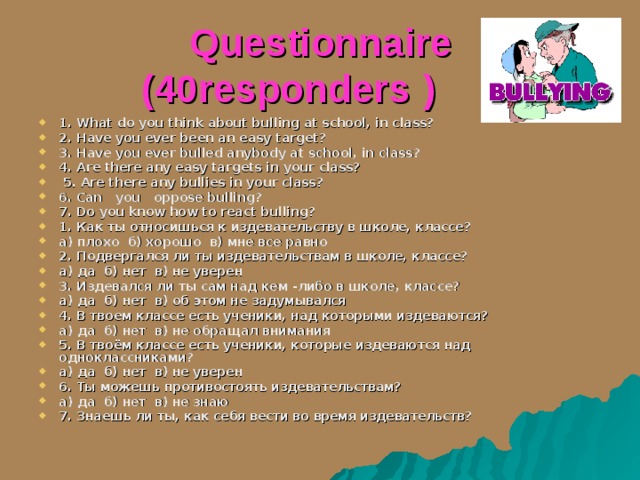
Questionnaire (40 responders )
- 1. What do you think about bulling at school, in class?
- 2. Have you ever been an easy target?
- 3. Have you ever bulled anybody at school, in class?
- 4. Are there any easy targets in your class?
- 5. Are there any bullies in your class?
- 6. Can you oppose bulling ?
- 7. Do you know how to react bulling?
- 1. Как ты относишься к издевательству в школе, классе?
- а) плохо б) хорошо в) мне все равно
- 2. Подвергался ли ты издевательствам в школе, классе?
- а) да б) нет в) не уверен
- 3. Издевался ли ты сам над кем -либо в школе, классе?
- а) да б) нет в) об этом не задумывался
- 4. В твоем классе есть ученики, над которыми издеваются?
- а) да б) нет в) не обращал внимания
- 5. В твоём классе есть ученики, которые издеваются над одноклассниками?
- а) да б) нет в) не уверен
- 6. Ты можешь противостоять издевательствам?
- а) да б) нет в) не знаю
- 7. Знаешь ли ты, как себя вести во время издевательств?
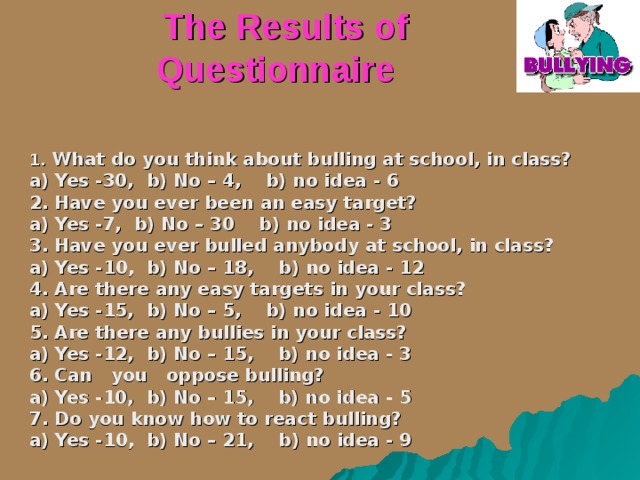
The Results of Questionnaire
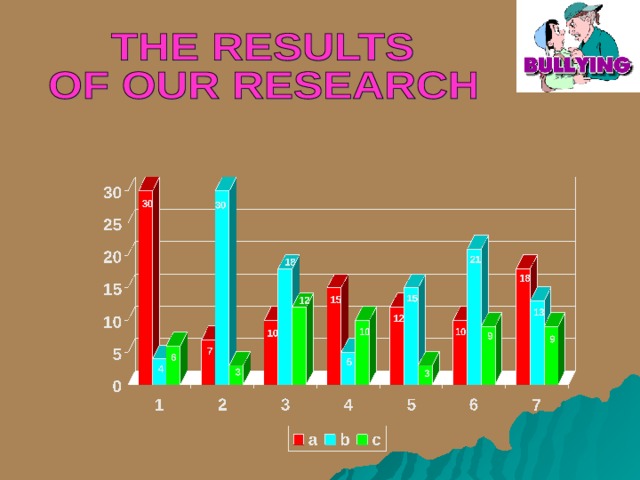
1. What do you think about bulling at school, in class?
a) Yes -30, b) No – 4, b) no idea - 6
2. Have you ever been an easy target?
a) Yes -7, b) No – 30 b) no idea - 3
3. Have you ever bulled anybody at school, in class?
a) Yes - 10 , b) No – 18 , b) no idea - 12
4. Are there any easy targets in your class?
a) Yes -15, b) No – 5, b) no idea - 10
5. Are there any bullies in your class?
a) Yes -12, b) No – 15, b) no idea - 3
6. Can you oppose bulling ?
a) Yes -10, b) No – 15, b) no idea - 5
7. Do you know how to react bulling?
a) Yes -1 0 , b) No – 21 , b) no idea - 9
- Are there any bullies in your class?
- В твоём классе есть ученики, которые издеваются над одноклассниками?
- How do they humiliate classmates?
- Как они унижают одноклассников?
- Can you oppose bulling ?
- Ты можешь противостоять издевательствам?
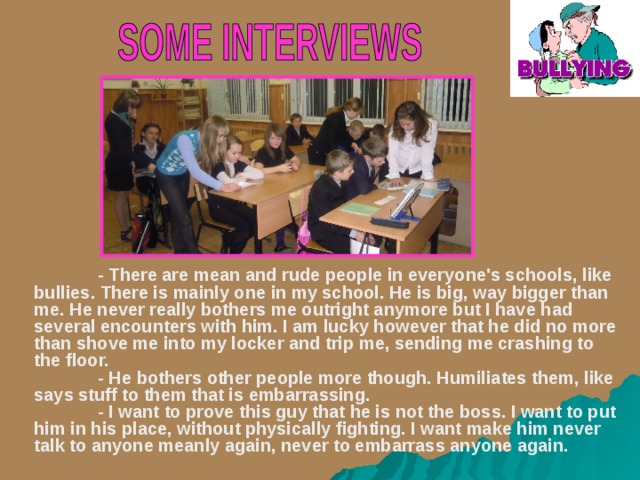
- There are mean and rude people in everyone's schools, like bullies. There is mainly one in my school. He is big, way bigger than me. He never really bothers me outright anymore but I have had several encounters with him. I am lucky however that he did no more than shove me into my locker and trip me, sending me crashing to the floor. - He bothers other people more though. Humiliates them, like says stuff to them that is embarrassing. - I want to prove this guy that he is not the boss. I want to put him in his place, without physically fighting. I want make him never talk to anyone meanly again, never to embarrass anyone again.
- Get an accurate assessment of the problem. An anonymous survey is a very effective way to learn about the true nature of a problem at a particular school.
- Maintain higher visibility. Supervising recess is especially important.
- Have students develop class rules about bullying that are then consistently reinforced.
- Conduct in-service training for both teachers and parents. It is also important to remember that verbal harassment can be just as scary and intimidating as physical attacks.
- Have serious talks with bullies, and make them realize that you are aware of their behavior and are not going to tolerate it. It is also important to develop ways to help them learn more positive social skills.
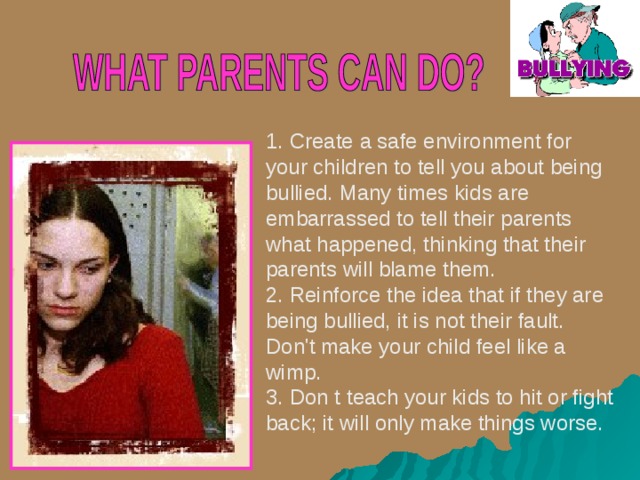
1. Create a safe environment for your children to tell you about being bullied. Many times kids are embarrassed to tell their parents what happened, thinking that their parents will blame them.
2. Reinforce the idea that if they are being bullied, it is not their fault. Don't make your child feel like a wimp.
3. Don t teach your kids to hit or fight back; it will only make things worse.
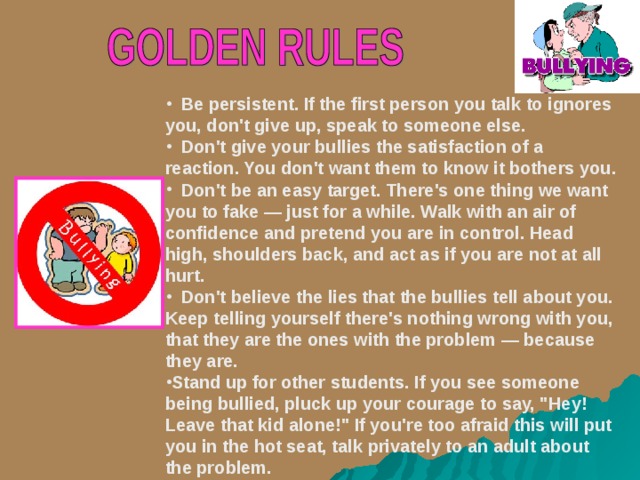
- Be persistent. If the first person you talk to ignores you, don't give up, speak to someone else.
- Don't give your bullies the satisfaction of a reaction. You don't want them to know it bothers you.
- Don't be an easy target. There's one thing we want you to fake — just for a while. Walk with an air of confidence and pretend you are in control. Head high, shoulders back, and act as if you are not at all hurt.
- Don't believe the lies that the bullies tell about you. Keep telling yourself there's nothing wrong with you, that they are the ones with the problem — because they are.
- Stand up for other students. If you see someone being bullied, pluck up your courage to say, "Hey! Leave that kid alone!" If you're too afraid this will put you in the hot seat, talk privately to an adult about the problem.

Вебинар для учителей

Свидетельство об участии БЕСПЛАТНО!