


Россия, Барнаул

СДЕЛАЙТЕ СВОИ УРОКИ ЕЩЁ ЭФФЕКТИВНЕЕ, А ЖИЗНЬ СВОБОДНЕЕ
Благодаря готовым учебным материалам для работы в классе и дистанционно
Скидки до 50 % на комплекты
только до
Готовые ключевые этапы урока всегда будут у вас под рукой
Организационный момент
Проверка знаний
Объяснение материала
Закрепление изученного
Итоги урока

Была в сети 20.05.2026 14:00

Пантелеева Ольга Геннадьевна
Преподаватель английского языка
49 лет
 21 147
 1 670
1 670 
Местоположение
Специализация
Chinese cuisine
Категория:
Английский язык
23.01.2017 14:30

Просмотр содержимого документа
«Chinese cuisine»

Chinese cuisine
The contents of the presentation
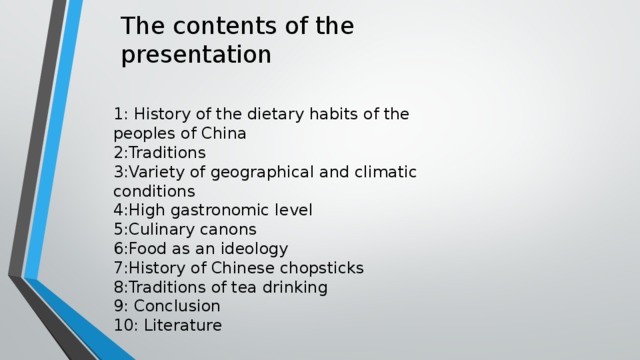
1: History of the dietary habits of the peoples of China
2:Traditions
3:Variety of geographical and climatic conditions
4:High gastronomic level
5:Culinary canons
6:Food as an ideology
7:History of Chinese chopsticks
8:Traditions of tea drinking
9: Conclusion
10: Literature
History
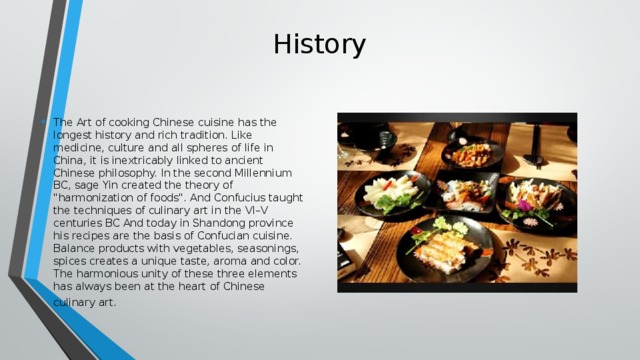
- The Art of cooking Chinese cuisine has the longest history and rich tradition. Like medicine, culture and all spheres of life in China, it is inextricably linked to ancient Chinese philosophy. In the second Millennium BC, sage Yin created the theory of "harmonization of foods". And Confucius taught the techniques of culinary art in the VI–V centuries BC And today in Shandong province his recipes are the basis of Confucian cuisine. Balance products with vegetables, seasonings, spices creates a unique taste, aroma and color. The harmonious unity of these three elements has always been at the heart of Chinese culinary art.
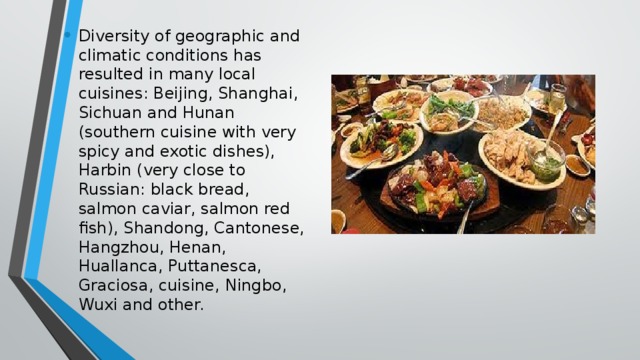
- Diversity of geographic and climatic conditions has resulted in many local cuisines: Beijing, Shanghai, Sichuan and Hunan (southern cuisine with very spicy and exotic dishes), Harbin (very close to Russian: black bread, salmon caviar, salmon red fish), Shandong, Cantonese, Hangzhou, Henan, Huallanca, Puttanesca, Graciosa, cuisine, Ningbo, Wuxi and other.

High gastronomic level. The oldest archaeological findings showing rather high gastronomic level of the Chinese, found in Anyang, Henan province. It was bronze pots, knives, kitchen boards, shovels, buckets and other utensils.

Culinary canons. Despite the regional diversity of Chinese cuisine, some rules of cooking remain the same for all chefs. Culinary canons of China demand from the chef that the food was not only delicious, but also useful and sometimes therapeutic.
"Food as an ideology". Meat can only be an addition to the dish, not its Foundation. It can provide the taste and flavor of vegetable dish. In the diet
the proportion of animal protein is not more than 20 %. And the main source of protein are peanuts, peas, mung, soy and other legumes, contain a lot of complex carbohydrates. The basis of the power of vegetables and fruits that provides a large amount of fiber. Sense of taste in Chinese cuisine is of special importance. For their strengthening using various spices and herbs, almost not containing fat.

The Combination of flavors. Yin ("warm" products, they tend to mostly warm colors) and Yang ("cold" products, mostly cool colors) makes the dish balanced and almost no fat.

Dishes for the meal are selected so that among them there prevailed a liquid and soft food. The meal begins with folding plates of the components. So, on the Grand parade lunch serves up to 40 different dishes, with each sitting at the table, usually round, gets a bowl with fresh boiled rice and chopsticks. In the center of the table are common dishes.

First drink green tea, without sugar and milk, then served in bowls with cold cuts, usually cut into small pieces, liver, meat, fish or vegetables. Chinese eat slowly and gradually, enjoying the process. Guest as a sign of special attention, the highest of care and respect taken to put in the treat bowl with her chopsticks. In conclusion, the meal is served the broth and again tea, but it adds a little bit of oil. It is this structure and order is the most favorable for digestion.
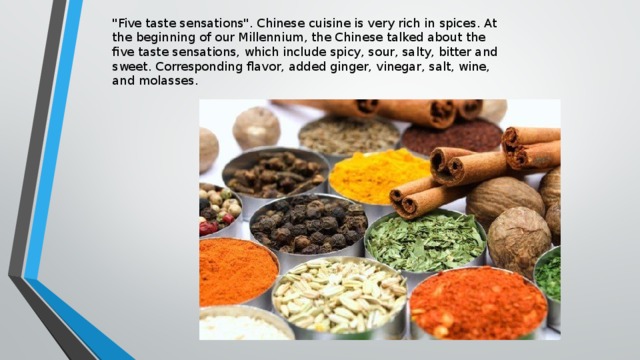
"Five taste sensations". Chinese cuisine is very rich in spices. At the beginning of our Millennium, the Chinese talked about the five taste sensations, which include spicy, sour, salty, bitter and sweet. Corresponding flavor, added ginger, vinegar, salt, wine, and molasses.

Chopsticks. Today without Chinese chopsticks, Chinese food was not Chinese, after all, unusual dishes China you need to eat only with all the famous Chinese sticks. In Chinese they are called, Quizzy

From the history of Chinese chopsticks. The history of Chinese chopsticks goes back several millennia. Scientists believe that the first time they were used in China before our era. According to one version, it happened during the reign of the dynasty of the Shang-Yin (about 1764 - 1027 BC).

From the history of Chinese chopsticks. There is a version that originally sticks were used only during cooking food wrapped in leaves. It cooks quickly and deftly transferred the hot stones and turn over meat, fish and vegetables. Later sticks replaced the scoop with a long handle, called "bi". If previously cooked food is removed from plates with a spoon, with the advent of sticks, the need for it disappeared.

Using sticks. Use chopsticks either easy or difficult. It is hard for those who first took them in hand no idea how to properly keep. It is believed that sticks and develop fine motor skills, and it directly affects the mental abilities of the child. Therefore, the Chinese from an early age develop children's desire to master the chopsticks: holding chopsticks, the child begins with one year of age.

Chinese tea culture. Chinese tea culture the ways of tea making, used utensils and appliances, as well as events that serve as an occasion for tea in China.
Tea drinking Tradition. The Chinese celebrate some special circumstances for the preparation and drinking of tea. "Sign of respect" "the Family meeting" "Apology," "Maintaining the tradition"
Literature
1) http://www.myshared.ru/slide/430369 /
2)Диль Китайская кухня/ Диль - СПб, 2001. – с. 160
3)Спенлоу Л. П Кулинарная экзотика, Китайская кухня/ Л. П Спенлоу : ЭКСМО ISBN, 2005. – с. 64
4)БЕЛОУСОВ С.Н. МАРШРУТ ГУРМАНА / С.Н. БЕЛОУСОВ //": Голубые ели, или Утка по-пекински - Новая Сибирь. – 2005. - №3
5)Кимов С.В. Еженедельный кулинарный журнал / С.В. Кимов // История и традиции китайской кухни– 2000. - №6

Conclusion
Chinese cuisine has the longest history and rich tradition. Like medicine, culture and all spheres of life in China, it is inextricably linked to ancient Chinese philosophy. In the second Millennium BC, sage Yin created the theory of "harmonization of foods". And Confucius taught the techniques of culinary art in the VI—V centuries BC And today in Shandong province his recipes are the basis of Confucian cuisine.
Chinese cuisine is distinguished by a huge variety of dishes. On the one hand numerous wars and natural disasters throughout history, and with another — desire of the nobility to decorate their tables with a variety of exotic dishes, contributed to the fact that today in this kitchen is used almost everything that nature gives, including such Exotica for our table, as shark fins, sea turtles, dried jellyfish, bird's nest, sea cucumbers, snakes, frogs, Lotus seeds and much more. Chinese cuisine has many thousands of dishes

Thank you for your attention!
Комплекты видеоуроков для учителей



Скачать
© 2017, Пантелеева Ольга Геннадьевна 2539 32
Похожие файлы
Вебинар для учителей

Свидетельство об участии БЕСПЛАТНО!



