Россия, Калининград

СДЕЛАЙТЕ СВОИ УРОКИ ЕЩЁ ЭФФЕКТИВНЕЕ, А ЖИЗНЬ СВОБОДНЕЕ
Благодаря готовым учебным материалам для работы в классе и дистанционно
Скидки до 50 % на комплекты
только до
Готовые ключевые этапы урока всегда будут у вас под рукой
Организационный момент
Проверка знаний
Объяснение материала
Закрепление изученного
Итоги урока
Была в сети 22.02.2025 14:18

Кичатова Галина Викторовна
Учитель английского языка
61 год
 1 130
1 130
 59 325
Местоположение
Classrom management
Категория:
Английский язык
26.02.2020 22:04

Просмотр содержимого документа
«Classrom management»
CLASSROOM MANAGEMENT
Classroom management-
Is what you do to prepare the lesson, the environment, and the students for learning. It includes all aspects of the classroom that the teacher may have some influence over, e.g., physical arrangement of space, student motivation, teaching approach, lesson plans, disciplinary techniques, etc.
Seating arrangement
Changing seating arrangements can help students interact with different people, change the focus from the teacher when appropriate, allow a range of different situations to be reached within the classroom, simply add some variety to the lesson.
For each activity you do in class consider what arrangements are most appropriate.
But
NO
constant movement every five minutes.
Gestures
Develop a range of gestures and facial expressions to save yourself repeating basic instructions. (e.g., time, pointing the verb tense, finishing the activity, etc.)
Think of your manner of teaching/presentation
Giving instructions
Be aware of your instruction- giving:
- Include only essential information
- Use simple, clear language
- Use short sentences- 1 sentence for each key piece of information
- Don’t say things that are visible or obvious
- Don’t give instructions that they don’t need to know
- Demonstrate rather than explain wherever possible
- Check that they understand what to do. Ask CCQ questions. (DON’T ask “Do you understand?”)
- FIRST instructions, THEN handouts
TTT-Teacher Talking Time
- The more a teacher talks- the less opportunity is for learners.
- Students need time to think.
- Give them time to think, don’t expect them giving answer at once.
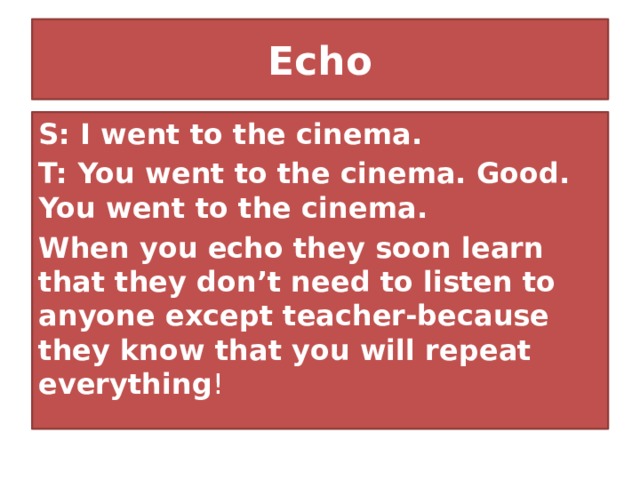
Echo
S: I went to the cinema.
T: You went to the cinema. Good. You went to the cinema.
When you echo they soon learn that they don’t need to listen to anyone except teacher-because they know that you will repeat everything !
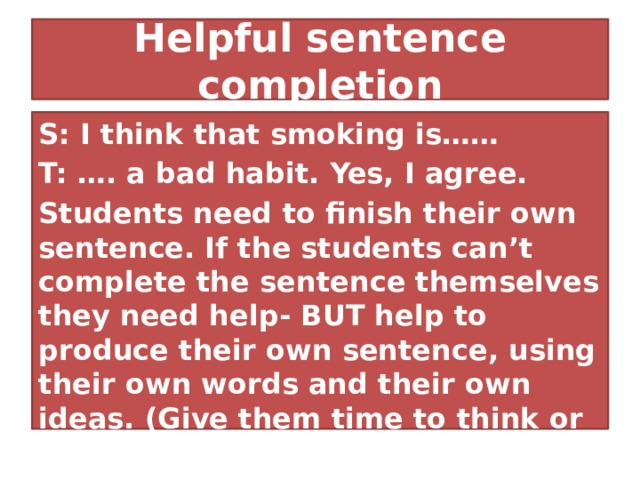
Helpful sentence completion
S: I think that smoking is……
T: …. a bad habit. Yes, I agree.
Students need to finish their own sentence. If the students can’t complete the sentence themselves they need help- BUT help to produce their own sentence, using their own words and their own ideas. (Give them time to think or ask other students to help.)
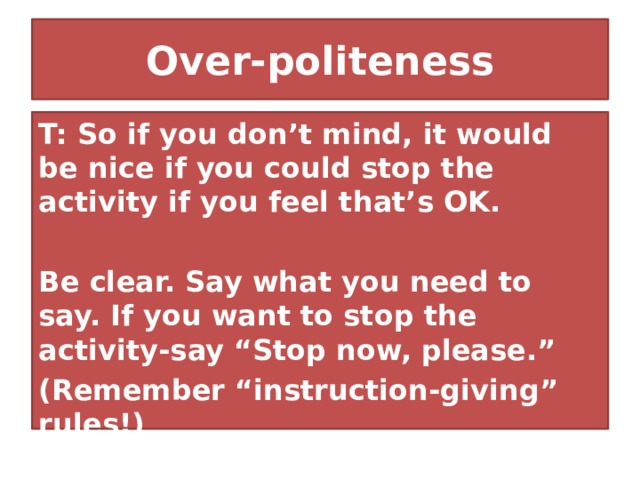
Over-politeness
T: So if you don’t mind, it would be nice if you could stop the activity if you feel that’s OK.
Be clear. Say what you need to say. If you want to stop the activity-say “Stop now, please.”
(Remember “instruction-giving” rules!)
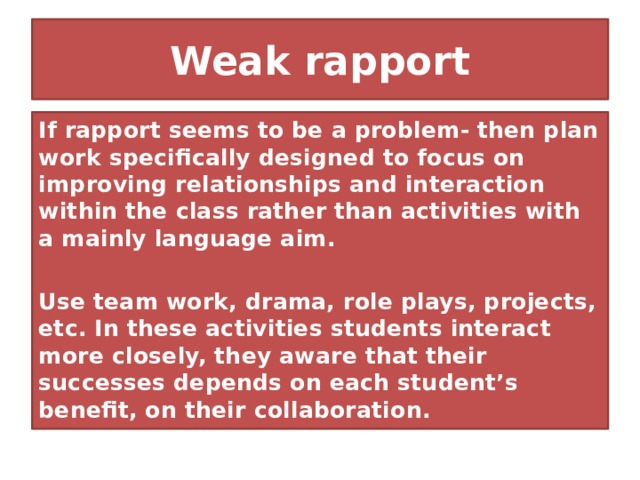
Weak rapport
If rapport seems to be a problem- then plan work specifically designed to focus on improving relationships and interaction within the class rather than activities with a mainly language aim.
Use team work, drama, role plays, projects, etc. In these activities students interact more closely, they aware that their successes depends on each student’s benefit, on their collaboration.
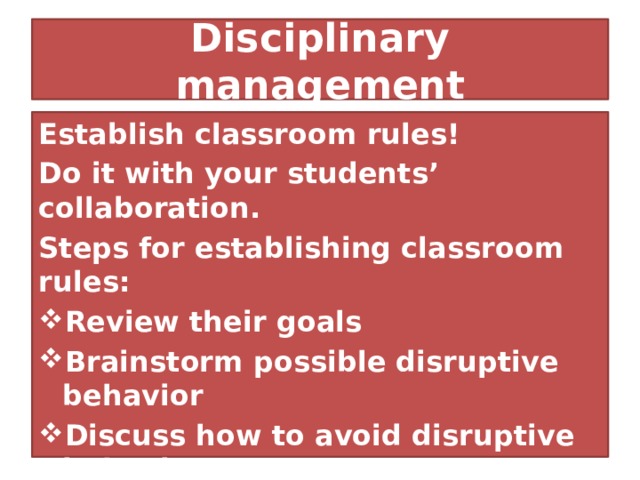
Disciplinary management
Establish classroom rules!
Do it with your students’ collaboration.
Steps for establishing classroom rules:
- Review their goals
- Brainstorm possible disruptive behavior
- Discuss how to avoid disruptive behavior
- The consequences
- The written contract
Вебинар для учителей
Свидетельство об участии БЕСПЛАТНО!