Армения, Чаренцаван


СДЕЛАЙТЕ СВОИ УРОКИ ЕЩЁ ЭФФЕКТИВНЕЕ, А ЖИЗНЬ СВОБОДНЕЕ
Благодаря готовым учебным материалам для работы в классе и дистанционно
Скидки до 50 % на комплекты
только до
Готовые ключевые этапы урока всегда будут у вас под рукой
Организационный момент
Проверка знаний
Объяснение материала
Закрепление изученного
Итоги урока

Была в сети 23.11.2020 21:46

Костандян Гаяне Размиковна
Учительница информатики
61 год
 1 643
1 643
 43 041
Местоположение
Специализация
Climate Change Is Shrinking Sparrows
Категория:
Окружающий мир
22.06.2020 22:28

Просмотр содержимого документа
«Climate Change Is Shrinking Sparrows»

Climate Change Is Shrinking Sparrows


1847, German biologist Carl Bergmann posited that cold climates give rise to bigger bodies, and that animals who live in warm places typically are smaller. It made sense, since bigger bodies preserve heat more efficiently than smaller ones.
One question remained unanswered. What about birds who endure both hot and cold? As it turns out, it’s all about the heat, a fact made clear by climate change.
Scientists now suspect that exposure to excessive heat is a stronger influence on body size than bitter cold, a finding that raises worrisome implications about the health of birds on a warming planet.
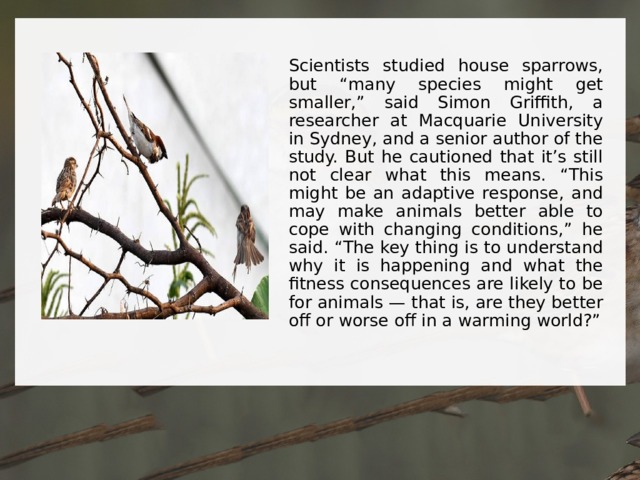
Scientists studied house sparrows, but “many species might get smaller,” said Simon Griffith, a researcher at Macquarie University in Sydney, and a senior author of the study. But he cautioned that it’s still not clear what this means. “This might be an adaptive response, and may make animals better able to cope with changing conditions,” he said. “The key thing is to understand why it is happening and what the fitness consequences are likely to be for animals — that is, are they better off or worse off in a warming world?”

Doctoral candidate Samuel Andrew, the study’s lead author, agreed, adding, “If these changes in size are an important part of adapting to warmer climates, then birds that don’t change their size in response to temperature change could be the species that are more vulnerable.”
For the study, Andrew and his team captured and measured about 40 adult house sparrows at each of 30 locations across Australia and New Zealand. They found that maximum temperatures during the summer, when the birds breed, were a better predictor of adult body size at each location than winter minimum temperatures.
![Because house sparrows are sedentary birds that live among humans, “this means you can compare the size of birds from different locations across a large distribution,” said Andrew, the study’s lead author. “The interesting thing about the Australian [sparrow] populations is that some of them live in the arid center of Australia, where it gets very hot during the summer, but also cold during the winter. This is in contrast to more mild changes between the seasons for populations closer to the coast, or in the tropics. We expected that the hottest temperatures during the summer, or the coldest temperatures during the winter, would be most relevant to the survival of the birds.”](https://static.multiurok.ru/multiurok/html/2020/06/22/s_5ef105bbbd53b/img5.jpg)
Because house sparrows are sedentary birds that live among humans, “this means you can compare the size of birds from different locations across a large distribution,” said Andrew, the study’s lead author. “The interesting thing about the Australian [sparrow] populations is that some of them live in the arid center of Australia, where it gets very hot during the summer, but also cold during the winter. This is in contrast to more mild changes between the seasons for populations closer to the coast, or in the tropics. We expected that the hottest temperatures during the summer, or the coldest temperatures during the winter, would be most relevant to the survival of the birds.”

But that’s not what they discovered. “We found that house sparrows are more likely to be smaller in locations with hot summers, and that there was no significant relationship between winter temperatures and size,” Andrew said. Scientists believe birds are regulating their development in response to the heat, conserving resources that would otherwise be used to grow larger.

Researchers chose to study house sparrows because the species exists across a wide swath of climates, from the Arctic Circle in Norway to the middle of Australia, Andrew said. “If we can understand the key traits that allow this species to be successful in such a range of climates, then we can do a better job of evaluating which species need the most help when it comes to climate change,” he said. “We just don’t know yet.”
Griffith agreed. “One of the big challenges for biodiversity generally is that the speed with which the climate is changing is faster than ever before,” he said. “That means that the capacity of different species to respond is going to be key to determining the extent to which they can cope.”









Вебинар для учителей

Свидетельство об участии БЕСПЛАТНО!