


Россия, пос. Орловский


СДЕЛАЙТЕ СВОИ УРОКИ ЕЩЁ ЭФФЕКТИВНЕЕ, А ЖИЗНЬ СВОБОДНЕЕ
Благодаря готовым учебным материалам для работы в классе и дистанционно
Скидки до 50 % на комплекты
только до
Готовые ключевые этапы урока всегда будут у вас под рукой
Организационный момент
Проверка знаний
Объяснение материала
Закрепление изученного
Итоги урока
Была в сети 01.06.2026 13:50

Лысенко Виктория Игоревна
Учитель иностранных языков
 221
221
 166 945
Местоположение
Специализация
Cross cultural communication
Категория:
Прочее
04.02.2026 16:39

Просмотр содержимого документа
«Cross cultural communication»

Cross cultural communication in India
Lysenko Victoria 351/2
Time
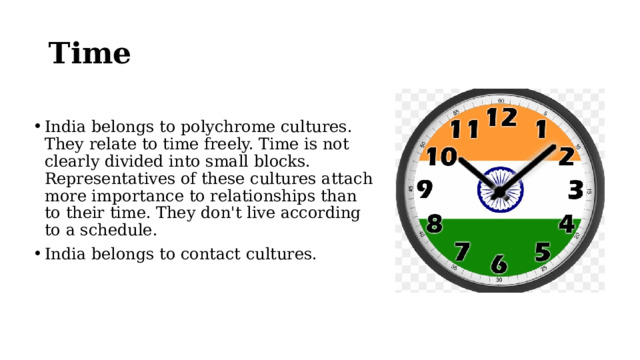
- India belongs to polychrome cultures. They relate to time freely. Time is not clearly divided into small blocks. Representatives of these cultures attach more importance to relationships than to their time. They don't live according to a schedule.
- India belongs to contact cultures.

Verbal communication
- Indirect Communication: The communication style of Indians tends to be polite and indirect.
- Refusals: direct refusals, such as ‘no’, may be considered to be too harsh and open disagreement is likely to be interpreted aggressive. Therefore, Indians tend to give indirectly express disagreement. Indians may use phrases such as ‘maybe’ or ‘I'll do my best’ as a way to express ‘no'.
- Silence: Sometimes people will remain silent rather than provide a direct ‘no’.

Non-Verbal communication
- Personal Space: Indians generally respect each other's personal space and an arm's length of distance is common during interactions. This is usually a similar proximity to what Westerners are familiar with. They may stand further away from those who are of the opposite gender.
- Nodding: Indians will often nod to acknowledge what is said out of . However, this does not always mean they understand or agree.

- Greeting in India, with a previously unknown person by the hand is considered bad form. A woman should not shake hands with a stranger at all it can be perceived as an insult.
- Traditionally greeting, here they fold their hands in front of them and say: "Namaste" (namas — a respectful bow and te — you).
- Hugging and kissing at a meeting among Indians is considered indecent.

- If an Indian shakes his hand from side to side, it means "No" or even worse "Go away."
- The left hand is considered unclean in India. Do not touch anyone with your left hand, do not take food, do not pass money, do not take a purchase with your left hand. Use only your right hand everywhere.

- If a woman draws a black dot on her child's face it means that in this way she protects her child from the evil eye. And women sometimes paint a black spot on their faces when they look particularly good.
- Women paint the parting on their head red to let everyone know that she is married and her husband is alive and well. Widows stop doing that.
- Many Indian women wear a red dot on their forehead. They claim that this is a sign of marriage. It’s called bindi.

- In India the color of mourning is white.
- Brides at the wedding are dressed in red.
- The number 7 is unfavorable.
- The owl means misfortune.



Вебинар для учителей

Свидетельство об участии БЕСПЛАТНО!



