Россия, санкт-петербург


СДЕЛАЙТЕ СВОИ УРОКИ ЕЩЁ ЭФФЕКТИВНЕЕ, А ЖИЗНЬ СВОБОДНЕЕ
Благодаря готовым учебным материалам для работы в классе и дистанционно
Скидки до 50 % на комплекты
только до
Готовые ключевые этапы урока всегда будут у вас под рукой
Организационный момент
Проверка знаний
Объяснение материала
Закрепление изученного
Итоги урока

Была в сети 13.04.2026 10:47

Савчиц Марина Анатольевна
English teacher and instructor
47 лет
 481
481
 109 299
Местоположение
Специализация
EGE. English. Cultures and Traditions.
Категория:
Английский язык
08.01.2026 18:57

Просмотр содержимого документа
«EGE. English. Cultures and Traditions.»
Cultures and Traditions
Exam and non-exam formats
speaking, listening,grammar in use
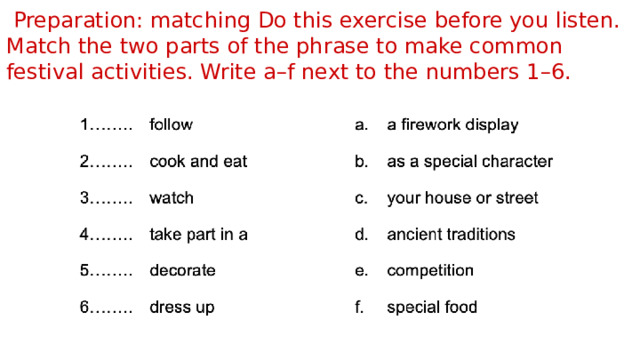
Preparation: matching Do this exercise before you listen.
Match the two parts of the phrase to make common festival activities. Write a–f next to the numbers 1–6.
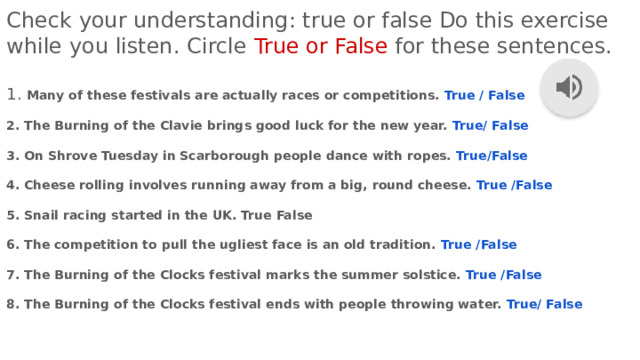
Check your understanding: true or false Do this exercise while you listen. Circle True or False for these sentences.
1. Many of these festivals are actually races or competitions. True / False
2. The Burning of the Clavie brings good luck for the new year. True/ False
3. On Shrove Tuesday in Scarborough people dance with ropes. True/False
4. Cheese rolling involves running away from a big, round cheese. True /False
5. Snail racing started in the UK. True False
6. The competition to pull the ugliest face is an old tradition. True /False
7. The Burning of the Clocks festival marks the summer solstice. True /False
8. The Burning of the Clocks festival ends with people throwing water. True/ False
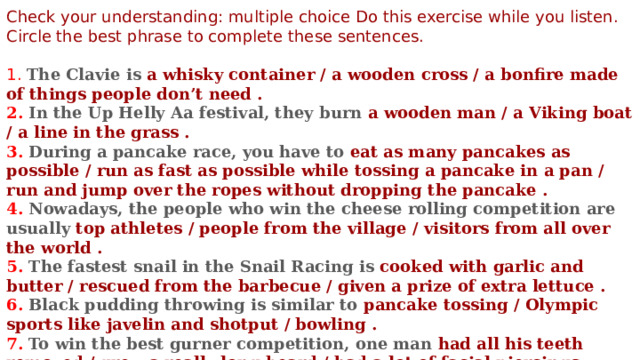
Check your understanding: multiple choice Do this exercise while you listen. Circle the best phrase to complete these sentences.
1. The Clavie is a whisky container / a wooden cross / a bonfire made of things people don’t need .
2. In the Up Helly Aa festival, they burn a wooden man / a Viking boat / a line in the grass .
3. During a pancake race, you have to eat as many pancakes as possible / run as fast as possible while tossing a pancake in a pan / run and jump over the ropes without dropping the pancake .
4. Nowadays, the people who win the cheese rolling competition are usually top athletes / people from the village / visitors from all over the world .
5. The fastest snail in the Snail Racing is cooked with garlic and butter / rescued from the barbecue / given a prize of extra lettuce .
6. Black pudding throwing is similar to pancake tossing / Olympic sports like javelin and shotput / bowling .
7. To win the best gurner competition, one man had all his teeth removed / grew a really long beard / had a lot of facial piercings .
8. The Burning of the Clocks festival is 2 years old / 20 years old / 200 years old .
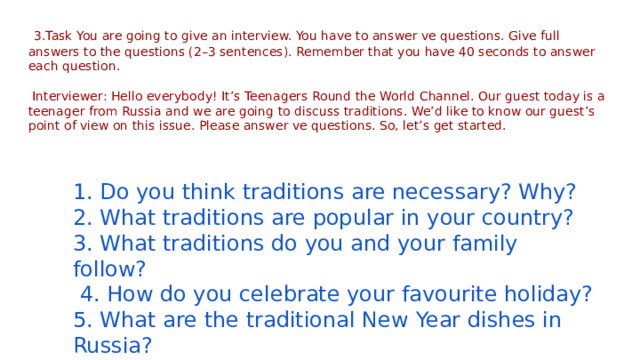
3.Task You are going to give an interview. You have to answer ve questions. Give full answers to the questions (2–3 sentences). Remember that you have 40 seconds to answer each question. Interviewer: Hello everybody! It’s Teenagers Round the World Channel. Our guest today is a teenager from Russia and we are going to discuss traditions. We’d like to know our guest’s point of view on this issue. Please answer ve questions. So, let’s get started.
1. Do you think traditions are necessary? Why?
2. What traditions are popular in your country?
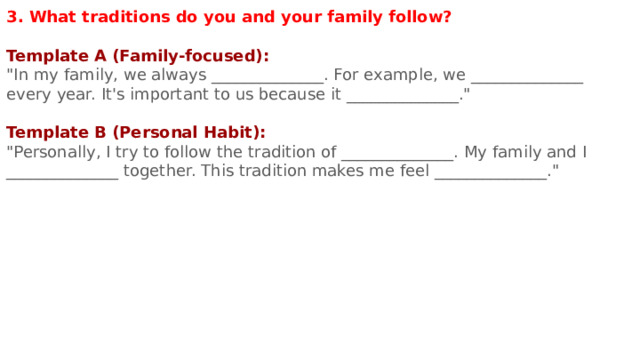
3. What traditions do you and your family follow?
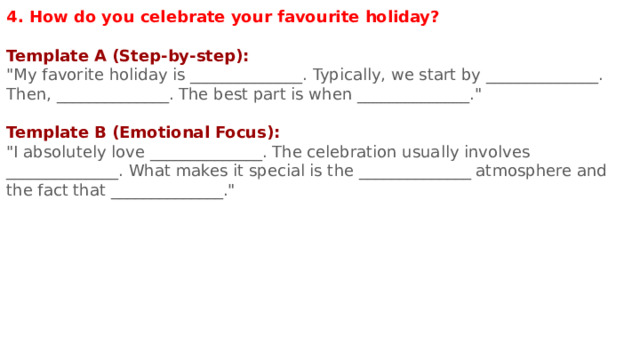
4. How do you celebrate your favourite holiday?
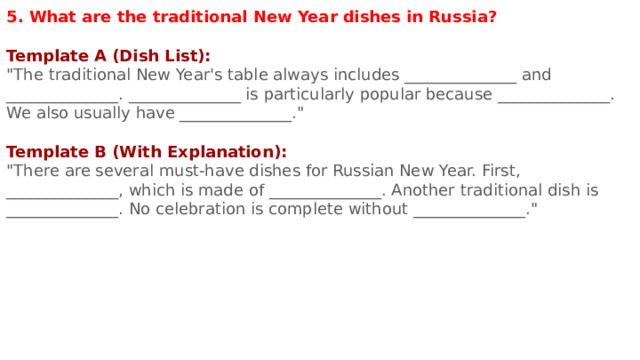
5. What are the traditional New Year dishes in Russia?
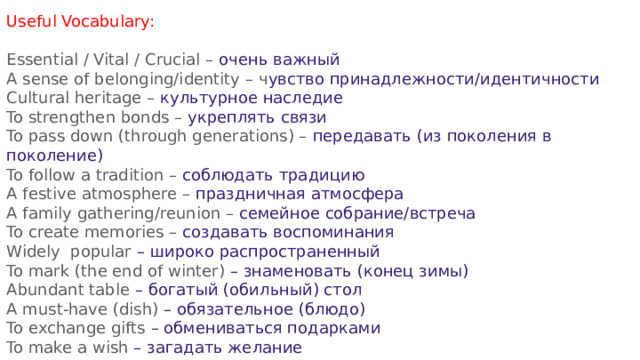
Useful Vocabulary:
Essential / Vital / Crucial – очень важный
A sense of belonging/identity – ч увство принадлежности/идентичности
Cultural heritage – культурное наследие
To strengthen bonds – укреплять связи
To pass down (through generations) – передавать (из поколения в поколение)
To follow a tradition – соблюдать традицию
A festive atmosphere – праздничная атмосфера
A family gathering/reunion – семейное собрание/встреча
To create memories – создавать воспоминания
Widely popular – широко распространенный
To mark (the end of winter) – знаменовать (конец зимы)
Abundant table – богатый (обильный) стол
A must-have (dish) – обязательное (блюдо)
To exchange gifts – обмениваться подарками
To make a wish – загадать желание
Fireworks / Firework display – фейерверк / салют
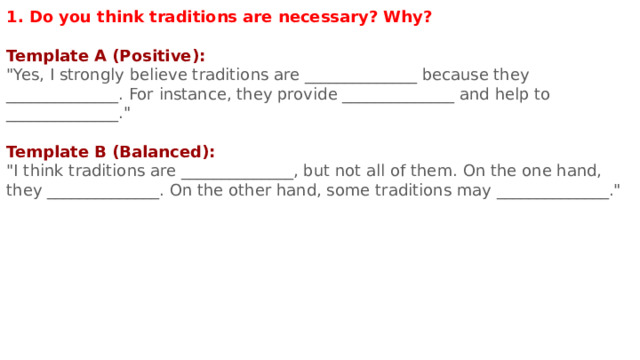
1. Do you think traditions are necessary? Why?
Template A (Positive):
"Yes, I strongly believe traditions are ______________ because they ______________. For instance, they provide ______________ and help to ______________."
Template B (Balanced):
"I think traditions are ______________, but not all of them. On the one hand, they ______________. On the other hand, some traditions may ______________."
Example using Template A:
"Yes, I strongly believe traditions are essential because they connect us to our culture. For instance, they provide a sense of identity and help to strengthen family bonds."
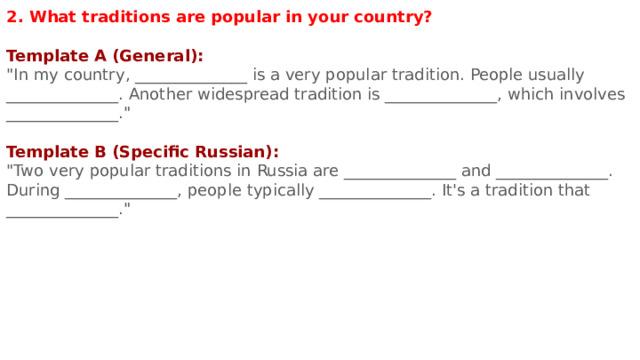
2. What traditions are popular in your country?
Template A (General):
"In my country, ______________ is a very popular tradition. People usually ______________. Another widespread tradition is ______________, which involves ______________."
Template B (Specific Russian):
"Two very popular traditions in Russia are ______________ and ______________. During ______________, people typically ______________. It's a tradition that ______________."
Example using Template A:
"In my country, celebrating Maslenitsa is a very popular tradition. People usually make blini and burn a straw effigy. Another widespread tradition is giving odd numbers of flowers, which involves presenting them on birthdays and other special occasions."
3. What traditions do you and your family follow?
Template A (Family-focused):
"In my family, we always ______________. For example, we ______________ every year. It's important to us because it ______________."
Template B (Personal Habit):
"Personally, I try to follow the tradition of ______________. My family and I ______________ together. This tradition makes me feel ______________."
Example using Template A:
"In my family, we always gather for New Year's Eve. For example, we watch the President's address and exchange gifts every year. It's important to us because it creates special memories."
4. How do you celebrate your favourite holiday?
Template A (Step-by-step):
"My favorite holiday is ______________. Typically, we start by ______________. Then, ______________. The best part is when ______________."
Template B (Emotional Focus):
"I absolutely love ______________. The celebration usually involves ______________. What makes it special is the ______________ atmosphere and the fact that ______________."
Example using Template A:
"My favorite holiday is New Year's Eve. Typically, we start by preparing a festive dinner. Then, we decorate the tree and wait for midnight. The best part is when we make wishes as the clock strikes twelve."
5. What are the traditional New Year dishes in Russia?
Template A (Dish List):
"The traditional New Year's table always includes ______________ and ______________. ______________ is particularly popular because ______________. We also usually have ______________."
Template B (With Explanation):
"There are several must-have dishes for Russian New Year. First, ______________, which is made of ______________. Another traditional dish is ______________. No celebration is complete without ______________."
Example using Template A:
"The traditional New Year's table always includes Olivier salad and 'herring under a fur coat'. Olivier salad is particularly popular because it's tasty and festive. We also usually have mandarins and sparkling wine."
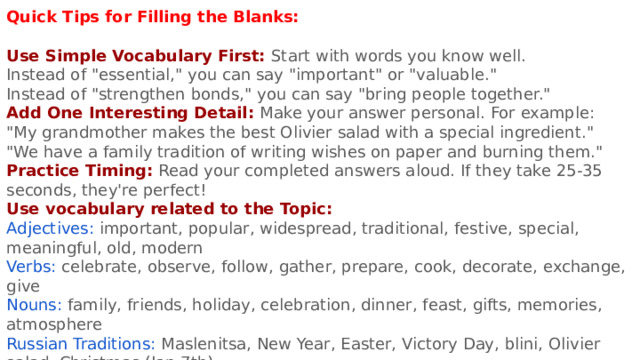
Quick Tips for Filling the Blanks:
Use Simple Vocabulary First: Start with words you know well.
Instead of "essential," you can say "important" or "valuable."
Instead of "strengthen bonds," you can say "bring people together."
Add One Interesting Detail: Make your answer personal. For example:
"My grandmother makes the best Olivier salad with a special ingredient."
"We have a family tradition of writing wishes on paper and burning them."
Practice Timing: Read your completed answers aloud. If they take 25-35 seconds, they're perfect!
Use vocabulary related to the Topic:
Adjectives: important, popular, widespread, traditional, festive, special, meaningful, old, modern
Verbs: celebrate, observe, follow, gather, prepare, cook, decorate, exchange, give
Nouns: family, friends, holiday, celebration, dinner, feast, gifts, memories, atmosphere
Russian Traditions: Maslenitsa, New Year, Easter, Victory Day, blini, Olivier salad, Christmas (Jan 7th)
Feelings/Effects: happy, united, connected, proud, warm, excited, creates memories, strengthens relationships
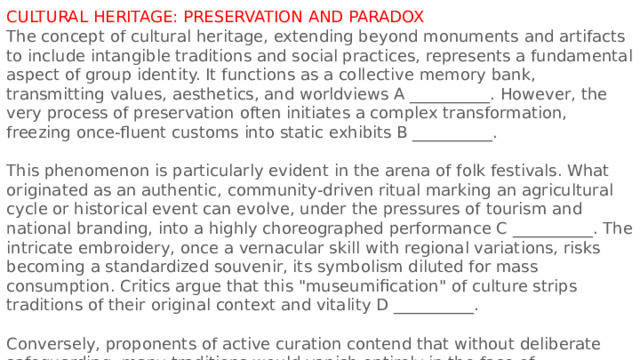
CULTURAL HERITAGE: PRESERVATION AND PARADOX
The concept of cultural heritage, extending beyond monuments and artifacts to include intangible traditions and social practices, represents a fundamental aspect of group identity. It functions as a collective memory bank, transmitting values, aesthetics, and worldviews A __________. However, the very process of preservation often initiates a complex transformation, freezing once-fluent customs into static exhibits B __________.
This phenomenon is particularly evident in the arena of folk festivals. What originated as an authentic, community-driven ritual marking an agricultural cycle or historical event can evolve, under the pressures of tourism and national branding, into a highly choreographed performance C __________. The intricate embroidery, once a vernacular skill with regional variations, risks becoming a standardized souvenir, its symbolism diluted for mass consumption. Critics argue that this "museumification" of culture strips traditions of their original context and vitality D __________.
Conversely, proponents of active curation contend that without deliberate safeguarding, many traditions would vanish entirely in the face of globalization. The digital archiving of endangered languages or the master-apprentice systems for traditional crafts are not acts of freezing but of proactive rescue E __________. The ultimate goal is not to prevent all change—an impossible feat—but to empower communities to steward their own cultural evolution consciously. They manage the delicate balance between preserving a distinct heritage F __________, ensuring continuity without stagnation. Thus, the guardianship of culture is not a mere act of conservation, but a continuous, and often contentious, negotiation between memory and modernity.
intangible traditions - нематериальные традиции
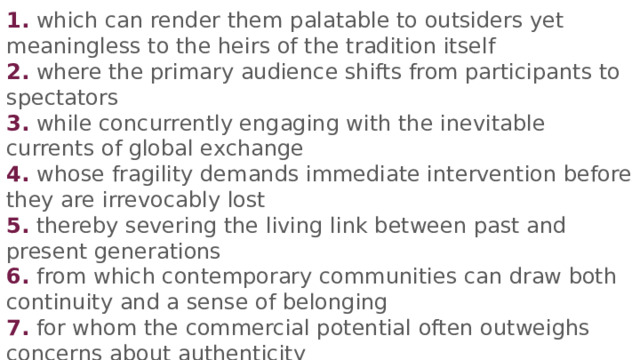
1. which can render them palatable to outsiders yet meaningless to the heirs of the tradition itself
2. where the primary audience shifts from participants to spectators
3. while concurrently engaging with the inevitable currents of global exchange
4. whose fragility demands immediate intervention before they are irrevocably lost
5. thereby severing the living link between past and present generations
6. from which contemporary communities can draw both continuity and a sense of belonging
7. for whom the commercial potential often outweighs concerns about authenticity
Пропуск A B C D E F
Номер части
palatable to - приятный, привлекательный (в этом контексте)
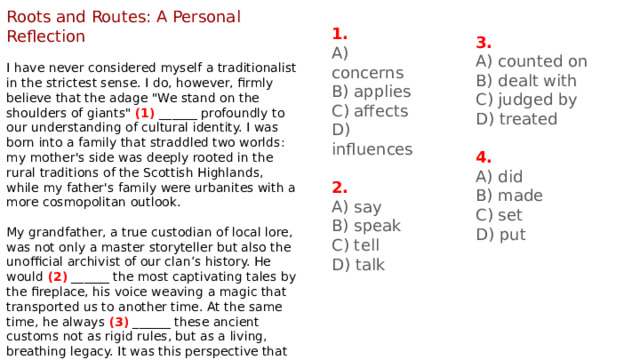
Roots and Routes: A Personal Reflection
I have never considered myself a traditionalist in the strictest sense. I do, however, firmly believe that the adage "We stand on the shoulders of giants" (1) ______ profoundly to our understanding of cultural identity. I was born into a family that straddled two worlds: my mother's side was deeply rooted in the rural traditions of the Scottish Highlands, while my father's family were urbanites with a more cosmopolitan outlook.
My grandfather, a true custodian of local lore, was not only a master storyteller but also the unofficial archivist of our clan’s history. He would (2) ______ the most captivating tales by the fireplace, his voice weaving a magic that transported us to another time. At the same time, he always (3) ______ these ancient customs not as rigid rules, but as a living, breathing legacy. It was this perspective that he (4) ______, this idea of tradition as a guiding compass rather than a locked cage, which has fundamentally shaped my own worldview.
1.
A) concerns
B) applies
C) affects
D) influences
2.
A) say
B) speak
C) tell
D) talk
3.
A) counted on
B) dealt with
C) judged by
D) treated
4.
A) did
B) made
C) set
D) put
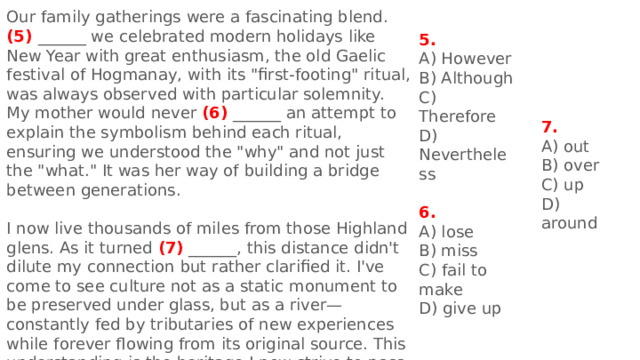
Our family gatherings were a fascinating blend. (5) ______ we celebrated modern holidays like New Year with great enthusiasm, the old Gaelic festival of Hogmanay, with its "first-footing" ritual, was always observed with particular solemnity. My mother would never (6) ______ an attempt to explain the symbolism behind each ritual, ensuring we understood the "why" and not just the "what." It was her way of building a bridge between generations.
I now live thousands of miles from those Highland glens. As it turned (7) ______, this distance didn't dilute my connection but rather clarified it. I've come to see culture not as a static monument to be preserved under glass, but as a river—constantly fed by tributaries of new experiences while forever flowing from its original source. This understanding is the heritage I now strive to pass on.
5.
A) However
B) Although
C) Therefore
D) Nevertheless
6.
A) lose
B) miss
C) fail to make
D) give up
7.
A) out
B) over
C) up
D) around
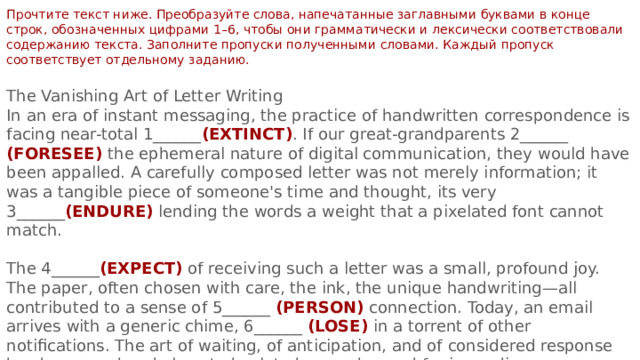
Прочтите текст ниже. Преобразуйте слова, напечатанные заглавными буквами в конце строк, обозначенных цифрами 1–6, чтобы они грамматически и лексически соответствовали содержанию текста. Заполните пропуски полученными словами. Каждый пропуск соответствует отдельному заданию.
The Vanishing Art of Letter Writing
In an era of instant messaging, the practice of handwritten correspondence is facing near-total 1______ (EXTINCT) . If our great-grandparents 2______ (FORESEE) the ephemeral nature of digital communication, they would have been appalled. A carefully composed letter was not merely information; it was a tangible piece of someone's time and thought, its very 3______ (ENDURE) lending the words a weight that a pixelated font cannot match.
The 4______ (EXPECT) of receiving such a letter was a small, profound joy. The paper, often chosen with care, the ink, the unique handwriting—all contributed to a sense of 5______ (PERSON) connection. Today, an email arrives with a generic chime, 6______ (LOSE) in a torrent of other notifications. The art of waiting, of anticipation, and of considered response has been rendered almost obsolete by our demand for immediacy.
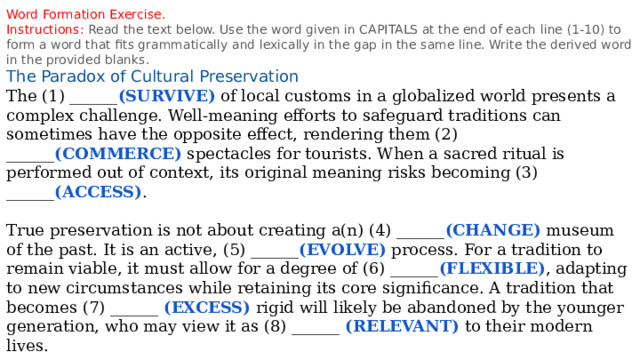
Word Formation Exercise.
Instructions: Read the text below. Use the word given in CAPITALS at the end of each line (1-10) to form a word that fits grammatically and lexically in the gap in the same line. Write the derived word in the provided blanks.
The Paradox of Cultural Preservation
The (1) ______ (SURVIVE) of local customs in a globalized world presents a complex challenge. Well-meaning efforts to safeguard traditions can sometimes have the opposite effect, rendering them (2) ______ (COMMERCE) spectacles for tourists. When a sacred ritual is performed out of context, its original meaning risks becoming (3) ______ (ACCESS) .
True preservation is not about creating a(n) (4) ______ (CHANGE) museum of the past. It is an active, (5) ______ (EVOLVE) process. For a tradition to remain viable, it must allow for a degree of (6) ______ (FLEXIBLE) , adapting to new circumstances while retaining its core significance. A tradition that becomes (7) ______ (EXCESS) rigid will likely be abandoned by the younger generation, who may view it as (8) ______ (RELEVANT) to their modern lives.
The most successful cultural strategies are those that empower communities themselves. When people feel a sense of (9) ______ (OWN) over their heritage, they are more likely to engage in its (10) ______ (TRANSMIT) for future generations, ensuring it is a living practice, not a forgotten relic.
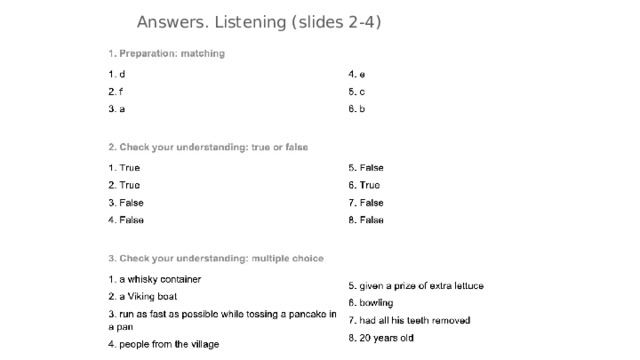
Answers. Listening (slides 2-4)
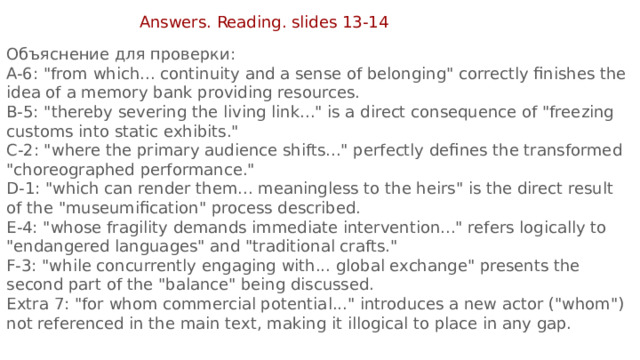
Answers. Reading. slides 13-14
Объяснение для проверки:
A-6: "from which... continuity and a sense of belonging" correctly finishes the idea of a memory bank providing resources.
B-5: "thereby severing the living link..." is a direct consequence of "freezing customs into static exhibits."
C-2: "where the primary audience shifts..." perfectly defines the transformed "choreographed performance."
D-1: "which can render them... meaningless to the heirs" is the direct result of the "museumification" process described.
E-4: "whose fragility demands immediate intervention..." refers logically to "endangered languages" and "traditional crafts."
F-3: "while concurrently engaging with... global exchange" presents the second part of the "balance" being discussed.
Extra 7: "for whom commercial potential..." introduces a new actor ("whom") not referenced in the main text, making it illogical to place in any gap.
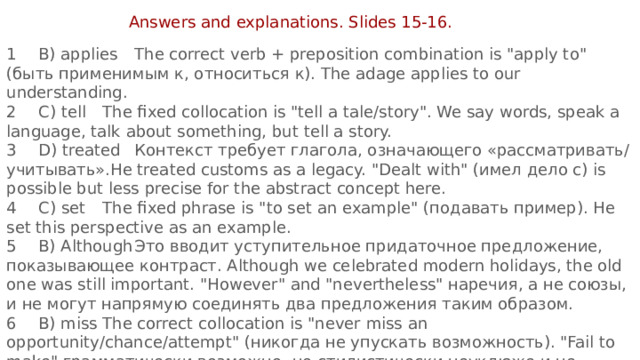
Answers and explanations. Slides 15-16.
1 B) applies The correct verb + preposition combination is "apply to" (быть применимым к, относиться к). The adage applies to our understanding.
2 C) tell The fixed collocation is "tell a tale/story". We say words, speak a language, talk about something, but tell a story.
3 D) treated Контекст требует глагола, означающего «рассматривать/учитывать».He treated customs as a legacy. "Dealt with" (имел дело с) is possible but less precise for the abstract concept here.
4 C) set The fixed phrase is "to set an example" (подавать пример). He set this perspective as an example.
5 B) Although Это вводит уступительное придаточное предложение, показывающее контраст. Although we celebrated modern holidays, the old one was still important. "However" and "nevertheless" наречия, а не союзы, и не могут напрямую соединять два предложения таким образом.
6 B) miss The correct collocation is "never miss an opportunity/chance/attempt" (никогда не упускать возможность). "Fail to make" грамматически возможно, но стилистически неуклюже и не является естественной идиомой.
7 A) out The phrasal verb is "turn out" (оказываться). As it turned out...
Answer Key and Explanations for slide 17.
1. extinction – Требуется существительное после прилагательного total. От EXTINCT (прилагательное) образуется существительное extinction (вымирание, исчезновение).
2. had foreseen – Условное предложение (third Conditional). Речь о гипотетической ситуации в прошлом.
3. endurance – Требуется существительное (с притяжательным местоимением its). От глагола ENDURE образуется существительное endurance (долговечность, стойкость). Контекст: "сама его долговечность придавала словам вес".
4. expectation – Требуется существительное (артикль The, предлог of). От глагола EXPECT образуется существительное expectation (ожидание).
5. personal – Требуется прилагательное для описания существительного connection. От существительного PERSON образуется прилагательное personal (личный).
6. lost – Требуется причастие для создания абсолютной причастной конструкции (Absolute Participial Construction). Логический субъект (email) и действие (теряться) пассивны по отношению друг к другу, поэтому используется Past Participle: lost (get lost – теряться). Контекст: "письмо прибывает..., потерянное в потоке других уведомлений".
necessary clarification for point two in the next slide (необходимое пояснение к пункту второму в следующем слайде)
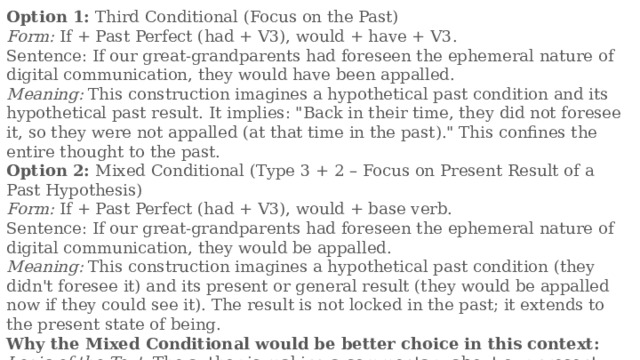
Option 1: Third Conditional (Focus on the Past)
Form: If + Past Perfect (had + V3), would + have + V3.
Sentence: If our great-grandparents had foreseen the ephemeral nature of digital communication, they would have been appalled.
Meaning: This construction imagines a hypothetical past condition and its hypothetical past result. It implies: "Back in their time, they did not foresee it, so they were not appalled (at that time in the past)." This confines the entire thought to the past.
Option 2: Mixed Conditional (Type 3 + 2 – Focus on Present Result of a Past Hypothesis)
Form: If + Past Perfect (had + V3), would + base verb.
Sentence: If our great-grandparents had foreseen the ephemeral nature of digital communication, they would be appalled.
Meaning: This construction imagines a hypothetical past condition (they didn't foresee it) and its present or general result (they would be appalled now if they could see it). The result is not locked in the past; it extends to the present state of being.
Why the Mixed Conditional would be better choice in this context:
Logic of the Text: The author is making a commentary about our present reality (digital communication, instant messaging). The writer is not just speculating about how our ancestors would have felt in their own time (Third Conditional). The point is to create a vivid contrast between their imagined perspective and our current situation. So this sentence would be better:
If our great-grandparents had foreseen the ephemeral nature of digital communication, they would be appalled. But since this grammar for the EGE is a little more advanced, we don’t use it here.
Slide 18
№ Answer Part of Speech Explanation
1 survival Noun The definite article The and the preposition of require a noun. From the verb SURVIVE, we form the abstract noun survival.
2 commercial Adjective The gap describes the noun spectacles, requiring an adjective. The suffix -ial is added to the noun COMMERCE to form the adjective commercial (related to business/money-making).
3 inaccessible Adjective The verb becoming is followed by an adjective. The negative prefix *in-* is added to the noun ACCESS to form the adjective inaccessible (unreachable, hard to understand). The context requires the opposite meaning of "clear."
4 unchanging Adjective The article a(n) and noun museum require an adjective. The negative prefix *un-* is added to the present participle of CHANGE (changing) to form the adjective unchanging (static, not changing).
5 evolutionary Adjective The gap between an article (an) and a noun (process) requires an adjective. From the verb EVOLVE, we get the noun evolution. The suffix -ary is then added to form the adjective evolutionary (related to gradual development).
6 flexibility Noun The article a degree of requires a noun. From the adjective FLEXIBLE, we replace -ble with -bility to form the abstract noun flexibility.
7 excessively Adverb The gap modifies the adjective rigid, requiring an adverb. From the noun EXCESS, we form the adjective excessive and then add *-ly* to create the adverb excessively (too, overly).
8 irrelevant Adjective The verb view it as is followed by an adjective. The negative prefix *ir-* (used before *r*) is added to the adjective RELEVANT to form its opposite, irrelevant (not connected, not important).
9 ownership Noun The phrase a sense of requires a noun. From the pronoun/verb OWN, we add the suffix -ship to form the abstract noun ownership (the state of possessing something).
10 transmission Noun The possessive its and preposition for require a noun. From the verb TRANSMIT, we replace -mit with -mission to form the noun transmission (the act of passing something on).


Вебинар для учителей

Свидетельство об участии БЕСПЛАТНО!