россия, петрозаводск


СДЕЛАЙТЕ СВОИ УРОКИ ЕЩЁ ЭФФЕКТИВНЕЕ, А ЖИЗНЬ СВОБОДНЕЕ
Благодаря готовым учебным материалам для работы в классе и дистанционно
Скидки до 50 % на комплекты
только до
Готовые ключевые этапы урока всегда будут у вас под рукой
Организационный момент
Проверка знаний
Объяснение материала
Закрепление изученного
Итоги урока

Был в сети 03.07.2019 15:10

джанелидзе александр шалвович
преподаватель английского языка
82 года
 7 542
7 542
 7 327
7 327 
Местоположение
Специализация
Discription of Russian Cuisine
Категория:
Английский язык
01.12.2018 21:07

Просмотр содержимого документа
«Discription of Russian Cuisine»
STATE AUTONOMOUS PROFESSIONAL EDUCATIONAL INSTITUTION OF THE REPUBLIC OF KARELIA "COLLEGE OF TECHNOLOGY AND Business. »
ABSTRACT
Russian cuisine
The work was done by a student:
Olga Mikhailovna Petrova,
Group: K-602
Petrozavodsk
2018
CONTENTS
Introduction
History of Russian cooking
Soups
Salads
Porridge main dishes
Meat
Fish
Vegetables
Desserts and pastries:
Blini
Syrniki
Vatrushka
Kulich
Paska
Varenye
Pastila
Zefir
Kissel or kisel
Beverages
Literature used
Introduction
Russian cuisine is distinctive and unique, and as any other national one, it was formed under the influence of different environmental, social, geographical, economic and historical factors. The main feature of Russian cuisine is considered to be an abundance and variety of products used for cooking. There are numerous dishes made of dough such as pies, cakes, rolls, pancake, etc. as well as unleavened dough, including dumplings and homemade noodles. Being a country of Orthodox Christian religion which implies numerous fasts, Russian cuisine offers a great number of vegetarian dishes including mushrooms, pickles etc. The Russian culinary palette is also rich in meat, poultry and fish dishes which are served on various occasions.
History of Russian cooking
Russian cuisine is a collection of the different cooking traditions of the Russian people. The cuisine is diverse, with Northern and Eastern European, Caucasian, Central Asian, Siberian, and East Asian influences. Russian cuisine derives its varied character from the vast and multi-ethnic expanse of Russia. Moreover, it is necessary to divide Russian traditional cuisine and Soviet cuisine, which has its own peculiarity. Its foundations were laid by the peasant food of the rural population in an often harsh climate, with a combination of plentiful fish, pork, poultry, caviar, mushrooms, berries, and honey. Crops of rye, wheat, barley and millet provided the ingredients for a plethora of breads, pancakes, pies, cereals, beer and vodka. Soups and stews are centered on seasonal or storable produce, fish and meats. Such food remained the staple for the vast majority of Russians well into the 20th century.
Russia's great expansions of culture, influence, and interest during the 16th–18th centuries brought more refined foods and culinary techniques, as well as one of the most refined food countries in the world. It was during this period that smoked meats and fish, pastry cooking, salads and green vegetables, chocolate, ice cream, wines, and juice were imported from abroad. At least for the urban aristocracy and provincial gentry, this opened the doors for the creative integration of these new foodstuffs with traditional Russian dishes.
Soups
Soups have always played an important role in the Russian meal. The traditional staple of soups such as shchi (щи), ukha (уха́), rassolnik (рассо́льник), solyanka (соля́нка), botvinya (ботви́нья), okroshka (окро́шка), and tyurya (тю́ря) were enlarged in the 18th to 20th centuries by both European and Central Asian staples like clear soups, pureed soups, stews, and many others.
Russian soups can be divided into at least seven large groups:
Chilled soups based on kvass, such as tyurya, okroshka, and botvinya.
Light soups and stews based on water and vegetables, such as swekolnik.
Noodle soups with meat, mushrooms, or milk.
Soups based on cabbage, most prominently shchi.
Thick soups based on meat broth, with a salty-sour base like rassolnik and solyanka.
Fish soups such as fish soup.
Grain- and vegetable-based soups.
Cold soups
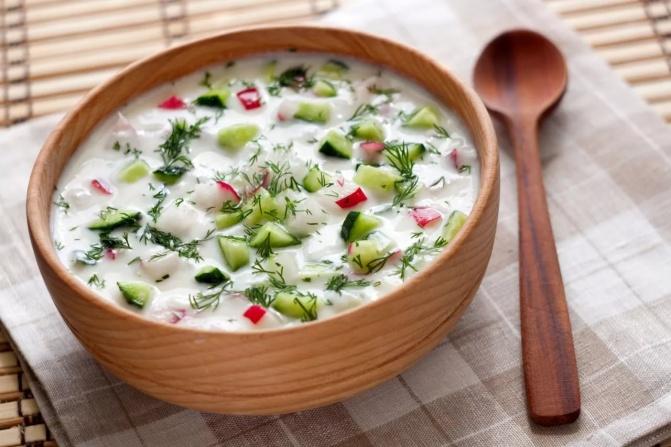
Okroshka is a cold soup based on kvass or lime milk. Okroshka is also a salad. The main ingredients are two types of vegetables that can be mixed with cold boiled meat or fish in a 1:1 proportion. There are typically two types of vegetables in okroshka. The first must have a neutral taste, such as boiled potatoes, turnips, rutabagas, carrots, or fresh cucumbers. The second must be spicy, consisting of mainly green onion as well as other herbs—greens of dill, parsley, chervil, celery, or tarragon.
Ingredients:
Kvass for okroshka 1.5 l
Meat boiled beef 300 g
Cucumbers 3-4 pieces.
Potatoes 4 PCs.
Eggs 4 PCs.
Green onion (1 bunch) 10-15 g
Sour cream 2 cups
Salt 0.5 tsp
Sugar 0.25 tsp
Mustard (sauce) 0.5 tsp
dill 10 g
parsley 10 g
Сut the meat into cubes across the fibers, dill, parsley and green onions finely chop, cucumber, eggs and potatoes cut into small cubes. All the ingredients combine, pour kvass.
Salads
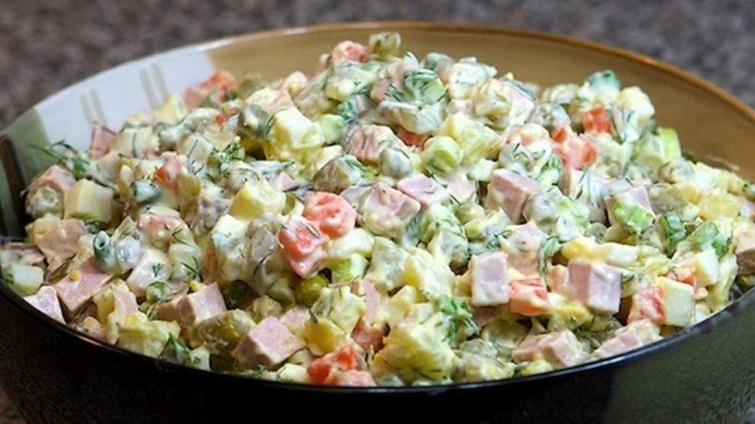
Olivier salad (also known as Russian salad), a mayonnaise-based potato salad distinguished by its diced texture and the contrasting flavors of pickles, hard-boiled eggs, boiled carrots, boiled potatoes, meat, and peas. This dish is one of the main New Year buffet.
Ingredients:
cooked sausage 400
Eggs 5
Green peas 1
Carrots 200
Potatoes 500
Pickles 350
Mayonnaise 100
Salt to taste
Green
Boil the eggs. In a separate pan, boil the carrots and potatoes. At this time, cut the sausage into cubes. Also cut the pickles. In the same way, cut the cooled eggs, carrots, potatoes. Try to make the cubes about the same size. Mix all ingredients, add green peas. Leave a few peas for decoration. Put the salad to cool in the refrigerator for 2-3 hours. Before serving, season the salad with mayonnaise, add salt if necessary. I do not do this, because my taste of salt is already enough in mayonnaise.
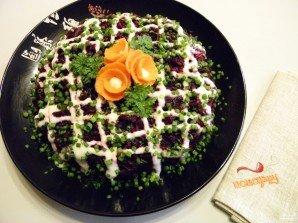
Sel'edka pod shuboy (or Shuba, from Russian шуба (fur coat)), also known as "dressed herring", is chopped salted herring under a "coat" of shredded cooked beet, sometimes with a layer of egg or other vegetables. Very popular New Year dish.
Ingredients:
Herring - 1 piece
Beets large-1 piece
Carrots-5 Pieces
Potatoes-6 Pieces
Onions-1 Piece
Onions green-1 Bunch
Mayonnaise-to taste
Take a convenient large dish. The first layer put the grated potatoes, make a mayonnaise mesh. Lay a layer of chopped herring on the potatoes. The herring on top, spread chopped onion, green onions. Next-carrot layer and mayonnaise mesh. Use salt and pepper if desired. The last layer are beets. Garnish with mayonnaise mesh salad. Arrange the salad with green onions, carrot roses. Insist the salad for at least 15 minutes in the refrigerator. Bon appétit!
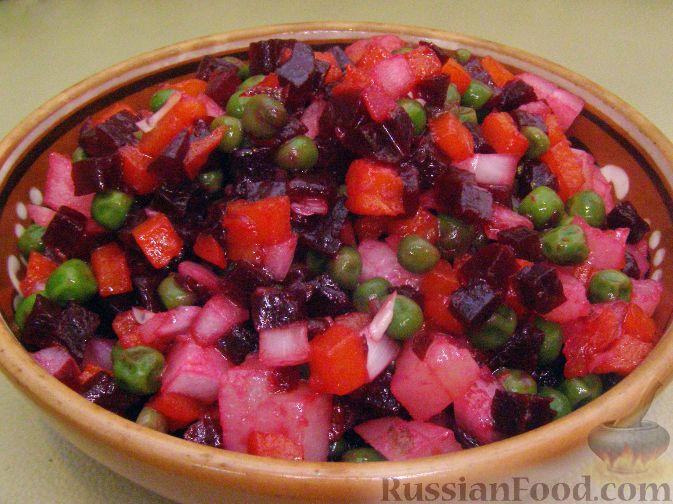
Vinegret (from French vinaigrette), a salad made of boiled beets, potatoes, carrots, pickles, onions, sauerkraut, and sometimes peas or white beans. Dressed with sunflower or olive oil.
Products:
Beetroot-300 g
Carrots-150 g
Potatoes-150 g
Frozen peas-150 g
Onion salad white-100 g
Lemon juice-4-5 teaspoons
Salt - of 0.25 tsp.
Vegetable oil-4-5 tablespoons
Wash the beets and boil in the peel for 30-40 minutes. Cool, clean and cut into small cubes (side 0.5 cm).Wash potatoes, boil in their skins. Cool, peel and cut into the same small cubes. Wash the carrots and boil in the skin for 20-30 minutes. Peel and cut into small cubes. Boil water. Put the peas in boiling water, bring to a boil and cook for 2-3 minutes. Drain the water. Peel and finely chop the onion. Mix beets, carrots, potatoes, peas and onions. Squeeze of lemon juice. Add salt and vegetable oil to the vinaigrette with peas, stir.
Porridge
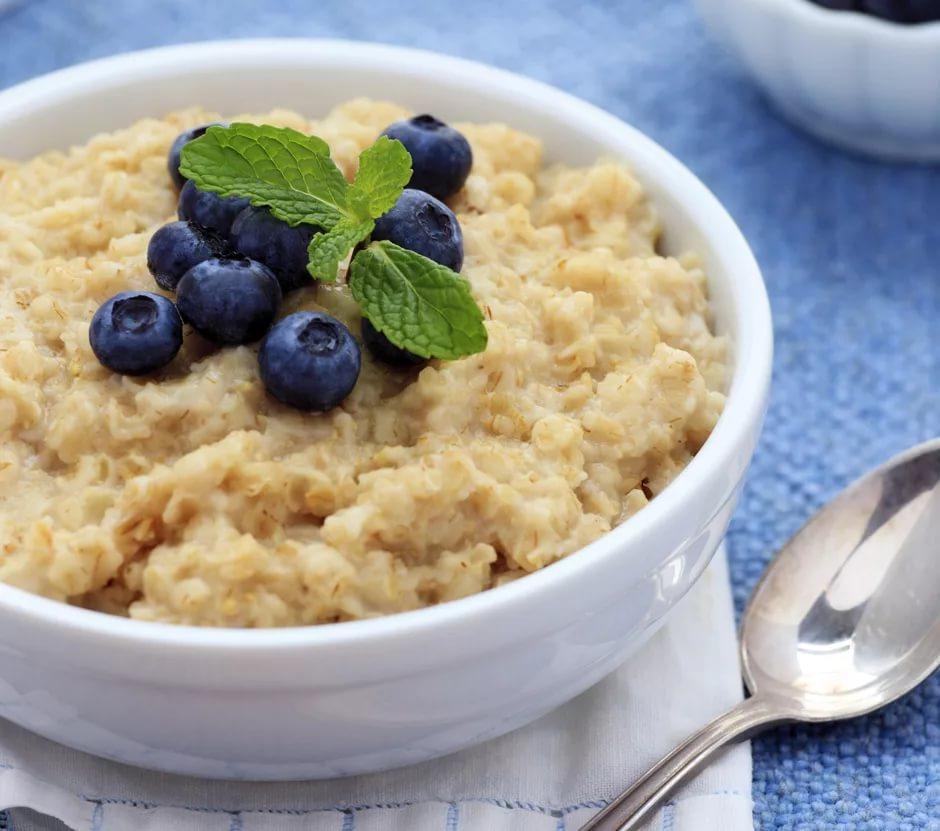
Porridge is one of the most important dishes in the traditional Russian cuisine. Varieties of cereals are based on variety of local crops. In Russian, the word kasha refers to any kind of porridge. Russian people have learned to do several varieties of cereals from whole grains to a variety of ways. The most popular cereals are buckwheat, millet, semolina, oats, barley, and rice. These cereals are traditionally cooked in milk, especially for breakfast. People add butter, salt, sugar, different jams or fresh fruit and berries to taste. Also, simply cooked salty porridges, especially buckwheat and rice, can be served as the side dish.
Main dishes
Meat
In traditional Russian cuisine three basic variations of meat dishes can be highlighted:
a large boiled piece of meat cooked in a soup or porridge, and then used as second course or served cold (particularly in jellied stock—see Kholodets' below)
offal dishes (liver, tripe, etc.), baked in pots together with cereals;
whole fowl dishes or parts of fowl (legs or breasts), or a large piece of meat (rump) baked on a baking tray in an oven, so-called "zharkoye" (from the word "zhar"(жар) meaning "heat")
The 16th century "Domostroi" aimed at affluent households also mentions sausage-making, spit-roasted meats, stews and many other meat dishes.
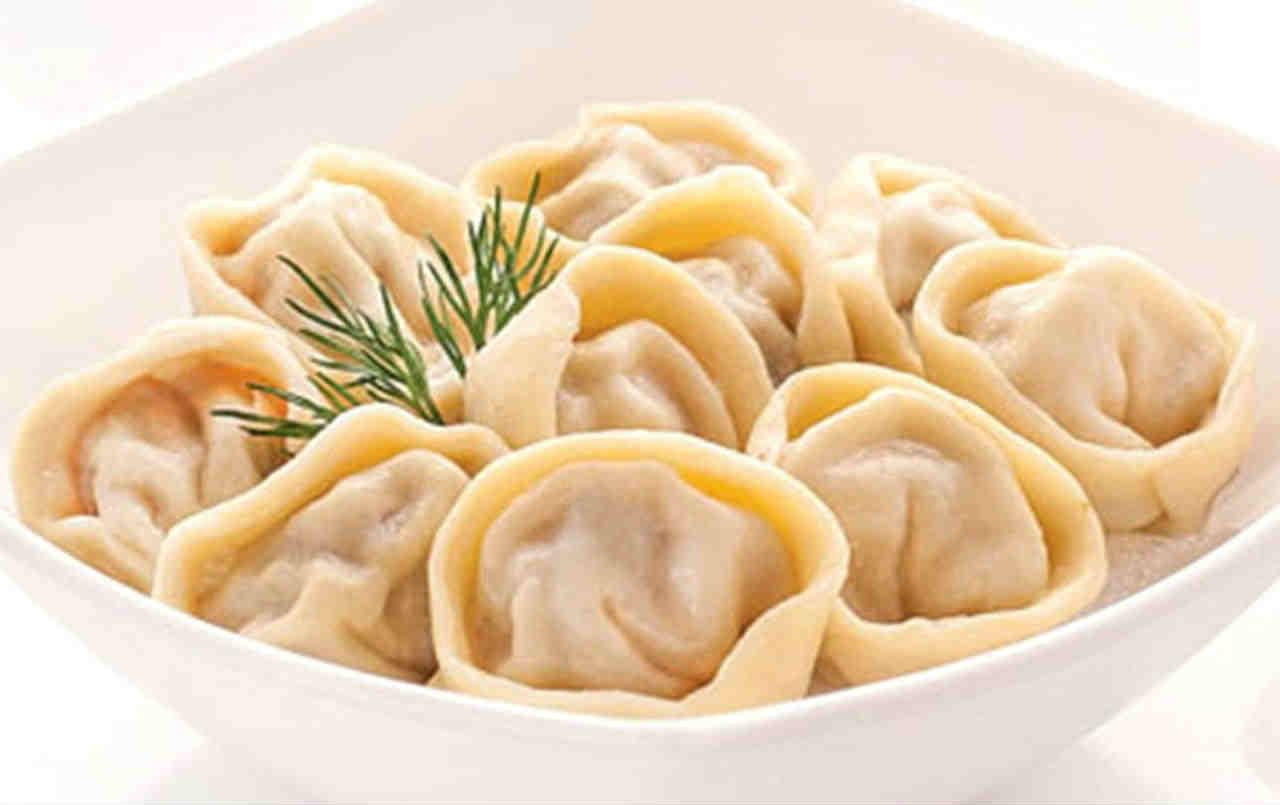
Pelmeni are a traditional Eastern European (mainly Russian) dish usually made with minced meat filling, wrapped in thin dough (made out of flour and eggs, sometimes with milk or water added). For filling, pork, lamb, beef, or any other kind of meat can be used; mixing several kinds is popular. The traditional Ural recipe requires the filling be made with 45% of beef, 35% of lamb, and 20% of pork. Traditionally, various spices, such as pepper, onions, and garlic, are mixed into the filling.
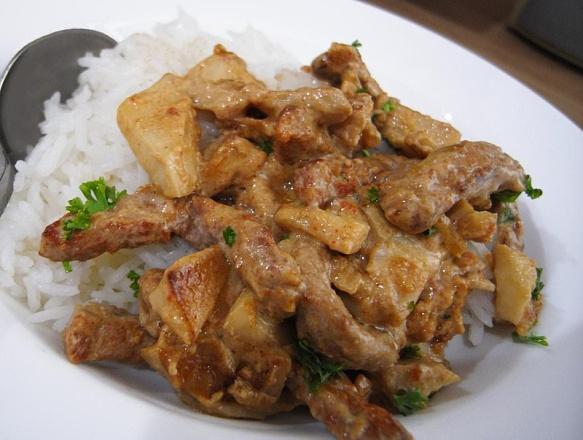
Chops (minced cutlets, meatballs), are small pan-fried meat balls, not dissimilar from Salisbury steak and other such dishes. Made primarily from pork and beef (sometimes also from chicken or fish), they are easily made and require little time. Ground beef, pork, onions and bread are put in a bowl and mixed thoroughly until it becomes relatively consistent. Once this effect is achieved, balls are formed and then put into a hot frying pan to cook.
Beef Stroganoff: Sautéed pieces of beef served in a sauce with smetana (sour cream). From its origins in mid-19th-century Russia, it has become popular around the world, with considerable variation from the original recipe.
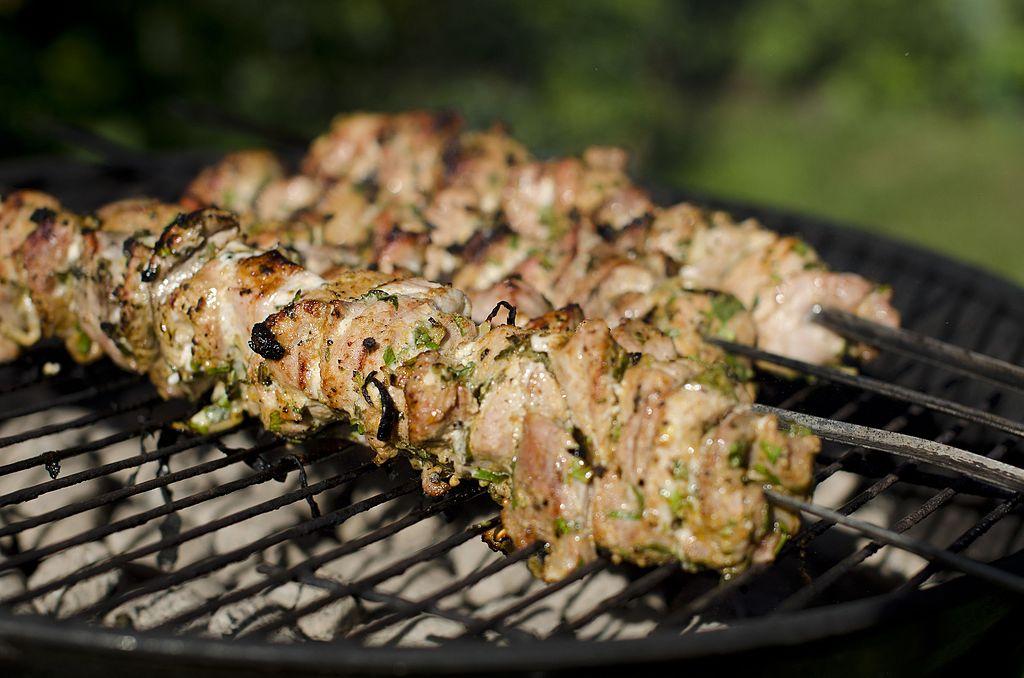
Shashlyk is a form of Shish kebab (marinated meat grilled on a skewer) popular in former Soviet Union countries, notably in Georgia, Russia, Armenia, Azerbaijan, and Uzbekistan. It often features alternating slices of meat and onions. Even though the word "shashlyk" was apparently borrowed from the Crimean Tatars by the Cossacks as early as the 16th century, kebabs did not reach Moscow until the late 19th century, according to Vladimir Gilyarovsky's "Moscow and Moscovites". From then on, their popularity spread rapidly; by the 1910s they were a staple in St Petersburg restaurants and by the 1920s they were already a pervasive street food all over urban Russia. Shashlik is also used in Russia as a food to be cooked in outdoor environment, similarly to barbecue in English-speaking countries.
Fish was important in pre-revolutionary cuisine, especially on Russian Orthodox fast days when meat was forbidden, similar to the Catholic custom of eating fish instead of meat on Fridays. Strictly freshwater fish such as carp and pike-perch were commonly eaten in inland areas, as well as an adromous sturgeon and in northern areas salmon, pike and trout. A greater variety of fish—including saltwater species—were preserved by salting, pickling or smoking and consumed as "zakuski" (hors d'oeuvres).
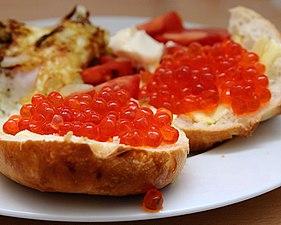
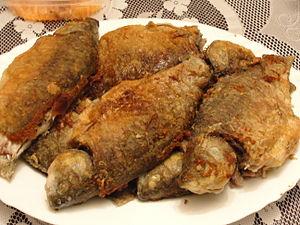
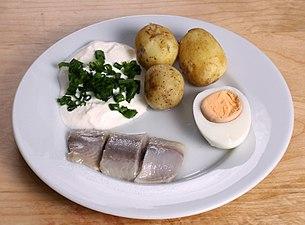
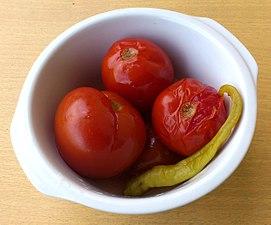
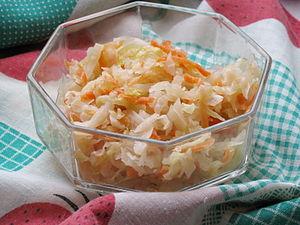
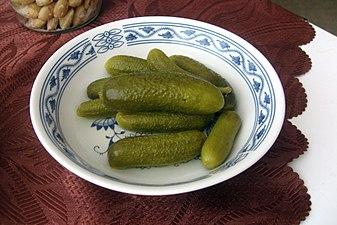
Cabbage, potatoes, and cold tolerant greens are common in Russian and other Eastern European cuisines. Pickling cabbage (sauerkraut), cucumbers, tomatoes and other vegetables in brine is used to preserve vegetables for winter use. Pickled apples and some other fruit also used to be widely popular. These are sources of vitamins during periods when fresh fruit and vegetables are traditionally not available.
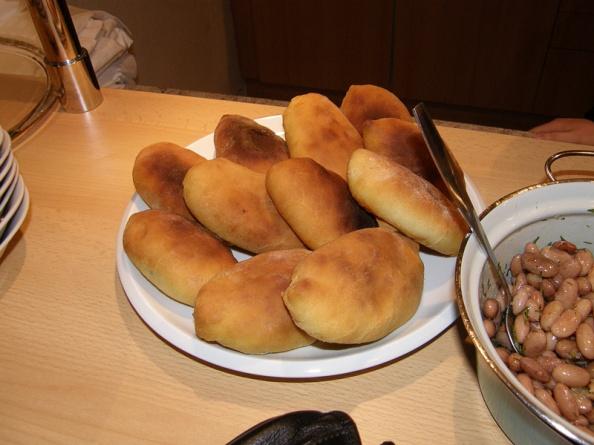
Pirozhki (patties) are small stuffed buns (pies) made of either yeast dough or short pastry. They are filled with one of many different fillings and are either baked (the ancient Slavic method) or shallow-fried (known as "priazhenie", this method was borrowed from the Tatars in the 1200's). One feature of patties that sets them apart from, for example, English pies is that the fillings used are almost invariably fully cooked. The use of chopped hard-boiled eggs in fillings is another interesting feature. Six typical fillings for traditional patties are:
Chopped boiled meat mixed with sautéed onions
Rice and boiled eggs with dill
Fish sautéed with onions and mixed with hard-boiled chopped eggs and rice
Mashed potatoes mixed with dill and green onion
Sautéed cabbage
Sautéed mushrooms with onions and sometimes carrots
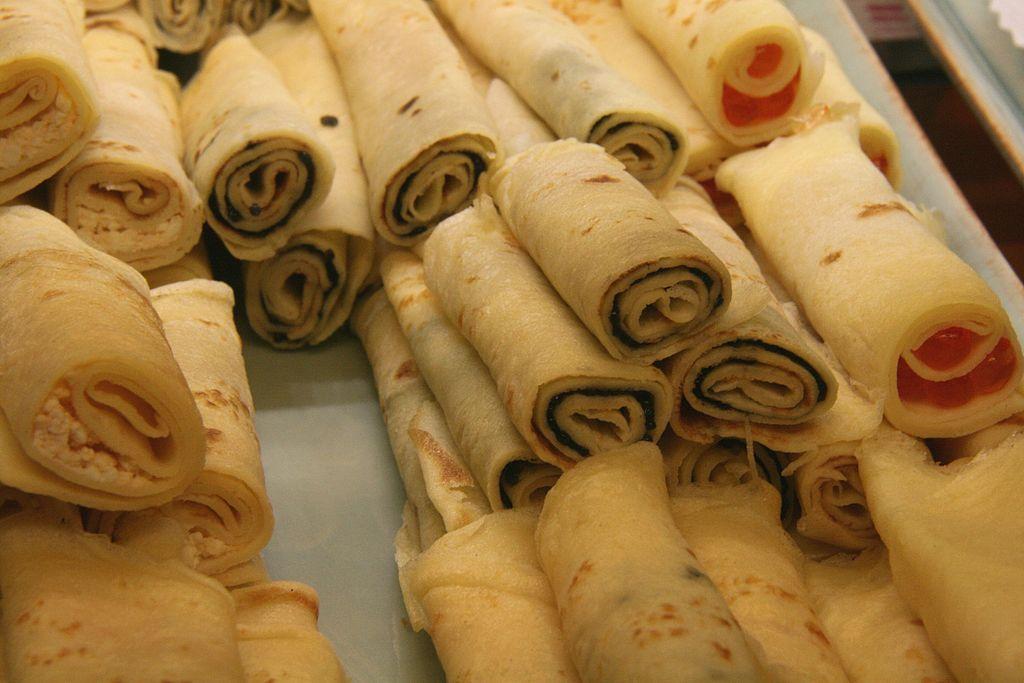
Blini are thin pancakes or crepes traditionally made with yeasted batter, although non-yeasted batter has become widespread in recent times. Blini are often served in connection with a religious rite or festival, but also constitute a common breakfast dish. The word "blin" (singular of blini) comes from Old Slavic "mlin", which means "to mill". Blini had a somewhat ritual significance for early Slavic peoples in pre-Christian times since they were a symbol of the sun, due to their round form. They were traditionally prepared at the end of the winter to honor the rebirth of the new sun during Maslenitsa (Масленица, Butter Week; also known as Pancake Week). This tradition was adopted by the Orthodox Church and is carried on to the present day, as the last week of dairy and egg products before Lent. Bliny are still often served at wakes, to commemorate the recently deceased. Blini can be made from wheat, buckwheat, or other grains, although wheat blini are most popular in Russia. They may be topped with butter, smetana (sour cream), fruit preserves or caviar. The word "blin" is also often used as a soft curse word, expressing frustration.
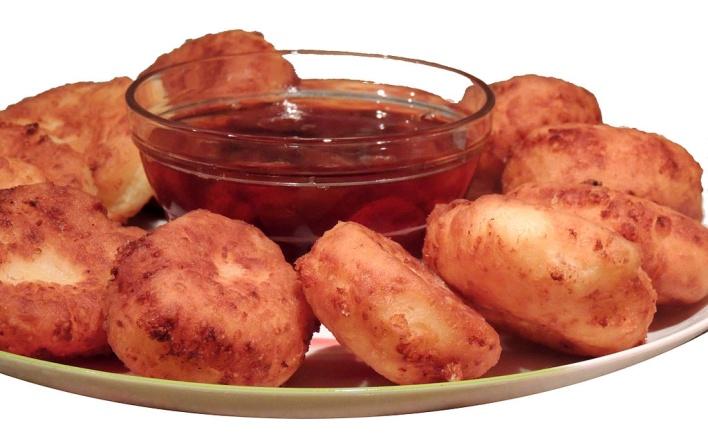
Syrniki are fried curd fritters, garnished with sour cream, jam, and honey or apple sauce.
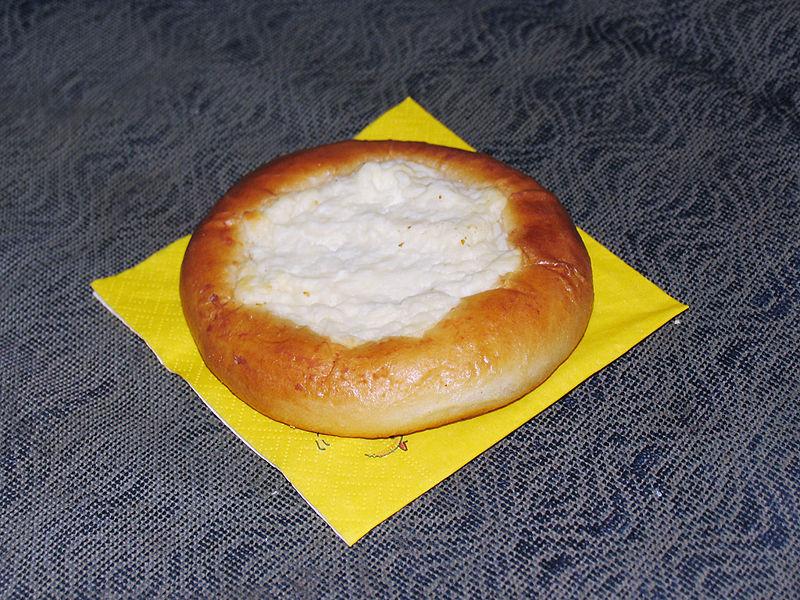
Vatrushka is a kind of cake with a ring of dough and tvorog (cottage cheese) in the middle, often with raisins or bits of fruit, from about five inches to two and a half feet in diameter.
Kulich is a kind of Easter bread that is traditional in the Orthodox Christian faith and is eaten in countries like Russia, Belarus, Ukraine, Bulgaria, Romania, Georgia, Macedonia, Moldova
and Serbia.

Traditionally after the Easter service, the kulich, which has been put into a basket and decorated with colorful flowers, is blessed by the priest. Blessed kulich is eaten before breakfast each day. Any leftover of kulich is not blessed is eaten with Paskha for dessert.
Kulich is baked in tall, cylindrical tins (like coffee or fruit juice tins). When cooled, kulich is decorated with white icing (which slightly drizzles down the sides) and colorful flowers. Historically, it was often served with cheese paskha bearing the symbol XB (from the traditional Easter greeting of Христос воскресе, "Christ is Risen").
Kulich is only eaten between Easter and Pentecost.
The recipe for kulich is similar to that of Italian panettone.
Paskha is a festive dish made in Eastern Orthodox countries which consists of food that is forbidden during the fast of Great Lent. It is made during Holy Week and then brought to Church on Great Saturday to be blessed after the Paschal Vigil. The name of the dish comes from Pascha, the Eastern Orthodox celebration of Easter.
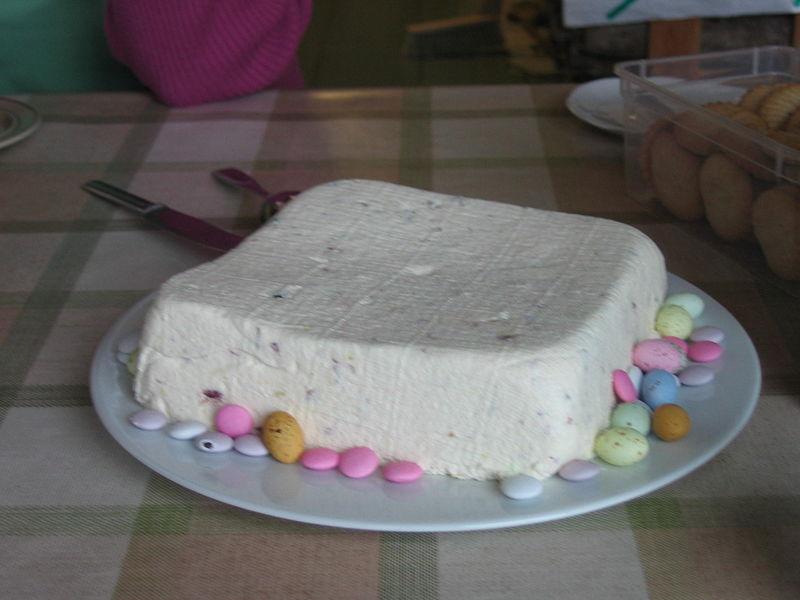
Cheese paskha is a traditional Easter dish made from quark (curd cheese, Russian: творог, tr. tvorog), which is white, symbolizing the purity of Christ, the Paschal Lamb, and the joy of the Resurrection. It is formed in a mould, traditionally in the shape of a truncated pyramid (a symbol of the Church; this form is also said to represent the Tomb of Christ). It is usually served as an accompaniment to a rich Easter bread called paska in Ukrainian and kulich in Russian.
The pascha is decorated with traditional religious symbols, such as the "Chi Ro" motif, a three-bar cross, and the letters X and B (Cyrillic letters which stands for Христосъ Воскресе. This is the Slavonic form of the traditional Paschal greeting: "Christ is Risen!"). All of these religious decorations symbolize Christ's Passion and Resurrection.
Varenye is a dessert and condiment. It is made from cooking fruits or berries. It is similar to jam except that fruits are not macerated and the consistency is more akin to fruit within syrup. It is used as a topping for crepes and syrniki and as a sweetener for tea. It is also eaten on its own as a sweet.
Pastila is a fruit confectionery (pâte de fruits). It has been described as "small squares of pressed fruit paste" and "light, airy puffs with a delicate apple flavor". In Imperial Russia, the "small jellied sweetmeats" were served for tea "with a white foamy top, a bit like marshmallow, but tasting of pure fruit".
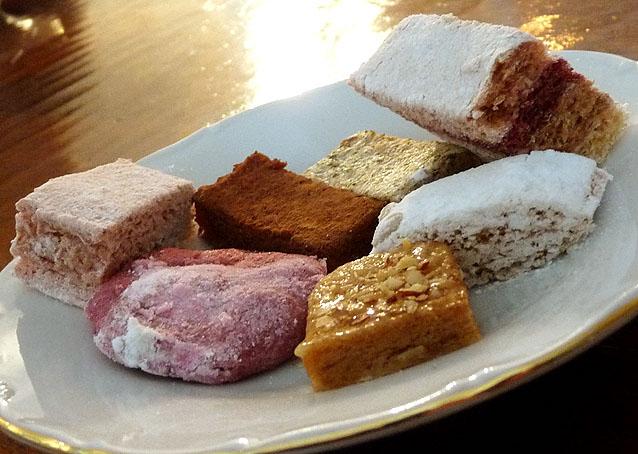
Zefir ( may also be spelled zephyr or zephir) is a type of soft confectionery made by whipping fruit and berry purée (mostly apple puree) with sugar and egg whites with subsequent addition of a gelling agent like pectin, carrageenan, agar, or gelatine. It is commonly produced and sold in the countries of the former Soviet Union. The name given after the Greek god of the light west wind Zephyr symbolizes its delicate airy consistency.
Zefir is somewhat similar in its consistency to marshmallows, Schokokuss or krembo. It is derived from the traditional Russian pastila but with added egg white foam and a gelling agent. The form typically resembles traditional meringue. However, in contrast to commercial meringue, it is never crisp. It is usually of white or rose color.
Chocolate-coated versions are also widespread. In contrast to the other chocolate-coated marshmallow-like confectioneries they normally do not include a biscuit layer.
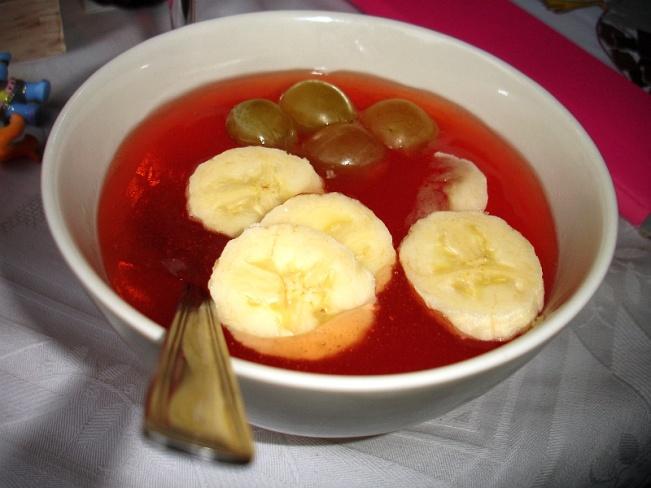
Kissel or kisel is a viscous fruit dish, popular as a dessert and as a drink. It consists of the sweetened juice of berries, like mors, but it is thickened with cornstarch, potato starch or arrowroot; sometimes red wine or fresh or dried fruits are added.] It is similar to the Danish rødgrød and German Rote Grütze. Swedish blåbärssoppa is a similarly prepared bilberry dessert, although only fresh or frozen bilberries, not dried berries are used to prepare it.
Kissel can be served either hot or cold, also together with sweetened quark or semolina pudding. Kissel can also be served on pancakes or with ice cream. If the kissel is made using less thickening starch, it can be drunk — this is common in Russia and Ukraine.
Literature used: https://en.wikipedia.org/wiki/Russian_cuisine
11


Вебинар для учителей

Свидетельство об участии БЕСПЛАТНО!