
Россия, Томск


СДЕЛАЙТЕ СВОИ УРОКИ ЕЩЁ ЭФФЕКТИВНЕЕ, А ЖИЗНЬ СВОБОДНЕЕ
Благодаря готовым учебным материалам для работы в классе и дистанционно
Скидки до 50 % на комплекты
только до
Готовые ключевые этапы урока всегда будут у вас под рукой
Организационный момент
Проверка знаний
Объяснение материала
Закрепление изученного
Итоги урока
Была в сети 19.04.2018 18:44

Миляр Жанна Николаевна
Учитель английского языка
48 лет
 1 080
1 080
 62 268
Местоположение
English for specific purpose
Категория:
Английский язык
19.04.2018 18:44

Просмотр содержимого документа
«English for specific purpose»

Types of Professional communicative skills and their application in ESP classes
J.N. Miliar
T.M. Nekrasova
Tomsk Polytechnic University
May 27, 2009

Introduction
- Communication and its benefits
- Criteria of communicative tasks
- Literature overview + student /content area teacher’s interviews
- Types of professional activities
- Types of professional activities
- List of language competencies
- Teaching aspects
- Presentation (example)
- Presentation (example)

Communication and its benefits
- Rehearsal;
- Feedback;
- Engagement;
- Real-life situations;
- Automation of declarative language knowledge

Criteria of communicative tasks
- Productivity Purposefulness Interactivity Challenge Authenticity
- Productivity
- Purposefulness
- Interactivity
- Challenge
- Authenticity

Types of professional speaking genres
- Presentations;
- Interviews;
- Conference talks;
- Brief reports;
- Project description;
- Conference talks;
- Brief reports;
- Project description (group, mini-research, literature-based);
- Seminars
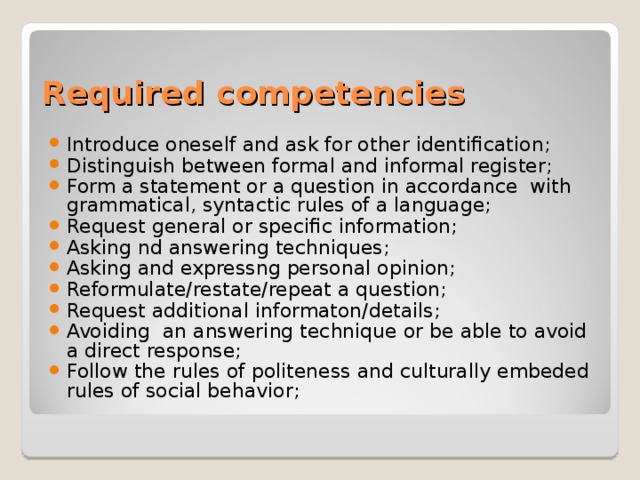
Required competencies
- Introduce oneself and ask for other identification;
- Distinguish between formal and informal register;
- Form a statement or a question in accordance with grammatical, syntactic rules of a language;
- Request general or specific information;
- Asking nd answering techniques;
- Asking and expressng personal opinion;
- Reformulate/restate/repeat a question;
- Request additional informaton/details;
- Avoiding an answering technique or be able to avoid a direct response;
- Follow the rules of politeness and culturally embeded rules of social behavior;

Teaching aspects: Presentation
- Organising information into coherent structure;
- Speaking from notes;
- Using« signals» to facilitate task of listeners;
- Developing listeners awareness;
- Achieving phonological, gammatical and lexical accuracy;
- Operating with greater fluency;
- Sequencing;
- Delivery (speed/clarity);
- Visual aids;
- Body language;
- Signposting;
- To avoid answering techniques;
- Answering questions;
- Clarification;
- Concluding;
- To recap and summing up
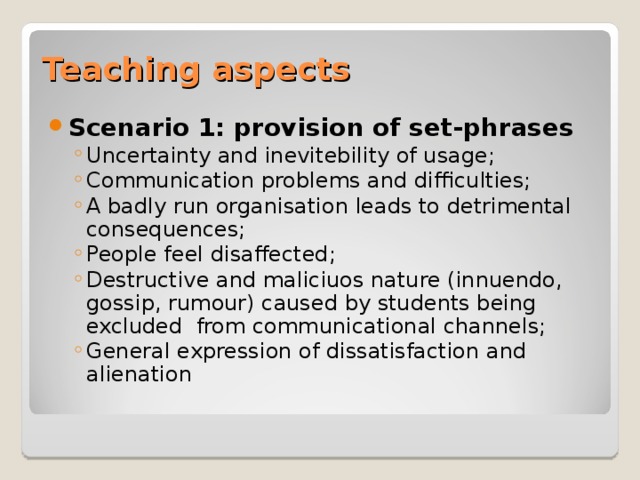
Teaching aspects
- Scenario 1: provision of set-phrases
- Uncertainty and inevitebility of usage; Communication problems and difficulties; A badly run organisation leads to detrimental consequences; People feel disaffected; Destructive and maliciuos nature (innuendo, gossip, rumour) caused by students being excluded from communicational channels; General expression of dissatisfaction and alienation
- Uncertainty and inevitebility of usage;
- Communication problems and difficulties;
- A badly run organisation leads to detrimental consequences;
- People feel disaffected;
- Destructive and maliciuos nature (innuendo, gossip, rumour) caused by students being excluded from communicational channels;
- General expression of dissatisfaction and alienation

Teaching aspects
- Scenario 2: Semi-controlled productive and free production activities
- To raise students awareness of the underlined competences; To create context in which students are involved to practice these competences; Inclusive approach is to manage the situation; Interectional approach is to notice the essential components of a language; Tecniques to automize the second language acquisition by mismatching what the students can do and need to do; To become aware of specific linguistic forms avaluable in the input;
- To raise students awareness of the underlined competences;
- To create context in which students are involved to practice these competences;
- Inclusive approach is to manage the situation;
- Interectional approach is to notice the essential components of a language;
- Tecniques to automize the second language acquisition by mismatching what the students can do and need to do;
- To become aware of specific linguistic forms avaluable in the input;

Conclusion
- Reflective analysis
- Needs analysis: Peer evaluation and Self-evaluation or assessment
- To stress the value of communication between and among students; To draw attention to the necessity for non-native speakers; To get feedback for the speaker on what the audience has understood; To obtain a wide sample of options than just one, regarding oral assessment The use of questionnaire; Surveys ; Structured interviews; Observation in class; Monitoring; Case study; Final tests; Presentation self-evaluation;
- To stress the value of communication between and among students;
- To draw attention to the necessity for non-native speakers;
- To get feedback for the speaker on what the audience has understood;
- To obtain a wide sample of options than just one, regarding oral assessment
- The use of questionnaire;
- Surveys ;
- Structured interviews;
- Observation in class;
- Monitoring;
- Case study;
- Final tests;
- Presentation self-evaluation;

References
- Dramma Techniques in Language Learning. Alom Maley and Alon Duff. Cambridge, 1978, 1982,2001. Pages 2-16, 38, 186, 201.
- Communication and Language.N. Thompson. Palgrave Macmillan. Great Britain, 2003.Pages 9, 98, 123-132
- How to teach English.Jeremy Harmer. Pearson Education Limited, 2007.Pages 123-132.
- Dramma. Sarah Phillips, Oxford, 2001.Pages 5-9.
- How to teach English.Jeremy Harmer, Longman, 1998.
Pages 87-96.








Вебинар для учителей

Свидетельство об участии БЕСПЛАТНО!