Россия, Бор

СДЕЛАЙТЕ СВОИ УРОКИ ЕЩЁ ЭФФЕКТИВНЕЕ, А ЖИЗНЬ СВОБОДНЕЕ
Благодаря готовым учебным материалам для работы в классе и дистанционно
Скидки до 50 % на комплекты
только до
Готовые ключевые этапы урока всегда будут у вас под рукой
Организационный момент
Проверка знаний
Объяснение материала
Закрепление изученного
Итоги урока

Была в сети 19.05.2026 00:10

Лопаткина Анастасия Николаевна
учитель английского языка
8 лет
 30 659
 947
947 
Местоположение
Специализация
English in Use/Extensive reading 7 Spotlight 7 Module
Категория:
Английский язык
01.04.2018 23:21

Просмотр содержимого документа
«English in Use/Extensive reading 7 Spotlight 7 Module»
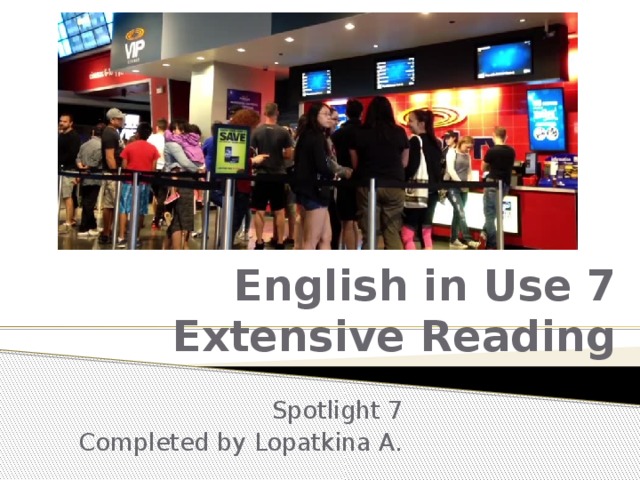
English in Use 7 Extensive Reading
Spotlight 7
Completed by Lopatkina A.

Guess the topic of our lesson:
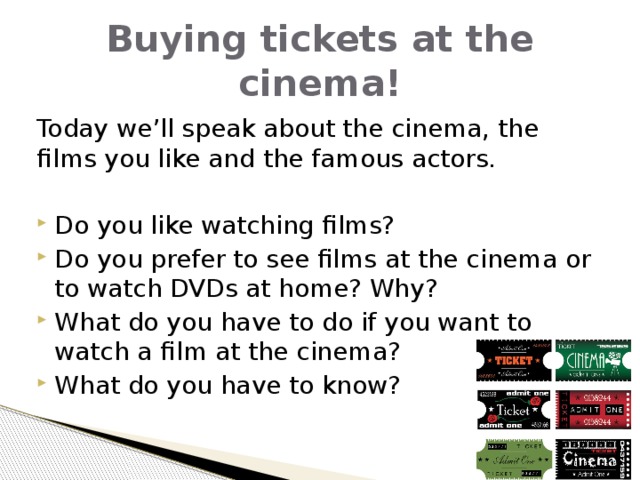
Buying tickets at the cinema!
Today we’ll speak about the cinema, the films you like and the famous actors.
- Do you like watching films?
- Do you prefer to see films at the cinema or to watch DVDs at home? Why?
- What do you have to do if you want to watch a film at the cinema?
- What do you have to know?
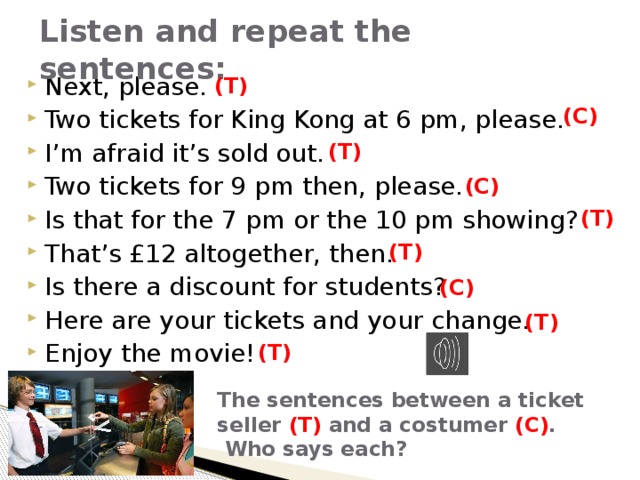
Listen and repeat the sentences:
- Next, please.
- Two tickets for King Kong at 6 pm, please.
- I’m afraid it’s sold out.
- Two tickets for 9 pm then, please.
- Is that for the 7 pm or the 10 pm showing?
- That’s £12 altogether, then.
- Is there a discount for students?
- Here are your tickets and your change.
- Enjoy the movie!
(T)
(C)
(T)
(C)
(T)
(T)
(C)
(T)
(T)
The sentences between a ticket seller (T) and a costumer (C) .
Who says each?
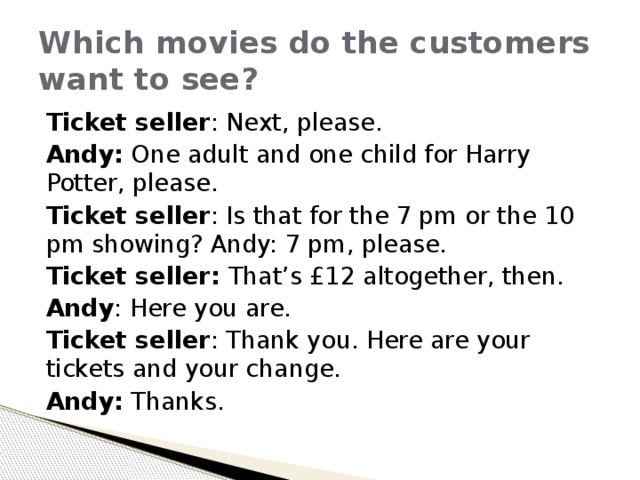
Which movies do the customers want to see?
Ticket seller : Next, please.
Andy: One adult and one child for Harry Potter, please.
Ticket seller : Is that for the 7 pm or the 10 pm showing? Andy: 7 pm, please.
Ticket seller: That’s £12 altogether, then.
Andy : Here you are.
Ticket seller : Thank you. Here are your tickets and your change.
Andy: Thanks.
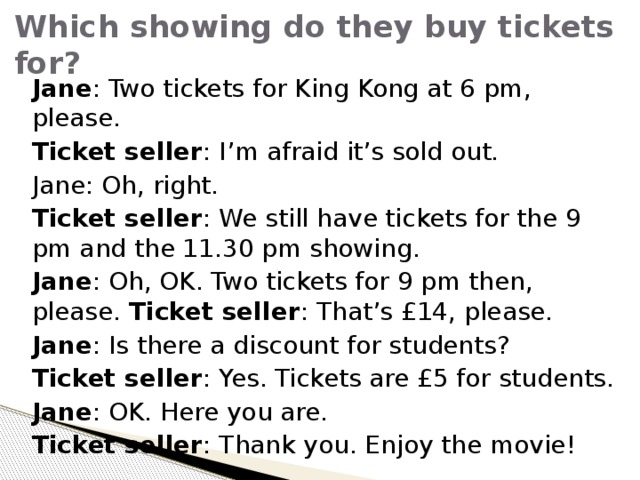
Which showing do they buy tickets for?
Jane : Two tickets for King Kong at 6 pm, please.
Ticket seller : I’m afraid it’s sold out.
Jane: Oh, right.
Ticket seller : We still have tickets for the 9 pm and the 11.30 pm showing.
Jane : Oh, OK. Two tickets for 9 pm then, please. Ticket seller : That’s £14, please.
Jane : Is there a discount for students?
Ticket seller : Yes. Tickets are £5 for students.
Jane : OK. Here you are.
Ticket seller : Thank you. Enjoy the movie!

Use the information to act out similar dialogues:
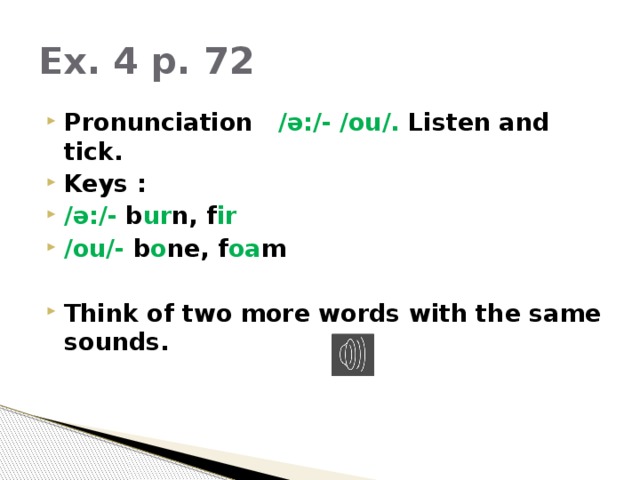
Ex. 4 p. 72
- Pronunciation /ә:/- /ou/. Listen and tick.
- Keys :
- /ә:/- b ur n, f ir
- /ou/- b o ne, f oa m
- Think of two more words with the same sounds.
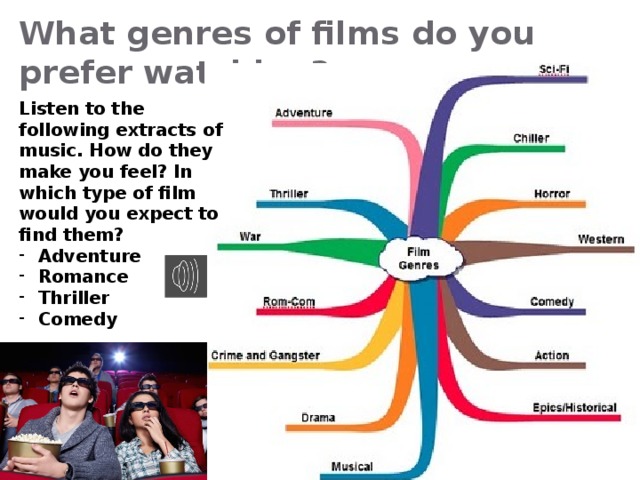
What genres of films do you prefer watching?
Listen to the following extracts of music. How do they make you feel? In which type of film would you expect to find them?
- Adventure
- Romance
- Thriller
- Comedy
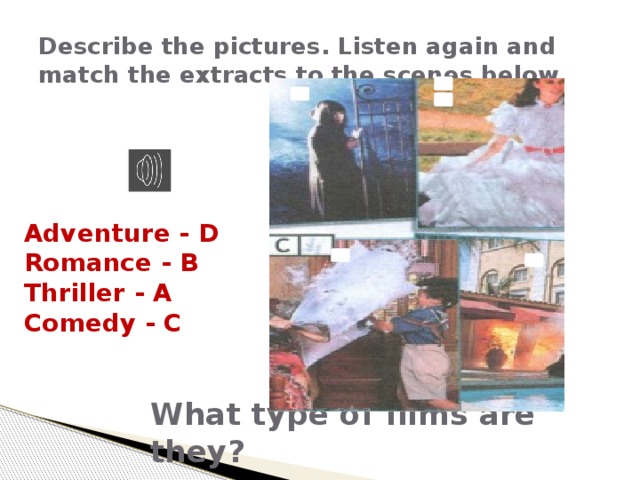
Describe the pictures. Listen again and match the extracts to the scenes below.
Adventure - D
Romance - B
Thriller - A
Comedy - C
What type of films are they?

………………
Your grandparents may remember the old silent Charlie Chaplin comedy films. If so, they'll probably tell you that without the music that accompanied them these films wouldn't be much fun.
………………
Later, when films began to have sound, the music stayed because directors use pieces of music and sound to create particular moods and feelings. We call these musical clichés.
………………
In horror films and thrillers, for example, loud sounds let you know when something frightening is going to happen. Violin tunes accompany emotional scenes in romantic films, and in adventure films we use sharp and fast sounds for action scenes.
…………… ..
Some musical clichés introduce specific places. Shots of Hong Kong, for example, often have xylophone music in the background while shots of Paris come with melodies played on the accordion. There are many musical cliches for a number of types of scenes.
………………
So, next time you watch a film, pay attention to the music in the background. You'll be surprised how many musical clichés you can spot.

Look at the headings and the title of the text (Ex. 2-3, p.73). What is the text about:
- 1.Before sound
- 2.Musical clichés
- 3. Stereotypical music sounds
- 4. Music around the world
- 5. Listen out
- 1. Listen out
- 2. Stereotypical music sounds
- 3. Before sound
- 4. Music around the world
- 5.Musical clichés
![New words: listen out [lɪsn aʊt]- прислушиваться familiar [fəˈmɪljə] - знакомый Accompany [əˈkʌmpənɪ] - сопровождать Create mood [kriːˈeɪt muːd] - создавать настроение Sharp sound [ʃɑːp saʊnd] - пронзительный звук Background [ˈbækgraʊnd] - фон Spot [spɔt]- заметить Silent film [ˈsaɪlənt fɪlm] - немое кино Musical clichés [ˈmjuːzɪkəl ˈkliːʃeɪ] – музыкальное клише](https://static.multiurok.ru/multiurok/html/2018/04/01/s_5ac13f53e47b6/img12.jpg)
New words:
- listen out [lɪsn aʊt]- прислушиваться
- familiar [fəˈmɪljə] - знакомый
- Accompany [əˈkʌmpənɪ] - сопровождать
- Create mood [kriːˈeɪt muːd] - создавать настроение
- Sharp sound [ʃɑːp saʊnd] - пронзительный звук
- Background [ˈbækgraʊnd] - фон
- Spot [spɔt]- заметить
- Silent film [ˈsaɪlənt fɪlm] - немое кино
- Musical clichés [ˈmjuːzɪkəl ˈkliːʃeɪ] – музыкальное клише

Homework
- Wl English in Use (to learn the words)
- Ex 3 p 72 ( to make up a dialogue), use the sentences from Ex. 1 as well as dialogue A as an example.
- Ex.5 p.73 ( choose a piece of music, find a picture and describe the scene to the class.
Вебинар для учителей

Свидетельство об участии БЕСПЛАТНО!