Россия, Пермь


СДЕЛАЙТЕ СВОИ УРОКИ ЕЩЁ ЭФФЕКТИВНЕЕ, А ЖИЗНЬ СВОБОДНЕЕ
Благодаря готовым учебным материалам для работы в классе и дистанционно
Скидки до 50 % на комплекты
только до
Готовые ключевые этапы урока всегда будут у вас под рукой
Организационный момент
Проверка знаний
Объяснение материала
Закрепление изученного
Итоги урока
Была в сети 18.06.2022 18:09

Зинченко Наталья Викторовна
учитель английского языка, классный руководитель
54 года
 15 651
 2 620
2 620 
Местоположение
Специализация
Frederic Francois Chopin (Фредерик Франсуа Шопен)
Категория:
Английский язык
13.12.2018 17:43

Просмотр содержимого документа
«Frederic Francois Chopin (Фредерик Франсуа Шопен)»
Frederic Francois Chopin the age of romanticism
Zinchencko Natalya
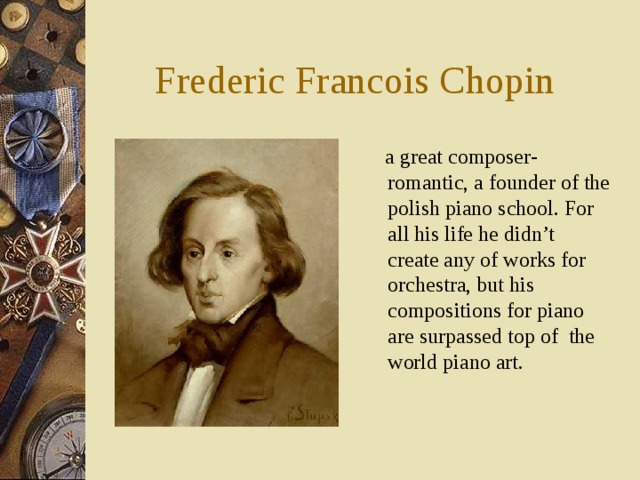
Frederic Francois Chopin
a great composer-romantic, a founder of the polish piano school. For all his life he didn’t create any of works for orchestra, but his compositions for piano are surpassed top of the world piano art.
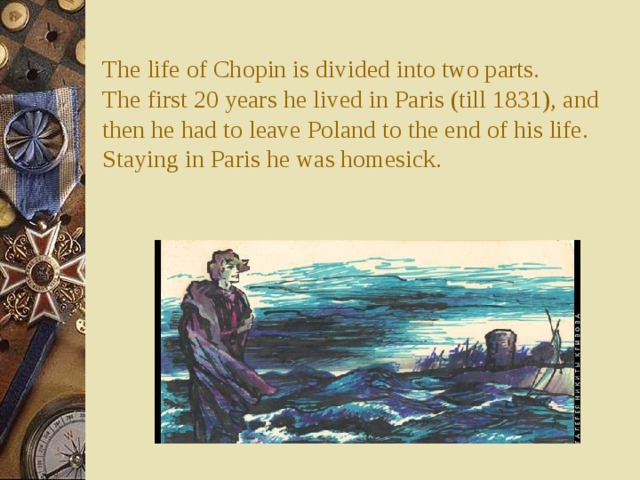
The life of Chopin is divided into two parts. The first 20 years he lived in Paris (till 1831), and then he had to leave Poland to the end of his life. Staying in Paris he was homesick.
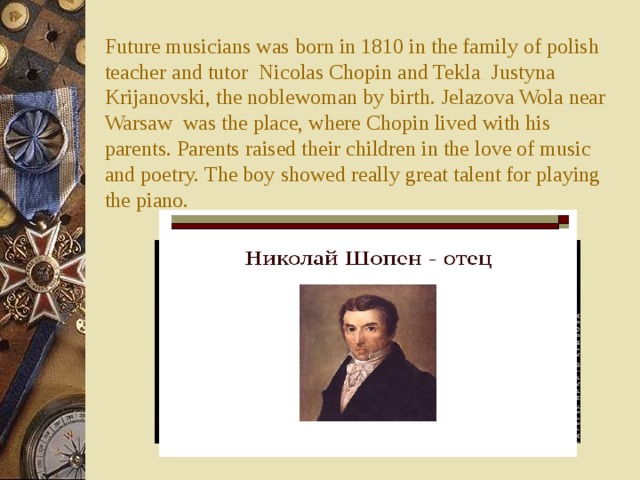
Future musicians was born in 1810 in the family of polish teacher and tutor Nicolas Chopin and Tekla Justyna Krijanovski, the noblewoman by birth. Jelazova Wola near Warsaw was the place, where Chopin lived with his parents. Parents raised their children in the love of music and poetry. The boy showed really great talent for playing the piano.

Musical skills
Little Frederic could spend hours to sit at the instrument picking up and digging into any work.
In his early childhood he amazed others with their musical abilities and love of music.
The boy almost in 5 years old began performing in concerts.
In 7 years he entered in the class of the famous Polish pianist of that time Wojciech Juvnom.
In 5 years Frederic became a real piano virtuoso.
At the technical and musical skills he was not enferior to adults.
Early works
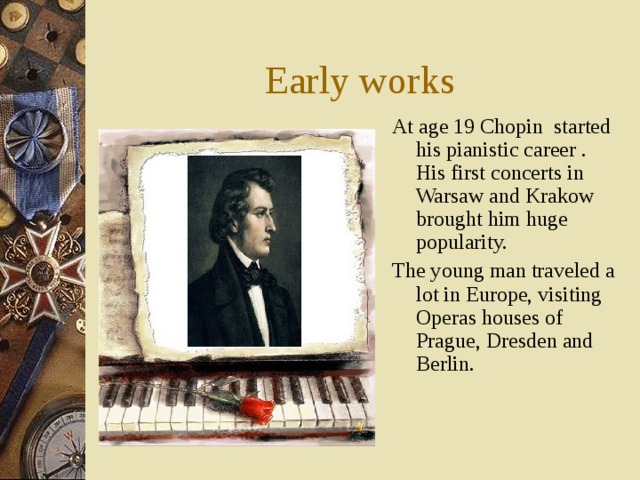
At age 19 Chopin started his pianistic career . His first concerts in Warsaw and Krakow brought him huge popularity.
The young man traveled a lot in Europe, visiting Operas houses of Prague, Dresden and Berlin.
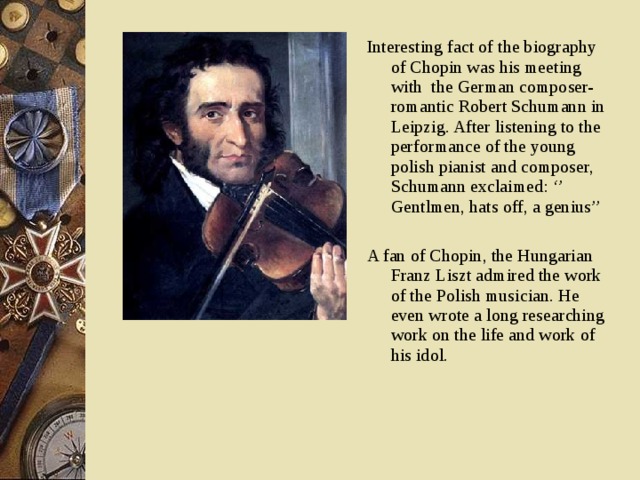
Interesting fact of the biography of Chopin was his meeting with the German composer-romantic Robert Schumann in Leipzig. After listening to the performance of the young polish pianist and composer, Schumann exclaimed: ‘’ Gentlmen, hats off, a genius’’
A fan of Chopin, the Hungarian Franz Liszt admired the work of the Polish musician. He even wrote a long researching work on the life and work of his idol.
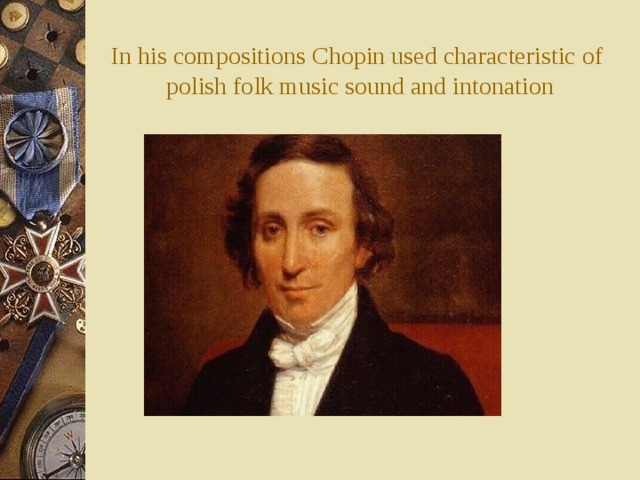
In his compositions Chopin used characteristic of polish folk music sound and intonation
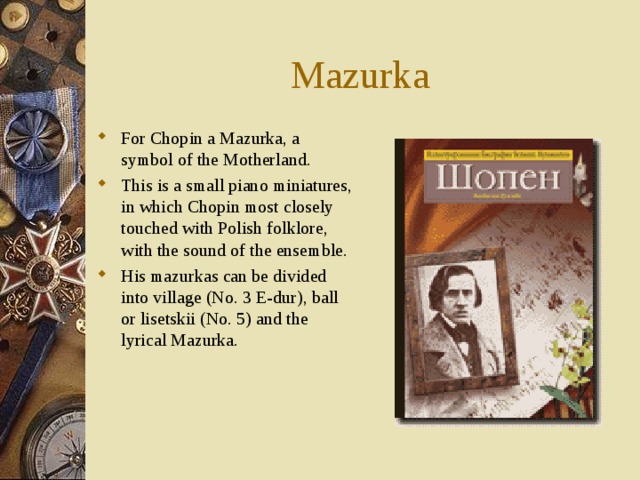
Mazurka
- For Chopin a Mazurka, a symbol of the Motherland.
- This is a small piano miniatures, in which Chopin most closely touched with Polish folklore, with the sound of the ensemble.
- His mazurkas can be divided into village (No. 3 E-dur), ball or lisetskii (No. 5) and the lyrical Mazurka.
Polonaises
- In the polonaises by Chopin recreates the heroic spirit of Poland's past
- Much more virtuosity, a major chord technique, the coverage of the extreme registers of the piano often sounds like an orchestra.
- Polonaises is full of vivid contrasts. They have fine points, reminiscent of the battle scenes.
- Almost all the polonaises written in complex of 3 private forms.
Prelude
- The genre has attracted Chopin his spontaneity, direct statements
- In Chopin's preludes you can find not only the characteristics of different genres, but the combination of different genres
- They, as well as preludes and fugues by Bach are like an encyclopedia of genres that time.
- Each prelude is written in its tone. They are located at the circle of fifths.
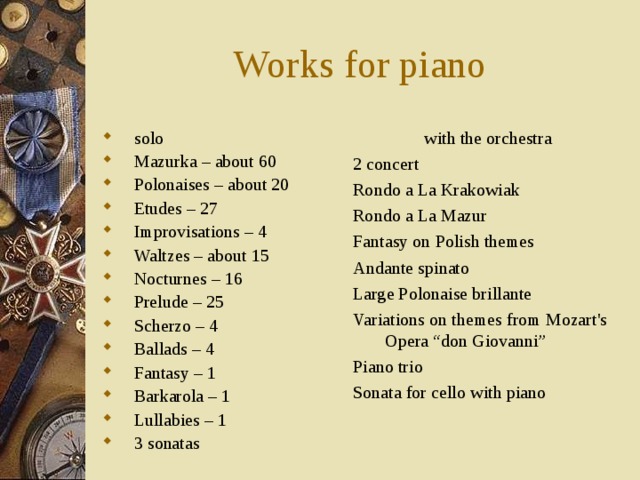
Works for piano
- solo
- Mazurka – about 60
- Polonaises – about 20
- Etudes – 27
- Improvisations – 4
- Waltzes – about 15
- Nocturnes – 16
- Prelude – 25
- Scherzo – 4
- Ballads – 4
- Fantasy – 1
- Barkarola – 1
- Lullabies – 1
- 3 sonatas
with the orchestra
2 concert
Rondo a La Krakowiak
Rondo a La Mazur
Fantasy on Polish themes
Andante spinato
Large Polonaise brillante
Variations on themes from Mozart's Opera “don Giovanni”
Piano trio
Sonata for cello with piano
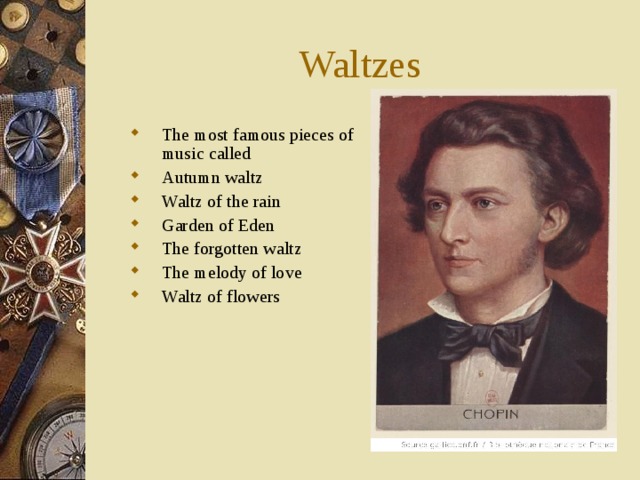
Waltzes
- The most famous pieces of music called
- Autumn waltz
- Waltz of the rain
- Garden of Eden
- The forgotten waltz
- The melody of love
- Waltz of flowers
- Chopin created his own piano style, which combines virtuosity, and subtle, profound lyricism. He created new types of piano's sound, a new flavor of the piano's sound, new appliances in the pedal.
- Chopin reinterpreted different genres of piano miniatures.
- Chopin made a lot of new things in the genre of the etude. Each sketch is a romantic miniature, and yet each sketch – a way to learn new techniques.
Still Chopin's works remain favorite in the repertoire of pianists all over the world








Вебинар для учителей

Свидетельство об участии БЕСПЛАТНО!