Россия, Новокузнецк

СДЕЛАЙТЕ СВОИ УРОКИ ЕЩЁ ЭФФЕКТИВНЕЕ, А ЖИЗНЬ СВОБОДНЕЕ
Благодаря готовым учебным материалам для работы в классе и дистанционно
Скидки до 50 % на комплекты
только до
Готовые ключевые этапы урока всегда будут у вас под рукой
Организационный момент
Проверка знаний
Объяснение материала
Закрепление изученного
Итоги урока

Была в сети 10.06.2026 09:36
Чигвинцева Ольга Михайловна
учитель английского языка
 3 026
3 026
 23 084
Местоположение
Специализация
Funny Mind Trick Questions
Категория:
Английский язык
08.06.2025 14:50

Просмотр содержимого документа
«Funny Mind Trick Questions»
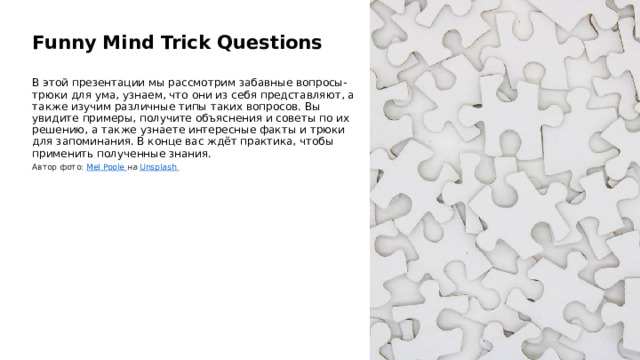
Funny Mind Trick Questions
В этой презентации мы рассмотрим забавные вопросы-трюки для ума, узнаем, что они из себя представляют, а также изучим различные типы таких вопросов. Вы увидите примеры, получите объяснения и советы по их решению, а также узнаете интересные факты и трюки для запоминания. В конце вас ждёт практика, чтобы применить полученные знания.
Автор фото: Mel Poole на Unsplash
Funny Mind Trick Questions
В этой презентации мы рассмотрим забавные вопросы-трюки для ума, узнаем, что они из себя представляют, а также изучим различные типы таких вопросов. Вы увидите примеры, получите объяснения и советы по их решению, а также узнаете интересные факты и трюки для запоминания. В конце вас ждёт практика, чтобы применить полученные знания.
Автор фото: Mel Poole на Unsplash
What is it
• Funny Mind Trick Questions are a collection of puzzles designed to challenge your logical thinking and perception.
• They often involve unexpected twists and require creative problem-solving to arrive at the correct answer.
• These questions are not only fun but also help improve cognitive flexibility and critical thinking skills.
Автор фото: Mel Poole на Unsplash
Types of questions
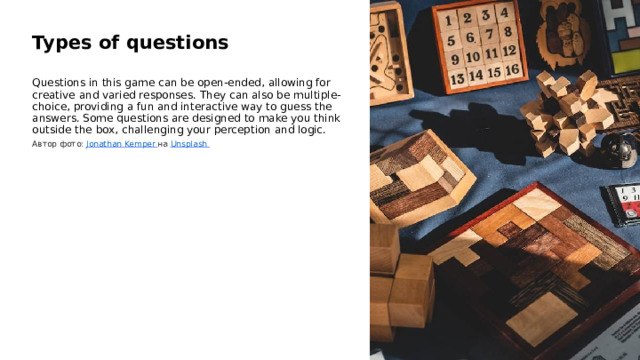
Questions in this game can be open-ended, allowing for creative and varied responses. They can also be multiple-choice, providing a fun and interactive way to guess the answers. Some questions are designed to make you think outside the box, challenging your perception and logic.
Автор фото: Jonathan Kemper на Unsplash
![Examples Here are some examples of mind trick questions that will make you think: Complete this series of numbers: 9 = 4, 21 = 9, 22 = 9, 24 = 10, 8 = 5, 7 = 5, 99 = 10, 100 = 7, 16 =?, 17 =? 16 = 7 and 17 = 9 [Answer (Each number equal the number of letters in their spelling, i.e. 16 (sixteen) is 7 and 17 (seventeen) is 9.]; What is the maximum number of times a single page of a newspaper can be folded in half by hand? (Answer - Only once, because after that you will be folding it into quarters, eighths, etc. These questions are designed to challenge your thinking and make you laugh at the same time. Автор фото: Ashkan Forouzani на Unsplash](https://static.multiurok.ru/multiurok/html/2025/06/08/s_68457916c809c/img4.jpg)
Examples
Here are some examples of mind trick questions that will make you think: Complete this series of numbers: 9 = 4, 21 = 9, 22 = 9, 24 = 10, 8 = 5, 7 = 5, 99 = 10, 100 = 7, 16 =?, 17 =? 16 = 7 and 17 = 9 [Answer (Each number equal the number of letters in their spelling, i.e. 16 (sixteen) is 7 and 17 (seventeen) is 9.]; What is the maximum number of times a single page of a newspaper can be folded in half by hand? (Answer - Only once, because after that you will be folding it into quarters, eighths, etc. These questions are designed to challenge your thinking and make you laugh at the same time.
Автор фото: Ashkan Forouzani на Unsplash
Explanations
• Mind trick questions are designed to challenge your logical thinking and perception, often leading to surprising answers.
• They work by exploiting cognitive biases and assumptions we make unconsciously.
• Understanding these mechanisms can enhance your critical thinking skills and offer insight into the workings of the human mind.
Автор фото: Hans-Peter Gauster на Unsplash
Tips for solving
Think outside the box to find unconventional solutions. Use analogies to connect familiar concepts with unfamiliar questions. Practice regularly to improve your ability to quickly identify patterns and make logical leaps.
Автор фото: gokhan polat на Unsplash
Fun facts
• Забавно, что наш мозг может подводить нас в решении простых вопросов.
• Например, сколько будет дважды два в квадрате? Большинство ответит, что восемь, но правильный ответ — четыре в квадрате, то есть шестнадцать.
• Ещё один интересный факт: мы часто ошибаемся в оценке времени, например, считаем, что минута длится дольше, когда занимаемся скучным делом.
Автор фото: Edge2Edge Media на Unsplash
Tricks to remember
Use visual associations to quickly remember complex information. Link questions to familiar images to make them easier to recall. Practice answering these questions out loud to reinforce your memory.
Автор фото: Sigmund на Unsplash
Practice
Practicing mind trick questions helps improve cognitive flexibility and quick thinking. It’s a fun way to engage your brain and enhance problem-solving skills. Regular practice makes these brain teasers an enjoyable and effective mental exercise.
Автор фото: Ryoji Iwata на Unsplash
Share and enjoy
These mind trick questions are designed to entertain and engage your audience. Share them in English lessons or extracurricular activities to generate lively discussions and laughter. Enjoy the fun and challenge as you explore the quirky world of puzzling questions.
Автор фото: Ross Sneddon на Unsplash
Спасибо за внимание!
Спасибо за внимание! В этой презентации мы рассмотрели различные типы вопросов, узнали примеры и получили советы по их решению. Надеемся, что информация была полезной и интересной, и вы сможете применить её на практике.
Вебинар для учителей
Свидетельство об участии БЕСПЛАТНО!