Узбекистан, Ташкент


СДЕЛАЙТЕ СВОИ УРОКИ ЕЩЁ ЭФФЕКТИВНЕЕ, А ЖИЗНЬ СВОБОДНЕЕ
Благодаря готовым учебным материалам для работы в классе и дистанционно
Скидки до 50 % на комплекты
только до
Готовые ключевые этапы урока всегда будут у вас под рукой
Организационный момент
Проверка знаний
Объяснение материала
Закрепление изученного
Итоги урока
Был в сети 07.03.2025 08:10

Алимов Элёржон Бахтияр угли
Студент
24 года
 3 046
3 046
 22 518
Местоположение
Geographical distribution of English language
Категория:
Английский язык
23.07.2022 18:16

Просмотр содержимого документа
«Geographical distribution of English language»
English language
Geographical distributionOld English As of 2016, 400 million people spoke English as their first language, and 1.1 billion spoke it as a secondary language.[65] English is the largest language by number of speakers. English is spoken by communities on every continent and on islands in all the major oceans.[66]
The countries where English is spoken can be grouped into different categories according to how English is used in each country. The "inner circle"[67] countries with many native speakers of English share an international standard of written English and jointly influence speech norms for English around the world. English does not belong to just one country, and it does not belong solely to descendants of English settlers. English is an official language of countries populated by few descendants of native speakers of English. It has also become by far the most important language of international communication when people who share no native language meet anywhere in the world.
Three circles of English-speaking countries
The Indian linguist Braj Kachru distinguished countries where English is spoken with a three circles model.[67] In his model,
the "inner circle" countries have large communities of native speakers of English,
"outer circle" countries have small communities of native speakers of English but widespread use of English as a second language in education or broadcasting or for local official purposes, and
"expanding circle" countries are countries where many people learn English as a foreign language.
Kachru based his model on the history of how English spread in different countries, how users acquire English, and the range of uses English has in each country. The three circles change membership over time.[68]

Braj Kachru's Three Circles of English
Countries with large communities of native speakers of English (the inner circle) include Britain, the United States, Australia, Canada, Ireland, and New Zealand, where the majority speaks English, and South Africa, where a significant minority speaks English. The countries with the most native English speakers are, in descending order, the United States (at least 231 million),[69] the United Kingdom (60 million),[70][71][72] Canada (19 million),[73] Australia (at least 17 million),[74] South Africa (4.8 million),[75] Ireland (4.2 million), and New Zealand (3.7 million).[76] In these countries, children of native speakers learn English from their parents, and local people who speak other languages and new immigrants learn English to communicate in their neighbourhoods and workplaces.[77] The inner-circle countries provide the base from which English spreads to other countries in the world.[68]
Estimates of the numbers of second language and foreign-language English speakers vary greatly from 470 million to more than 1 billion, depending on how proficiency is defined.[17] Linguist David Crystal estimates that non-native speakers now outnumber native speakers by a ratio of 3 to 1.[78] In Kachru's three-circles model, the "outer circle" countries are countries such as the Philippines,[79] Jamaica,[80] India, Pakistan, Singapore,[81] Malaysia and Nigeria[82][83] with a much smaller proportion of native speakers of English but much use of English as a second language for education, government, or domestic business, and its routine use for school instruction and official interactions with the government.[84]
Those countries have millions of native speakers of dialect continua ranging from an English-based creole to a more standard version of English. They have many more speakers of English who acquire English as they grow up through day-to-day use and listening to broadcasting, especially if they attend schools where English is the medium of instruction. Varieties of English learned by non-native speakers born to English-speaking parents may be influenced, especially in their grammar, by the other languages spoken by those learners.[77] Most of those varieties of English include words little used by native speakers of English in the inner-circle countries,[77] and they may show grammatical and phonological differences from inner-circle varieties as well. The standard English of the inner-circle countries is often taken as a norm for use of English in the outer-circle countries.[77]
In the three-circles model, countries such as Poland, China, Brazil, Germany, Japan, Indonesia, Egypt, and other countries where English is taught as a foreign language, make up the "expanding circle".[85] The distinctions between English as a first language, as a second language, and as a foreign language are often debatable and may change in particular countries over time.[84] For example, in the Netherlands and some other countries of Europe, knowledge of English as a second language is nearly universal, with over 80 percent of the population able to use it,[86] and thus English is routinely used to communicate with foreigners and often in higher education. In these countries, although English is not used for government business, its widespread use puts them at the boundary between the "outer circle" and "expanding circle". English is unusual among world languages in how many of its users are not native speakers but speakers of English as a second or foreign language.[87]
Many users of English in the expanding circle use it to communicate with other people from the expanding circle, so that interaction with native speakers of English plays no part in their decision to use the language.[88] Non-native varieties of English are widely used for international communication, and speakers of one such variety often encounter features of other varieties.[89] Very often today a conversation in English anywhere in the world may include no native speakers of English at all, even while including speakers from several different countries. This is particularly true of the shared vocabulary of mathematics and the sciences.[90]
Pluricentric English
Pie chart showing the percentage of native English speakers living in "inner circle" English-speaking countries. Native speakers are now substantially outnumbered worldwide by second-language speakers of English (not counted in this chart).
US (64.3%)
UK (16.7%)
Canada (5.3%)
Australia (4.7%)
South Africa (1.3%)
Ireland (1.1%)
New Zealand (1%)
Other (5.6%)
English is a pluricentric language, which means that no one national authority sets the standard for use of the language.[91][92][93][94] Spoken English, for example English used in broadcasting, generally follows national pronunciation standards that are also established by custom rather than by regulation. International broadcasters are usually identifiable as coming from one country rather than another through their accents,[95] but newsreader scripts are also composed largely in international standard written English. The norms of standard written English are maintained purely by the consensus of educated English-speakers around the world, without any oversight by any government or international organisation.[96]
American listeners generally readily understand most British broadcasting, and British listeners readily understand most American broadcasting. Most English speakers around the world can understand radio programmes, television programmes, and films from many parts of the English-speaking world.[97] Both standard and non-standard varieties of English can include both formal or informal styles, distinguished by word choice and syntax and use both technical and non-technical registers.[98]
The settlement history of the English-speaking inner circle countries outside Britain helped level dialect distinctions and produce koineised forms of English in South Africa, Australia, and New Zealand.[99] The majority of immigrants to the United States without British ancestry rapidly adopted English after arrival. Now the majority of the United States population are monolingual English speakers,[69][100] and English has been given official or co-official status by 30 of the 50 state governments, as well as all five territorial governments of the US, though there has never been an official language at the federal level.[101][102]
English as a global language
Main article: English as a lingua franca
See also: Foreign language influences in English and Study of global communication
English has ceased to be an "English language" in the sense of belonging only to people who are ethnically English.[103][104] Use of English is growing country-by-country internally and for international communication. Most people learn English for practical rather than ideological reasons.[105] Many speakers of English in Africa have become part of an "Afro-Saxon" language community that unites Africans from different countries.[106]
As decolonisation proceeded throughout the British Empire in the 1950s and 1960s, former colonies often did not reject English but rather continued to use it as independent countries setting their own language policies.[54][55][107] For example, the view of the English language among many Indians has gone from associating it with colonialism to associating it with economic progress, and English continues to be an official language of India.[108] English is also widely used in media and literature, and the number of English language books published annually in India is the third largest in the world after the US and UK.[109] However English is rarely spoken as a first language, numbering only around a couple hundred-thousand people, and less than 5% of the population speak fluent English in India.[110][111] David Crystal claimed in 2004 that, combining native and non-native speakers, India now has more people who speak or understand English than any other country in the world,[112] but the number of English speakers in India is very uncertain, with most scholars concluding that the United States still has more speakers of English than India.[113]
Modern English, sometimes described as the first global lingua franca,[57][114] is also regarded as the first world language.[115][116] English is the world's most widely used language in newspaper publishing, book publishing, international telecommunications, scientific publishing, international trade, mass entertainment, and diplomacy.[116] English is, by international treaty, the basis for the required controlled natural languages[117] Seaspeak and Airspeak, used as international languages of seafaring[118] and aviation.[119] English used to have parity with French and German in scientific research, but now it dominates that field.[120] It achieved parity with French as a language of diplomacy at the Treaty of Versailles negotiations in 1919.[121] By the time of the foundation of the United Nations at the end of World War II, English had become pre-eminent[122] and is now the main worldwide language of diplomacy and international relations.[123] It is one of six official languages of the United Nations.[124] Many other worldwide international organisations, including the International Olympic Committee, specify English as a working language or official language of the organisation.
Many regional international organisations such as the European Free Trade Association, Association of Southeast Asian Nations (ASEAN),[58] and Asia-Pacific Economic Cooperation (APEC) set English as their organisation's sole working language even though most members are not countries with a majority of native English speakers. While the European Union (EU) allows member states to designate any of the national languages as an official language of the Union, in practice English is the main working language of EU organisations.[125]
Although in most countries English is not an official language, it is currently the language most often taught as a foreign language.[57][58] In the countries of the EU, English is the most widely spoken foreign language in nineteen of the twenty-five member states where it is not an official language (that is, the countries other than Ireland and Malta). In a 2012 official Eurobarometer poll (conducted when the UK was still a member of the EU), 38 percent of the EU respondents outside the countries where English is an official language said they could speak English well enough to have a conversation in that language. The next most commonly mentioned foreign language, French (which is the most widely known foreign language in the UK and Ireland), could be used in conversation by 12 percent of respondents.[126]
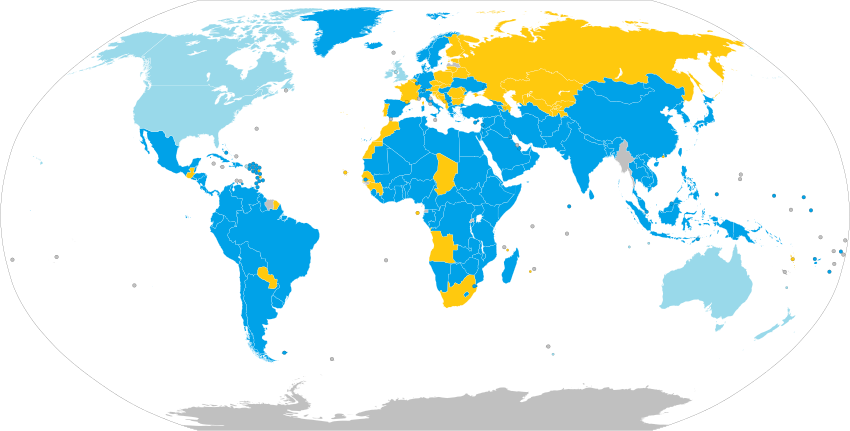
Countries in which English Language is a Mandatory or an Optional Subject
English is the dominant language
English is a mandatory subject
English is an optional subject
No data
A working knowledge of English has become a requirement in a number of occupations and professions such as medicine[127] and computing. English has become so important in scientific publishing that more than 80 percent of all scientific journal articles indexed by Chemical Abstracts in 1998 were written in English, as were 90 percent of all articles in natural science publications by 1996 and 82 percent of articles in humanities publications by 1995.[128]
International communities such as international business people may use English as an auxiliary language, with an emphasis on vocabulary suitable for their domain of interest. This has led some scholars to develop the study of English as an auxiliary language. The trademarked Globish uses a relatively small subset of English vocabulary (about 1500 words, designed to represent the highest use in international business English) in combination with the standard English grammar.[129] Other examples include Simple English.
The increased use of the English language globally has had an effect on other languages, leading to some English words being assimilated into the vocabularies of other languages. This influence of English has led to concerns about language death,[130] and to claims of linguistic imperialism,[131] and has provoked resistance to the spread of English; however the number of speakers continues to increase because many people around the world think that English provides them with opportunities for better employment and improved lives.[132]
Although some scholars[who?] mention a possibility of future divergence of English dialects into mutually unintelligible languages, most think a more likely outcome is that English will continue to function as a koineised language in which the standard form unifies speakers from around the world.[133] English is used as the language for wider communication in countries around the world.[134] Thus English has grown in worldwide use much more than any constructed language proposed as an international auxiliary language, including Esperanto



Вебинар для учителей
Свидетельство об участии БЕСПЛАТНО!