, Донецк

СДЕЛАЙТЕ СВОИ УРОКИ ЕЩЁ ЭФФЕКТИВНЕЕ, А ЖИЗНЬ СВОБОДНЕЕ
Благодаря готовым учебным материалам для работы в классе и дистанционно
Скидки до 50 % на комплекты
только до
Готовые ключевые этапы урока всегда будут у вас под рукой
Организационный момент
Проверка знаний
Объяснение материала
Закрепление изученного
Итоги урока

Была в сети 07.04.2026 08:19

Романова Екатерина Александровна
Учитель английского и немецкого языков и зарубежной литературы
36 лет
 3 799
3 799
 17 438
Местоположение
Geographical peculiarities of Wales
Категория:
Английский язык
02.04.2016 16:58

Просмотр содержимого документа
«Geographical peculiaries of Wales»
17

Geographical peculiarities of Wales.

“Cymru am birth” (Wales forever)
Contest:
Introduction p.3
Chapter one “Geographical position and peculiarities” p.4
Chapter two “Climate” p.5
Chapter three “The Seven Wonders of Wales” p.5
Conclusion p.12
Glossary of terms p.13
List of references p.15
Introduction

Wales is a country that is part of the United Kingdom, bordered by England to its east, and the Atlantic Ocean and Irish Sea to its west. Wales has a population estimated at three million and is officially bilingual; Welsh and English have equal status, and bilingual signs are the norm throughout the land. For most people in Wales, English is their only language. The once-steady decline in Welsh speaking has reversed over recent years, however, with Welsh speakers currently estimated to be around 20% of the population.
During the Iron Age and early medieval period, Wales was inhabited by the Celtic Britons. A distinct Welsh national identity emerged in the centuries after the ROMAN WITHDRAWAL FROM BRITAIN in the 5th century, and Wales is regarded as one of the modern Celtic nations today. In the 13th century, the defeat of LLEWELYN THE GREAT by EDWARD I completed the Anglo-Norman conquest of Wales and brought about centuries of English occupation. Wales was subsequently incorporated into England with the LAWS IN WALES ACTS, creating the legal entity known today as England and Wales. Distinctive Welsh politics developed in the 19th century, and in 1881 the Welsh Sunday Closing Act became the first legislation applied exclusively to Wales. In 1955, Cardiff was proclaimed as the capital city and in 1999 the National Assembly for Wales was created, which holds responsibility for a range of devolved matters.
The capital Cardiff is the largest city in Wales with 317,500 people. For a period it was the biggest coal port in the world and, for a few years before World War I, it handled a greater tonnage of cargo than either London or Liverpool. Two-thirds of the Welsh population live in South Wales, with another concentration in eastern North Wales. Many tourists have been drawn to Wales's "wild ... and picturesque" landscapes. From the late 19th century onwards, Wales acquired its popular image as the "land of song", attributable in part to the revival of the eisteddfod tradition. Actors, singers and other artists are celebrated in Wales today, often achieving international success. Cardiff is the largest media centre in the UK outside of London.
Llywelyn the Great founded the PRINCIPALITY OF WALES in 1216. Just over a hundred years after the Edwardian Conquest, in the early 15th century OWAIN GLYNDŴR briefly restored independence to what was to become modern Wales. Traditionally the British Royal Family have bestowed the courtesy title of "Prince of Wales" upon the heir apparent of the reigning monarch. Wales is sometimes referred to as the "Principality of Wales", or just the "principality", although this has no modern geographical or constitutional basis.
Chapter one
Geographical position and peculiarities
Wales is located on a peninsula in central-west Great Britain. Its area is about 20,779 km2 (8,023 sq mi) – about the same size as Massachusetts, Israel, Slovenia or El Salvador and about a quarter of the area of Scotland. It is about 274 km (170 mi) north–south and 97 km (60 mi) east–west. Wales is bordered by England to the east and by sea in the other three directions: the BRISTOL CHANNEL to the south, CELTIC SEA to the west, and the IRISH SEA to the north. Altogether, Wales has over 1,200 km (746 mi) of coastline. There are several islands off the Welsh mainland, the largest being ANGLESEY in the northwest.
Much of Wales's diverse landscape is mountainous, particularly in the north and central regions. The mountains were shaped during the last ice age, the Devensian glaciation. The highest mountains in Wales are in SNOWDONIA, and include Snowdon, which, at 1,085 m (3,560 ft) is the highest peak in Wales. The 14 (or possibly 15) Welsh mountains over 3,000 feet (914 m) high are known collectively as the Welsh 3000s, and are located in a small area in the north-west.
The highest outside the 3000s is Aran Fawddwy 905m (2,969 ft) in the south of Snowdonia. The BRECON BEACONS are in the south (highest point Pen-y-Fan 886 m/2,907 ft, and are joined by the Cambrian Mountains in Mid Wales, the latter name being given to the earliest geological period of the Paleozoic era, the Cambrian.
Chapter two
Climate
Highest maximum temperature: 35.2 °C (95.4 °F) at Hawarden Bridge, Flintshire on 2 August 1990.
Lowest minimum temperature: −23.3 °C (−10 °F) at Rhayader, Radnorshire (now Powys) on 21 January 1940.[67]
Maximum number of hours of sunshine in a month: 354.3 hours at Dale Fort, Pembrokeshire in July 1955.[68]
Minimum number of hours of sunshine in a month: 2.7 hours at Llwynon, Brecknockshire in January 1962.[69]
Maximum rainfall in a day (0900 UTC – 0900 UTC): 211 millimetres (8 in) at Rhondda, Glamorgan (now Rhondda Cynon Taf), on 11 November 1929.[70]
Wettest spot – an average of 4,473 millimetres (176 in) rain a year at Crib Goch in Snowdonia, Gwynedd (making it also the wettest spot in the United Kingdom
Chapter three
The Seven Wonders of Wales
The Seven Wonders of Wales is a list in doggerel verse of seven geographic and cultural landmarks in Wales probably composed in the late 18th century under the influence of tourism from England. All the "wonders" are in north Wales: SNOWDON (the highest mountain), the GRESFORD BELLS (the peal of bells in the medieval church of All Saints at Gresford), the LLANGOLLEN BRIDGE (built in 1347 over the RIVER DEE), ST. WINEFRIDE WELL (a pilgrimage site at Holywell, in Flintshire), the WREKXAM STEEPLE (16th century tower of St. Giles Church in Wrexham), the OVERTON YEW TREES (ancient yew trees in the churchyard of St. Mary's at Overton-on-Dee) and PISTYLL RHAEADR – a tall waterfall, at 240 ft (73 m). The wonders are part of the rhyme:
Pistyll Rhaeadr and Wrexham steeple,
Snowdon's mountain without its people,
Overton yew trees, St Winefride's Wells,
Llangollen bridge and Gresford bells.
Snowdon.

Snowdon (Welsh: Yr Wyddfa, pronounced [əɾ ˈwɪðva]) is the highest mountain in Wales and is Great Britain's highest mountain south of the Scottish Highlands. It has been described as "probably the busiest mountain in Britain." It is located in Snowdonia National Park (Parc Cenedlaethol Eryri) in Gwynedd. The summit is known as Yr Wyddfa ("the tumulus") and lies at an altitude of 1,085 metres (3,560 ft) above sea level. In terms of 'absolute height' it is the same height as Table Mountain in South Africa. As the highest peak in Wales, Snowdon is one of three mountains climbed as part of the National Three Peaks Challenge.
The English name "Snowdon" comes from the Old English Snow Dun, meaning "snow hill" as snowdon can offer significant falls of snow each winter from October to April, but in the past, rare fresh late-seasonal snow has been reported to fall on Snowdon, well into the months of May and June. Although the amount of snow on Snowdon in winter has varied significantly recently, 55% less snow had fallen in 2004 than in 1994.
Snowdon has one of the wettest climates in Great Britain, receiving an annual average of more than 4,500 millimetres (180 in) of precipitation. The annual average temperature is estimated to be around +2.5 celsius.
2. Gressford bells All Saints' Church.
All Saints' Church stands proudly in the former coal mining village of Gresford in Wrexham County Borough, Wales. The bells of the parish church of All Saints is one of the Seven Wonders of Wales. Not only are the peal of bells of note, listed it is said for the purity of their tone, but the church itself is remarkable for its size, beauty, interior church monuments, and its churchyard yew trees.
Though the present edifice was built in the late 13th century by the Welsh patron Trahaearn ap Ithel ap Eunydd (and his five brothers), additions and improvements in the 14th and 15th centuries obscure much of the original building. The very size of All Saints meant that it was probably a place of pilgrimage for centuries, housing a relic or stature of a saint that has since disappeared. Some of the stained glass windows in the church came from the dissolved abbey at Basingwerk on the banks of the River Dee below Holywell. The church was also richly endowed by Thomas Stanley, Earl of Derby, whose intervention at the Battle of Bosworth helped Welsh-born Henry Tudor overcome Richard III in his successful quest for the throne of England.
The earliest record of the peal of Gresford bells dates back only to 1714. An apparatus was installed in the belfry in 1877 so that all eight bells could be chimed by one person. The bells are rung regularly for church services, and the old custom of ringing on November 5th is still continued, though it is unclear whether this is to commemorate the successful landing of William of Orange in 1688, or the Gunpowder Plot of Guy Fawkes to blow up Parliament in 1605. During World War II, the custom of tolling the passing bell was discontinued, as the bells were to be rung only as an invasion warning.
The church is surrounded by a grove of Yews, some of which are equal in size and age to those of Overton listed in the Seven Wonders of Wales. Twenty-five of these were planted in 1726, but one growing near the south gate is older. It was already an ancient tree at the time of Richard II's proclamation that ordered the general planting of yews to support the army and the use of yew in the Longbow.
The church was designated as a Grade I listed building on 7 June 1963.
Llangollen Bridge.
The little town of Llangollen (the Church of St. Collen) is nestled snugly in the Dee Valley (Dyffryn Dyfrdwy) among high green hills. Whilst near the border with England, the town has managed to retain much of its Welsh character, but for one week each July, the visitor might be excused for thinking he is not in Wales at all.
The destination, 14th century Llangollen Bridge is truly a wonder, not to be missed, for at this time, from one end to the other it will be crowded with dancers, singers, musicians and merrymakers (with the requisite numbers of tourists, of course), from dozens of different nations, resplendent in their national costumes.
Not long after the War had finally ended, a brilliant idea came to the mind of an official of the British Council, Welshman Harold Tudor of Coedpoeth (a few miles from Llangollen). Harold conceived the idea of an international folk festival, conducted very much along the lines of the Welsh National Eisteddfod, but open to competitors from all parts of the world.
The actual site chosen for the new festival was in a broad grassy space between the banks of the River Dee and the Llangollen Canal. Fourteen different nationalities were represented, filling the streets of the drab, postwar town with colour and spectacle but above all, with glorious sound. It has been held each year since, attracting many thousands of spectators and hundreds of competitors, whose colourful native costumes and delightful singing and dancing fill the streets for one whole week, transforming a little Welsh town into a miniature universe. In the pavilion, choirs from places as diverse as Ukraine, Morocco and Argentina meet in friendly competition, getting together afterwards to celebrate their wins and losses in local pubs.
In recent years, the competitions have been augmented by "Choir of the Year" and "Singer of the Year" contests. The Choir of the world competition is open to male, female and mixed choirs, attracting performers of a very high standard. One of the competitors was the great tenor Luciano Pavarotti, who came with his father to sing in a choir from Italy in the early years of the festival and who returned to give a goodwill concert in 1995. Llangollen Bridge may be listed as one of the seven wonders of Wales, but it is the International Eisteddfod with its motto: “Blessed is a world that sings; gentle are its songs” that is the true wonder.
St Winefride's Well.

St Winefride's Well is a holy well located in Holywell, in Flintshire in North Wales. It is the oldest continuously operating pilgrimage site in Great Britain.
The healing waters have been said to cause miraculous cures, The legend of St Winefride tells how in 660AD, Caradoc, the son of a local prince, severed the head of the young Winefride after she spurned his advances, and how a spring rose from the ground at the spot where her head fell and how she was later restored to life by her uncle, St. Beuno
The holy well is known as "the Lourdes of Wales" and is mentioned in an old rhyme as one of the Seven Wonders of Wales. It has been a pilgrimage site since the 7th century.
After a shrine was established in Shrewsbury around 1138, it and St Winefride's Well became important pilgrimage destinations. Some of the structures at the well date from the reign of King Henry VII, or earlier. Later King Henry VIII caused the shrine and saintly relics to be destroyed, but some have been recovered to be housed at Shrewsbury and Holywell.
The Jesuits have traditionally supported the holy well. In fact in 1605, many of those involved with the Gunpowder plot visited here with Father Edward Oldcorne to give thanks for his deliverance from cancer, or as some said, to plan the plot. It is also believed to be connected to St Mary's well and chapel in Cefn Meiriadog, Denbighshire.
As one of the few locations mentioned by name in the anonymous medieval alliterative poem Sir Gawain and the Green Knight, it is interesting to compare the site's beheading history with the beheading game in the poem.
5. Whekham Steeple.
The richly-decorated tower, 135-feet high, with its four striking hexagonal turrets, was begun in 1506. It is graced by many medieval carvings including those of an arrow and a deer, the attributes of St. Giles. The interior of the church also contains many late medieval carvings and monuments. On a window you can find the words of the 1819 hymn by Reginald Heber, "From Greenland's Icy Mountains." Just outside the church, west of the tower is the grave of Elihu Yale, after whom Yale University in the USA is named.
To enter the churchyard, you pass through the magnificently-carved wrought-iron gates, completed in 1719 by the Davies Brothers of nearby Bersham, who were also responsible for the even more elaborate gates of Chirk Castle, perhaps the finest example of wrought-iron work in Britain. It is well worth a short diversion to the little village of Chirk to view these gates; their painstaking detail makes us wonder why they were not given an honoured place as one of the so-called seven wonders of Wales.
The only comparable ironwork is found in two other sets of Davies Brothers' gates: at Sandringham, one of the English monarch's residences and at Leeswood Hall, near Mold in Flintshire. Near Wrexham, too, is the village of Acton, where Judge Jeffreys, the infamous hanging judge of the Bloody Assizes of 1685 was born in 1645.
Bersham is a small village that holds special importance for historians, for not only did it house the workshops of the Davies Brothers, it was one of the cradles of the Industrial Revolution. This is the place where British iron making began in 1670 and where John "Iron-Mad" Wilkinson set up shop in 1761.
6. Overton Yew trees.
For many centuries, the pleasant village of Overton was located in Maelor Saesneg (English Maelor), a part of Flintshire entirely surrounded by English territory. It is now in the county of Wrexham. On the way from Chester to Overton, via Wrexham, visitors should stop at Bangor-Is-Y-Coed (Bangor-on-Dee), whose 17th century bridge is said to have been designed by the famed architect Inigo Jones, and where one of the very earliest monasteries in Britain was founded in the fifth century.
Perhaps the yew tree, which begins again with new roots after the older tree has rotted away and therefore lasts for many centuries, has a pre-Christian tradition. It is certainly difficult to ascertain the importance to Welsh history of the Overton yew trees and their inclusion in the nursery rhyme unless one considers the honoured place of Welsh mercenary soldiers in the armies of England.
Yew's elastic properties made it the ideal wood for the longbow, for over three centuries the main weapon of the English army. The English King Edward I is said to have decreed that yews trees should be planted in all English churchyards to provide a plentiful supply of wood for the longbow.
7. Pistyll Rhaeadr

Pistyll Rhaeadr ("spring of the waterfall") is a waterfall in Wales. It is located a few miles from the village of Llanrhaeadr-ym-Mochnant in Powys, Wales, twelve miles west of Oswestry.
Pistyll Rhaeadr is formed by the Afon Disgynfa's falling, in three stages, over a 240-foot (73 m) Silurian cliff-face, after which the river is known as the Afon Rhaeadr. The tallest stage is estimated at about 40 metres. It is counted as one of the Seven Wonders of Wales and is a Site of Special Scientific Interest. The 19th-century author George Borrow, in his book Wild Wales, remarked of the waterfall: "What shall I liken it to? I scarcely know, unless it is to an immense skein of silk agitated and disturbed by tempestuous blasts, or to the long tail of a grey courser at furious speed. I never saw water falling so gracefully, so much like thin, beautiful threads as here."
There is car parking space at the foot of the waterfall for people who want to explore the waterfall, with a café and a B&B alongside.
The waterfall is often referred to by the media, government sources, and other sources as the tallest in Wales or the tallest single drop in the United Kingdom. However, it is not a single drop, and both its single drop height and total height are surpassed by both the Devil's Appendix and Pistyll y Llyn, as well as several other waterfalls.
Conclusion
Wales is a country of lakes and mountains. Its about the half the size of Switzerland, and it has a population of two and three quarter million. On the north of Wales is some of the most beautiful scenery in the British islands, the Snowdon mountain. Snowdon is Britain’s second highest mountain.
Wales has a distinctive culture including its own language, customs, holidays and music.
Welsh is one of the oldest languages in Europe. Its a Celtic language, like Breton in France, Gaelic in Ireland, or Gaelic in Scotland. Two and a half thousand years before these languages were spoken in many parts of Europe. They died out when the Romans invaded these areas, but some of them survived in the northwest corner of Europe. But over the last hundred years the number of Welsh-speaker has fallen very quickly. Now only twenty per cent of Welsh people speak Welsh. Here are some of the reasons for the decline.
Wales has a distinctive culture including its own language, customs, holidays and music.
Wales is primarily represented by the symbol of the red Welsh Dragon, but other national emblems include the leek and daffodil. The Welsh words for leeks (cennin) and daffodils (cennin Pedr, lit. "(Saint) Peter's Leeks") are closely related and it is likely that one of the symbols came to be used due to a misunderstanding for the other one, though it is not clear which came first.
Wales, like other constituent nations, enjoys independent representation in major world sporting events such as the FIFA World Cup, Rugby World Cup and in the Commonwealth Games (however as Great Britain in the Olympics).
Glossary of terms
Anglesey ( /æŋɡəlsi/) is an island and county off the northwest coast of Wales. (Англси), (p. 4).
Brecon Beacons is a mountain range in South Wales. (Брекон Биконз), (p.4).
Bristol Channel is a major inlet in the island of Britain, separating South Wales from Devon and Somerset in South West England. (Бристольский канал), (p.4).
Celtic sea is the area of the Atlantic Ocean off the south coast of Ireland. (Кельтское море), (p.4).
Edward I (17 June 1239 – 7 July 1307), also known as Edward Longshanks and the Hammer of the Scots, was King of England from 1272 to 1307. (Эдвард I), (p.3).
Gresford bells is the peal of bells in the medieval church of All Saints at Gresford. (Колокола Грэсфорда), (p. 5).
Irish Sea separates the islands of Ireland and Great Britain. It is connected to the Atlantic Ocean in the south by St George's Channel, and in the north by the North Channel. (Ирландское море), (p.4).
Laws in Wales Acts were a series of parliamentary measures by which the legal system of Wales was annexed to England and the norms of English administration introduced in order to create a single state and a single legal jurisdiction, which is frequently referred to as England and Wales. The Acts refer in particular to two Acts of Parliament passed in 1536 and 1543 during the reign of King Henry VIII of England, who came from the Welsh Tudor dynasty. (Валлийские законы), (p.3).
Llangollen bridge is one of the Seven wonders of Wales, a first stone bridge built in 1347 over the river Dee. (Лланголенский мост), (p.5).
Llywelyn the Great ([hə:wɛlin]), full name Llywelyn ab Iorwerth, (c. 1173 – 11 April 1240) was a Prince of Gwynedd in north Wales and eventually de facto ruler
over most of Wales. (Грифид ап Лливелин),
Owain Glyndŵr ([ˈoʊain ɡlɨ̞nˈduːr]), (c. 1354 or 1359 – c. 1416) by modern historians, was a Welsh ruler and the last native Welsh person to hold the title Prince of Wales. He instigated an ultimately unsuccessful but long-running revolt against English rule of Wales. (Оуэн Глиндур), (p.4).
Overton yew trees are 21 yew trees at St Mary's Church, Overton-on-Dee. (Овэртонские тисовые деревья), (p.5).
Pistyll Rhaeadr ("spring of the waterfall") is a waterfall in Wales. It is located a few miles from the village of Llanrhaeadr-ym-Mochnant in Powys, Wales, twelve miles west of Oswestry. (Пистул Рэдар), (p.5).
Principality of Wales covered the lands ruled by the Prince of Wales directly, and was formally founded in 1216 at the Council of Aberdyfi, and later recognised by the 1218 Treaty of Worcester between Llywelyn the Great and the English Crown. The treaty gave substance to the political reality of 13th century Wales and England, both part of the Angevin Empire. (Княжество Уэльса), (p.4).
River Dee is a 70-mile (110 km) long river in the United Kingdom. It travels through Wales and England, forms part of the border between them. (Река Ди), (p.5).
Roman withdrawal (departure) from Britain is traditionally considered to have been complete by 410 AD. The Roman Empire legions left Britain in the first decade of the fifth century. (Уход римских войск из Британии), (p.3).
Snowdon is the highest mountain in Wales and is Great Britain's highest mountain south of the Scottish Highlands. (Сноудон), (p.4).
Snowdonia is a region in north Wales and a national park of 838 square miles (2,170 km2) in area. It was the first to be designated of the three National Parks in Wales, in 1951. (Сноудония), (p.4).
St Winefride's Well is a holy well located in Holywell, in Flintshire in North Wales. It is the oldest continuously operating pilgrimage site in Great Britain. (Колодец святого Уинфреда), (p.5).
Wrexham steeple /ˈrɛksəm/ is a 16th century tower of St. Giles Church in Wrexham. (Башня Рэксем), (p.5).
List of references:
1. http://en.wikipedia.org/wiki/Wales
2. http://en.wikipedia.org/wiki/Wales#Geography
3. http://en.wikipedia.org/wiki/Brecon_Beacons
4. http://en.wikipedia.org/wiki/Anglesey
5.http://en.wikipedia.org/wiki/Snowdon
6. http://en.wikipedia.org/wiki/Snowdonia_National_Park #Snowdonia_ National_Park
7. http://en.wikipedia.org/wiki/Seven_Wonders_of_Wales
8. http://en.wikipedia.org/wiki/Pistyll_Rhaeadr
9. http://en.wikipedia.org/wiki/St_Giles%27_Church,_Wrexham
10. http://en.wikipedia.org/wiki/Overton-on-Dee#St_Mary_the_Virgin_ Church_and_its_yew_trees
11. http://en.wikipedia.org/wiki/St_Winefride%27s_Well
12. http://en.wikipedia.org/wiki/Llangollen
13. http://en.wikipedia.org/wiki/All_Saints%27_Church,_Gresford
Просмотр содержимого презентации
«Geografical peculiarities of Wales»

Geographical peculiarities of Wales
- Wales is a country that is part of the United Kingdom , bordered by England to its east, and the Atlantic Ocean and Irish Sea to its west.

Bristol channel
- The Bristol Channel in its turn is a major inlet in the island of Great Britain , separating South Wales from Devon and Somerset in South West England , and extending from the lower estuary of the River Severn to the North Atlantic Ocean .
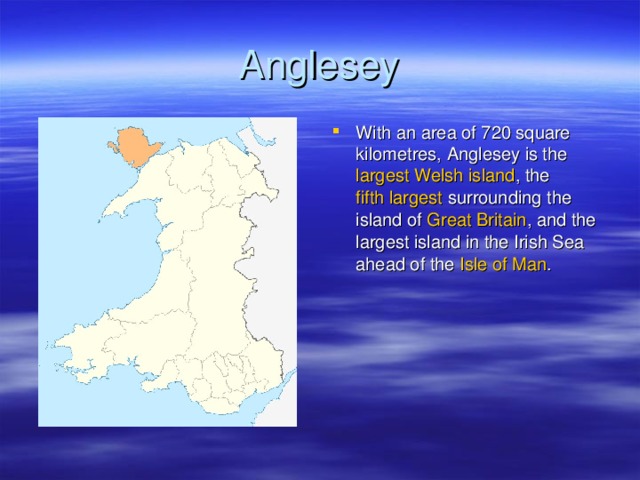
Anglesey
- With an area of 720 square kilometres, Anglesey is the largest Welsh island , the fifth largest surrounding the island of Great Britain , and the largest island in the Irish Sea ahead of the Isle of Man .
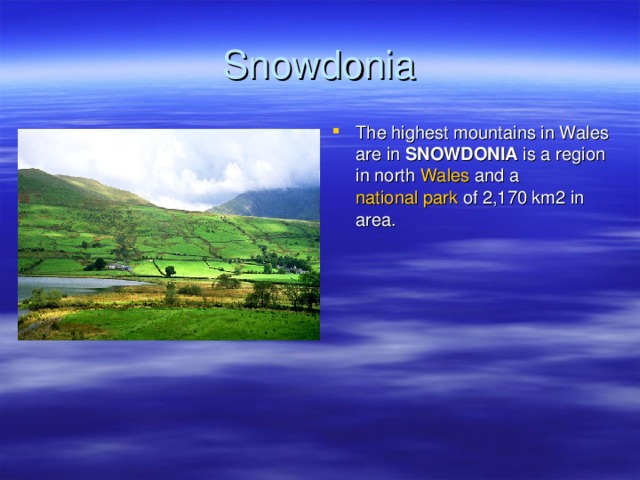
Snowdonia
- The highest mountains in Wales are in SNOWDONIA is a region in north Wales and a national park of 2,170 km2 in area.

Brecon Beacons
- The BRECON BEACONS is a mountain range in South Wales ( highest point Pen-y-Fan 886 m ) .

Snowdon
- One of the Wales Seven Wonders. Snowdon is the highest peak in Wales and is Great Britain 's highest mountain

Gressford bells
- One of the Seven Wonders of Wales, the peal of bells in the medieval church of All Saints at Gresford
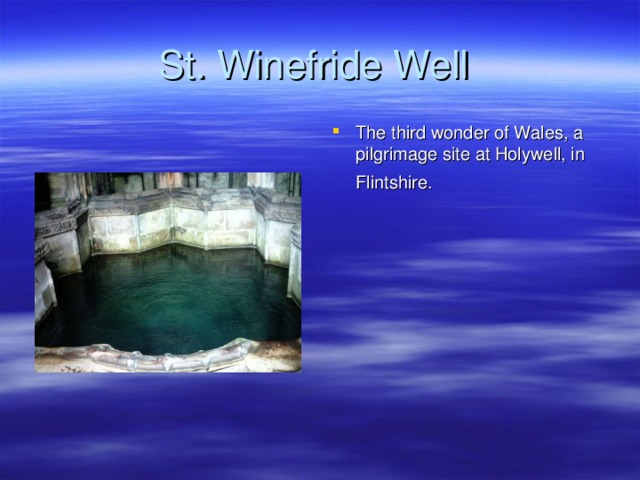
St. Winefride Well
- The third wonder of Wales, a pilgrimage site at Holywell, in Flintshire.
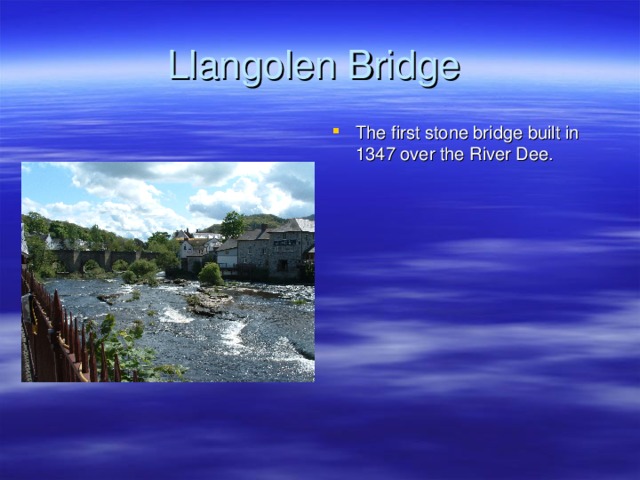
Llangolen Bridge
- The first stone bridge built in 1347 over the River Dee.

Wrekxam Steeple
- A part of the Seven Wonders, 16th century tower of St. Giles Church in Wrexham.

Overton Yew Trees
- Ancient yew trees in the churchyard of St. Mary's at Overton-on-Dee.

Pistyll Rhaeadr
- A tall waterfall, at 240 ft (73 m).
- The wonders are part of the rhyme:
Pistyll Rhaeadr and Wrexham
steeple,
Snowdon's mountain without its
people,
Overton yew trees, St Winefride's
Wells,
Llangollen bridge and Gresford
bells.







Вебинар для учителей

Свидетельство об участии БЕСПЛАТНО!