Россия, Kaliningrad

СДЕЛАЙТЕ СВОИ УРОКИ ЕЩЁ ЭФФЕКТИВНЕЕ, А ЖИЗНЬ СВОБОДНЕЕ
Благодаря готовым учебным материалам для работы в классе и дистанционно
Скидки до 50 % на комплекты
только до
Готовые ключевые этапы урока всегда будут у вас под рукой
Организационный момент
Проверка знаний
Объяснение материала
Закрепление изученного
Итоги урока
Была в сети 05.12.2024 18:01

Игнаукайте Дарья Васильевна
Преподаватель иностранного языка
24 года
 181
181
 180 215
Местоположение
Грамматико-переводческий метод в преподавании английского языка
Категория:
Английский язык
26.11.2024 10:37

Просмотр содержимого документа
«Грамматико-переводческий метод в преподавании английского языка»

In most teacher preparation courses in which the ‘history of methods’ is reviewed, it all began with Grammar-Translation. And it was bad! In fact, neither claim – that Grammar-Translation was the first method, and that it was inherently wrong – is entirely true.
Grammar-Translation Method
Made by daria ignaukaite 4-1ak.
![The background Johann Seiden-stiicker, Karl Plotz, H. S. Ollendorf, and Johann Meidinger Grammar Translation was in fact first known in the United States as the Prussian Method. (A book by B. Sears, an American classics teacher, published in 1845 was entitled The Ciceronian or the Prussian Method of Teaching the Elements of the Latin Language [Kelly 1969]).](https://static.multiurok.ru/multiurok/html/2024/11/26/s_67457ad050202/img1.jpg)
The background Johann Seiden-stiicker, Karl Plotz, H. S. Ollendorf, and Johann Meidinger
- Grammar Translation was in fact first known in the United States as the Prussian Method. (A book by B. Sears, an American classics teacher, published in 1845 was entitled The Ciceronian or the Prussian Method of Teaching the Elements of the Latin Language [Kelly 1969]).
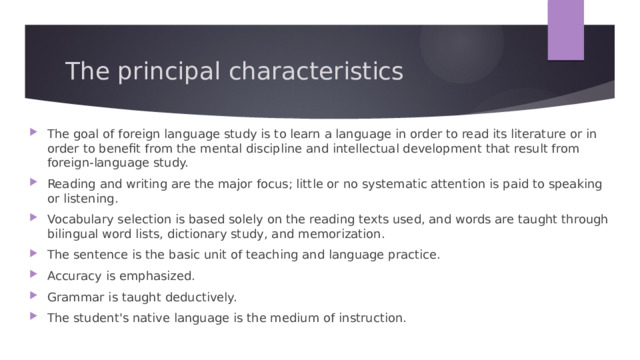
The principal characteristics
- The goal of foreign language study is to learn a language in order to read its literature or in order to benefit from the mental discipline and intellectual development that result from foreign-language study.
- Reading and writing are the major focus; little or no systematic attention is paid to speaking or listening.
- Vocabulary selection is based solely on the reading texts used, and words are taught through bilingual word lists, dictionary study, and memorization.
- The sentence is the basic unit of teaching and language practice.
- Accuracy is emphasized.
- Grammar is taught deductively.
- The student's native language is the medium of instruction.
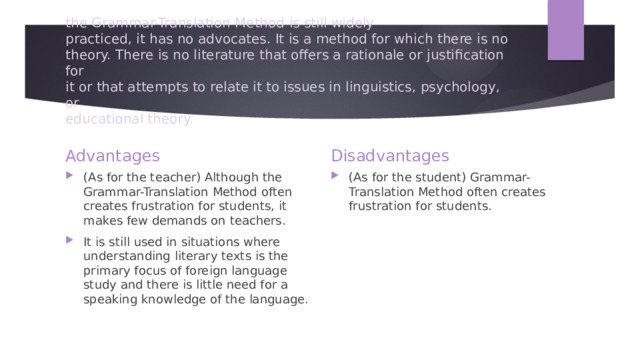
the Grammar-Translation Method is still widely practiced, it has no advocates. It is a method for which there is no theory. There is no literature that offers a rationale or justification for it or that attempts to relate it to issues in linguistics, psychology, or educational theory.
Advantages
Disadvantages
- (As for the teacher) Although the Grammar-Translation Method often creates frustration for students, it makes few demands on teachers.
- It is still used in situations where understanding literary texts is the primary focus of foreign language study and there is little need for a speaking knowledge of the language.
- (As for the student) Grammar-Translation Method often creates frustration for students.

Dimensions of Methodology

Bibliography
- 1. Thornbury S. “30 Language Teaching Methods”.
- 2. Richards J., Rodgers T. “Approaches and Methods in Language Teaching”.
Thanks for attention!
Made by daria ignaukaite 4-1ak.

Вебинар для учителей

Свидетельство об участии БЕСПЛАТНО!