Россия, Ейск

СДЕЛАЙТЕ СВОИ УРОКИ ЕЩЁ ЭФФЕКТИВНЕЕ, А ЖИЗНЬ СВОБОДНЕЕ
Благодаря готовым учебным материалам для работы в классе и дистанционно
Скидки до 50 % на комплекты
только до
Готовые ключевые этапы урока всегда будут у вас под рукой
Организационный момент
Проверка знаний
Объяснение материала
Закрепление изученного
Итоги урока
Была в сети 14.06.2026 15:52

Толок Дарья Дмитриевна
Преподаватель Английского языка
 1 485
1 485
 47 531
Местоположение
Специализация
Health Care System in USA
Категория:
Английский язык
20.06.2024 12:52

Просмотр содержимого документа
«Health Care System in USA»

Health Care System in USA

Family medicine
Family medicine is the science of the most common family and patient health problems regardless of gender and age.
Family doctor is a specialist with a higher medical education who provides primary health care to the population.
A family medicine practitioner should have a good understanding of how the family affects a person's health and how a person's health affects his family.
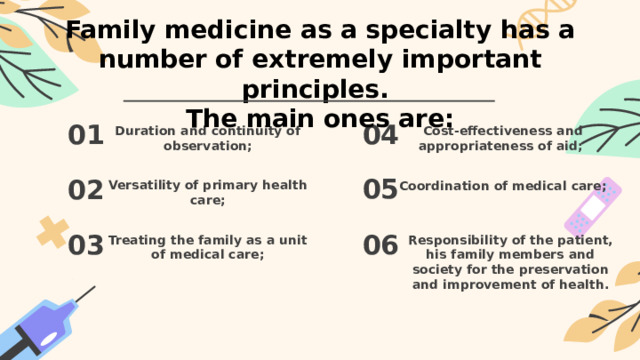
Family medicine as a specialty has a number of extremely important principles. The main ones are:
01
04
Duration and continuity of observation;
Cost-effectiveness and appropriateness of aid;
05
02
Versatility of primary health care;
Coordination of medical care;
06
03
Treating the family as a unit of medical care;
Responsibility of the patient, his family members and society for the preservation and improvement of health.

United States Public Health Service
- United States Public Health Service - united States Federal Executive Office.
- Foundation date may 4, 1980
- The main goal of the event is to protect the health of all Americans.
- Main Division - State Health Service

- Health and Social Sciences Research
- Disease Prevention, Including Immunization Services
- Ensuring the safety of food and medicine
- Medicare (health insurance for the elderly and disabled) and Medicaid (health insurance for people with low income)
- Information technology in healthcare
- Financial assistance and services for low-income families
- Improving maternal and child health, including a Nurse Home Visitation
- program to support mothers
- Head Start (early childhood education)
- Religious and community initiatives
- Preventing Child Abuse and Domestic Violence
- Treatment and prevention of drug addiction
- Services for Seniors Including Food Delivery Home
- Health Services for Native Americans
- Emergency medical training program
Social and health programs:

Hospital care is central to the medical system
There are two types of hospitals in the hospitals:
large , often run by large private corporations
small , managed by district and state authorities, religious communities or independent public organizations
They provide a certain amount of outpatient care in emergency departments and specialized clinics, but they are mainly intended to provide hospital care.
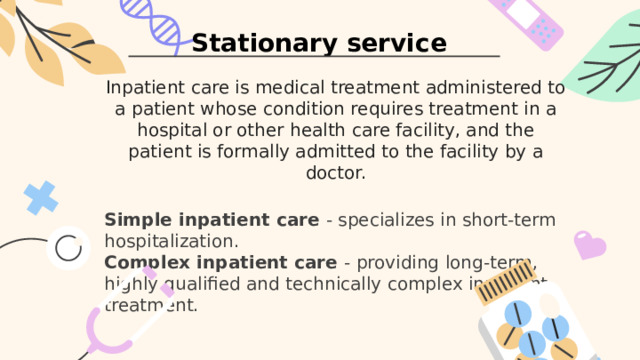
Stationary service
Inpatient care is medical treatment administered to a patient whose condition requires treatment in a hospital or other health care facility, and the patient is formally admitted to the facility by a doctor.
Simple inpatient care - specializes in short-term hospitalization.
Complex inpatient care - providing long-term, highly qualified and technically complex inpatient treatment.

Inpatient institutions include:
Inpatient structure
- hospitals,
- clinics,
- maternity hospitals,
- sanatoriums
- hospices.
- admission department,
- medical departments (therapeutic, surgical, urological, etc. - depending on the profile of the hospital),
- diagnostic department (laboratory, ultrasound, radiography, EFGDS, etc.),
- pathological department,
- catering unit,
- pharmacy,
- administrative part (administration, garage, oxygen, laundry, etc.).
There are multidisciplinary (specialized) hospitals designed to treat patients with any one disease (for example, tuberculosis). Multidisciplinary, which include departments of various profiles (for example: therapeutic, surgical, neurological, endocrinological, etc.)

Вебинар для учителей
Свидетельство об участии БЕСПЛАТНО!