Россия, Ставрополь

СДЕЛАЙТЕ СВОИ УРОКИ ЕЩЁ ЭФФЕКТИВНЕЕ, А ЖИЗНЬ СВОБОДНЕЕ
Благодаря готовым учебным материалам для работы в классе и дистанционно
Скидки до 50 % на комплекты
только до
Готовые ключевые этапы урока всегда будут у вас под рукой
Организационный момент
Проверка знаний
Объяснение материала
Закрепление изученного
Итоги урока
Была в сети 18.12.2018 15:05

Сорокина Наталья Борисовна
преподаватель иностранного языка
63 года
 3 467
3 467
 19 437
Местоположение
Holidays in Britain
Категория:
Английский язык
20.02.2017 11:06

Просмотр содержимого документа
«Holidays in Britain»
Holidays in Britain

There are official holidays in Great Britain on which people need not go to work. Some of them are named Bank Holidays due to the fact that on those days the banks and post offices are closed. They are: Christmas Day, Boxing Day, Good Friday, Easter Monday, Spring Bank Holiday and August Bank Holiday (Late Summer Bank Holiday).

Christmas Day
Christmas Day is the most popular bank holiday. It is celebrated on December 25. On Christmas Eve most cities are decorated with coloured lights across the streets and enormous Christmas trees. On this day many people go to churches, open their Christmas presents.
The turkey, pudding and cake are prepared for Christmas dinner. Many people watch the Queen’s Christmas broadcast on TV. This day is a traditional family reunion day.
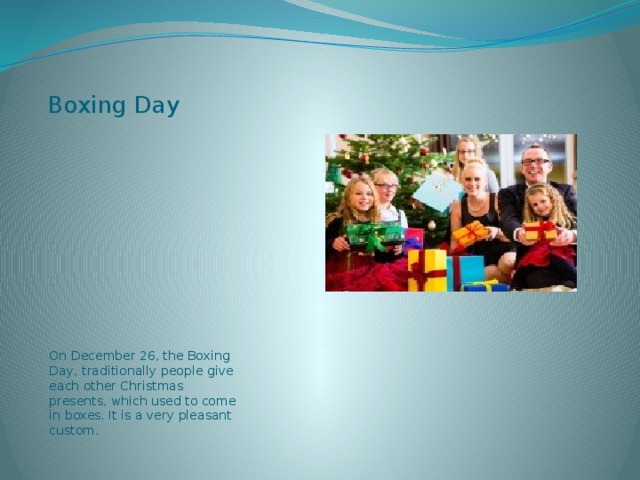
Boxing Day
On December 26, the Boxing Day, traditionally people give each other Christmas presents, which used to come in boxes. It is a very pleasant custom.
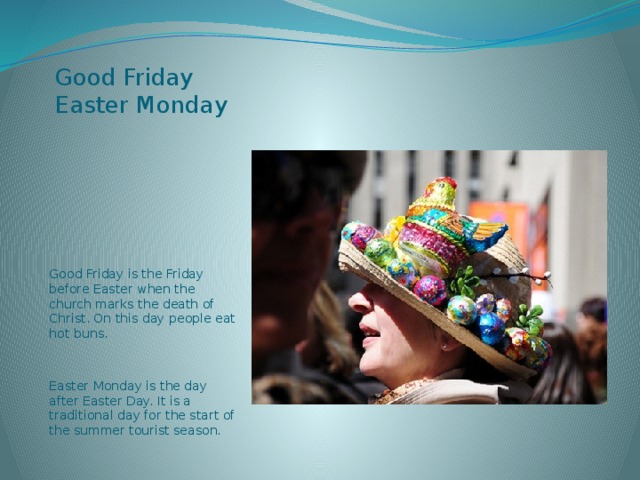
Good Friday Easter Monday
Good Friday is the Friday before Easter when the church marks the death of Christ. On this day people eat hot buns.
Easter Monday is the day after Easter Day. It is a traditional day for the start of the summer tourist season.

Spring Bank Holiday August Bank Holiday
Spring Bank Holiday is the most popular holiday, it is a 87 celebration of the coming of spring. Different outdoor events are held. It takes place on the last Monday in May.
August Bank Holiday is held on the last Monday in August.
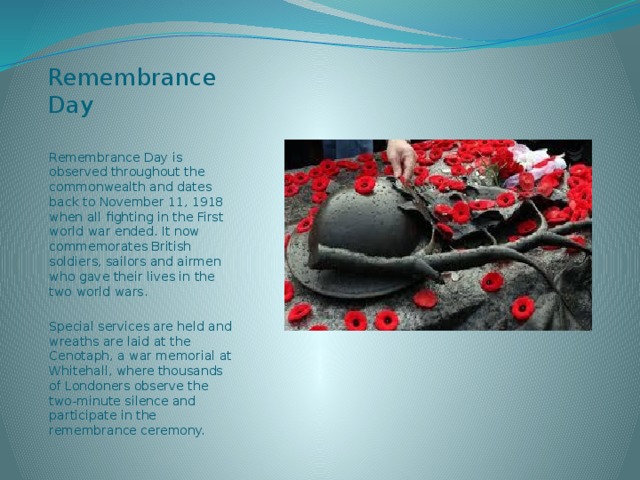
Remembrance Day
Remembrance Day is observed throughout the commonwealth and dates back to November 11, 1918 when all fighting in the First world war ended. It now commemorates British soldiers, sailors and airmen who gave their lives in the two world wars.
Special services are held and wreaths are laid at the Cenotaph, a war memorial at Whitehall, where thousands of Londoners observe the two-minute silence and participate in the remembrance ceremony.
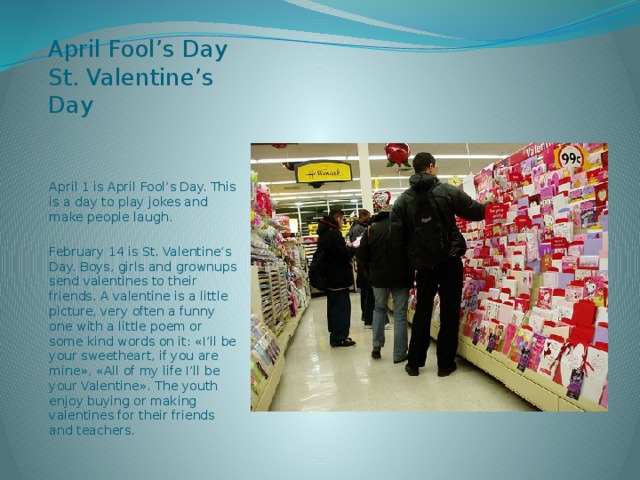
April Fool’s Day St. Valentine’s Day
April 1 is April Fool’s Day. This is a day to play jokes and make people laugh.
February 14 is St. Valentine’s Day. Boys, girls and grownups send valentines to their friends. A valentine is a little picture, very often a funny one with a little poem or some kind words on it: «I’ll be your sweetheart, if you are mine», «All of my life I’ll be your Valentine». The youth enjoy buying or making valentines for their friends and teachers.
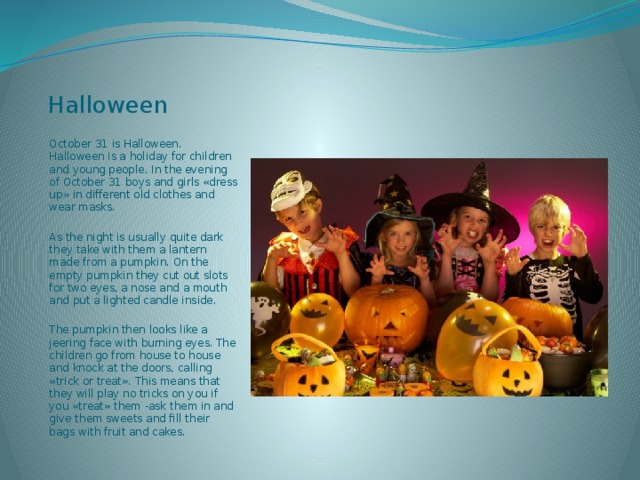
Halloween
October 31 is Halloween. Halloween is a holiday for children and young people. In the evening of October 31 boys and girls «dress up» in different old clothes and wear masks.
As the night is usually quite dark they take with them a lantern made from a pumpkin. On the empty pumpkin they cut out slots for two eyes, a nose and a mouth and put a lighted candle inside.
The pumpkin then looks like a jeering face with burning eyes. The children go from house to house and knock at the doors, calling «trick or treat». This means that they will play no tricks on you if you «treat» them -ask them in and give them sweets and fill their bags with fruit and cakes.
Guy Fawkes’s Day
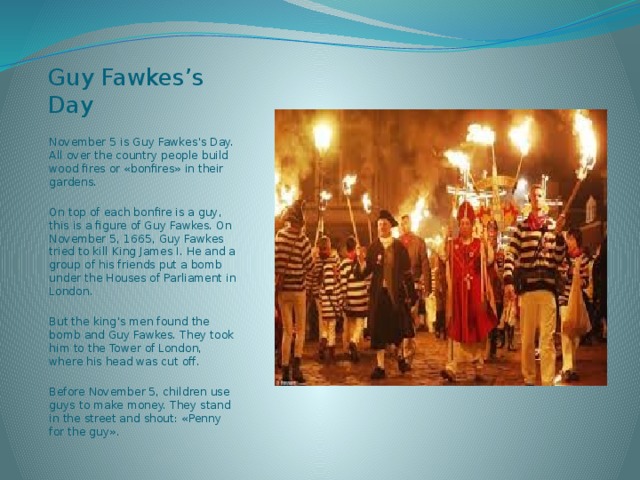
November 5 is Guy Fawkes’s Day. All over the country people build wood fires or «bonfires» in their gardens.
On top of each bonfire is a guy, this is a figure of Guy Fawkes. On November 5, 1665, Guy Fawkes tried to kill King James I. He and a group of his friends put a bomb under the Houses of Parliament in London.
But the king’s men found the bomb and Guy Fawkes. They took him to the Tower of London, where his head was cut off.
Before November 5, children use guys to make money. They stand in the street and shout: «Penny for the guy».





Вебинар для учителей
Свидетельство об участии БЕСПЛАТНО!