Казахстан, Алматы

СДЕЛАЙТЕ СВОИ УРОКИ ЕЩЁ ЭФФЕКТИВНЕЕ, А ЖИЗНЬ СВОБОДНЕЕ
Благодаря готовым учебным материалам для работы в классе и дистанционно
Скидки до 50 % на комплекты
только до
Готовые ключевые этапы урока всегда будут у вас под рукой
Организационный момент
Проверка знаний
Объяснение материала
Закрепление изученного
Итоги урока
Была в сети 24.04.2018 09:59

Ажитаева Динара Маратовна
учитель английского языка
 3 159
3 159
 22 032
Местоположение
Hononymes and its classification
Категория:
Английский язык
24.04.2018 09:44

Просмотр содержимого документа
«Hononymes and its classification»

Homonyms

- Definition of Homonymy
- Diachronic Study of Homonymy and Sources of Homonyms
- Homonyms treated synchronically
- Classification of homonyms
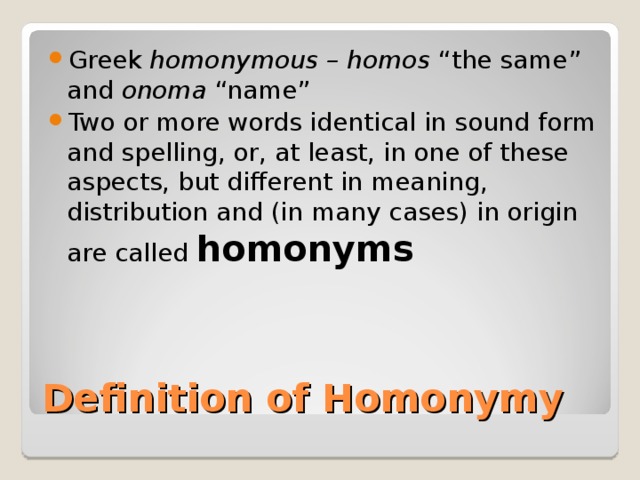
- Greek homonymous – homos “the same” and onoma “name”
- Two or more words identical in sound form and spelling, or, at least, in one of these aspects, but different in meaning, distribution and (in many cases) in origin are called homonyms
Definition of Homonymy

- monosyllabic character of the language
- analytic structure of English
- predominance of free forms in English
- high-developed polysemy
Reasons for intense development of homonyms in English

- Convergent development of sound form
- Divergent meaning development
Sources of Homonymy

- two or more words which were pronounced differently at an earlier date develop identical sound forms
- e.g. OE з emane “common”
mean
OE manen “think”
Convergent development of sound form (phonetic changes)

- different meanings of the same word move so far away from each other that they come to be regarded as two separate units
chest “large box”
e.g. OE cest
chest “part of human body”
Divergent semantic development (split polysemy)

- shortening
e.g. fan – “an implement for waving lightly to produce a cool current of air”
fan fanatic
- sound-imitation
e.g. bang – “a loud, sudden, explosive sound
bang – “a fringe of hair combed over the forehead”
Other Sources of Homonymy

- borrowings
e.g. bank – “a shore” – a native word
bank – “a financial institution” - an Italian borrowing
Other Sources of Homonymy

- the criteria distinguishing homonymy from polysemy
- the formulation of rules for recognizing different meanings of homonyms in terms of their distribution
Synchronic Approach to Homonymy

- Semantic criterion of related and unrelated meanings – connections between the various meanings are apprehended by speakers or not apprehended
Homonymy and Polysemy
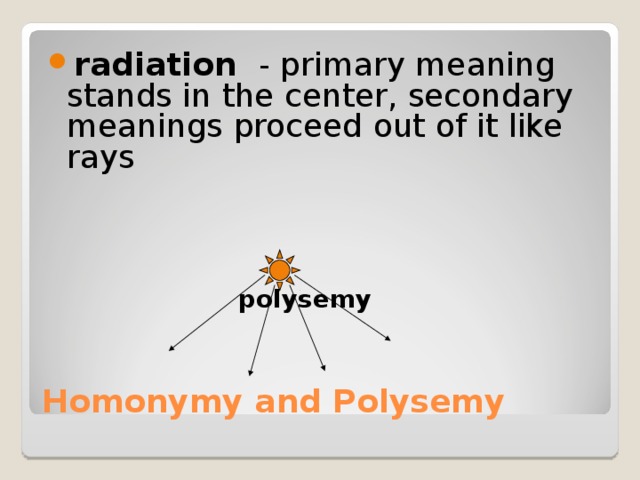
- radiation - primary meaning stands in the center, secondary meanings proceed out of it like rays
polysemy
Homonymy and Polysemy

- concatenation – secondary meanings develop like a chain. It is difficult to trace some meanings to the primary one.
homonymy
Homonymy and Polysemy

- homonyms differ in their syntactic function
e.g. I think that this “that” is a conjunction but that that “that” that that man used was a pronoun.
Distribution Criterion

- full homonyms
- partial homonyms
Professor A. I. Smirnitsky’s Classification of Homonyms

- words which represent the same category of parts of speech and have the same paradigm
- have the same spelling an pronunciation
- e.g. match – a game, a contest
match – a short piece of wood for producing fire
Full homonyms

- simple lexico-grammatical partial homonyms
- belong to the same part of speech
- their paradigms have only one identical form
- it is never the same form
Partial homonyms

- e.g. to found , verb
found , verb (Past Ind., Past. Part. of to find )
- e.g. to lay , verb
lay , verb (Past Ind. of to lie )
Simple lexico-grammatical partial homonyms

2. Complex lexico-grammatical partial homonyms
- belong to different parts of speech
- have one identical form in their paradigms
e.g. rose , noun
rose , verb (Pat Ind. of to rise )
e.g. one , numeral
won , verb (Past Ind., Past Part. of to win )
Partial homonyms

3. Partial lexical homonyms
- belong to the same part of speech
- identical only in corresponding forms of their paradigms
e.g. to lie (lay, lain), verb
to lie (lied, lied ), verb
e.g. to can (canned, canned)
(I) can (could)
Partial homonyms
- homonyms proper – words identical in pronunciation and spelling
e.g. a ball (a sphere) – a ball (a dancing party)
- homophones – words of the same sound form but different in spelling
e.g. sent (Past Inf., Past Part. of to send) – scent - cent
Walter Skeat’s classification of Homonyms
![homographes – words have the same spelling but different sound form e.g. to bow [ b аu] , verb – bow [ b əu] , noun to tear [ te ə] , verb – tear [ ti ə] , noun Walter Skeat’s classification of Homonyms](https://static.multiurok.ru/multiurok/html/2018/04/24/s_5aded1a2cb2d7/img21.jpg)
- homographes – words have the same spelling but different sound form
e.g. to bow [ b аu] , verb – bow [ b əu] , noun
to tear [ te ə] , verb – tear [ ti ə] , noun
Walter Skeat’s classification of Homonyms

1. full homonyms – words belonging to the same part of speech and having the same paradigms
e.g. a seal ( тюлень) – a seal ( печать)
2 . partial homonyms – word-forms belonging to different parts of speech
e.g. a seal – to seal
Classification of Homonyms by R.S. Ginzburg

- lexical homonyms – words that differ in their lexical meaning but identical in their grammatical meaning
e.g. a seal ( тюлень) – a seal ( печать)
Classification of homonyms according to their meaning

- lexico-grammatical homonyms – belong to different parts of speech and have different lexical and grammatical meanings
e.g. a seal - to seal
Classification of homonyms according to their meaning

- grammatical homonyms – different word-forms of one and the same word are identical
e.g. a seal – seals – seal’s – seals’
Classification of homonyms according to their meaning
Вебинар для учителей
Свидетельство об участии БЕСПЛАТНО!