Россия, Санкт-Петербург


СДЕЛАЙТЕ СВОИ УРОКИ ЕЩЁ ЭФФЕКТИВНЕЕ, А ЖИЗНЬ СВОБОДНЕЕ
Благодаря готовым учебным материалам для работы в классе и дистанционно
Скидки до 50 % на комплекты
только до
Готовые ключевые этапы урока всегда будут у вас под рукой
Организационный момент
Проверка знаний
Объяснение материала
Закрепление изученного
Итоги урока

Была в сети 07.03.2020 00:00

Трубицына Татьяна Михайловна
учитель английского языка
 597
597
 96 935
Местоположение
Специализация
Imperial Porcelain Factory
Категория:
Английский язык
10.06.2016 00:03

Просмотр содержимого документа
«Imperial Porcelain Factory»
National Treasure IMPERIAL PORCELAIN FACTORY
Students: Basil Kornishov
Ivan Grigoryev
School: 667
Form: 8v
Teacher: Trubitsina T.M.
Saint Petersburg
Nevsky district
Project: Looking at the world out of my window
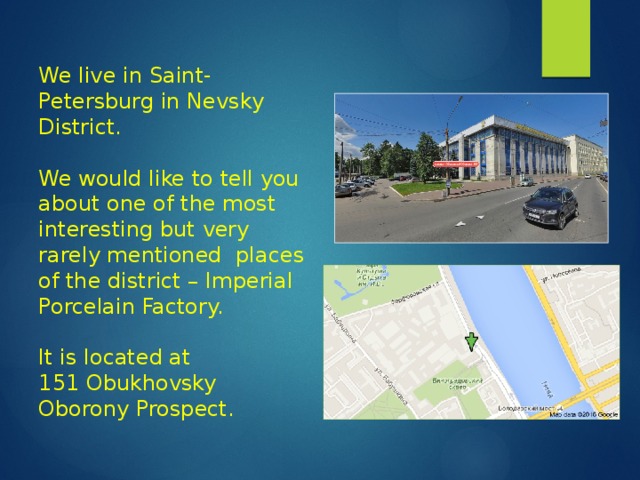
We live in Saint-Petersburg in Nevsky District.
We would like to tell you about one of the most interesting but very rarely mentioned places of the district – Imperial Porcelain Factory.
It is located at
151 Obukhovsky Oborony Prospect.

18 th CENTURY
Russian porcelain factory was founded in 1744 by Empress Elizabeth, the daughter of Peter the Great.
Russian scientist Dmitry Vinogradov discovered the secret of making porcelain and developed the technology for its manufacture.

Dmitry Vinogradov used local raw materials - Gzel clays and Olonets quartz and alabaster.
The factory belonged to the House of Romanov and it produced tableware and other porcelain pieces only for Russian Tsar court.
18 th CENTURY
Only a few pieces of the Vinogradov period have survived and are today of great historical value.
19 th CENTURY
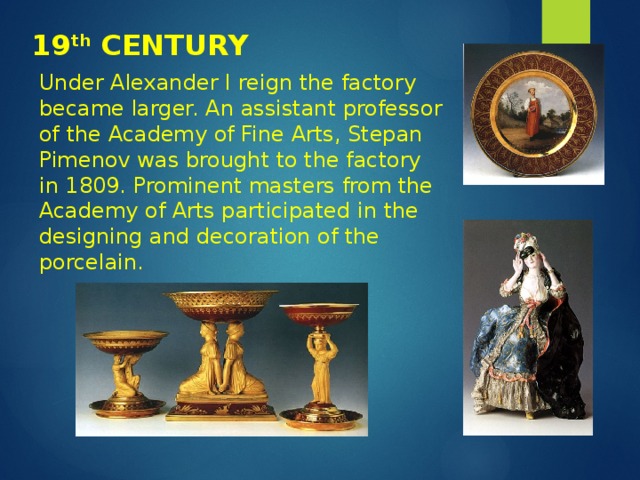
Under Alexander I reign the factory became larger. An assistant professor of the Academy of Fine Arts, Stepan Pimenov was brought to the factory in 1809. Prominent masters from the Academy of Arts participated in the designing and decoration of the porcelain.

19 th CENTURY
Stepan Pimenov designed the Guryevski service , which was typical for Empire style and consisted of 4500 items. Several kilograms of gold were used for decoration. This palace service is a glorification of the multinational Russian empire. The decoration was modeled on sketches of Moscow and Petersburg, views of suburbs, the martial scenes and scenes from the life of the capital.
20 th CENTURY
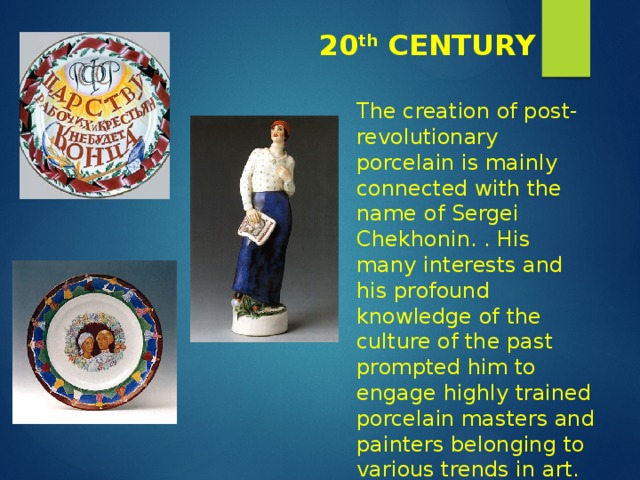
The creation of post-revolutionary porcelain is mainly connected with the name of Sergei Chekhonin. . His many interests and his profound knowledge of the culture of the past prompted him to engage highly trained porcelain masters and painters belonging to various trends in art.
20 th CENTURY
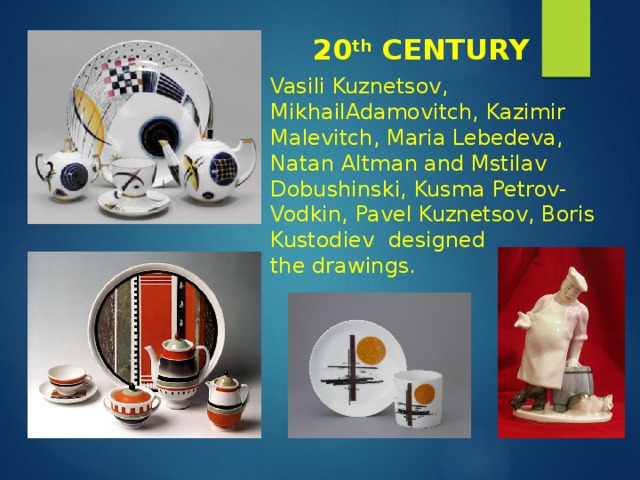
Vasili Kuznetsov, MikhailAdamovitch, Kazimir Malevitch, Maria Lebedeva, Natan Altman and Mstilav Dobushinski, Kusma Petrov-Vodkin, Pavel Kuznetsov, Boris Kustodiev designed
the drawings.
20 th CENTURY
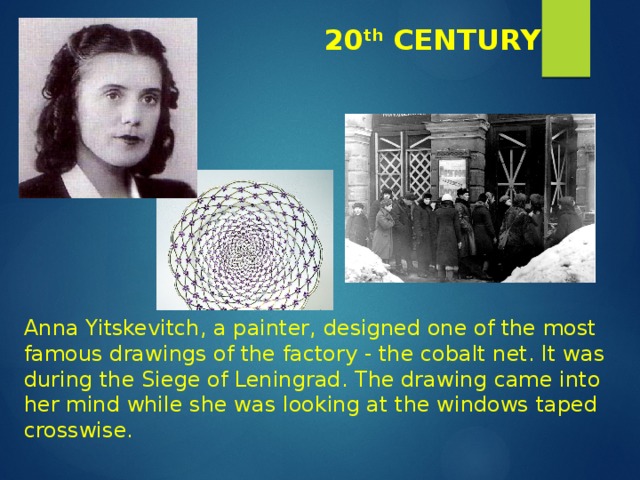
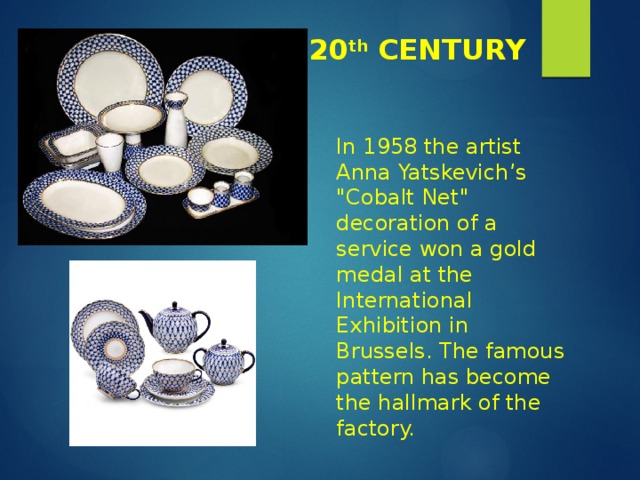
Anna Yitskevitch, a painter, designed one of the most famous drawings of the factory - the cobalt net. It was during the Siege of Leningrad. The drawing came into her mind while she was looking at the windows taped crosswise.
20 th CENTURY
In 1958 the artist Anna Yatskevich’s "Cobalt Net" decoration of a service won a gold medal at the International Exhibition in Brussels. The famous pattern has become the hallmark of the factory.

21st CENTURY
The Factory produces a varied assortment of porcelain ware - tea and coffee services of different shapes and decor, vases, sculptures, and all kinds of souvenirs. Up to 500 items are simultaneously in production.

21st CENTURY
Porcelain items with "LFZ" trademark are well-known in 30 counties; they are exported into Belgium, Canada, Denmark, England, Finland, France, Germany, Holland, Japan, Italy, USA and others.

THANK YOU FOR YOUR ATTENTION




Вебинар для учителей
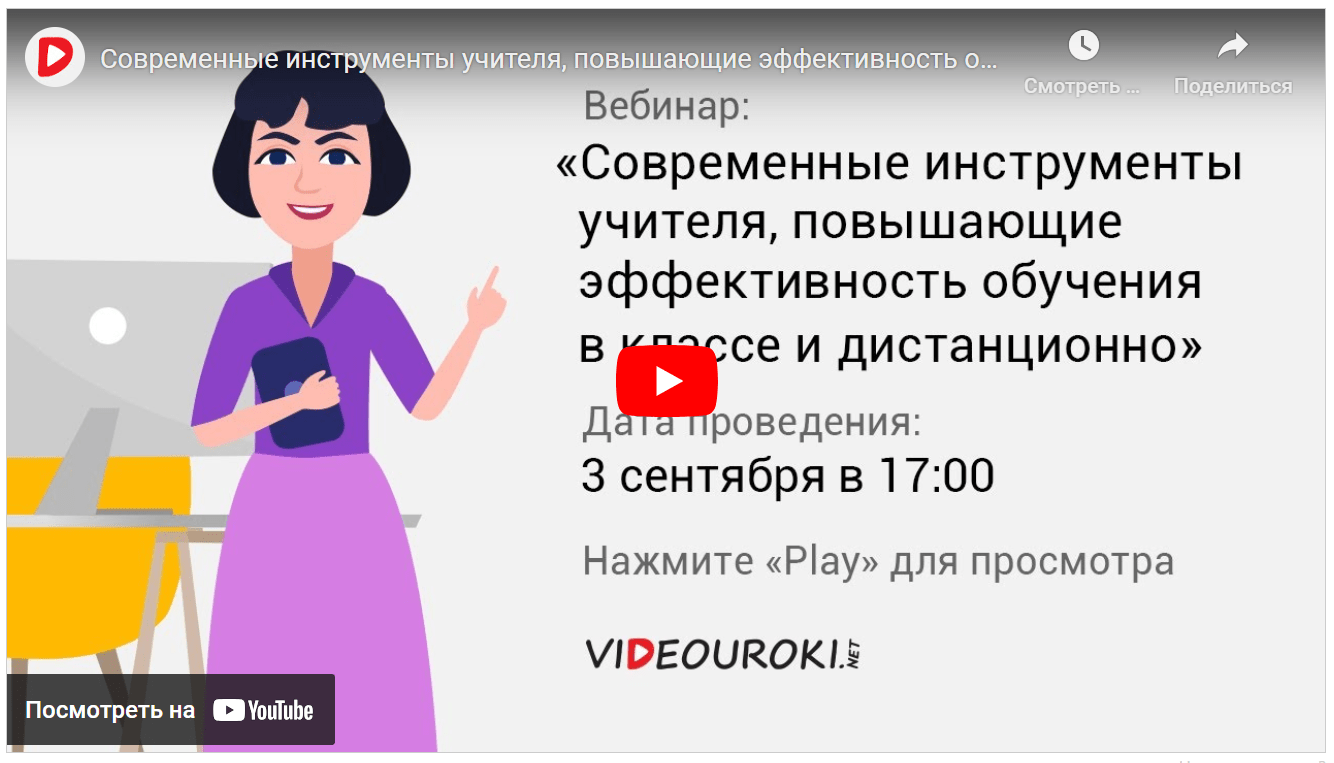
Свидетельство об участии БЕСПЛАТНО!