Украина, Донецк

СДЕЛАЙТЕ СВОИ УРОКИ ЕЩЁ ЭФФЕКТИВНЕЕ, А ЖИЗНЬ СВОБОДНЕЕ
Благодаря готовым учебным материалам для работы в классе и дистанционно
Скидки до 50 % на комплекты
только до
Готовые ключевые этапы урока всегда будут у вас под рукой
Организационный момент
Проверка знаний
Объяснение материала
Закрепление изученного
Итоги урока
Была в сети 16.02.2022 10:31

Иеговская Наталья Константиновна
Учитель английского языка
64 года
 4 868
4 868
 12 883
Местоположение
Специализация
Инструкции к урокам 2a и 2b Модуля 2 Spotlight 7 для ДО
Категория:
Английский язык
09.12.2021 20:19

Просмотр содержимого документа
«Инструкции к урокам 2a и 2b Модуля 2 Spotlight 7 для ДО»
Module 2: “Tale Time”
Units 2a and 2b
(уроки № и в 7-А и 7-Б классах
What is Module 2 about? Module page (p. 15). Work through the pictures
- Open your books at page 15. Let’s work through the illustrations.
- Look at picture 1. What page is the picture from?
- Can you guess who this man is?
- Look at picture 2. What page is the picture from?
- What do you expect to read about in the text?
- Look at picture 3. What page is the picture from?
- Is the story illustrated by this picture about real or imaginary events?
What is Module 2 about? Module page (p. 15). Check your answers
- Let’s check your answers.
- Picture 1 is from page 23.
- This man is Oscar Wilde.
- Picture 2 is from page 20.
- We expect to read about some strange and scary events.
- Picture 3 is from page 18.
- The story illustrated by this picture is about imaginary events.
What is Module 2 about? Module page (p. 15). Work through the content
- Let’s find the page numbers for the things in the list:
- an extract from a short story a quote an illustrated story a quiz
- an extract from a short story
- a quote
- an illustrated story
- a quiz
- Do it as quickly as you can.
- Consult WL2 page of your book for the words you don’t understand.
4
What is Module 2 about? Module page (p. 15). Check your answers
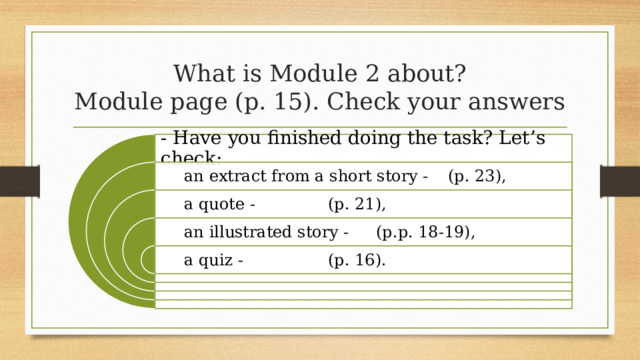
- Have you finished doing the task? Let’s check:
an extract from a short story - (p. 23),
a quote - (p. 21),
an illustrated story - (p.p. 18-19),
a quiz - (p. 16).
5
What are we going to learn, read and talk about?
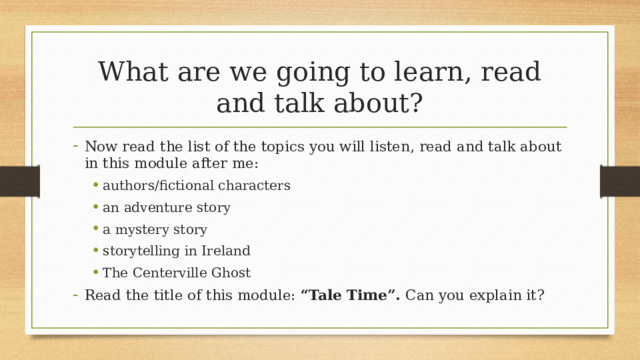
- Now read the list of the topics you will listen, read and talk about in this module after me:
- authors/fictional characters an adventure story a mystery story storytelling in Ireland The Centerville Ghost
- authors/fictional characters
- an adventure story
- a mystery story
- storytelling in Ireland
- The Centerville Ghost
- Read the title of this module: “Tale Time”. Can you explain it?
5
What skills are we going to acquire? What are we going to practice?
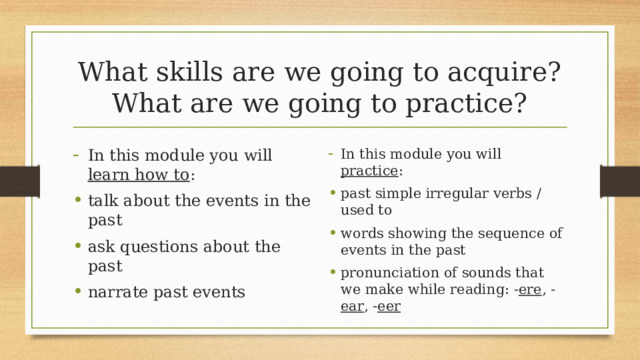
- In this module you will learn how to :
- talk about the events in the past
- ask questions about the past
- narrate past events
- In this module you will practice :
- past simple irregular verbs / used to
- words showing the sequence of events in the past
- pronunciation of sounds that we make while reading: - ere , - ear , - eer
5
Unit 2a: “Bookworms” Who are they?
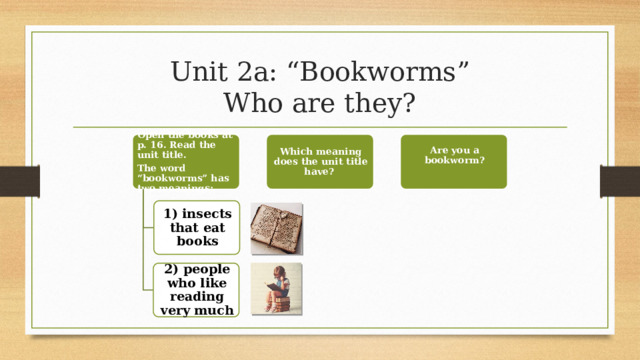
Open the books at p. 16. Read the unit title.
Which meaning does the unit title have?
Are you a bookworm?
The word “bookworms” has two meanings:
1) insects that eat books
2) people who like reading very much
8
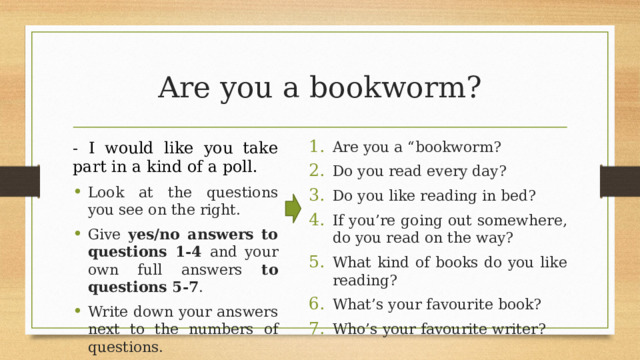
Are you a bookworm?
- I would like you take part in a kind of a poll.
- Are you a “bookworm?
- Do you read every day?
- Do you like reading in bed?
- If you’re going out somewhere, do you read on the way?
- What kind of books do you like reading?
- What’s your favourite book?
- Who’s your favourite writer?
- Look at the questions you see on the right.
- Give yes/no answers to questions 1-4 and your own full answers to questions 5-7 .
- Write down your answers next to the numbers of questions.
8
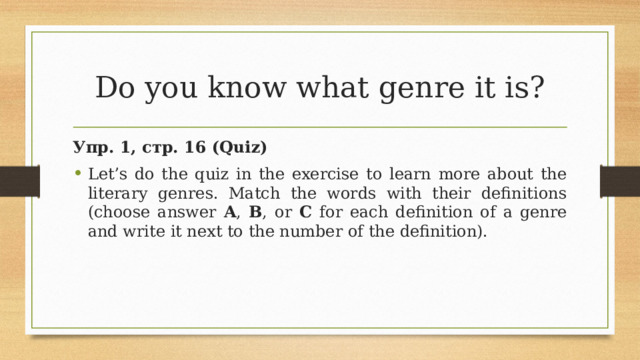
Do you know what genre it is?
Упр. 1, стр. 16 (Quiz)
- Let’s do the quiz in the exercise to learn more about the literary genres. Match the words with their definitions (choose answer A , B , or C for each definition of a genre and write it next to the number of the definition).
8
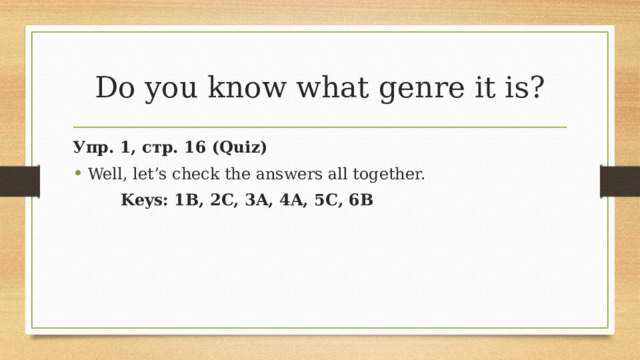
Do you know what genre it is?
Упр. 1, стр. 16 (Quiz)
- Well, let’s check the answers all together.
Keys: 1B, 2C, 3A, 4A, 5C, 6B
8
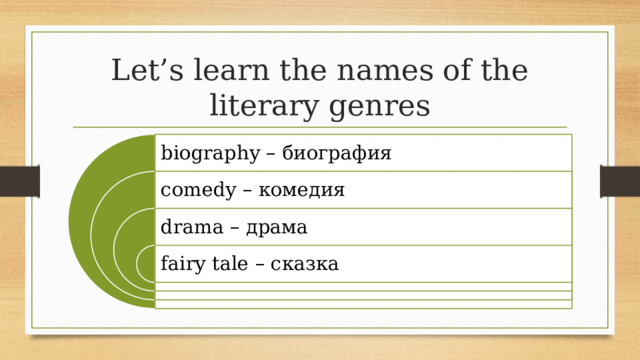
Let’s learn the names of the literary genres
biography – биография
comedy – комедия
drama – драма
fairy tale – сказка
12
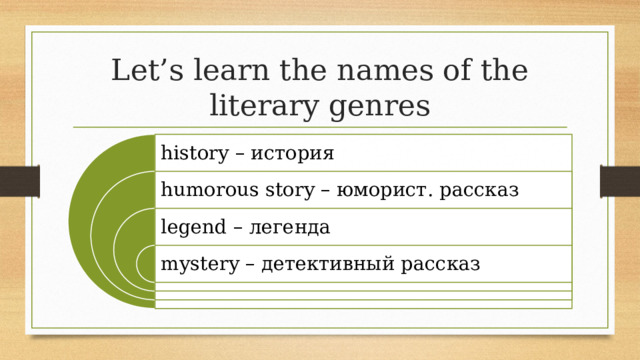
Let’s learn the names of the literary genres
history – история
humorous story – юморист. рассказ
legend – легенда
mystery – детективный рассказ
13
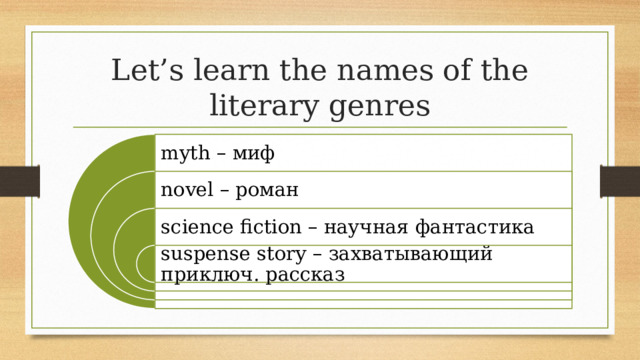
Let’s learn the names of the literary genres
myth – миф
novel – роман
science fiction – научная фантастика
suspense story – захватывающий приключ. рассказ
14
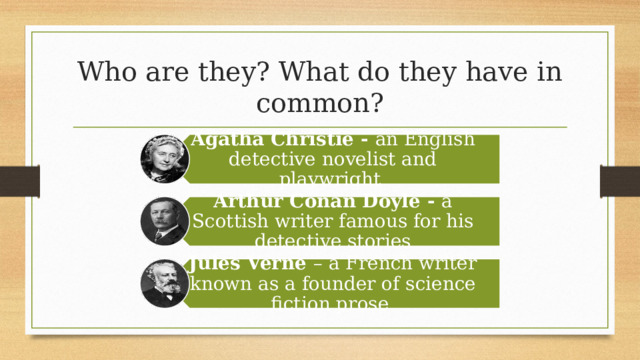
Agatha Christie - an English detective novelist and playwright
Arthur Conan Doyle - a Scottish writer famous for his detective stories
Jules Verne – a French writer known as a founder of science fiction prose
Who are they? What do they have in common?
15
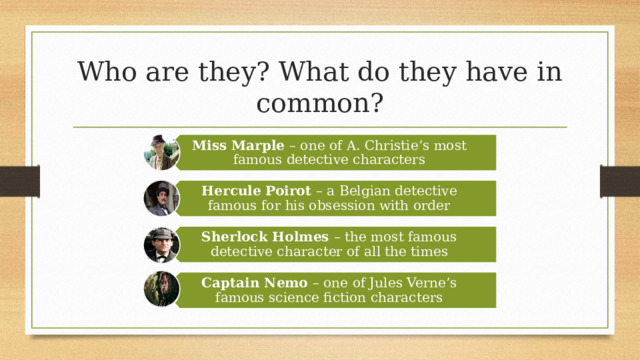
Miss Marple – one of A. Christie’s most famous detective characters
Hercule Poirot – a Belgian detective famous for his obsession with order
Sherlock Holmes – the most famous detective character of all the times
Captain Nemo – one of Jules Verne’s famous science fiction characters
Who are they? What do they have in common?
16
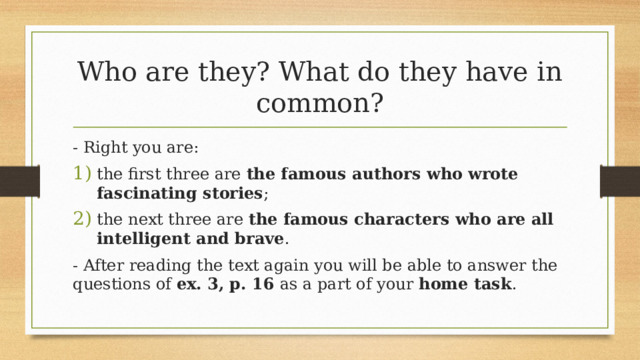
Who are they? What do they have in common?
- Right you are:
- the first three are the famous authors who wrote fascinating stories ;
- the next three are the famous characters who are all intelligent and brave .
- After reading the text again you will be able to answer the questions of ex. 3, p. 16 as a part of your home task .
16
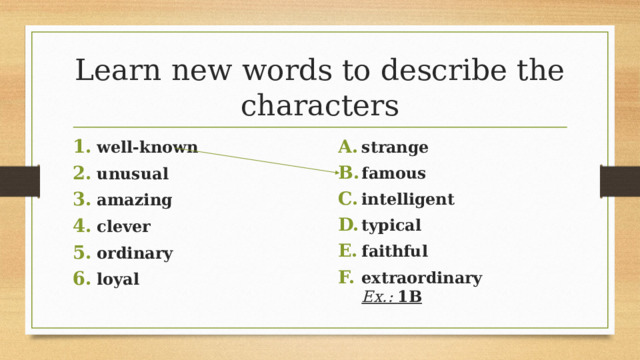
Learn new words to describe the characters
- strange
- famous
- intelligent
- typical
- faithful
- extraordinary Ex.: 1B
- well-known
- unusual
- amazing
- clever
- ordinary
- loyal
16
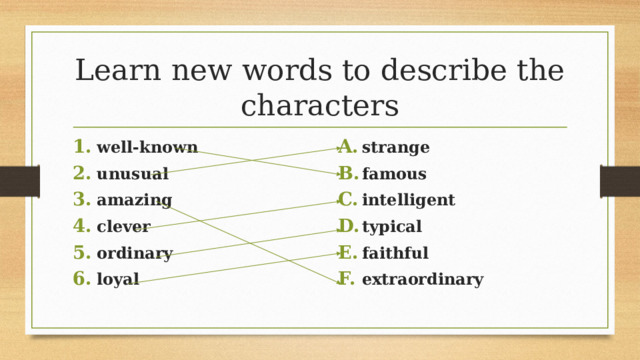
Learn new words to describe the characters
- strange
- famous
- intelligent
- typical
- faithful
- extraordinary
- well-known
- unusual
- amazing
- clever
- ordinary
- loyal
16
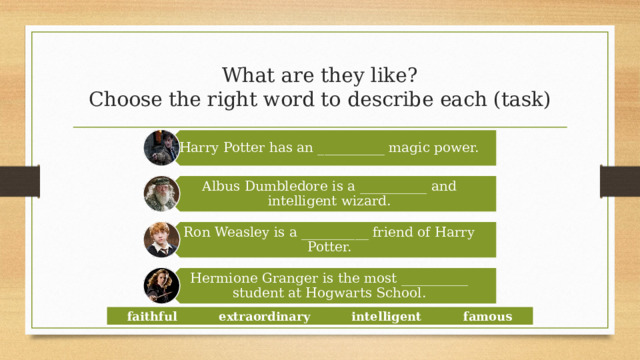
Harry Potter has an __________ magic power.
Albus Dumbledore is a __________ and intelligent wizard.
Ron Weasley is a __________ friend of Harry Potter.
Hermione Granger is the most __________ student at Hogwarts School.
What are they like? Choose the right word to describe each (task)
faithful extraordinary intelligent famous
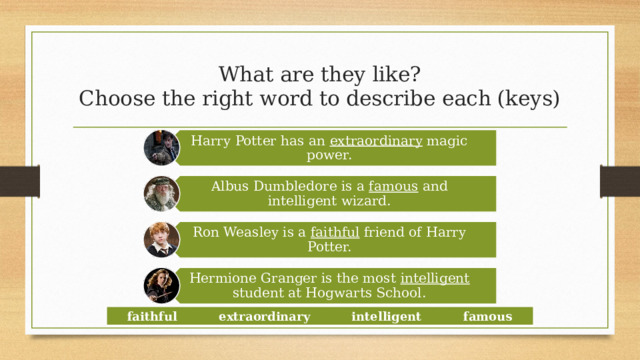
Harry Potter has an extraordinary magic power.
Albus Dumbledore is a famous and intelligent wizard.
Ron Weasley is a faithful friend of Harry Potter.
Hermione Granger is the most intelligent student at Hogwarts School.
What are they like? Choose the right word to describe each (keys)
faithful extraordinary intelligent famous
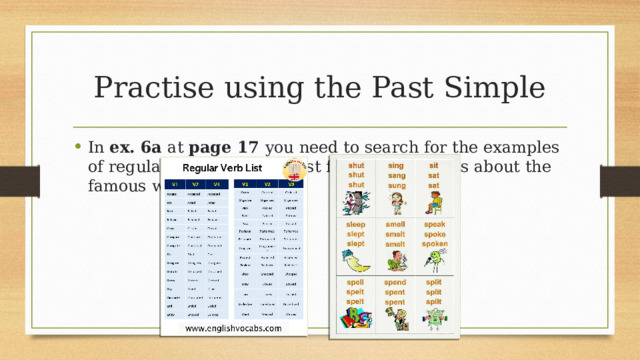
Practise using the Past Simple
- In ex. 6a at page 17 you need to search for the examples of regular and irregular past forms in the texts about the famous writers.
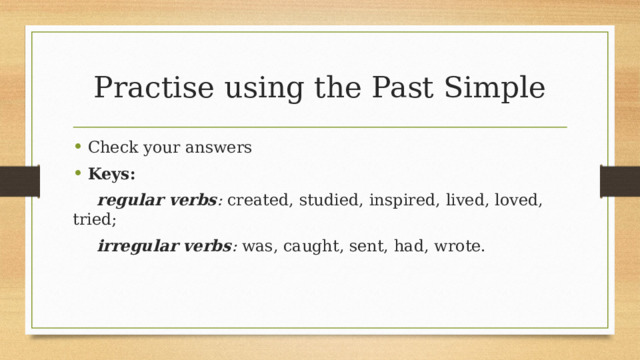
Practise using the Past Simple
- Check your answers
- Keys:
regular verbs : created, studied, inspired, lived, loved, tried;
irregular verbs : was, caught, sent, had, wrote.
![Revise how Past Simple forms of regular verbs are used in positive, negative and interrogative sentences (GR2 in your books) Утверждение Ед. Ч. I play[ed] Отрицание Вопрос I didn’t play[ ] He play[ed] Did I play[ ]? She play[ed] He didn’t play[ ] It play[ed] Мн. Ч. She didn’t play[ ] Did he play[ ]? Did she play[ ]? We play[ed] It didn’t play[ ] Did it play[ ]? We didn’t play[ ] You play[ed] Did we play[ ]? They play[ed] You didn’t play[ ] Did you play[ ]? They didn’t play[ ] Did they play[ ]?](https://static.multiurok.ru/multiurok/html/2021/12/09/s_61b23886d755d/img23.jpg)
Revise how Past Simple forms of regular verbs are used in positive, negative and interrogative sentences (GR2 in your books)
Утверждение
Ед. Ч.
I play[ed]
Отрицание
Вопрос
I didn’t play[ ]
He play[ed]
Did I play[ ]?
She play[ed]
He didn’t play[ ]
It play[ed]
Мн. Ч.
She didn’t play[ ]
Did he play[ ]?
Did she play[ ]?
We play[ed]
It didn’t play[ ]
Did it play[ ]?
We didn’t play[ ]
You play[ed]
Did we play[ ]?
They play[ed]
You didn’t play[ ]
Did you play[ ]?
They didn’t play[ ]
Did they play[ ]?
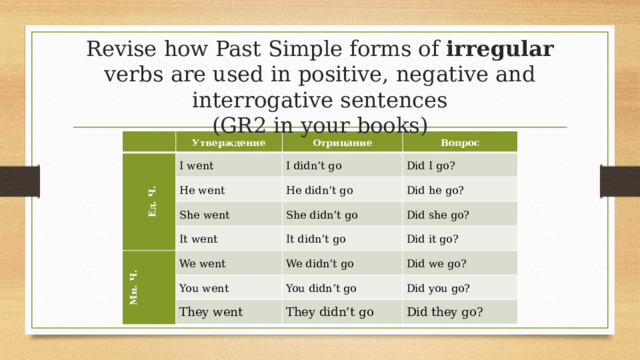
Revise how Past Simple forms of irregular verbs are used in positive, negative and interrogative sentences (GR2 in your books)
Утверждение
Ед. Ч.
I went
Отрицание
Вопрос
I didn’t go
He went
She went
Did I go?
He didn’t go
Did he go?
She didn’t go
It went
Мн. Ч.
We went
Did she go?
It didn’t go
Did it go?
We didn’t go
You went
Did we go?
They went
You didn’t go
Did you go?
They didn’t go
Did they go?
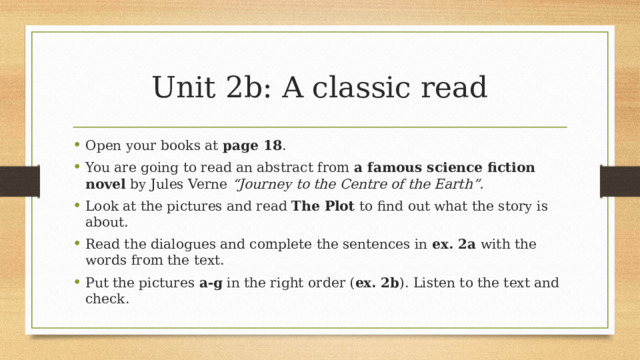
Unit 2b: A classic read
- Open your books at page 18 .
- You are going to read an abstract from a famous science fiction novel by Jules Verne “Journey to the Centre of the Earth”.
- Look at the pictures and read The Plot to find out what the story is about.
- Read the dialogues and complete the sentences in ex. 2a with the words from the text.
- Put the pictures a-g in the right order ( ex. 2b ). Listen to the text and check.
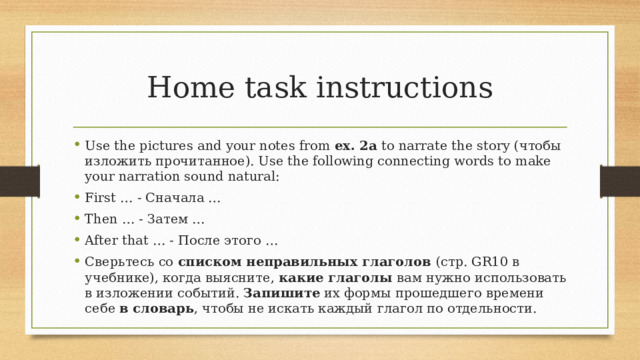
Home task instructions
- Use the pictures and your notes from ex. 2a to narrate the story (чтобы изложить прочитанное). Use the following connecting words to make your narration sound natural:
- First … - Сначала …
- Then … - Затем …
- After that … - После этого …
- Сверьтесь со списком неправильных глаголов (стр. GR10 в учебнике), когда выясните, какие глаголы вам нужно использовать в изложении событий. Запишите их формы прошедшего времени себе в словарь , чтобы не искать каждый глагол по отдельности.
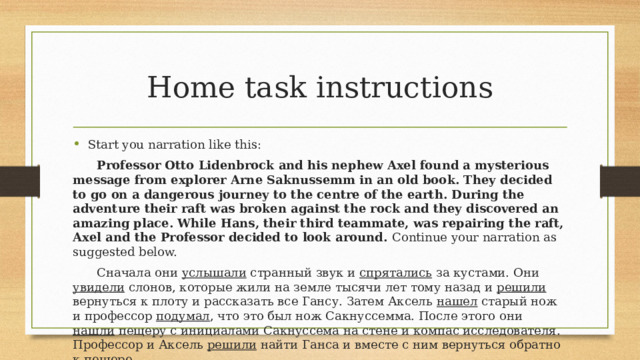
Home task instructions
- Start you narration like this:
Professor Otto Lidenbrock and his nephew Axel found a mysterious message from explorer Arne Saknussemm in an old book. They decided to go on a dangerous journey to the centre of the earth. During the adventure their raft was broken against the rock and they discovered an amazing place. While Hans, their third teammate, was repairing the raft, Axel and the Professor decided to look around. Continue your narration as suggested below.
Сначала они услышали странный звук и спрятались за кустами. Они увидели слонов, которые жили на земле тысячи лет тому назад и решили вернуться к плоту и рассказать все Гансу. Затем Аксель нашел старый нож и профессор подумал , что это был нож Сакнуссемма. После этого они нашли пещеру с инициалами Сакнуссема на стене и компас исследователя. Профессор и Аксель решили найти Ганса и вместе с ним вернуться обратно к пещере.
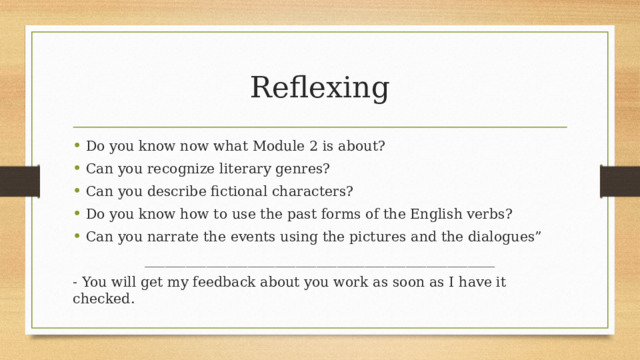
Reflexing
- Do you know now what Module 2 is about?
- Can you recognize literary genres?
- Can you describe fictional characters?
- Do you know how to use the past forms of the English verbs?
- Can you narrate the events using the pictures and the dialogues”
___________________________________________________
- You will get my feedback about you work as soon as I have it checked.
Вебинар для учителей

Свидетельство об участии БЕСПЛАТНО!