Россия, Воронеж


СДЕЛАЙТЕ СВОИ УРОКИ ЕЩЁ ЭФФЕКТИВНЕЕ, А ЖИЗНЬ СВОБОДНЕЕ
Благодаря готовым учебным материалам для работы в классе и дистанционно
Скидки до 50 % на комплекты
только до
Готовые ключевые этапы урока всегда будут у вас под рукой
Организационный момент
Проверка знаний
Объяснение материала
Закрепление изученного
Итоги урока

Был в сети 29.06.2020 15:30

Ермаков Сергей Алексеевич
преподаватель английского языка
58 лет
 1 791
1 791
 39 209
Местоположение
Специализация
Internal combustion engine.
Категория:
Английский язык
16.02.2019 10:51

Просмотр содержимого документа
«Internal combustion engine.»
INTERNAL COMBUSTION ENGINE
Ермаков Сергей Алексеевич
ГБПОУ ВО ВПТ
For about a hundred years throughout the world the main power unit on cars and motorcycles, tractors and combines, other equipment is an internal combustion engine. Coming in the early twentieth century to replace the external combustion engines (steam), he and the twenty-first century remains the most cost-effective type of motor. In this article we will consider in detail the device, the principle of operation of different types of ICE and its main auxiliary systems.
DEFINITION AND GENERAL FEATURES OF THE OPERATION OF THE INTERNAL COMBUSTION ENGINE
The main feature of any internal combustion engine is that the fuel is ignited directly inside its working chamber, and not in additional external carriers. During operation, the chemical and thermal energy from the combustion of fuel is converted into mechanical work. The principle of operation of the internal combustion engine is based on the physical effect of thermal expansion of gases, which is formed during the combustion of the fuel-air mixture under pressure inside the engine cylinders.
CLASSIFICATION OF INTERNAL COMBUSTION ENGINES
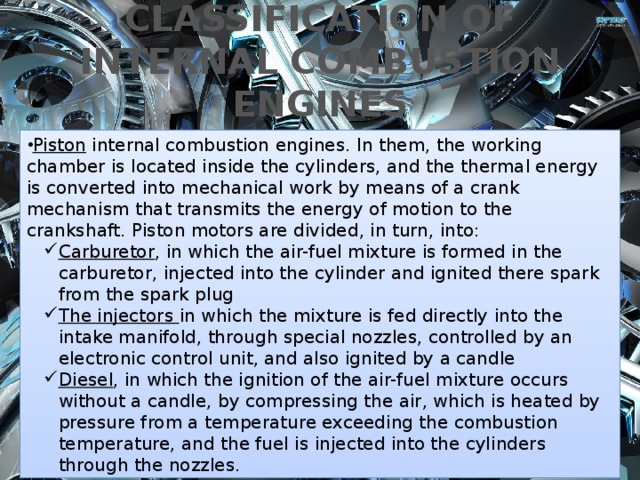
- Piston internal combustion engines. In them, the working chamber is located inside the cylinders, and the thermal energy is converted into mechanical work by means of a crank mechanism that transmits the energy of motion to the crankshaft. Piston motors are divided, in turn, into:
- Carburetor , in which the air-fuel mixture is formed in the carburetor, injected into the cylinder and ignited there spark from the spark plug The injectors in which the mixture is fed directly into the intake manifold, through special nozzles, controlled by an electronic control unit, and also ignited by a candle Diesel , in which the ignition of the air-fuel mixture occurs without a candle, by compressing the air, which is heated by pressure from a temperature exceeding the combustion temperature, and the fuel is injected into the cylinders through the nozzles.
- Carburetor , in which the air-fuel mixture is formed in the carburetor, injected into the cylinder and ignited there spark from the spark plug
- The injectors in which the mixture is fed directly into the intake manifold, through special nozzles, controlled by an electronic control unit, and also ignited by a candle
- Diesel , in which the ignition of the air-fuel mixture occurs without a candle, by compressing the air, which is heated by pressure from a temperature exceeding the combustion temperature, and the fuel is injected into the cylinders through the nozzles.
CLASSIFICATION OF INTERNAL COMBUSTION ENGINES
- Piston internal combustion engines. In them, the working chamber is located inside the cylinders, and the thermal energy is converted into mechanical work by means of a crank mechanism that transmits the energy of motion to the crankshaft. Piston motors are divided, in turn, into:
- Carburetor , in which the air-fuel mixture is formed in the carburetor, injected into the cylinder and ignited there spark from the spark plug The injectors in which the mixture is fed directly into the intake manifold, through special nozzles, controlled by an electronic control unit, and also ignited by a candle Diesel , in which the ignition of the air-fuel mixture occurs without a candle, by compressing the air, which is heated by pressure from a temperature exceeding the combustion temperature, and the fuel is injected into the cylinders through the nozzles.
- Carburetor , in which the air-fuel mixture is formed in the carburetor, injected into the cylinder and ignited there spark from the spark plug
- The injectors in which the mixture is fed directly into the intake manifold, through special nozzles, controlled by an electronic control unit, and also ignited by a candle
- Diesel , in which the ignition of the air-fuel mixture occurs without a candle, by compressing the air, which is heated by pressure from a temperature exceeding the combustion temperature, and the fuel is injected into the cylinders through the nozzles.
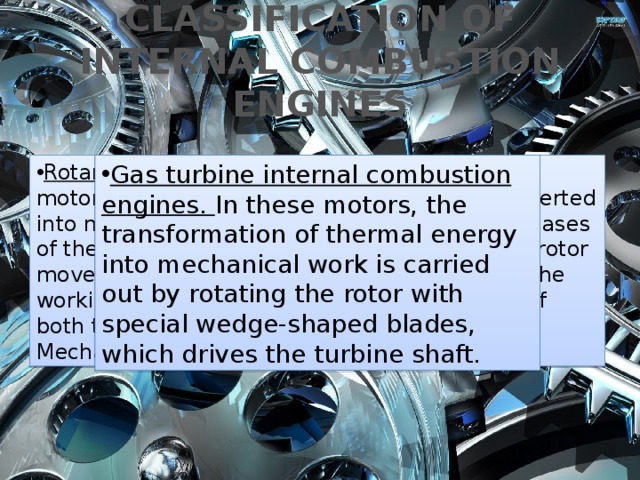
- Rotary-piston internal combustion engines . In motors of this type, the thermal energy is converted into mechanical work by rotating the working gases of the rotor of a special shape and profile. The rotor moves along the "planetary trajectory" inside the working chamber and performs the functions of both the piston and the GDM (Gas Distribution Mechanism), and the crankshaft
CLASSIFICATION OF INTERNAL COMBUSTION ENGINES
- Rotary-piston internal combustion engines . In motors of this type, the thermal energy is converted into mechanical work by rotating the working gases of the rotor of a special shape and profile. The rotor moves along the "planetary trajectory" inside the working chamber and performs the functions of both the piston and the GDM (Gas Distribution Mechanism), and the crankshaft
- Gas turbine internal combustion engines. In these motors, the transformation of thermal energy into mechanical work is carried out by rotating the rotor with special wedge-shaped blades, which drives the turbine shaft.
The device of the internal combustion engine
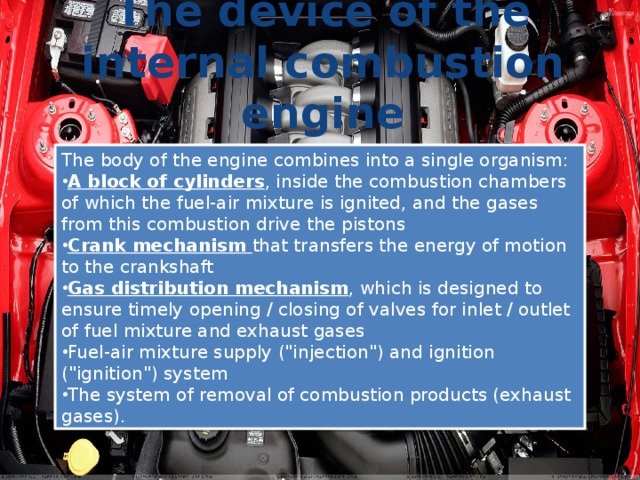
The body of the engine combines into a single organism:
- A block of cylinders , inside the combustion chambers of which the fuel-air mixture is ignited, and the gases from this combustion drive the pistons
- Crank mechanism that transfers the energy of motion to the crankshaft
- Gas distribution mechanism , which is designed to ensure timely opening / closing of valves for inlet / outlet of fuel mixture and exhaust gases
- Fuel-air mixture supply ("injection") and ignition ("ignition") system
- The system of removal of combustion products (exhaust gases).
The device of the internal combustion engine
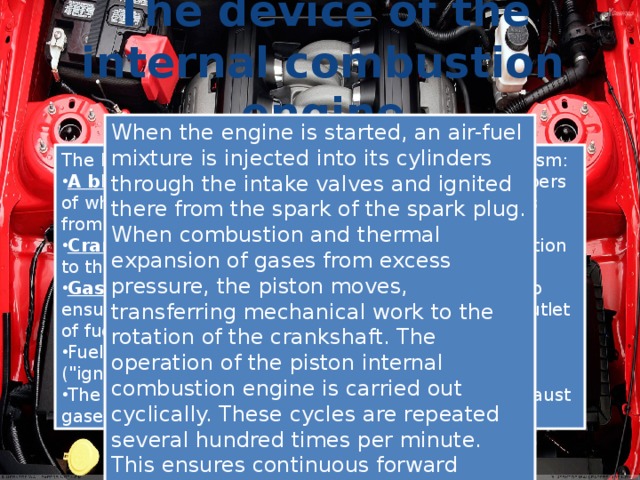
When the engine is started, an air-fuel mixture is injected into its cylinders through the intake valves and ignited there from the spark of the spark plug. When combustion and thermal expansion of gases from excess pressure, the piston moves, transferring mechanical work to the rotation of the crankshaft. The operation of the piston internal combustion engine is carried out cyclically. These cycles are repeated several hundred times per minute. This ensures continuous forward rotation of the crankshaft leaving the engine.
The body of the engine combines into a single organism:
- A block of cylinders , inside the combustion chambers of which the fuel-air mixture is ignited, and the gases from this combustion drive the pistons
- Crank mechanism that transfers the energy of motion to the crankshaft
- Gas distribution mechanism , which is designed to ensure timely opening / closing of valves for inlet / outlet of fuel mixture and exhaust gases
- Fuel-air mixture supply ("injection") and ignition ("ignition") system
- The system of removal of combustion products (exhaust gases).
The device of the internal combustion engine
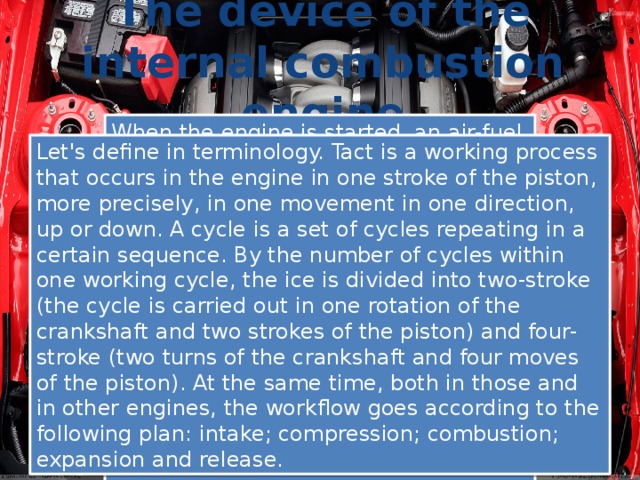
When the engine is started, an air-fuel mixture is injected into its cylinders through the intake valves and ignited there from the spark of the spark plug. When combustion and thermal expansion of gases from excess pressure, the piston moves, transferring mechanical work to the rotation of the crankshaft. The operation of the piston internal combustion engine is carried out cyclically. These cycles are repeated several hundred times per minute. This ensures continuous forward rotation of the crankshaft leaving the engine.
Let's define in terminology. Tact is a working process that occurs in the engine in one stroke of the piston, more precisely, in one movement in one direction, up or down. A cycle is a set of cycles repeating in a certain sequence. By the number of cycles within one working cycle, the ice is divided into two-stroke (the cycle is carried out in one rotation of the crankshaft and two strokes of the piston) and four-stroke (two turns of the crankshaft and four moves of the piston). At the same time, both in those and in other engines, the workflow goes according to the following plan: intake; compression; combustion; expansion and release.
PRINCIPLES OF ENGINE OPERATION
Push-pull engine
When the engine is started, the piston, carried away by the rotation of the crankshaft, is set in motion. As soon as it reaches its lower dead center and moves to the upward movement, the fuel-air mixture is fed into the combustion chamber of the cylinder.
In its upward motion, the piston compresses it. When the piston reaches its upper dead center, the spark from the electronic spark plug ignites the fuel-air mixture. Instantly expanding, vapors of burning fuel rapidly push the piston back to the bottom dead center.
At this time, the exhaust valve is opened, through which the hot exhaust gases are removed from the combustion chamber. Again passing the lower dead center, the piston resumes its movement to the upper dead center. During this time, the crankshaft makes one revolution.
PRINCIPLES OF ENGINE OPERATION
Push-pull engine
When the engine is started, the piston, carried away by the rotation of the crankshaft, is set in motion. As soon as it reaches its lower dead center and moves to the upward movement, the fuel-air mixture is fed into the combustion chamber of the cylinder.
With the new movement of the piston, the inlet channel of the fuel-air mixture opens again, which replaces the entire volume of the released exhaust gases, and the whole process is repeated again. Due to the fact that the work of the piston in such motors is limited to two cycles, it makes much less than a four-stroke engine, the number of movements for a certain unit of time. Friction losses are minimized. However, a lot of heat energy is released, and two-stroke engines are faster and more heated.
In its upward motion, the piston compresses it. When the piston reaches its upper dead center, the spark from the electronic spark plug ignites the fuel-air mixture. Instantly expanding, vapors of burning fuel rapidly push the piston back to the bottom dead center.
At this time, the exhaust valve is opened, through which the hot exhaust gases are removed from the combustion chamber. Again passing the lower dead center, the piston resumes its movement to the upper dead center. During this time, the crankshaft makes one revolution.
PRINCIPLES OF ENGINE OPERATION
Push-pull engine
With the new movement of the piston, the inlet channel of the fuel-air mixture opens again, which replaces the entire volume of the released exhaust gases, and the whole process is repeated again. Due to the fact that the work of the piston in such motors is limited to two cycles, it makes much less than a four-stroke engine, the number of movements for a certain unit of time. Friction losses are minimized. However, a lot of heat energy is released, and two-stroke engines are faster and more heated.
In two-stroke engines, the piston replaces the valve mechanism of gas distribution, during its movement at certain moments, opening and closing the working openings of the inlet and outlet in the cylinder. The worst, in comparison with the four-stroke engine, gas exchange is the main disadvantage of the two-stroke engine system. At the time of removal of exhaust gases lost a certain percentage of not only the working substance, but also power.
PRINCIPLES OF ENGINE OPERATION
Four-stroke engine
Push-pull engine
These disadvantages are devoid of four-stroke engine, which, in different versions, and are installed on almost all modern cars, tractors and other equipment. In them, the inlet/outlet of the fuel mixture / exhaust gases are carried out in the form of separate working processes, and are not combined with compression and expansion, as in two-stroke ones. With the help of a gas distribution mechanism provides mechanical synchronization of the inlet and outlet valves with the crankshaft speed. In a four-stroke engine, injection of the fuel-air mixture occurs only after complete removal of the exhaust gases and closing the exhaust valves.
In two-stroke engines, the piston replaces the valve mechanism of gas distribution, during its movement at certain moments, opening and closing the working openings of the inlet and outlet in the cylinder. The worst, in comparison with the four-stroke engine, gas exchange is the main disadvantage of the two-stroke engine system. At the time of removal of exhaust gases lost a certain percentage of not only the working substance, but also power.
PRINCIPLES OF ENGINE OPERATION
Four-stroke engine
These disadvantages are devoid of four-stroke engine, which, in different versions, and are installed on almost all modern cars, tractors and other equipment. In them, the inlet/outlet of the fuel mixture / exhaust gases are carried out in the form of separate working processes, and are not combined with compression and expansion, as in two-stroke ones. With the help of a gas distribution mechanism provides mechanical synchronization of the inlet and outlet valves with the crankshaft speed. In a four-stroke engine, injection of the fuel-air mixture occurs only after complete removal of the exhaust gases and closing the exhaust valves.
Each stroke is one stroke of the piston from the top to the bottom of the dead points. In this case, the engine passes through the following phases of operation:
The beat of the first intake . The piston moves from the top to the bottom dead center. At this time, vacuum occurs inside the cylinder, the inlet valve opens and the fuel-air mixture enters. At the end of the inlet pressure in the cylinder cavity is in the range from 0.07 to 0.095 MPa; temperature-from 80 to 120 degrees Celsius.
PRINCIPLES OF ENGINE OPERATION
Four-stroke engine
Each stroke is one stroke of the piston from the top to the bottom of the dead points. In this case, the engine passes through the following phases of operation:
The beat of the first intake . The piston moves from the top to the bottom dead center. At this time, vacuum occurs inside the cylinder, the inlet valve opens and the fuel-air mixture enters. At the end of the inlet pressure in the cylinder cavity is in the range from 0.07 to 0.095 MPa; temperature-from 80 to 120 degrees Celsius.
The beat of the second compression . When the piston moves from the bottom to the top dead point and closed inlet and outlet valve is a compression of the combustible mixture in the cavity of the cylinder. This process is accompanied by an increase in pressure to 1,2-1,7 MPa, and temperature-to 300-400 degrees Celsius.
PRINCIPLES OF ENGINE OPERATION
Four-stroke engine
The beat of the third extension . The fuel-air mixture ignites. This is accompanied by the release of a significant amount of thermal energy. The temperature in the cylinder cavity increases sharply to 2.5 thousand degrees Celsius. Under pressure, the piston moves quickly to its lower dead center. The pressure index is from 4 to 6 MPa.
The beat of the second compression . When the piston moves from the bottom to the top dead point and closed inlet and outlet valve is a compression of the combustible mixture in the cavity of the cylinder. This process is accompanied by an increase in pressure to 1,2-1,7 MPa, and temperature-to 300-400 degrees Celsius.
PRINCIPLES OF ENGINE OPERATION
Four-stroke engine
The beat fourth edition . During the reverse movement of the piston to the upper dead center, the exhaust valve opens, through which the exhaust gases are ejected from the cylinder into the exhaust pipe, and then into the environment. Indicators pressure in the final stage of the cycle is 0.1-0.12 MPa; temperature-600-900 degrees Celsius.
The beat of the third extension . The fuel-air mixture ignites. This is accompanied by the release of a significant amount of thermal energy. The temperature in the cylinder cavity increases sharply to 2.5 thousand degrees Celsius. Under pressure, the piston moves quickly to its lower dead center. The pressure index is from 4 to 6 MPa.
Thank you for viewing








Вебинар для учителей

Свидетельство об участии БЕСПЛАТНО!