


Россия, Нижний Новгород

СДЕЛАЙТЕ СВОИ УРОКИ ЕЩЁ ЭФФЕКТИВНЕЕ, А ЖИЗНЬ СВОБОДНЕЕ
Благодаря готовым учебным материалам для работы в классе и дистанционно
Скидки до 50 % на комплекты
только до
Готовые ключевые этапы урока всегда будут у вас под рукой
Организационный момент
Проверка знаний
Объяснение материала
Закрепление изученного
Итоги урока
Была в сети 16.08.2022 14:41

Кузнецова Светлана Ивановна
Преподаватель английского языка
61 год
 7 809
7 809
 7 108
7 108 
Местоположение
Специализация
INTERNET AND e-MAIL
Категория:
Английский язык
29.10.2019 19:34

Просмотр содержимого документа
«INTERNET AND e-MAIL»
INTERNET AND e-MAIL
Презентация выполнена преподавателем английского языка
«Нижегородского Губернского колледжа»
Кузнецовой Светланой Ивановной.
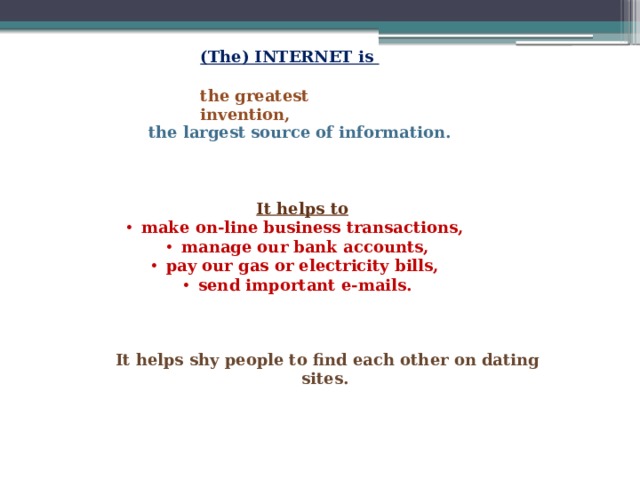
(The) INTERNET is
the greatest invention,
the largest source of information.
It helps to
- make on-line business transactions,
- manage our bank accounts,
- pay our gas or electricity bills,
- send important e-mails.
It helps shy people to find each other on dating sites.

People can
do on-line shopping choosing the desirable thing at the best price,
read about everything: science, history, psychology, sports, fashion, music, cooking and many other subjects.
download favourite movies or songs, listen to the radio,
play games, learn foreign languages.

On-line chatting through
social networking websites

Disadvantages
Some people
- date on-line,
- play games,
- over-use the net,
- become addicted to it,
- spend all days long surfing the net,
- start neglecting their families, friends, work and hobbies.

How to write the word Internet - with or without article?
Examples of using the word Internet WITHOUT article
A lot of providers, now tie you into a bundle: TV, phone and internet. Многие провайдеры предлагают комплекс «всё в одном»: ТВ, телефон и интернет.
We just have phone and internet, but that can still be
as much as £65 a month. У нас только телефон и интернет, но это все равно стоит до 65 фунтов в месяц.
Kate pays $200 a month for internet, TV and unlimited voice. Кейт платит 200 долларов в месяц за интернет, телевидение и безлимитную телефонную связь.
It takes just a few seconds to send
an instant message by e-mail.

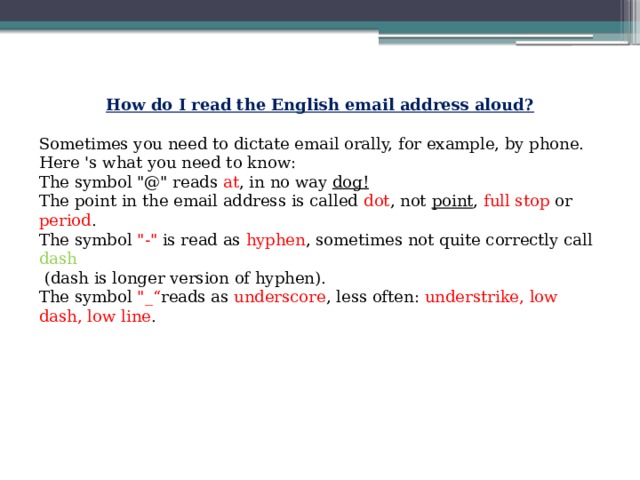
How do I read the English email address aloud?
Sometimes you need to dictate email orally, for example, by phone.
Here 's what you need to know:
The symbol "@" reads at , in no way dog!
The point in the email address is called dot , not point , full stop or period .
The symbol "-" is read as hyphen , sometimes not quite correctly call dash
(dash is longer version of hyphen).
The symbol "_“ reads as underscore , less often: understrike, low dash, low line .

support@hotmail.com – support at hotmail dot com
help-me@gmail.com – help hyphen me at gmail dot com
(gmail читается как “джи мейл”, а не “гмейл”)
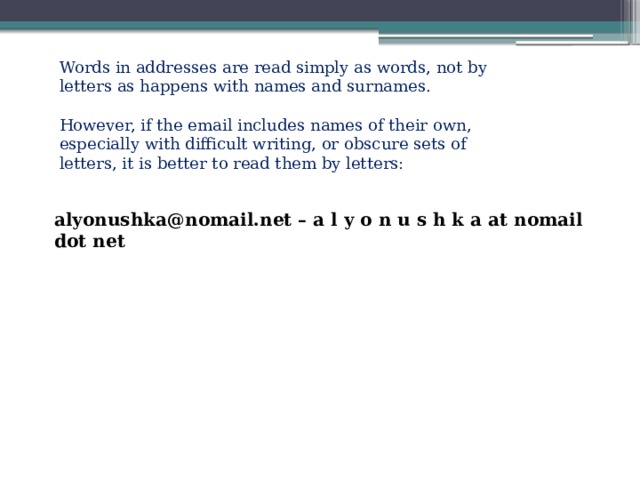
Words in addresses are read simply as words, not by letters as happens with names and surnames.
However, if the email includes names of their own, especially with difficult writing, or obscure sets of letters, it is better to read them by letters:
alyonushka@nomail.net – a l y o n u s h k a at nomail dot net

The well-known domain zones com, net, org read as a word, not in letters.
Lesser known, for example ru, usually in letters.
example_address@mail.ru
– example underscore address at mail dot r u

The main elements of the email are :
Greeting - can include a name-based contact to the addressee, if known.
Entry - if you are not familiar with the recipient of the letter, briefly introduce yourself.
The purpose of the message is to go to the case and explain why you are contacting.
Details - If necessary, mention important details. If it is assumed that the recipient of the letter must, having read it, do something (comply with the instruction, call someone, answer, forward the letter, etc.) write about it politely, but unambiguously.
Signature - the letter traditionally ends with some kind of farewell courtesy formula, your name, last name, sometimes an indication of the place of work, address and phone number, if appropriate.

Вебинар для учителей

Свидетельство об участии БЕСПЛАТНО!



