Россия, Обнинск


СДЕЛАЙТЕ СВОИ УРОКИ ЕЩЁ ЭФФЕКТИВНЕЕ, А ЖИЗНЬ СВОБОДНЕЕ
Благодаря готовым учебным материалам для работы в классе и дистанционно
Скидки до 50 % на комплекты
только до
Готовые ключевые этапы урока всегда будут у вас под рукой
Организационный момент
Проверка знаний
Объяснение материала
Закрепление изученного
Итоги урока

Была в сети 22.08.2023 20:59

Исмаилова Парвина Обиджоновна
учитель английского языка
36 лет
 1 577
1 577
 44 193
Местоположение
Специализация
История Лондона
Категория:
Английский язык
06.01.2022 22:54

Просмотр содержимого документа
«История Лондона»

Municipal Budgetary General Education Institution " Secondary General Education School No. 1
Theme of the project: “The history of London”

ОГЛАВЛЕНИЕ
Введение ..........................................................................................................3
Глава 1. История происхождения Лондона ..................................................7
1.1. Начало ...................................................................................................7
1.2. Средневековье ......................................................................................8
1.3. Викторианская эпоха ........................................................................9
.4. Новое время .......................................................................................11
Глава 2. Тайны и загадки Лондона
2.1. Лондонский камень .........................................................................12
2.2. Автобус-призрак в ингтоне ............................................................13
2.3. Саттон Хаус: дом ................................................................14
2.4. Летающая карета в Инфилде......................................................15
2.5. Монашка в Банке Англии ............................................................16
Заключение .....................................................................................17
Список использованной литературы и других источнико……8
Приложение....................................................................................
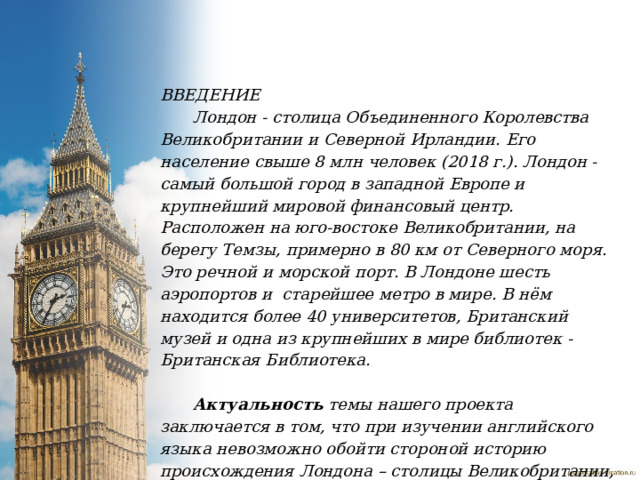
ВВЕДЕНИЕ
Лондон - столица Объединенного Королевства Великобритании и Северной Ирландии. Его население свыше 8 млн человек (2018 г.). Лондон - самый большой город в западной Европе и крупнейший мировой финансовый центр. Расположен на юго-востоке Великобритании, на берегу Темзы, примерно в 80 км от Северного моря. Это речной и морской порт. В Лондоне шесть аэропортов и старейшее метро в мире. В нём находится более 40 университетов, Британский музей и одна из крупнейших в мире библиотек - Британская Библиотека.
Актуальность темы нашего проекта заключается в том, что при изучении английского языка невозможно обойти стороной историю происхождения Лондона – столицы Великобритании, познакомиться поближе с его национальным колоритом. Поэтому наша исследовательская работа посвящена истории Лондона.
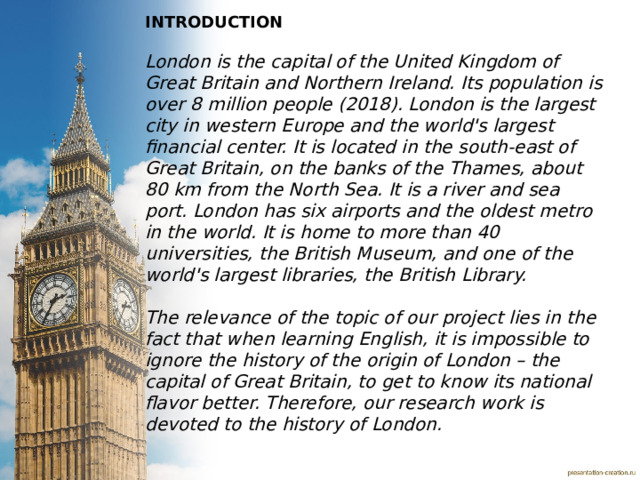
INTRODUCTION
London is the capital of the United Kingdom of Great Britain and Northern Ireland. Its population is over 8 million people (2018). London is the largest city in western Europe and the world's largest financial center. It is located in the south-east of Great Britain, on the banks of the Thames, about 80 km from the North Sea. It is a river and sea port. London has six airports and the oldest metro in the world. It is home to more than 40 universities, the British Museum, and one of the world's largest libraries, the British Library.
The relevance of the topic of our project lies in the fact that when learning English, it is impossible to ignore the history of the origin of London – the capital of Great Britain, to get to know its national flavor better. Therefore, our research work is devoted to the history of London.
Цели: изучить историю происхождения Лондона
изучить современный Лондон
изучить достопримечательности Лондона
Задачи :
1) найти и сопоставить информацию по теме из различных научно-популярных источников;
2) Систематизировать полученную
3)Проследить исторический путь от времен древних бриттов до наших дней .
4) сделать вывод, опираясь на подобранный материал.
Этапы работы над проектом:
- Планирование
- Поиск материала по интересующим темам в сети Интернет
- Анализ собранного и просмотренного материала
- Выбор иллюстраций и видеоматериалов
- Оформление презентации проекта
- Защита проекта.

Roman London
Londinium was established as civilian town by the Romans about four years after the invasion of AD 43.London like Rome was founded on the point of the river where it was narrow enough to bridge and the strategic location of the city provided easy access to much of Europe. Early Roman London occupied a relatively small area roughly equivalent to the size of Hyde Park. In around AD 60, it was destroyed by the lceni led by their queen Boudica.The city was quickly rebuilt as a panned Roman town and recovered after perhaps 10 years; the city grew rapidly over the following decades.
During the 2 nd century Londinium was at its height and replaced Colchester as the capital of Roman Britain (Britannia). Its population was around 60,000 inhabitants. It boasted major public buildings, including the largest basilica north of the Alps, temples, bath houses an amphitheatre and a large fort for the city garrison. Political instability and recession from the 3 rd century onwards led to a decline.
Viking attacks dominated most of the 9 th century, becoming increasingly common from around 830onwards. London was sacked in 842 and again in 851. The Danish «Great Heathen Army” which had rampaged across England since 865, wintered in London 871. The city remained in Danish hands until886, when it was captured by the forces of King Alfred the Great of Wessex and reincorporated into Mercia, then governed under Alfred’s sovereignty by his son-in-law Ealdorman Ethelred.
Around the time the focus of settlement moved within the old Roman walls for the sake of defense, and the city become known as Lundenburh. The Roman walls were repaired and the defensive ditch re-cut, while the bridge was probably rebuilt at this time.
From this point, the City of London began to develop its own unique local government.
The Normans advanced to the south bank of the Thames opposite London, where they defeated an English attack and burned Southwark but where unable to storm the bridge Thames. Having occupied London, William was crowned king in Westminster Abbey.

William the Conqueror
William the Conqueror was the first Norman king of England reigning from 1066 until his death in 1087. The rest of his life was marked by struggles to consolidate his hold over England and his continental lands and by difficulties with his eldest son.
In the 1050 s and early 1060s William became a contender for the throne of England, then held by the childless Edward the Confessor, his first cousin once removed. William’s final years were marked by difficulties in his continental domains, trouble s with his eldest son. William died in September 1087 while leading a campaign in northern French, and was buried in Caen. His reign in England was marked by the construction of castle the settling of a new Norman nobility on the land, and change in the composition of the English clergy.

London bridge
London bridge is two thousand years old. The first bridge was of wood. Then people built the bridge of stone and called it London Bridge. There were houses and shops on it and people paid money when they crossed bridge.
In 1831 a new bridge rose on the place of the first bridge. But the city grew very quickly and in 1960 the people wanted to build a large new bridge at that place.
A very rich American bought the old London bridge as people buy old things. He wanted to show the old bridge in America to people for money. The people of London liked their old bridge. But the city needed money for the new bridge.
The American brought the parts of the bridge on a ship to Arizona in the USA. Workers built the old bridge but there was no river under it now, only a street. No ships pass under it now, only walk along the street and look at the old bridge. In 1973 the new London Bridge was opened on the site of the old bridge over the Thames.

«IN SIXTEEN HUNDRED AND SIXTY-SIX, OLD LONDON BURNED LIKE ROTTEN STICKS.»
In 1666,London was a city just waiting to burn. A long, hot summer had just come to an end, and the wood-built city was bone dry. On the evening of Saturday,1 st September ,Thomas Farynor, baker of King Charles II, went to bed without properly putting out the fire in one of his ovens. Sometime after 1:00 am on Sunday morning, a speak from the fires embers ignited some straw on the bakery floor. Flames quickly engulfed the house in Pudding Lane. Neighbours attempted to put out the fire, but the flames were too fierce. The fire began to spread.
By early morning, three hundred houses were on fire and winds from the fire to spread with frightening speed. Over the next three days and nights, the fire raged out of control. It took until the evening of Wednesday, 5 th September, when the strong winds finally died down, to bring the fire under control. When the fire was totally extinguished on Thursday,6 th September, five-sixths of the heart of the city had been destroyed. Over 13,000 houses,87churches and 4 bridges, along with many important buildings, such as St Paul’s Cathedral, were gone. Astonishingly, however, it is though that fewer than ten people died in the blaze!
If you visit London today, you can see a tall column – called The see a tall column- called The Monument –commemorating the Great Fire.


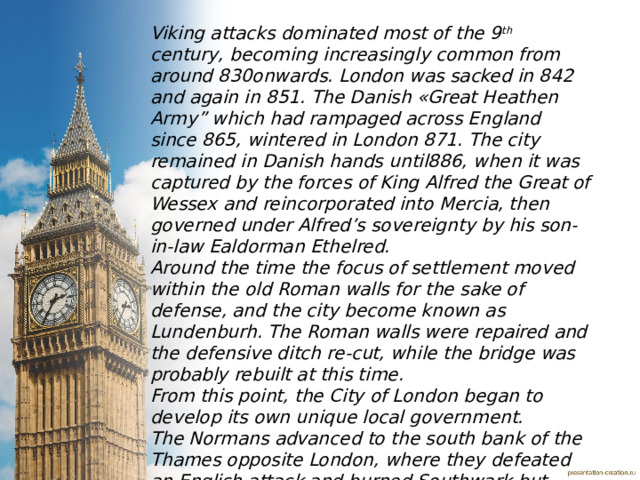
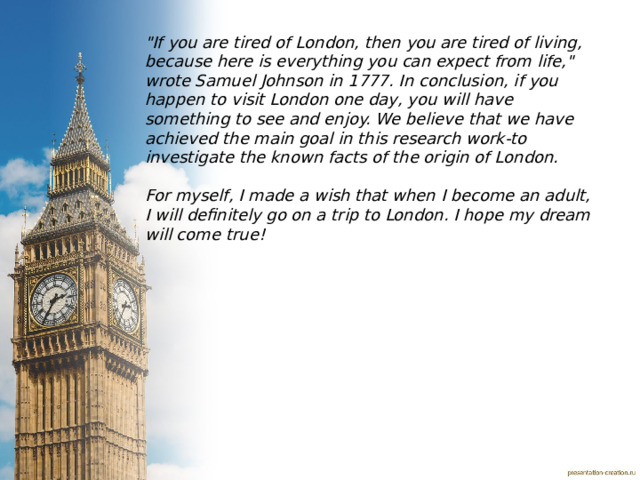
1.THE BIG BEN
The world-known clock. Every day about 500 tourists come to London to see the Big Ben. Built in 1858,it was named after an architect whose name was BEN(Benjamin).The interesting fact is that you are not allowed to get inside the Big Ben if you aren’t an Englishman. No tourists allowed.

2.MADAM TUSSAUD’S MUSEUM
The most famous museum of waxworks. It presents all famous people from singes and actors to Prime Ministers and Presidents .All the waxworks are such a good a quality , that sometimes you can mistake them for a real person.

3.PICCADILLY CIRCUS
The place is far from what is called “a circus”.it is a well-known meeting point of the city. It has become so popular, that is now considered to be a place to visit for all the tourist

4.LONDON EYE
It is one of the biggest observation wheels in the world. Its height is 135meters. It was 32 cabins which symbolize 32districts of London. It take 30 minutes to make a full circle. But it is the view you will never forget . The cost is about 20pounds.

5. LONDON NATIONAL GALLERY
The gallery has more than 2000works of would- known artists of 13-20 centuries. You can spend the whole day there and it will not be enough. What is interesting, is that the gallery is free for everyone.

6.PARKS OF LONDON
London is famous for its parks. Combined, all these parks cover more land than the Principality of Monaco. The most well-known is the HYDE Park. It is traditional place of Festivals and celebration
7.ST.PAUIS CATHEBRAL
It was built on the highest point of London 300 years ago. It is the London Bishops residence and is the most popular place of visit. The price of visit is 16.
8.THE HOUSES OF PARLIAMENT
The official name is Palace of Westminster . It includes more than 1,100rooms more than a hundred starts and about 5 kilometers of corridors. House of Commons and the House of Lords (two traditional chambers ) are located here. Nowadays anyone can visit the Houses of Parliament and even attend the session. You have to register by phone and go through special registration procedure.

9.THE THAMES The longest and most famous river in the UK which the British often call the « Father Thames». In 1894 Tower Bridge was opened, and in 2012 a modern cableway was built over it. Popular tourist activities are river excursions and water-bus or boat trips. Every year one can watch here the boat race between Oxford and Cambridge universities.
ЗАКЛЮЧЕНИЕ
Так, в ходе моей работы был обозначен путь развития Лондона. Причины возникновения города были установлены. В связи с этим можно еще раз повторить, что важнейшим фактором возникновения столицы Великобритании по праву можно считать близость реки Темзы. Наличие водных путей позволяло ускоренными темпами налаживать отношения с соседями, а значит, и развивать торговлю. Постепенно Лондон превратился из кельтского поселения в римский город, который уже в Средние века занял прочное место среди крупнейших городов страны, а выгодное расположение давало ему право претендовать на роль столицы Великобритании. Лондон - "уникальная жемчужина в сокровищнице мировой цивилизации", "столица мира", "город чудес", как восторженно писал Герберт Уэллс, "самый интересный, самый красивый, самый удивительный город в мире". Отражение огней в сумеречной глади Темзы и звон башенных часов, чарующий пар над чашкой свежего чая и вечнозеленый ковер плетеных газонов — грандиозный оазис жизни. "Если вы устали от Лондона, значит, вы устали от жизни, потому что здесь есть все, что вы можете ожидать от жизни", - писал Сэмюэл Джонсон в 1777 году. В заключение, если вам случится однажды посетить Лондон, вам будет на что посмотреть и чем насладиться. Мы считаем, что достигли главной цели в этой исследовательской работе-исследовать известные факты происхождения Лондона. Для себя я загадала, что, когда стану взрослой, обязательно отправлюсь в путешествие в Лондон. Я надеюсь, что моя мечта сбудется!

CONCLUSION
So, in the course of my work, the path of development of London was marked. The causes of the city were established. In this regard, we can once again repeat that the most important factor in the emergence of the capital of Great Britain can rightly be considered the proximity of the River Thames. The presence of waterways made it possible to establish relations with neighbors at an accelerated pace, and therefore to develop trade. Gradually, London turned from a Celtic settlement into a Roman city, which already in the Middle Ages took a strong place among the largest cities in the country, and the favorable location gave it the right to claim the role of the capital of Great Britain.
London is "a unique jewel in the treasury of world civilization", "the capital of the world", "a miracle city", as H. G. Wells enthusiastically wrote, "the most interesting, most beautiful, most amazing city in the world". The reflection of the lights in the twilight surface of the Thames and the ringing of the tower clock, the enchanting steam over a cup of fresh tea and the evergreen carpet of woven lawns — a grand oasis of life
"If you are tired of London, then you are tired of living, because here is everything you can expect from life," wrote Samuel Johnson in 1777. In conclusion, if you happen to visit London one day, you will have something to see and enjoy. We believe that we have achieved the main goal in this research work-to investigate the known facts of the origin of London.
For myself, I made a wish that when I become an adult, I will definitely go on a trip to London. I hope my dream will come true!

Literature and other resources:
- Clout Hugh. History of London.- 2002.
- Bernard Oudin. London. Biography of London. - 2009.
- Catherine Couty. Great Britain. Land of castles, palaces and parks. - 2012.
- Andrew Duncan. Secrets of London. Walking in the past of the British capital. Travel guide. - 2010.
- https://www.o-london.ru/history.php
- http://www.spletnik.ru/blogs/govoryat_chto/43269_londonskie_prizraki
http://tourism-london.ru/putevoditel-po-londonu/156-istoriya-londona.html
Комплекты видеоуроков для учителей








Скачать
© 2022, Исмаилова Парвина Обиджоновна 1104 1
Похожие файлы
Вебинар для учителей

Свидетельство об участии БЕСПЛАТНО!