Россия, Улан-Удэ

СДЕЛАЙТЕ СВОИ УРОКИ ЕЩЁ ЭФФЕКТИВНЕЕ, А ЖИЗНЬ СВОБОДНЕЕ
Благодаря готовым учебным материалам для работы в классе и дистанционно
Скидки до 50 % на комплекты
только до
Готовые ключевые этапы урока всегда будут у вас под рукой
Организационный момент
Проверка знаний
Объяснение материала
Закрепление изученного
Итоги урока
Была в сети 23.12.2024 10:41

Банзарова Туяна Алексеевна
учитель английского языка
52 года
 473
473
 110 776
Местоположение
Специализация
Лекция 1. Social Emotional Learning профессора Дженифер Айдэм
Категория:
Английский язык
12.12.2024 14:05

Просмотр содержимого документа
«Лекция 1. Social Emotional Learning профессора Дженифер Айдэм»
Social Emotional Learning:
Self- Care for Stronger Teachers
February 8, 2024 Dr. Jennifer Eidum
Associate Professor of English, Elon University English Language Specialist

What is Social- Emotional Learning?
“ SEL is the process through which all young people and adults acquire and apply the knowledge, skills, and attitudes to develop healthy identities, manage emotions and achieve personal and collective goals, feel and show empathy for others, establish and maintain supportive relationships, and make responsible and caring decisions”
- Collaborative for Academic, Social, and Emotional Learning (CASEL)
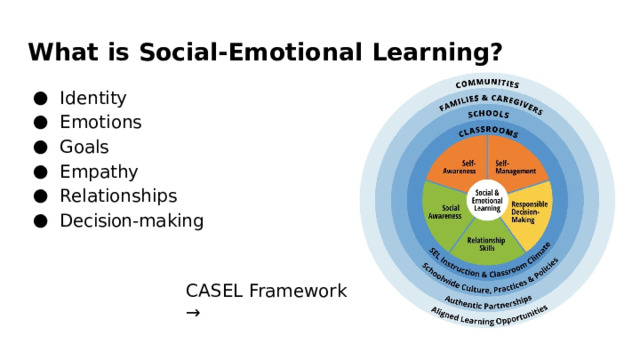
What is Social- Emotional Learning?
- Identity
- Emotions
- Goals
- Empathy
- Relationships
- Decision- making
CASEL Framework →
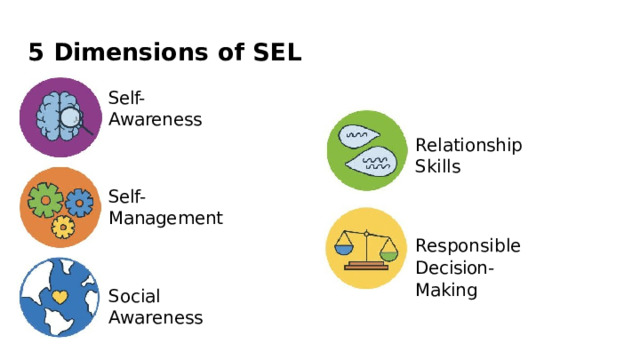
5 Dimensions of SEL
Self- Awareness
Relationship Skills
Self- Management
Responsible Decision- Making
Social Awareness
Why Social- Emotional Learning?
Why Social- Emotional Learning?
- Students are increasingly culturally and linguistically diverse .
- Instability is the norm (climate change, pandemics, etc.).
- Our communities are facing significant socio- economic divides.
→ In Russia, the Urban - Rural divide significantly impacts student outcomes (Pinskaya et al., 2019).
- Teachers & researchers have increased awareness of
social- emotional needs of students.

Why Social- Emotional Learning?
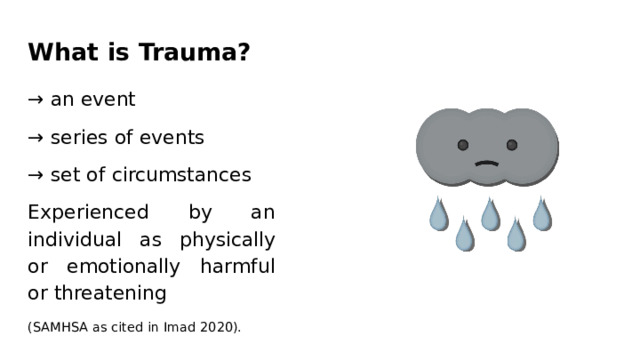
What is Trauma?
→ an event
→ series of events
→ set of circumstances
Experienced by an individual as physically or emotionally harmful or threatening
(SAMHSA as cited in Imad 2020).
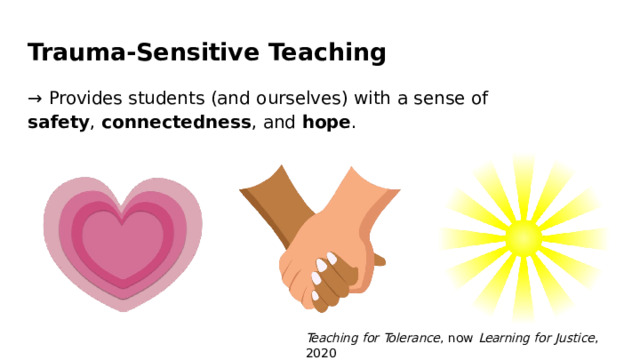
Trauma- Sensitive Teaching
→ Provides students (and ourselves) with a sense of safety , connectedness , and hope .
Teaching for Tolerance , now Learning for Justice , 2020
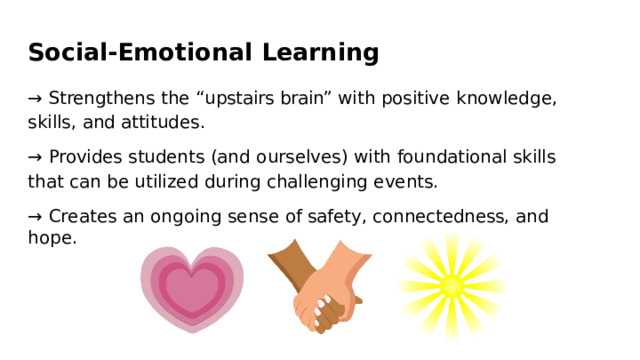
Social- Emotional Learning
→ Strengthens the “upstairs brain” with positive knowledge, skills, and attitudes.
→ Provides students (and ourselves) with foundational skills that can be utilized during challenging events.
→ Creates an ongoing sense of safety, connectedness, and hope.

Key terms
Social- Emotional Learning (SEL)
Stress Burnout Resilience
Communities of Practice (CoP)

Zoom Poll
On a scale of 1- 10, how Stressed are you feeling today?
1= Not stressed at all
5= About average: been better, been worse 10= Super stressed

Recognizing Stress and Burnout
Teacher Stress:
Experiencing unpleasant or negative emotions as a result of their work as a teacher
- Anger
- Anxiety
- Fear
- Frustration
- Depression
- Tension
- Worry
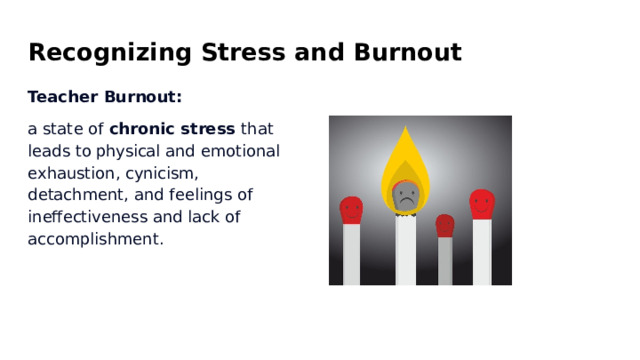
Recognizing Stress and Burnout
Teacher Burnout:
a state of chronic stress that leads to physical and emotional exhaustion, cynicism, detachment, and feelings of ineffectiveness and lack of accomplishment.

Maslach Burnout Inventory
Emotional Exhaustion: feeling emotionally overburdened.
Depersonalization: avoiding interactions, displaying indifference, becoming less idealistic.
Personal Accomplishment: sense of reduced professional satisfaction, feelings of futility and resignation.

Recognizing Stress and Burnout
Signs of Teacher Burnout
- Exhaustion (physical or emotional)
- Anxiety, anger, impatience
- Detachment from the job
- Reduced performance
- Poor self image
Caring professions like teaching are especially at risk of burnout.

Recognizing Stress and Burnout

Causes of Teacher Stress
Poor funding
Feeling underappreciated
Classroom disruptions
Long Hours
Staffing shortages
Lack of autonomy
Administrative tasks Heavy workloads
Difficult parents

Wellness Wheel Assessment

How can teachers resist stress and burnout?
→ By developing resilience via Social Emotional Learning!

What is resilience?
“ the process of, capacity for, or outcome of successful adaptation despite challenging or threatening circumstances”
Bitterroot flowers, the state plant of Montana (where I grew up)
-Masten, Best and Garmezy (1990, p 425)
Resilient Teachers
Resilient teachers report having:
- A feeling of agency , or choice
- A strong support group, including a competent and caring leadership team
- A feeling of pride in one’s achievements, and
- A feeling of competence in areas of personal importance
- Howard and Johnson (2004), p 415

Resilient Teachers
Resilient teachers report having:
- A feeling of agency, or choice
- A strong support group , including a competent and caring leadership team
- A feeling of pride in one’s achievements, and
- A feeling of competence in areas of personal importance
- Howard and Johnson (2004), p 415

Resilient Teachers
Resilient teachers report having:
- A feeling of agency, or choice
- A strong support group, including a competent and caring leadership team
- A feeling of pride in one’s achievements , and
- A feeling of competence in areas of personal importance
- Howard and Johnson (2004), p 415

Resilient Teachers
Resilient teachers report having:
- A feeling of agency, or choice
- A strong support group, including a competent and caring leadership team
- A feeling of pride in one’s achievements, and
- A feeling of competence in areas of personal importance
- Howard and Johnson (2004), p 415


Why do we need resilience?

Resilience helps people adapt to challenges.

Resilient teachers are happier, more patient, more hopeful.
Resilient teachers are better teachers.
Teacher Strategies for Resisting Stress & Burnout
STRESS
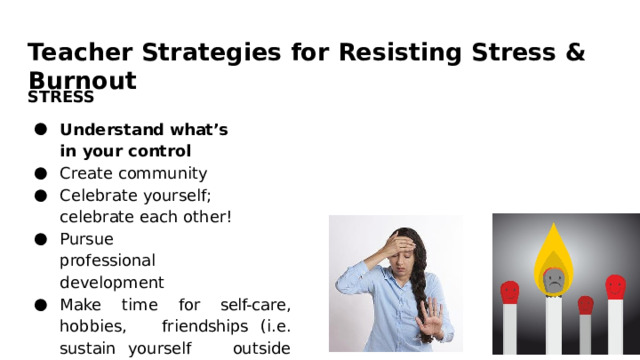
- Understand what’s in your control
- Create community
- Celebrate yourself; celebrate each other!
- Pursue professional development
- Make time for self- care, hobbies, friendships (i.e. sustain yourself outside of your work)

Circles of Control
Circle of Concern
Weather, Pandemics, Politics, Economics

Circles of Control
Circle of Concern
Circle of Influence
Weather, Pandemics, Politics, Economics
Your school’s culture, Your student’s attitudes or success
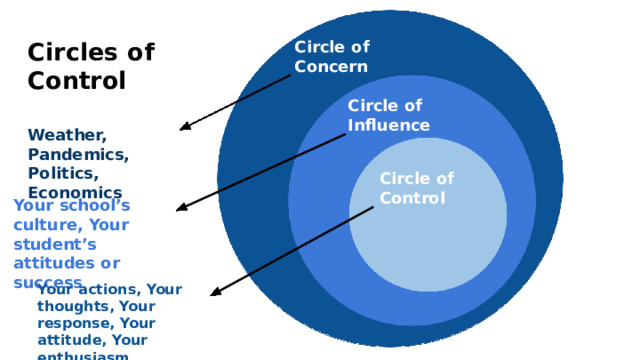
Circles of Control
Circle of Concern
Circle of Influence
Weather, Pandemics, Politics, Economics
Circle of Control
Your school’s culture, Your student’s attitudes or success
Your actions, Your thoughts, Your response, Your attitude, Your enthusiasm

Teacher Strategies for Resisting Stress & Burnout
STRESS
- Understand what’s in your control
- Create community
- Celebrate yourself; celebrate each other!
- Pursue professional development
- Make time for self- care, hobbies, friendships (i.e. sustain yourself outside of your work)
Communities of Practice
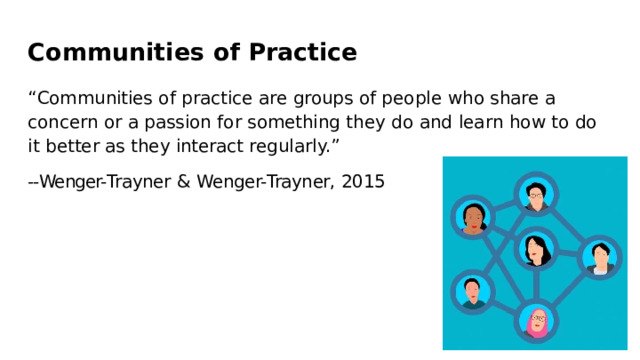
“ Communities of practice are groups of people who share a concern or a passion for something they do and learn how to do it better as they interact regularly.”
-- Wenger- Trayner & Wenger- Trayner, 2015
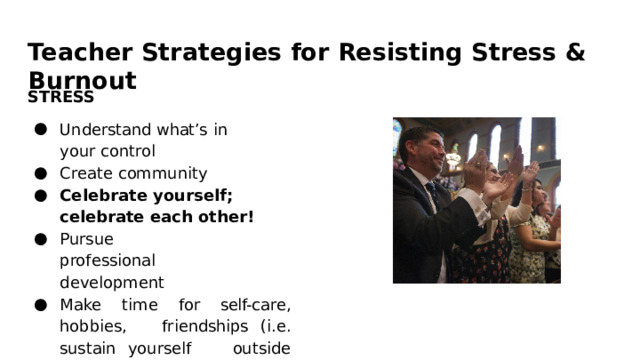
Teacher Strategies for Resisting Stress & Burnout
STRESS
- Understand what’s in your control
- Create community
- Celebrate yourself; celebrate each other!
- Pursue professional development
- Make time for self- care, hobbies, friendships (i.e. sustain yourself outside of your work)
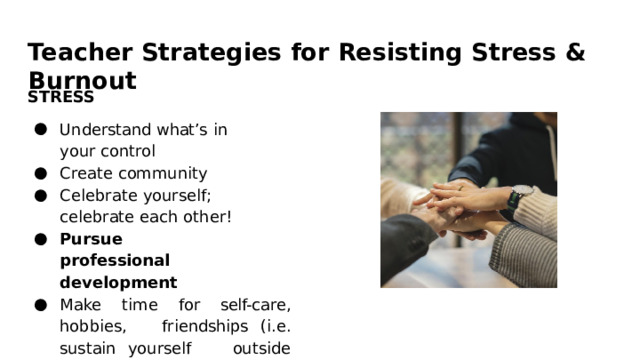
Teacher Strategies for Resisting Stress & Burnout
STRESS
- Understand what’s in your control
- Create community
- Celebrate yourself; celebrate each other!
- Pursue professional development
- Make time for self- care, hobbies, friendships (i.e. sustain yourself outside of your work)

Teacher Strategies for Resisting Stress & Burnout
STRESS
- Understand what’s in your control
- Create community
- Celebrate yourself; celebrate each other!
- Pursue professional development
- Make time for self- care, hobbies, friendships (i.e. sustain yourself outside of your work )

Teacher Strategies for Resisting Stress & Burnout
BURNOUT
- Pay attention to your stress levels
- Take true breaks
- Set (loving) boundaries

Teacher Strategies for Resisting Stress & Burnout
BURNOUT
- Pay attention to your stress levels
- Take true breaks
- Set (loving) boundaries
Teacher Strategies for Resisting Stress & Burnout
BURNOUT
- Pay attention to your stress levels
- Take true breaks
- Set (loving) boundaries
Teacher Strategies for Resisting Stress & Burnout
STRESS BURNOUT
- Understand is in your control
- Create community
- Pay attention to your stress levels
- Celebrate yourself; celebrate each other!
- Pursue professional development
- Take true breaks
- Set (loving) boundaries
- Make time for self- care, hobbies, friendships (i.e. sustain yourself outside of your work)

Dr. Jennifer Eidum
Associate Professor of English, Elon University English Language Specialist
jeidum@elon.edu





Вебинар для учителей

Свидетельство об участии БЕСПЛАТНО!