Россия, пгт Первомайский Тамбовской области


СДЕЛАЙТЕ СВОИ УРОКИ ЕЩЁ ЭФФЕКТИВНЕЕ, А ЖИЗНЬ СВОБОДНЕЕ
Благодаря готовым учебным материалам для работы в классе и дистанционно
Скидки до 50 % на комплекты
только до
Готовые ключевые этапы урока всегда будут у вас под рукой
Организационный момент
Проверка знаний
Объяснение материала
Закрепление изученного
Итоги урока

Была в сети 29.06.2019 17:09
Филатова Лилия Викторовна
учитель иностранного языка
69 лет
 5 350
5 350
 11 444
Местоположение
Специализация
Mikhail Bulgakov
Категория:
Английский язык
13.11.2018 19:20

Просмотр содержимого документа
«Mikhail Bulgakov»
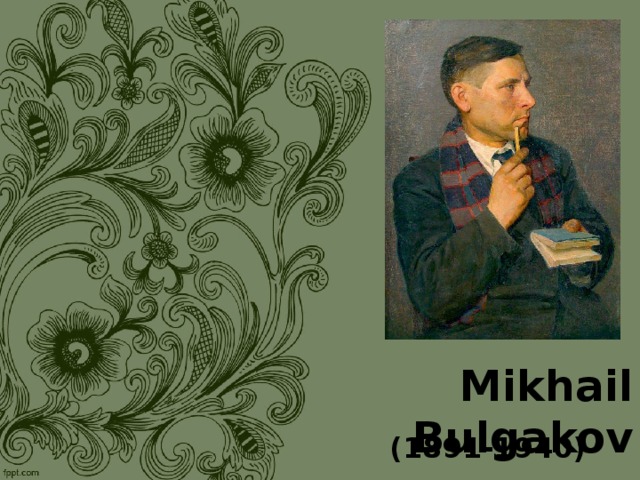
Mikhail Bulgakov
(1891-1940)
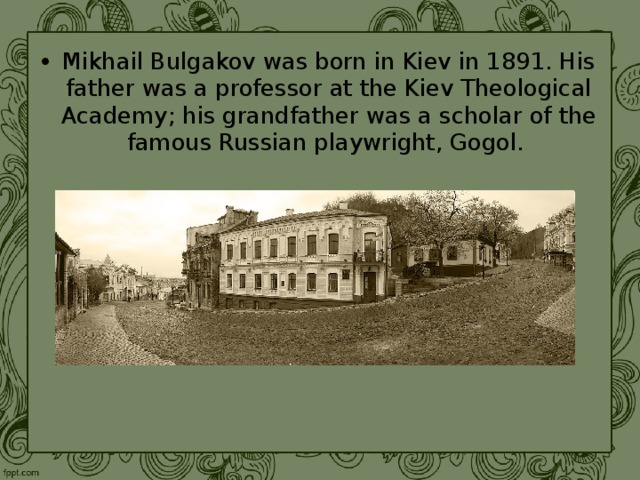
- Mikhail Bulgakov was born in Kiev in 1891. His father was a professor at the Kiev Theological Academy; his grandfather was a scholar of the famous Russian playwright, Gogol.
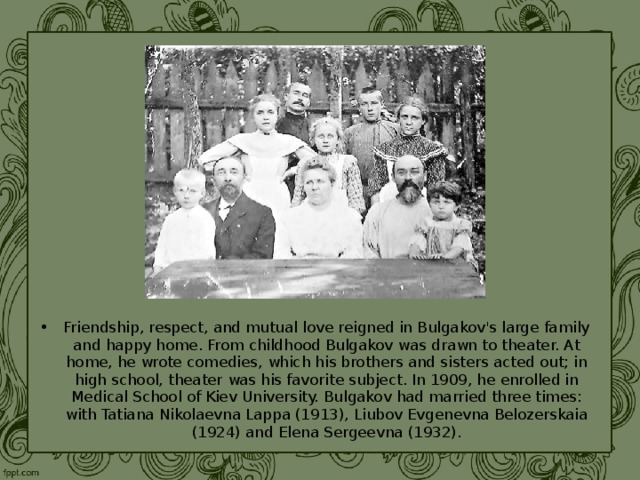
- Friendship, respect, and mutual love reigned in Bulgakov's large family and happy home. From childhood Bulgakov was drawn to theater. At home, he wrote comedies, which his brothers and sisters acted out; in high school, theater was his favorite subject. In 1909, he enrolled in Medical School of Kiev University. Bulgakov had married three times: with Tatiana Nikolaevna Lappa (1913), Liubov Evgenevna Belozerskaia (1924) and Elena Sergeevna (1932).
- In 1918 Bulgakov returned to Kiev and began to practice medicine. Kiev was at that time the focal point of an intense struggle between German troops, the Ukrainian Nationalist Army, Red troops, and the Russian Volunteer Army. Bulgakov enlisted as a field doctor in a Volunteer Army regiment and went to the Caucasus. Toward the end of 1919, he resigned from military service and started to work as a journalist and playwright. After a few of his early plays were staged in local theaters, Bulgakov moved to Moscow.
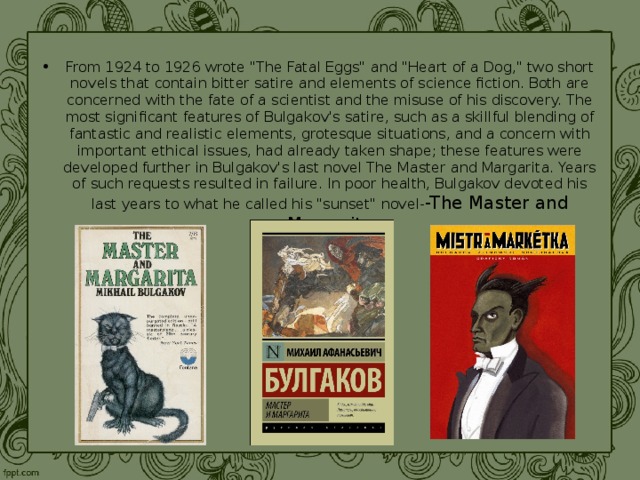
- From 1924 to 1926 wrote "The Fatal Eggs" and "Heart of a Dog," two short novels that contain bitter satire and elements of science fiction. Both are concerned with the fate of a scientist and the misuse of his discovery. The most significant features of Bulgakov's satire, such as a skillful blending of fantastic and realistic elements, grotesque situations, and a concern with important ethical issues, had already taken shape; these features were developed further in Bulgakov's last novel The Master and Margarita. Years of such requests resulted in failure. In poor health, Bulgakov devoted his last years to what he called his "sunset" novel- -The Master and Margarita
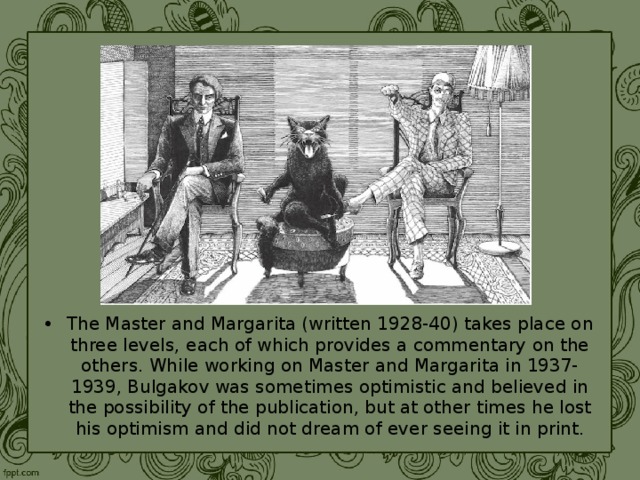
- The Master and Margarita (written 1928-40) takes place on three levels, each of which provides a commentary on the others. While working on Master and Margarita in 1937-1939, Bulgakov was sometimes optimistic and believed in the possibility of the publication, but at other times he lost his optimism and did not dream of ever seeing it in print.
- In the sixties, after Stalin's death, many of the literary works previously banned in the USSR were published. Master and Margarita was first published in censored form in 1967 in number 11 of Moscow magazine. The novel's readers experienced a sharp feeling of loss, which stemed from the conclusion of the novel: "You will be reading these pages when I will no longer be among you; you will look for me, but you will not find me". Master and Margarita was again republished in a fuller form in 1973; yet it took until 1989 before Bulgakov's work could be published in Russia in its original form.
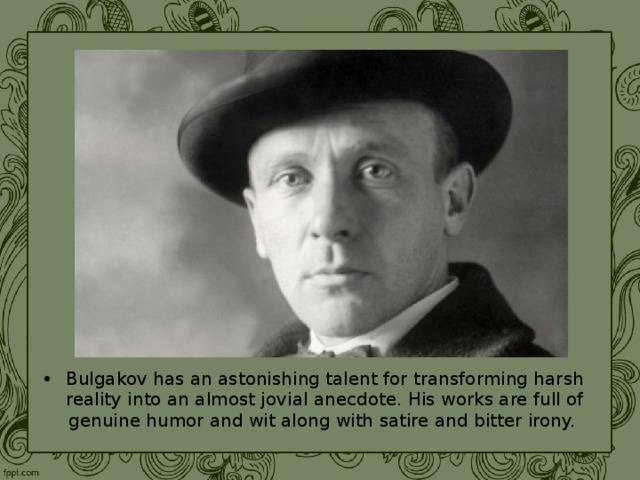
- Bulgakov has an astonishing talent for transforming harsh reality into an almost jovial anecdote. His works are full of genuine humor and wit along with satire and bitter irony.
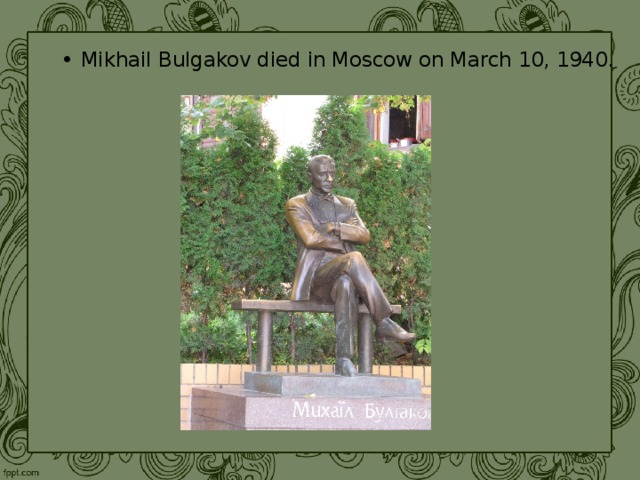
- Mikhail Bulgakov died in Moscow on March 10, 1940.








Вебинар для учителей

Свидетельство об участии БЕСПЛАТНО!