
СДЕЛАЙТЕ СВОИ УРОКИ ЕЩЁ ЭФФЕКТИВНЕЕ, А ЖИЗНЬ СВОБОДНЕЕ

Благодаря готовым учебным материалам для работы в классе и дистанционно

Скидки до 50 % на комплекты
только до

Готовые ключевые этапы урока всегда будут у вас под рукой

Организационный момент

Проверка знаний

Объяснение материала

Закрепление изученного

Итоги урока
Мой день урок+презентация

Нажмите, чтобы узнать подробности

разработка содержит конспект урока и презентацию по теме "Мой деннь".

Просмотр содержимого документа
«конспект урока»

УРОК В 4 КЛАССЕ

Тема: «Режим дня».

Цели: учебные:

- формирование навыков диалогической и монологической речи (расспрос и рассказ о распорядке дня);

- учить поисковому чтению текста с извлечением нужной информации;

- учить восприятию на слух короткого аутентичного текста с пониманием основного содержания прослушанного.

развивающие: - развитие способностей к догадке, имитации, сравнению и сопоставлению речевых единиц;

воспитательные: - воспитание потребности в здоровом образе жизни, способности к сотрудничеству и взаимопомощи при работе в паре.

Оборудование: игрушка Буратино, компьютерная презентация, диск с аудиозаписью, карточки для индивидуальной работы.

Ход урока.

I Оргмомент.

1. Приветствие учителя:

-Good morning,boys and girls!

-Good morning, good morning,

good morning to you.

Good morning, good morning,

we are glad to see you.

-Glad to see you too. Sit down, please.

2. How are you, Vika?

How are you, Roman?

What day is it today?

What season is it today?

3. Today you will describe your daily life. (слайд1)

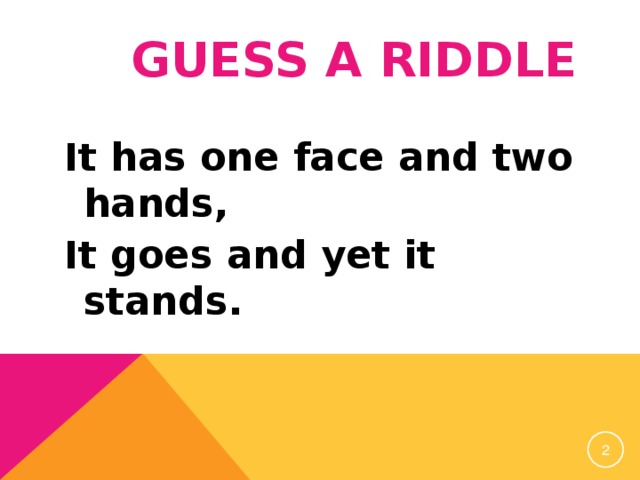
4. Now I will tell you a riddle. Do you know what’s that?

It has one face and two hands

It goes and yet it stands.

(clock)

II Фонетическая разминка.

1. Let’s recite the poem about the clock:

Tick-tock”

says the clock,

Get up, Nick,

It’s 7 o’clock”.

2.Children, Buratino wants to know some words about working day. Let’s help him. Say after me:

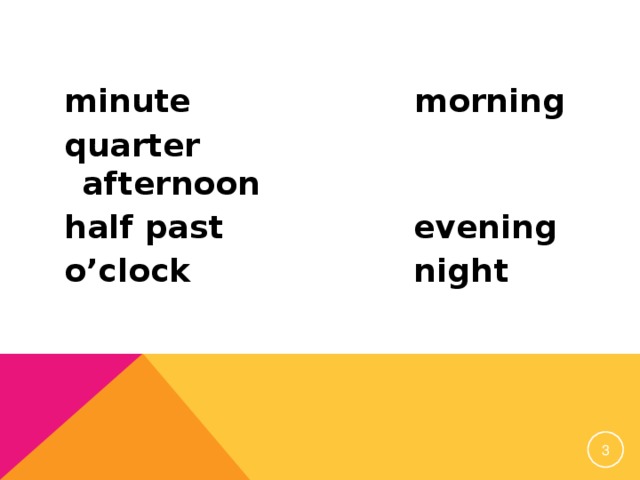
minute morning

quarter afternoon

half past evening

oclock night (слайд 2)

III Речевая разминка.

1.Now answer my questions:

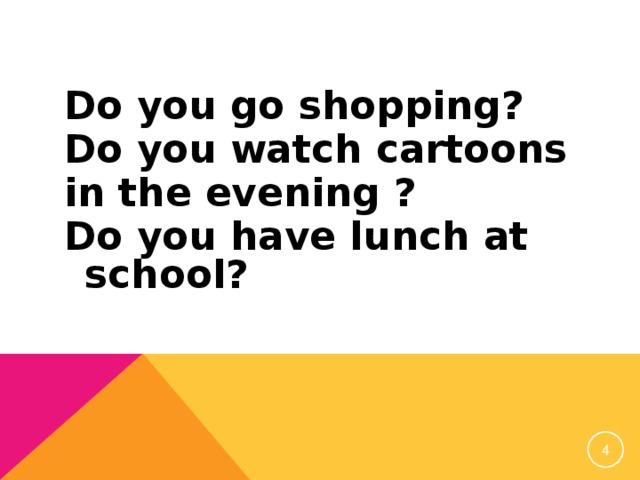
Do you go shopping?

Do you watch cartoons in the evening?

Do you have lunch at school?(Слайд 3)

2.Работа с макетом циферблата часов.

T: what’s the time, children?

P1: It’s 9 o’clock.

T: And now, what’s the time?

P2: It’s half past 4.

T: And now, what’s the time?

P3: It’s a quarter past 5.

T: What’s the time now?

P4: It’s 7 o’clock. (слайд 4)

Very nice, children.

IV Предлогивремени. (слайд 5)

1.Fill in the prepositions of time. Help Buratino:

at 3 o’clock at noon

in the morning in the evening

at midnight at half past 6

2.And now the phrases with am and pm. You have some cards on your desks. Please, take them. I will tell you the time. You must show the card with this time.

It’s 7 o’clock in the morning.

It’s 2 o’clock in the afternoon.

It’s 10 o’clock in the morning.

It’s 11 o’clock in the evening.

It’s 9 o’clock in the evening.

It’s 6 o’clock in the morning.

V Диалогическая речь.

1. It’s time to listen to the dialogues. The children are talking about their daily activities.

1– Where do you live?

  • I live in a small Russian town.

  • Do you go to school?

-Yes, I do. I am a pupil.

  • When do you go to school?

  • I go to school at 8 o’clock.

2.– Do you like watching TV?

-Yes, I do. I watch TV a lot.

- What films do you like?

- I like new films. They are very good.

- And when do you watch TV?

- I usually watch TV in the evening.

3. – When do you do your homework?

- I do my homework in the afternoon.

- What do you do in the evening?

- I read books and watch TV in the evening.

Thank you, children.

2. Now look at the screen. This is Sally’s daily life. (слайд 6)

-What does Sally do in the morning?

- in the afternoon?

- in the evening?

What do you do in the morning?

-in the afternoon?

- in the evening?

VI Физкультминутка.

I see you are tired. Let’s stand up and do some exercises with me:

Teddy Bear, turn around,

Teddy Bear, touch the ground,

Teddy Bear, nod your head,

Close your eyes and go to bed.

VII Устная речь.

Buratino is interested to know how you spend your working day. Let’s listen to your stories about your daily life.

Ученики по очереди рассказывают о своем режиме дня.

VIII Чтение.

1 Now we shall read a story about Jack’s weekends. Open your books at p.44, ex.1.

I’ve written some words for you. Say after me:

gets up clean

have breakfast have lunch

play computer games go to bed

2 Чтение текста уч-ся по цепочке.

3 Find the English equivalents:

-Он гуляет с Фредди и кормит его.

-Джессика читает или выходит поиграть с друзьями.

-По субботам мы всегда убираем в доме.

-По выходным мы часто ложимся спать поздно.

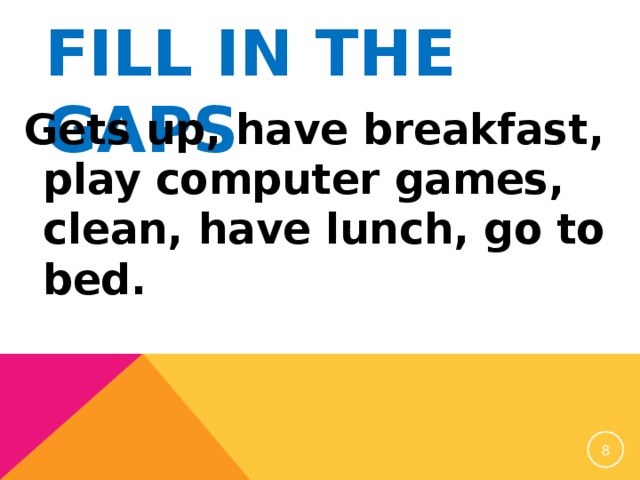
4 And now take the cards and fill in the gaps with the following words:

Gets up, have breakfast, play computer games, clean, have lunch, go to bed


At weekends dad _____(1) early too. Jessica and I get up late, at 10 or 11 o’clock. First we watch TV, then wash, get dressed and _____(2).At weekends I often _____ (3) or go to my friend Ben’s house. On Saturdays we always _____ (4) the house. At weekend we usually ___(5) and dinner at home. At weekend we often _____ (6) late!

Very good, children.

IX Аудирование.

Children, you will listen to the story of Jack’s friend, follow the information in the table and guess the name.

Проверка понимания: уч-ся догадываются и называют имя друга.

Х Ролевая игра «Интервью».

And now letsplay! Arina, come up to me. Imagine that she is an American girl. Ask her questions about her working day.

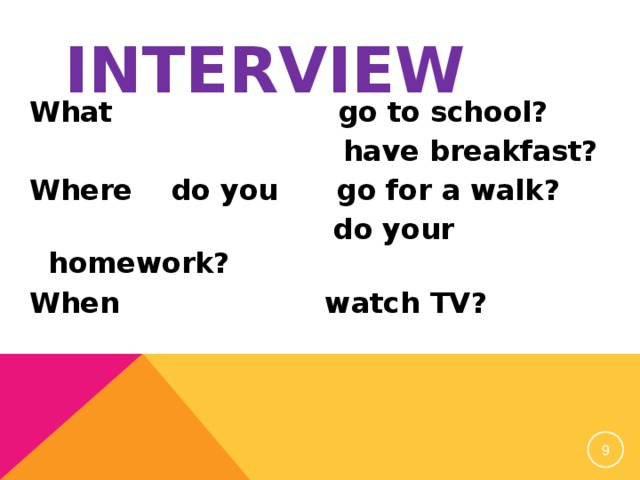
And you will answer them.

What go to school?

have breakfast?

Where do you go for a walk?

do your homework?

When watch TV?

Подведение итогов, рефлексия: Our lesson is over. You worked well. Your marks are

Ребята, наш урок подходит к концу. Если занятие вам понравилось, поднимите вверх солнышко. Если остались какие-либо вопросы, поднимите вверх облако.

Goodbye!

Дом. задание: p. 30, ex.4 (Reader)


Просмотр содержимого презентации
«МОЙ день исп.»

Daily Life
Daily Life

GUESS A RIDDLE It has one face and two hands, It goes and yet it stands.
GUESS A RIDDLE

It has one face and two hands,

It goes and yet it stands.

minute morning quarter afternoon half past evening o’clock night
minute morning

quarter afternoon

half past evening

o’clock night

Do you go shopping? Do you watch cartoons in the evening ? Do you have lunch at school?

Do you go shopping?

Do you watch cartoons

in the evening ?

Do you have lunch at school?

ASKING ABOUT/TELLING THE TIME What time is it? It’s 12 o’clock. It’s half past six . It’s a quarter past five . It’s a quarter to seven .

ASKING ABOUT/TELLING THE TIME

What time is it?

It’s 12 o’clock.

It’s half past six .

It’s a quarter past five .

It’s a quarter to seven .

PREPOSITIONS OF TIME … at… 3 o’clock … .in…. the morning … at… midnight … at.. noon .in…. the evening ..at…. half past six  (the time) 3o’clock  Noon At + midnight  night  the morning  IN + the afternoon  the evening

PREPOSITIONS OF TIME

… at… 3 o’clock

… .in…. the morning

… at… midnight

… at.. noon

.in…. the evening

..at…. half past six

(the time) 3o’clock

Noon

At + midnight

night

the morning

IN + the afternoon

the evening

SALLY’S DAILY LIFE What does Sally do…..? In the morning Sally In the afternoon V s / es In the evening What do you do…..? In the morning In the afternoon I   V. In the evening
SALLY’S DAILY LIFE

What does Sally do…..?

In the morning Sally

In the afternoon V s / es

In the evening

What do you do…..?

In the morning

In the afternoon I V.

In the evening

FILL IN THE GAPS Gets up, have breakfast, play computer games, clean, have lunch, go to bed.
FILL IN THE GAPS

Gets up, have breakfast, play computer games, clean, have lunch, go to bed.

INTERVIEW What  go to school?  have breakfast? Where do you go for a walk?  do your homework? When watch TV?
INTERVIEW

What go to school?

have breakfast?

Where do you go for a walk?

do your homework?

When watch TV?

You worked well. Thank you for attention!
You worked well.

Thank you for attention!