Россия,

СДЕЛАЙТЕ СВОИ УРОКИ ЕЩЁ ЭФФЕКТИВНЕЕ, А ЖИЗНЬ СВОБОДНЕЕ
Благодаря готовым учебным материалам для работы в классе и дистанционно
Скидки до 50 % на комплекты
только до
Готовые ключевые этапы урока всегда будут у вас под рукой
Организационный момент
Проверка знаний
Объяснение материала
Закрепление изученного
Итоги урока

Была в сети 16.05.2023 22:05

Репина Наталия Владимировна
учитель английского языка
 626
626
 92 776
Местоположение
Специализация
My fair lady. Home reading. Pygmalion
Категория:
Английский язык
04.04.2023 13:19

Просмотр содержимого документа
«My fair lady. Home reading. Pygmalion»


A few weeks ago I had the pleasure of seeing My Fair Lady , the classic Broadway musical, based on George Bernard Shaw’s 1913 play, Pygmalion . It was performed at the Lyric Opera here in Chicago.
It was a great performance.
The singing was outstanding, the actors perfect, the set design creative and engaging. As you might recall, the story is about Eliza Doolittle, a poor flower girl from th e East side of London. She speaks with a strong Cockney accent.
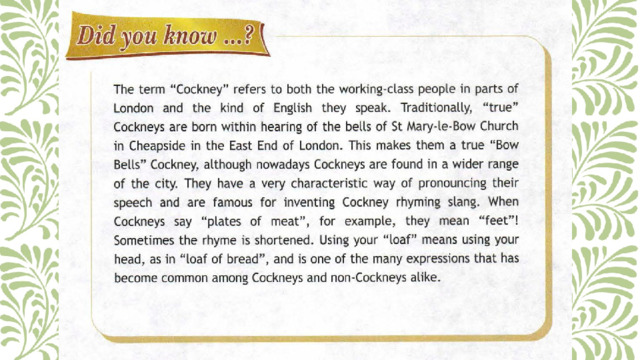

All was lovely with this play until Professor Higgins began his teaching with Eliza. He had her repeat the vowel names over and over (“a – e – i – o- u”). She said them with a Cockney accent and he reprimanded her. She tried again. Same result.
He simply asked her to repeat. Same with “The rain in Spain falls mainly in the plain,” the famous phrase meant to each the /e/ sound.
To learn not to drop the /h/ sound at the beginning of words, Higgins had Eliza speak the phrase, “In Hartford, Hereford, and Hampshire, hurricanes hardly ever happen” with a lit candle in front of her. If the flame wavered (i.e., she was aspirating the /h/ sound properly), she was pronouncing the /h/ correctly.

Вставка рисунка
1.George Bernard Shaw wrote his Pygmalion in 1930.
a)True b) False c) Not stated
2.The name of the play was chosen according to a Greek myth.
a)True b) False c) Not stated
3.Henry Higgins was a professor of phonetics in London University.
a)True b) False c) Not stated
4.Eliza is a glamorous aristocrat.
a)True b) False c) Not stated
5.Cockney is a working class Londoner born in a particular place in the East End.
a)True b) False c) Not stated
6.Professor Higgins fell in love with Eliza.
a)True b) False c) Not stated
George Bernard Show (1856 – 1950)









Вебинар для учителей

Свидетельство об участии БЕСПЛАТНО!