, Уральск

СДЕЛАЙТЕ СВОИ УРОКИ ЕЩЁ ЭФФЕКТИВНЕЕ, А ЖИЗНЬ СВОБОДНЕЕ
Благодаря готовым учебным материалам для работы в классе и дистанционно
Скидки до 50 % на комплекты
только до
Готовые ключевые этапы урока всегда будут у вас под рукой
Организационный момент
Проверка знаний
Объяснение материала
Закрепление изученного
Итоги урока

Была в сети 15.05.2018 18:41

Абишова Сезим Темирбулатовна
учитель английского языка
31 год
 187
187
 177 520
Местоположение
Специализация
Научные работы на теме English idioms using three languages
Категория:
Английский язык
11.05.2018 23:04

Просмотр содержимого документа
«Научные работы на теме English idioms using three languages»
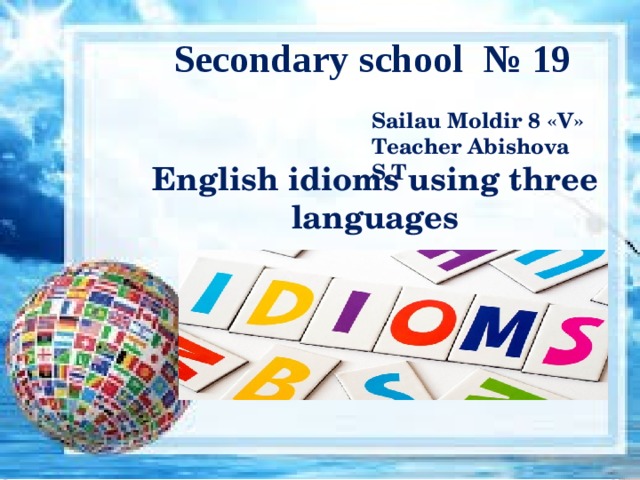
Secondary school № 19
Sailau Moldir 8 «V»
Teacher Abishova S.T
English idioms using three languages
Education is not the learning of facts,
but the training of the mind to think .
Albert Einstein
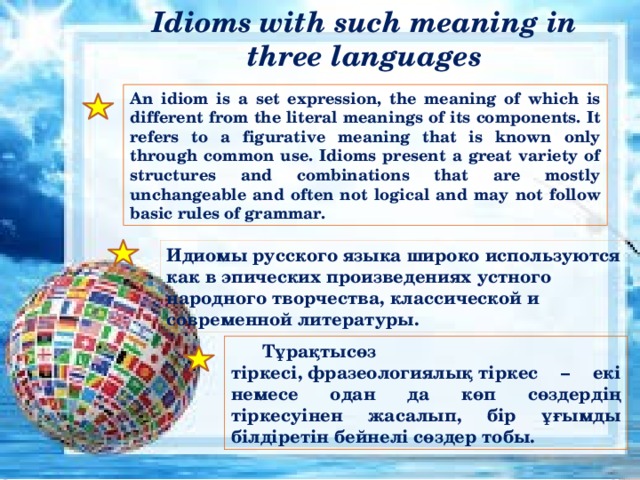
Idioms with such meaning in three languages
An idiom is a set expression, the meaning of which is different from the literal meanings of its components. It refers to a figurative meaning that is known only through common use. Idioms present a great variety of structures and combinations that are mostly unchangeable and often not logical and may not follow basic rules of grammar.
Идиомы русского языка широко используются как в эпических произведениях устного народного творчества, классической и современной литературы.
Тұрақтысөз тіркесі, фразеологиялық тіркес – екі немесе одан да көп сөздердің тіркесуінен жасалып, бір ұғымды білдіретін бейнелі сөздер тобы.
The field for my research is the idiomatic similes. To my mind they are widely used in all spheres of our life and if you know their translation
exactly you will use them
just in the right place
and time. You can use
your mind clear and
understandable.
The aim of research work is to learn in three languages and attract my classmates’ attention to them, proving that using idioms in our speech makes it brighter and more intelligent. As well as our
pupils exactly English
idioms use other subjects.
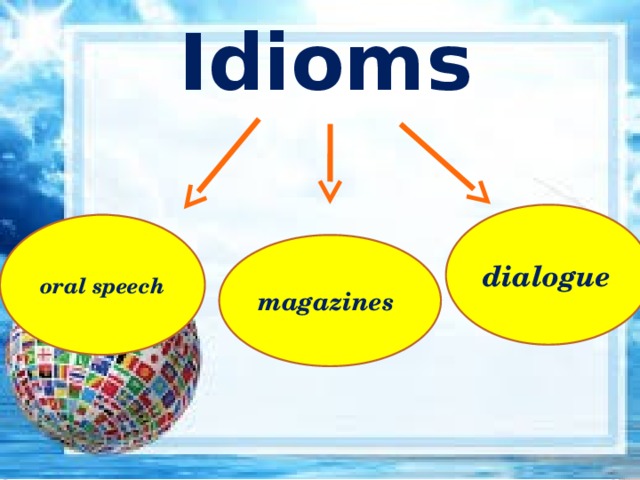
Idioms
dialogue
oral speech
magazines
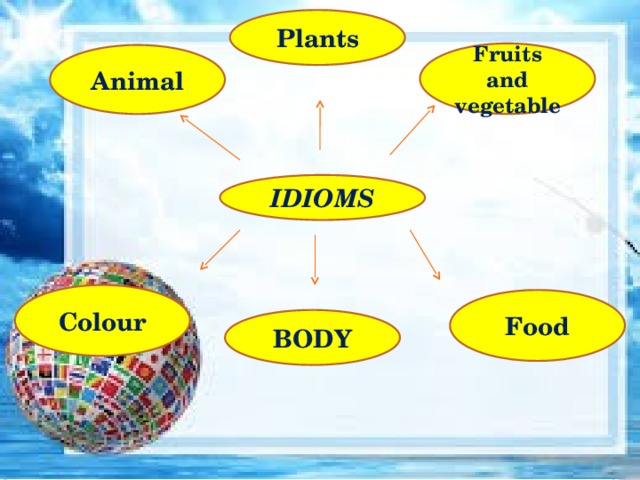
Plants
Fruits and vegetable
Animal
IDIOMS
Colour
Food
BODY
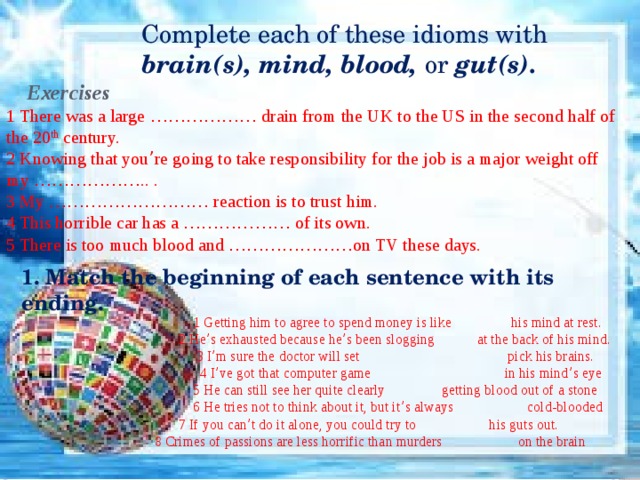
1 Getting him to agree to spend money is like his mind at rest.
2 He ’ s exhausted because he ’ s been slogging at the back of his mind.
3 I ’ m sure the doctor will set pick his brains.
4 I ’ ve got that computer game in his mind ’ s eye
5 He can still see her quite clearly getting blood out of a stone
6 He tries not to think about it, but it ’ s always cold-blooded
7 If you can ’ t do it alone, you could try to his guts out.
8 Crimes of passions are less horrific than murders on the brain
Complete each of these idioms with
brain(s), mind, blood, or gut(s).
Exercises
1 There was a large ……………… drain from the UK to the US in the second half of the 20 th century.
2 Knowing that you ’ re going to take responsibility for the job is a major weight off my ……………… .. .
3 My ……………………… reaction is to trust him.
4 This horrible car has a ……………… of its own.
5 There is too much blood and ………………… on TV these days.
1. Match the beginning of each sentence with its ending.

Қазақ тілінің идиомалары арқылы талдап орындау:
Берілген тұрақты сөздерді бір сөзбен айту керек. Бармағын тістеу - Көз аларту Ақ саусақ - Ит терісін басына қаптау – Сілесі қату -
Қазақ тілінің идиомалары арқылы талдап
орындау:
Берілген тұрақты сөздерді бір сөзбен айту керек. Бармағын тістеу - Көз аларту Ақ саусақ - Ит терісін басына қаптау – Сілесі қату -

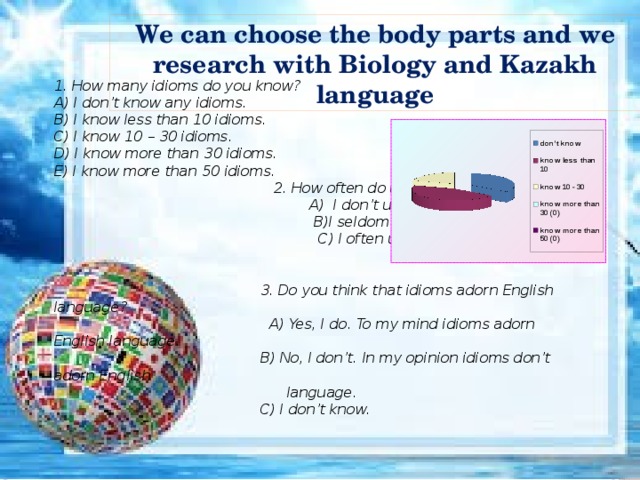
We can choose the body parts and we research with Biology and Kazakh language
1. How many idioms do you know?
A) I don’t know any idioms.
B) I know less than 10 idioms.
C) I know 10 – 30 idioms.
D) I know more than 30 idioms.
E) I know more than 50 idioms.
2. How often do use idioms?
A) I don’t use idioms.
B)I seldom use idioms.
C) I often use idioms.
3. Do you think that idioms adorn English language?
A) Yes, I do. To my mind idioms adorn English language.
B) No, I don’t. In my opinion idioms don’t adorn English
language.
C) I don’t know.
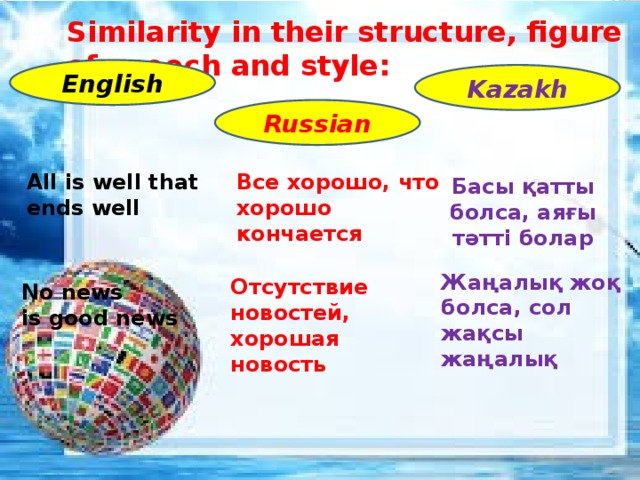
Similarity in their structure, figure of speech and style:
English
Kazakh
Russian
All is well that ends well
Все хорошо, что хорошо кончается
Басы қатты болса, аяғы тәтті болар
Жаңалық жоқ болса, сол жақсы жаңалық
Отсутствие новостей, хорошая новость
No news
is good news
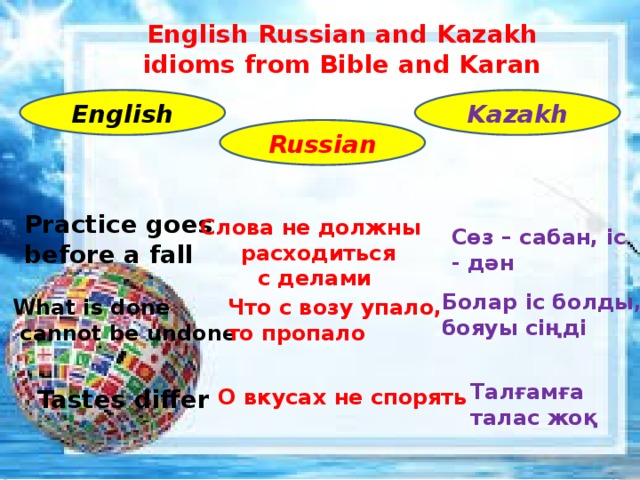
English Russian and Kazakh idioms from Bible and Karan
English
Kazakh
Russian
Practice goes
before a fall
Слова не должны
расходиться
с делами
Сөз – сабан, іс - дән
Болар іс болды,
бояуы сіңді
What is done
Что с возу упало,
cannot be undone
то пропало
Талғамға
талас жоқ
Tastes differ
О вкусах не спорять
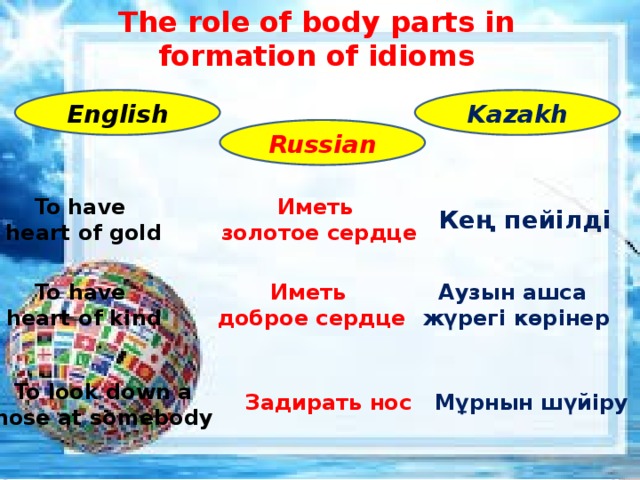
The role of body parts in formation of idioms
English
Kazakh
Russian
To have
Иметь
heart of gold
золотое сердце
Кең пейілді
Аузын ашса
Иметь
To have
доброе сердце
жүрегі көрінер
heart of kind
To look down a
nose at somebody
Задирать нос
Мұрнын шүйіру
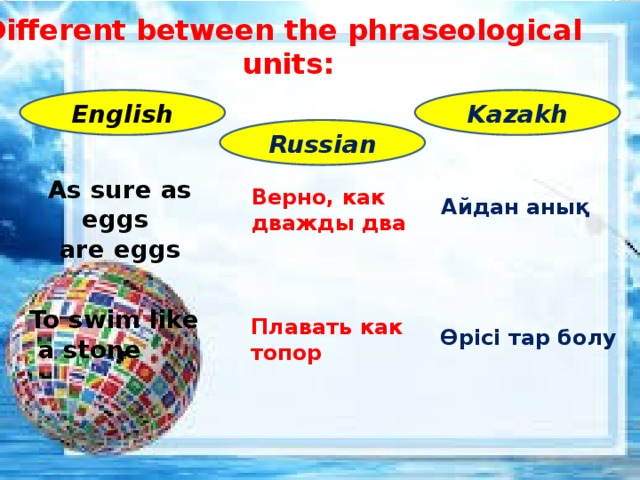
Different between the phraseological
units:
English
Kazakh
Russian
As sure as eggs
are eggs
Верно, как
дважды два
Айдан анық
To swim like
a stone
Плавать как
топор
Өрісі тар болу

While there is life there is a hope
Где жизнь, там и надежда
Өмір бар жерде, үміт бар
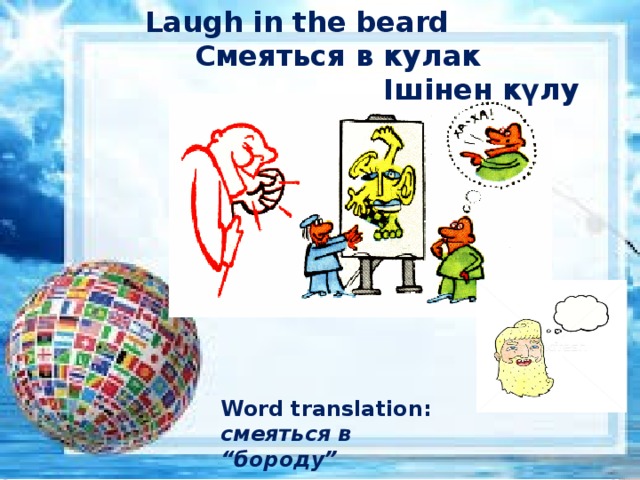
Laugh in the beard
Смеяться в кулак
Ішінен күлу
Word translation: смеяться в “бороду”
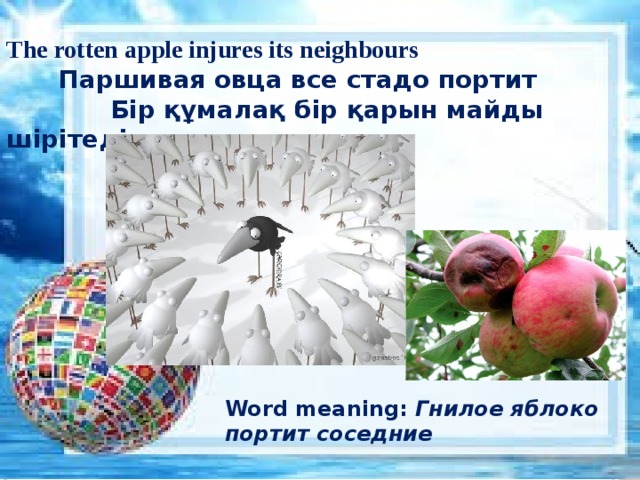
The rotten apple injures its neighbours
Паршивая овца все стадо портит
Бір құмалақ бір қарын майды шірітеді
Word meaning: Гнилое яблоко портит соседние
Conclusion
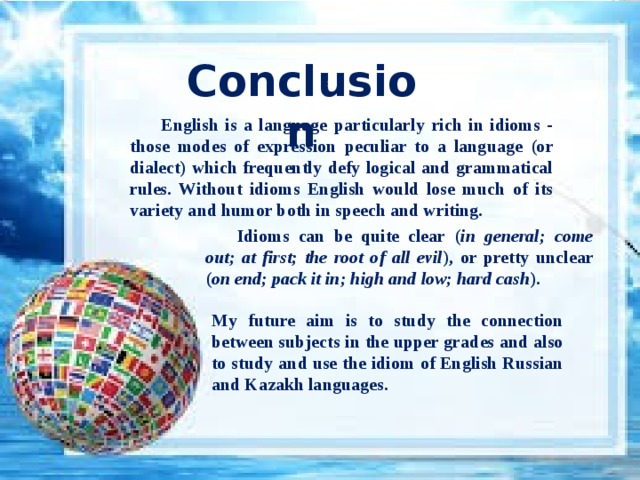
English is a language particularly rich in idioms - those modes of expression peculiar to a language (or dialect) which frequently defy logical and grammatical rules. Without idioms English would lose much of its variety and humor both in speech and writing.
Idioms can be quite clear ( in general; come out; at first; the root of all evil ), or pretty unclear ( on end; pack it in; high and low; hard cash ).
My future aim is to study the connection between subjects in the upper grades and also to study and use the idiom of English Russian and Kazakh languages.

Thanks for attention!
Вебинар для учителей

Свидетельство об участии БЕСПЛАТНО!