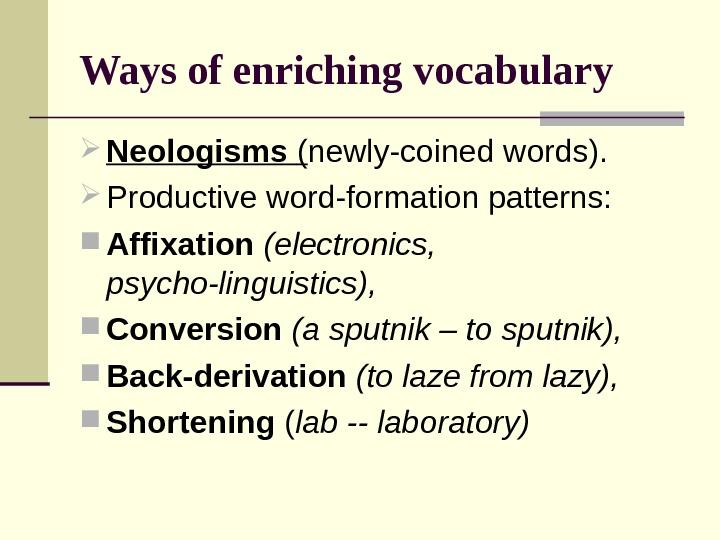
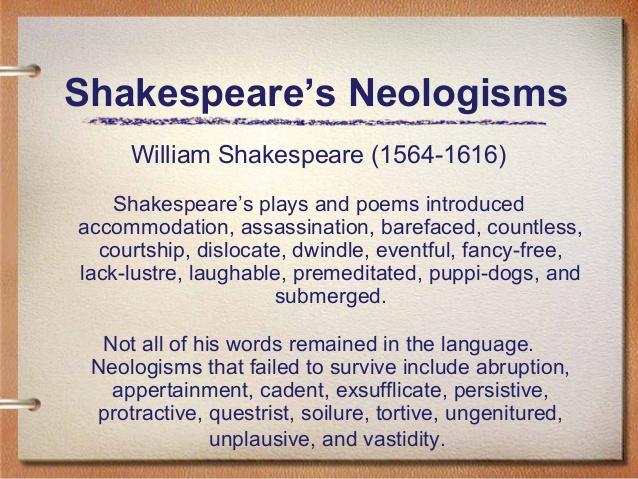
Today our world is rappidly changing. Every change is inevitably followed by a change of a language. English is a language of many countries, and it is shaped a lot every time something new comes out.
As you've already undersood, I am willing to talk about neolgisms.
Personally, I like to watch the language change in a dictionary. Let me just give you some examples of recently found words in an online Cambridge dictionary. So, here they are:
New words – 13 February 2017
thrisis noun [C] /ˈθraɪ.sɪs/
feelings of unhappiness, worry, and disappointment that some people experience when they are around 30 years old and that can sometimes lead them to make important changes in their life
From the outside, my life looks pretty good. I’m 32. I have fantastic friends and a great job … So why do I feel like I’m doing everything wrong? Welcome to the 30-something crisis – or ‘thrisis’ – the feeling that, just a decade into being a grown-up, you’re running out of time.
JAM noun [C] /dʒæm/
abbreviation for just about managing; used in the UK to describe people who have just enough money to survive, but nothing more
Jams account for two-thirds of all families with children receiving tax credits … More than two thirds have less than a month’s income’s worth of savings. So, the argument goes, Jams are especially vulnerable to weak income growth, rising costs and the freeze on working-age benefits until 2019.
New words – 20 February 2017
Calexit noun [U] /kæl.’ek.sɪt/
an exit by the state of California from the United States of America
Californians would need to pass an amendment to the US Constitution, which requires the blessings of the other 49 states. The measure would also survey voters on whether a “Calexit” is something that interests them.
Bremoaner noun [C] UK /brə.’məʊn.ə/ US /brə.’moʊn.ɚ/
someone who complains about Britain’s exit from the European Union
Anybody asking questions about our future relationship with our biggest trading partner is dismissed as a Bremoaner. I have been called worse in my time.
democracy sausage noun [C] UK /dɪˈmɒk.rə.si ˈsɒs.ɪdʒ/ US /dɪˈmɑː.krə.si ˈsɑː.sɪdʒ/
a sausage cooked on a barbecue and served on bread, sold at polling booths on election day in Australia
A humble barbequed sausage on a slice of bread sold at polling booths around Australia has been picked as the country’s official word of the year — “democracy sausage.”
conversational commerce noun [U]
UK /kɒn.vəˌseɪ.ʃən.əl ˈkɒm.ɜːs/ US /kɑːn.vɚˌseɪ.ʃən.əl ˈkɑː.mɝːs/
direct conversations between people and companies or services using technology such as apps
Echo is part of the new wave of conversational commerce technologies, where the use of messaging, digital assistants, chat apps, or question-and-answer dialogue makes it possible for people to simply ask for what they need.
the internet of everything noun [S]
UK /ˌɪn.tə.net əv ˈev.ri.θɪŋ/ US /ˌɪn.t̬ɚ.net əv ˈev.ri.θɪŋ/
the interaction between people, data, machines, communications and interactions using a system of linked devices
The internet of everything in both the consumer and B2B market will continue to rise, especially in North America, connecting data, things, processes and people.