Россия, Курск

СДЕЛАЙТЕ СВОИ УРОКИ ЕЩЁ ЭФФЕКТИВНЕЕ, А ЖИЗНЬ СВОБОДНЕЕ
Благодаря готовым учебным материалам для работы в классе и дистанционно
Скидки до 50 % на комплекты
только до
Готовые ключевые этапы урока всегда будут у вас под рукой
Организационный момент
Проверка знаний
Объяснение материала
Закрепление изученного
Итоги урока
Была в сети 24.04.2020 19:21

Борисенко Галина Викторовна
Учитель английского языка
69 лет
 1 557
1 557
 44 717
Местоположение
Специализация
О России на английском языке
Категория:
Английский язык
11.04.2019 13:37

Просмотр содержимого документа
«О России на английском языке»
1
The Party “Welcome to Russia”
(For the pupils of the 6-th form)
The aim is: to develop the feeling of patriotism and pride for our Motherland.
Pupil1: We study English because we want to communicate with people of other countries. We study English because with the help of the English language we want to tell the people of other countries about our native country – Russia. So, welcome to Russia!
( The pupils sing the song “Russia is my Motherland”).
RUSSIA IS MY MOTHERLAND
Music by V. Muradeli, words by V. Kharitonov.
Moscow’s forests always glisten
At dawn in autumn and in May
To Nature’s song of love I listen,
A song to Russia’s bright new day.
When dawn first shines on the horizon,
To touch the trees with autumn’s glow,
I hear the birch, as in my childhood,
She tells me singing very low:
Refrain:
My Russia, my Russia,
My land so beautiful and free,
My Russia, my Russia,
The dearest land a man can see!
My Russia, my Russia,
The dearest land a man can see!
Pupil 2; Russia is the biggest country in the world. It is washed in the north by the Arctic Ocean and its seas: the Barents, Chukchee, East Siberian, Kara, Laptev and White Seas, in the south by the Вlack, Asov and Caspian Seas; in the east by the Bering Sea, the Sea of Japan and Okhotsk Sea; in the west- by the Baltic Sea.
Pupil 3: The size of Russia is hard to imagine. Russia is a land of long rivers and large lakes. Among the world’s longest rivers are the North Dvina, the three mighty Siberian rivers: the Ob, the Lena and theYenisey and the Amur. The largest of all Russian rivers is the Volga. The three largest lakes in Russia are: Baikal in South-Eastern Siberia and Ladoga and Onega in Northern Russia.
Pupil 4: The relief of Russia is mostly flat. It is located on two plains: the Great Russian Plain and the Western Siberian Plain. There are three main mountain ranges in Russia. The Caucasus stretch from the Black Sea to the Caspian Sea. The highest mountain is the Mount Elbrus. The Urals extend from the Arctic Ocean to the steppes. They devide the Europian and Asian parts of Russia.
Pupil 5:The plant and animal worlds of the country are also very rich. There are a lot of different animals, birds and plants in our forests, fields and mountains. Russia is also rich in gold, silver, oil, gas, iron and other minerals. And now let’s sing a song about Russia, we can sing it together.
2
SONG OF THE MOTHERLAND
Music by I. Dunayevsky, words by V. Lebedev-Kumuch.
Refrain:
Our country is a land of beauty?
Our country is a land of glee.
Many are its rivers, forests, cities,
Where a man is happy, proud and free.
In the heart of our land, in Moscow,
In the South, where highest mountains stand,
On the shores of our northern oceans
Man is lord and master of the land!
Ev’rywhere our full life flows as freely
As the Volga River’s waters flow;
To the young now ev’ry door is open,
Ev’rywhere our old with honour go.
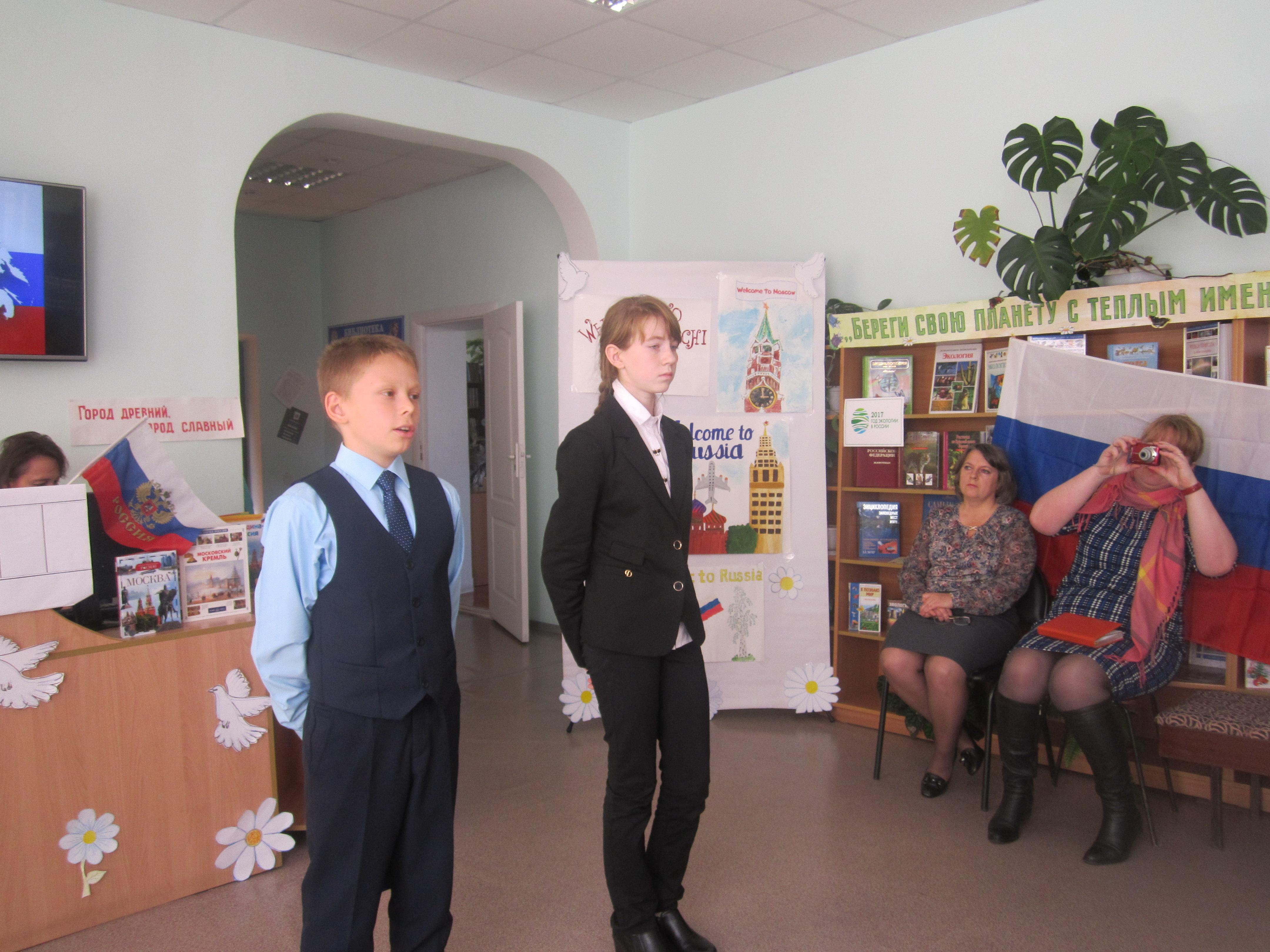
Pupil 6: Now we shall tell you about our symbols.
Russian national flag has three wide stripes on it. The stripes are white, blue and red. The upper stripe is white, the middle stripe is blue and the red stripe is at the bottom. These colours have always been symbolic in Russia: white means noble and sincere, blue – honest and devoted, devoted to friends, family and to the country. The red colour has always meant love and bravery.
3
Pupil 7: The other symbol of Russia which all Russian people know and love is the birch tree. You can find these trees everywhere. People sing beautiful songs with poetic words about birch trees and plant them near their houses. In old Russian towns people often call young lovely girls”beryozka, beryozonka”. They compare them with young birch trees.
Teacher: comrades, let’s sing one more song about our country.
GOLDEN CHILDHOOD
Music by Kabalevsky, words by Prishelets.
There are apple trees and birch trees
Growing just behind the stream.
It’s the nicest place the world through,
It’s as pleasant as a dream!
It’s the nicest place the world through,
It’s as pleasant as a dream!
It’s as pleasant as a dream!
From the mountains through the forests
To the seas so large and blue,
There are roads in all directions.
And each road is calling you.
There are roads in all directions.
And each road is calling you.
And each road is calling you.
So we pass our golden childhood
Here in this great land we love,
And our life is always guided
By a bright red star above!
And our life is always guided
By a bright red star above!
By a bright red star above!
4
Teacher: Really, Russia is a great country. There are a lot of big cities and small towns in our country.
And now, tell me, please, what is the capital of Moscow? (The pupils answer). Yes, right you are. The capital of our country is Moscow. Comrades, let’s do a small quiz about Moscow. We shall see who knows the history of our capital.
Now a small quiz about Moscow.
1.When did chronicles first mention Moscow?
(In 1147).
2.Who founded Moscow?
(Prince Yuri Dolgoruky).
3.Why was Prince Yuri Dolgoruky called Prince Long Arms?
(He was the Prince of Vladimir and Suzdal and became Prince of Kiev as well).
4.On how many hills does Moscow stand?
(It stands on seven hills).
5.Why is Moscow called “Moscow”?
(It was named after the river Moskva on which it stands. Moskva from Slavonic means “wet, swampy”.)
6.You know that the most beautiful cathedral in the Red Square is St. Basil’s cathedral. Why was this cathedral built?
( It was built in 1551-1561 after the victory over the Kazan Kingdom.)
7. What tower of the Kremlin is one of the symbols of Moscow, the most important tower?
(It is the Spasskaya Tower.)
8. How many ancient Russian towns are included into the Golden Ring (Zolotoye Koltso)?
(There are five of them).
9. Please name the five ancient Russian towns which are known as Zolotoye Koltso(The Golden Ring). (The Golden Ring includes Rostov Veliky, Suzdal, Vladimir, Zvenigorod and Yaroslavl)
10. What is the oldest theatre in Moscow?
(It is the Bolshoi Theatre. It was founded on March 28-th, 1776.
11. Did the Queen of the United Kingdom visit Moscow?
(The first visit of her Majesty Queen Elizabeth the second was in October 1994.)
(The pupils who were the best received the prizes.)
5
Teacher: The most popular song about Moscow is Moscow Suburb Nights. People all over the world know and sing it. Let’s sing it all together.
MOSCOW SUBURB NIGHTS
Music by V. Solovyov-Sedoy.
Words by M. Matusovsky.
Not a rustling leaf, not a bird in flight.
In the sleepy grove until dawn.
How I love these nights, Moscow suburb nights,
The caress of the waking sun.
How I love these nights, Moscow suburb nights,
The caress of the waking sun.
The calm rilling stream seems to ebb and flow
Like a silver web in moonlight.
In my heart I hear singing come and go
On this wonderful summer night.
In my heart I hear singing come and go
On this wonderful summer night.
Why this downcast look? Does the rising day
Bring us near the hour when we part?
It’s as hard to keep as to give away
All the presses upon my heart.
It’s as hard to keep as to give away
All the presses upon my heart.
Dawn is nigh, and pale grow the amber lights
Let me hope, my dear that you too
Will remember these Moscow suburb nights
And our love that has been so true.
Will remember these Moscow suburb nights
And our love that has been so true.
Our party is finished. Thank you for your attention, good- bye.
Литература:
1.Родкин К.А. и Соловьева Т.А. Стихи и пьесы для детей. Сборник на английском языке для учащихся 6-8 кл. средн. школы. Сост. И адаптация К.А Родкина и Т.А. Соловьевой, М., «Просвещение», 1977.
2. Учебник для 6 класса общеобразовательных учреждений. Базовый уровень: в 2 ч. Ч. 1: учебник/ О. В. Афанасьева, И. В. Михеева., К, М, Баранова. – М. : Дрофа, 2014. – 144с. Ч. 2: учебник/О. В. Афанасьева, И. В. Михеева., К, М, Баранова. – М. : Дрофа, 2014. – 176с. ( Rainbow English).
3. Верещагина И.Н., Афанасьева О.В. Английский язык: Учеб. Для IV кл. шк. с углубл. Изуч. Англ. Яз. – Мю: Просвещение, 1995. 448с.
Вебинар для учителей
Свидетельство об участии БЕСПЛАТНО!