Россия, Курагино

СДЕЛАЙТЕ СВОИ УРОКИ ЕЩЁ ЭФФЕКТИВНЕЕ, А ЖИЗНЬ СВОБОДНЕЕ
Благодаря готовым учебным материалам для работы в классе и дистанционно
Скидки до 50 % на комплекты
только до
Готовые ключевые этапы урока всегда будут у вас под рукой
Организационный момент
Проверка знаний
Объяснение материала
Закрепление изученного
Итоги урока
Была в сети 15.05.2025 06:09
Ревенко Надежда Владимировна
Учитель английского языка
53 года
 18 249
 2 067
2 067 
Местоположение
Специализация
Оценочные и методические материалы
Категория:
Английский язык
13.09.2018 14:49

Просмотр содержимого документа
«Оценочные и методические материалы»
Оценочные и методические материалы
Образец варианта контрольной работы №1 по теме «Начнём сначала»
Планируемые результаты:
- проверить у учащихся восприятие на слух и понимание основного содержания аутентичных аудио текстов различных жанров
- проконтролировать умение читать и понимать простые аутентичные тексты различных стилей и отвечать на уточняющие вопросы
- проверить у учащихся знание логично и чётко распределять информацию внутри абзацев в письменных текстах
- проверить у учащихся умение распознавать и употреблять изученные лексические единицы грамматические времена
Progress Check Unit 1 (10th form)
1.Listen to four people speaking about their experience of doing dangerous sports and match the statement with speakers.
A She / He has never been seriously injured.
B She / He used to do other kinds of sports for some time.
C She / He started doing the sport far away from home.
D She / He is doing this kind of sport to prove her / his belief about what makes a happy person.
2.Read the text and decide which pair of twins.
a)is going to the same university …
b)is going to study different subjects …
c)always stick together …
d)is going to different universities …
e)is surprised about their result …
f)is going to celebrate their result …
Twins shine at A-levels
It would seem that 2005 is the year of the twin. Of all the A-level success stories – and with the pass going up again there are more that ever – four sets of twins.
1 Lydia and Caroline, from Gloucester ,are both going to Cambridge University to study veterinary science after getting five As each – in the same subjects: maths ,biology ,physics, chemistry and general studies. Lydia admitted competition did come into it. «I`m glad we got the same, otherwise one of us would have had boasting about it to the other.» Caroline added : «It`s very strange that we both got the same result ,I can`t quite believe it»
2 Alexa and Sophie, achieved nine grade – A passes between them and have both secured placed at Cambridge – although studying different subjects at different colleges. The twins were students at Colchester Country School for girls, where 18 pupils achieved five passes at grade A. Alexasaid , «I was reasonably confident. My As-levels were good and I only needed to get Cs so it wasn`t much of a shock.»
3 Wendy and Grace, identical twins, both got four A- grades and are going to study medicine at Leeds University together. They do everything together. Wendy said , «We both got the same results in our GCSE and A- levels so it seems to be becoming a bit of a habit.» Celebration will be at local pub tonight, they said.
4 Henry and Ken , both pupils at Bishop Vesey`s grammar school in Sutton Coldfield ,West Midlands, followed their 11 A or A-star grades at GCSE with five As at A-level – each. But these twins aren`t sticking together. Henry is to study medicine at Nottingham University and Ken will be studying engineering at Cambridge.
b)Read the text again and write down what these numbers stand for in it.
a)18… b)2005… c)4sets… d)9 grade A passes…
Критерии оценивания контрольной работы:
Каждое задание оценивается в один балл:
10 баллов – “5”
9-7 баллов – “4”
6-3 баллов – “3”
2-0 баллов – “2”
Оценочные и методические материалы
Образец варианта контрольной работы №2 по теме «История моей семьи»
Планируемые результаты:
- проверить у учащихся восприятие на слух и понимание основного содержания аутентичных аудио и видеотекстов различных жанров
- проконтролировать умение читать и понимать простые аутентичные тексты различных стилей и отвечать на уточняющие вопросы
- проверить у учащихся умение распознавать и употреблять изученные лексические единицы
- проверить знание логично и чётко распределять информацию внутри абзацев в письменных текстах
- проконтролировать правильное употребление в речи и в заданиях грамматические времена
Progress Check Unit 2 (10th form)
I Choose the odd word:
Fascinating/ boring/attractive/enjoyable
II Choose the correct verbs:
1. In childhood we often fought about everything with my brother, but now we ______ on well.
Make/do/ get/take
2. This jewel has been ______ down through my family.
Hanged/ handed/handled/given
3. After divorce Elena had difficulties with money, she realized she could not ____ a new house.
Afford/move/take/pay
4. My sister used to _____ on my nerves, but now we rarely see each other as she moved to another town.
Get/feel/fight/take
5. If you had tried, you _____ have done it.
Could/can/are able to/was able to
III Choose the correct words:
1. I wish I could take _____ everything I said yesterday.
Off/ back/through/out
2. The teacher talked me ____ all the difficulties I may face during the test, so now I feel more confident.
Through/out/against/about
3. When I saw him with a girl I thought that she was his sister, but now I realize it was his girlfriend, because I found out that he has no ____.
Parents/children/single/siblings
4. You should keep an _____ on your little brother.
Attention/hand/sight/eye
5. According to psychologists, rows are good for relationships when people are able to reach some kind of _______.
Argument/problem/conflict/conclusion
IV Fill in the gaps with the following words . Make necessary changes.
Come from, hand down, come alive, ancestors, find out, keep you company, residence, in-laws, provoke, cope with
In a big company you always have somebody…….
I started out on my research about my……
We moved to our new …… last spring.
We are going to stay with the …. this weekend.
My mother ….Tula. She finished school there and her family moved here.
A talent for singing……from generation to generation in my family.
Our lovely town …. In summer when a lot of visitors come to spend their holidays.
He usually … a difficult situation in his family.
The girl often … a lot of rows in our class.
I was surprised to….. about some facts of the connections we had.
V Choose the correct translation:
1. Я бы никогда не подумал, что это возможно, если бы не увидел этого своими глазами.
I would have thought it possible if I hadn't seen it with my own eyes.
I wouldn't have thought it possible if I saw it with my own eyes.
I wouldn't have thought it possible if I hadn't seen it with my own eyes.
2. Он бы не стал ссориться с этим мужчиной, если бы знал, что он твой родственник.
He wouldn’t have quarrelled with this man if he had not known this man was your relative.
He wouldn’t have quarrelled with this man if he had known this man was your relative.
He wouldn’t quarrelled with this man if he had known this man was your relative.
V I Translate the sentences:
Ты проиграешь игру, если не подготовишься.
Если бы ты купил пальто, тебе бы не было так холодно.
Если бы ты подписал документы вчера, мы бы отослали их.
VII Translate the sentences from Russian into English:
Мы пьем кофе каждый понедельник.
Ты работаешь по выходным? – Нет, я не работаю по выходным, я работаю по будням.
Она готовит обед каждый день.
Что он сейчас делает? – Он готовит обед.
Как долго он готовит обед? – Он готовит обед с часу.
Мама уже приготовила обед? – Да.
Как долго ты жаришь (toroast) курицу? – Я жарю ее в течение 2 часов.
Ты ходил вчера в театр? – Нет, я не ходил вчера в театр. Я ходил в кино.
В то время когда я смотрела телевизор, моя сестра готовила обед.
Вчера я приготовила обед к 5 часам.
Оценочные и методические материалы
Образец варианта контрольной работы №3 по теме «Цивилизация и прогресс»
Планируемые результаты:
- проверить у учащихся восприятие на слух и понимание основного содержания аутентичных аудио и видеотекстов различных жанров
- проконтролировать умение читать и понимать простые аутентичные тексты различных стилей и отвечать на уточняющие вопросы
- проверить у учащихся умения описывать события и излагать факты, выражая свои суждения и чувства
- проверить умение логично и чётко распределять информацию внутри абзацев в письменных текстах
- проконтролировать умение распознавать и употреблять изученные лексические единицы
The 10-th form
PROGRESS CHECK 3
PART I. LISTENING COMPREHENSION (Student’s Book: ex. 1 p. 125); (10 points)
I.
a) Listen to a part of a radio programme and make notes on the following:
1. Date of the event:....
2. Name of the event:....
3. Number of people:....
4. Number of cities:....
b) Listen again to a part of a radio programme and decide whether these statements are true (T) or false (F).
1. Many cars will be given away free to poor people on Car Free Day.
2. The day will encourage drivers to use their cars less.
3. Many cities will completely close whole roads to cars.
4. The day forms part of Europe's Mobility Week.
5. The theme in Europe this year is "Clever Computing".
6. Car Free Day hopes to reduce traffic jams and greenhouse gases.
PART II. READING COMPREHENSION
Read the article and fill in the gaps with the sentences and parts of sentences A- G. Write the letter of the missing sentence in the box. There are two extra letters you will not need (5 points).
Robot technologies in our home
There are lots of science fiction books and films about robots. Nice and humanlike metal and plastic creatures often become children's friends there. Robots learn how to distinguish (различить) between good and evil, and how to become a friend to a human being. To our surprise and delight we find out that robots are able to experience feelings — they can feel happy, upset, and even angry. [1] They can even risk their life, [2], for someone they love.
Is artificial intellect a pure fantasy or are there any scientific discoveries behind this idea? [3] What we know for sure is that robotics is a rapidly developing technology, and soon we can expect robots to enter our houses and stay there for a long time. It’s already happening in Japan, where machines of all shapes and sizes are widely used. Besides being used in different industries, robots do lots of housework: they clean the house, serve tea and wash up after that. [4] These robots wake people up in the morning, inform them about the weather and ask questions about their health. The robots are able to recognize faces, keep eye contact and maintain conversations. In Japan, [5] humanoid robots have already become friends for lots of elderly people.
Robots for households are usually designed in a humanlike manner and resemble human beings — they have a head, arms and legs. Japanese scientists believe that in several years robots will be common in every household and feel very enthusiastic about it.
in robots’ terms they risk being destroyed or reprogrammed
Amazing but robots can take care of disabled or aged people!
Some rescue robots, which can dig deep after earthquakes, have already been created.
It’s still difficult to answer this question.
We can see robots break the technological low of logic and rational to defend human beings.
Elderly people often feel lonely and need some company.
which has the largest percentage of aged people in the world
| Number | 1 | 2 | 3 | 4 | 5 |
| Letter | | | | | |
PART III. USE OF ENGLISH (GRAMMAR/VOCABULARY) (15 points)
I. Read the text and choose the correct options to fill in the gaps.
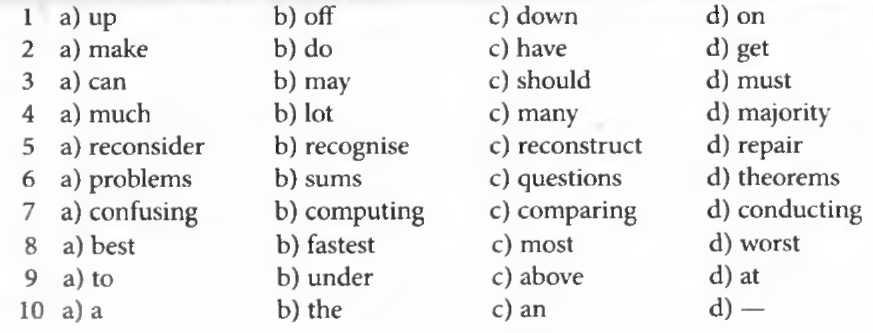
A robot's brain is a computer. It switches (1) ... the parts of the robot that make it move and (2)... certain tasks. The programmer programs the robot with information for each task. A simple task needs very complicated software and hardware.
The robots of today (3)... talk, play football, walk upstairs, dance and even conduct an orchestra! A (4) ... of robots can see and hear — using cameras and microphones with software that helps them (5) ... things. Some can even smell. Robots can't think like we do, but some robots can solve (6).... They collect information, and process it by (7) ... it to the data in their program. Then they "decide" which is the (8) ... solution. Some robots can also communicate with humans (9) ... a very simple level: their software can recognise people's body language and how they use their voice. Now (10) ... South Korean professor has developed new software using human DNA as a model. He says it will give robots personalities and feelings.
Text taken from Quick Smart English Pre-Intermediate
by Rebecca Robb Benne
II.Fill in the gaps in the text with the correct forms of the words in CAPITAL LETTERS at the end of each line.
| Without my computer I would not have the pleasure of the getting to my favourite sites, I would have difficulty (1) ... with friends, and I would not be able to do my work for school. I often wonder how we all managed before computers were a common place in the home. I just don't have the time to be always running to the post box to send letters. E-mail is very (2) ... when you have a tough schedule. Most of my (3) ... time is spent at the computer as by the time I finish doing homework I am too tired and it is often too late to go out. It is a wonderful reference aid and (4) ... tool. If all else fails, you can play cards on it, although my own (5) ... is for action games! |
COMMUNICATE
IMPORTANCE
RELAX
EDUCATION PREFER |
| 1. |
|
| 2. |
|
| 3. |
|
| 4. |
|
| 5. |
|
PART IV.WRITING (Student’s Book: ex. 5 p. 127);
Write an essay in about 180-200 words.
“Imagine that you could only use ONE of the following: a computer, a mobile phone or a fridge”
PARTV. SPEAKING
Оценочные и методические материалы
Образец варианта контрольной работы №4 по теме «Мир возможностей»
Планируемые результаты:
- проверить у учащихся восприятие на слух и понимание основного содержания аутентичных аудио текстов различных жанров
- проконтролировать умение читать и понимать простые аутентичные тексты различных стилей и отвечать на уточняющие вопросы
- проверить у учащихсязнание логично и чётко распределять информацию внутри абзацев в письменных текстах
- умение распознавать и употреблять изученные лексические единицы
- умение распознавать и употреблять в речи и в заданиях грамматические времена
- проверить умение писать письмо- заявление, излагать сведения о себе в форме, принятой в стране изучаемого языка
The 10-th form
PROGRESS CHECK 4
PART I. LISTENING COMPREHENSION (Student’s Book: ex 1 p. 157) (16 points)
1. a) Listen to the airline safety instructions and match the pictures with the items mentioned on the recording.
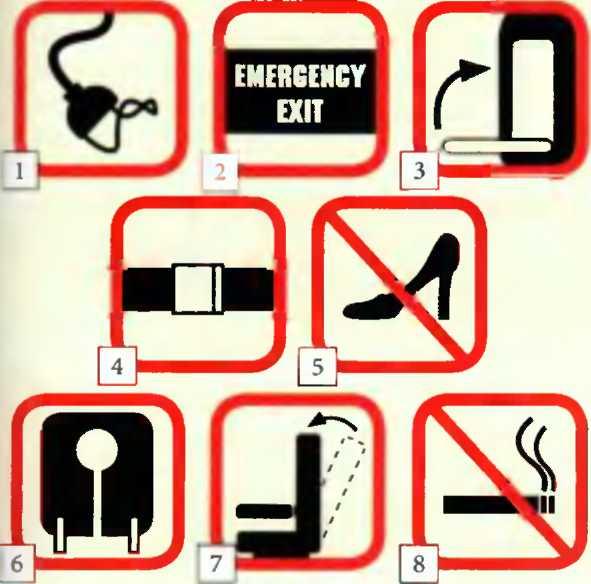
| Items | Picture numbers | Items in the correct order |
| A. table folded away |
|
|
| В. life jacket |
|
|
| С. oxygen masks |
|
|
| D. seat in upright position |
|
|
| E. no smoking sign |
|
|
| F. emergency exit |
|
|
| G. no high-heeled shoes sign |
|
|
| H. seat belts |
|
|
b) Listen again and put the items on the list in the correct order.
PART II. READING (. (18 points)
1. Read the text and match the headings with the paragraphs. (8 points)
We are all thinking about our holidays this time of the year, so to help you prepare, here is the list of top things you must not leave without.
| 1 swimwear | 5 guidebook |
| 2 clothes | 6 sun lotion |
| 3 good book | 7 medication |
| 4 money | 8 documents |
a) An all important requirement that you must not forget, especially if it's prescribed as it might not be easy to get hold of abroad. The last thing you want is to feel ill or worried on your holiday.
b) This will save you a lot of time because you won't be deciding what you want to do for half the day before eventually agreeing on something. It's a great way to find out about the culture and traditions of the area that you are going to be staying in.
c) Please don't forget these, especially if your tickets and your passports are kept together with them!!!!
d) Remember not to pack too much! It's a good idea to lay everything out on your bed that you want to pack and then be really ruthless and only take what you really need!
e) Applicable to so many holidays as the weather does get hot sometimes and your skin can burn. Even if you're going on a ski holiday, you still need to bring it as the rays of the sun reflect off the snow making it even more dangerous.
f) Where would we be without at least some cash? Of course, you can take your credit card with you, but it is essential to carry a small amount of cash. Telephone calls, bottles of water, sweets, etc are all small purchases that are better paid with cash.
g) OK, so you will be on holiday, but that doesn't mean you have every moment planned. You may want to relax before going to bed. You can also read on the beach, or while travelling.
h) Nearly always essential even if you're not going to the beach, as some hotels in the cities
might have swimming pools. You'll only envy the other people enjoying the water if you don't bring yours along.
2. Read the text and choose the correct options to fill in the gaps. (10 points)
Package holidays, covering a two weeks' stay in an attractive location are increasingly popular, because they offer an (1) ... price with few extras. Once you get to the airport, it is up to the (2) ... operator to see that you get safely to your (3) ... . Excursions, local (4) ... , swimming, sunbathing, skiing — you name it — it's all laid out for you.
There is, in fact, no reason for you to bother to (5) ... anything yourselves. You (6) ... friends and (7) ... a good time, but there is very little chance that you will really get to know the local people. This is even less likely on a bus trip, when you spend most of your time travelling. Of course, there are carefully scheduled stops for you to visit (8)... buildings and monuments, but you'll probably be allowed only a brief stay (9) ... in some famous city, with a polite reminder to be (10) ... and have breakfast early in time for the bus next morning. You may visit the beautiful, the historic, the ancient, but there is always a time constraint.
| | А inclusive | В inclusion | C exclusive | Dincluding |
| | А journey | B travel | C trip | Dtour |
| | А vacation | B location | C allocation | Ddestination |
| | А enjoyment | B fulfillment | C entertainment | Damusement |
| | А provide | B supply | C guarantee | Darrange |
| | А make | B do | Chave | Dget |
| | А do | B have | Cget | Dmake |
| | А historic | B history | Chistorical | Dhistorian |
| | А overdue | B overtime | Coverday | Dovernight |
| | А about | B down | Cout | Dup |
PART III. USE OF ENGLISH (GRAMMAR/ VOCABULARY) (6 points)
1. Fill in the gaps in the text with the correct forms of the words in CAPITAL LETTERS at the end of each line.
| Bowing The tradition of bowing is so (0) complexthat Asians attend special classes to learn how to do it (1).... It's unlikely that any international (2) ... would be able to carry out the formal bow(3) ..., doing it to the right depth and with the correct duration. However, a polite attempt to bow in greeting will be appreciated by your (4) ... acquaintance. If you want to express some special respect in the (5) ..., bow lower. Be sure to learn an appropriate verbal (6)...to accompany the bow. |
0) COMPLEXITY |
| 1) PROPER | |
| 2) VISIT | |
| 3) APPROPRIATE | |
| 4) ASIA | |
| 5) RELATION | |
| 6) GREET | |
|
|
PART IV. WRITING (Student’s Book: p. 159) (5 points)
You see this advertisement and decide to respond to it. Write your letter of application (about 180-200 words).
The university welcomes applications to all its courses from overseas students. Please write to the International Department giving details of the course you wish to apply for and why. Your letter should include an outline of your achievements and qualifications and any other relevant information.
PART V. SPEAKING (Student’s Book: p. 159) (5 points)
Вебинар для учителей
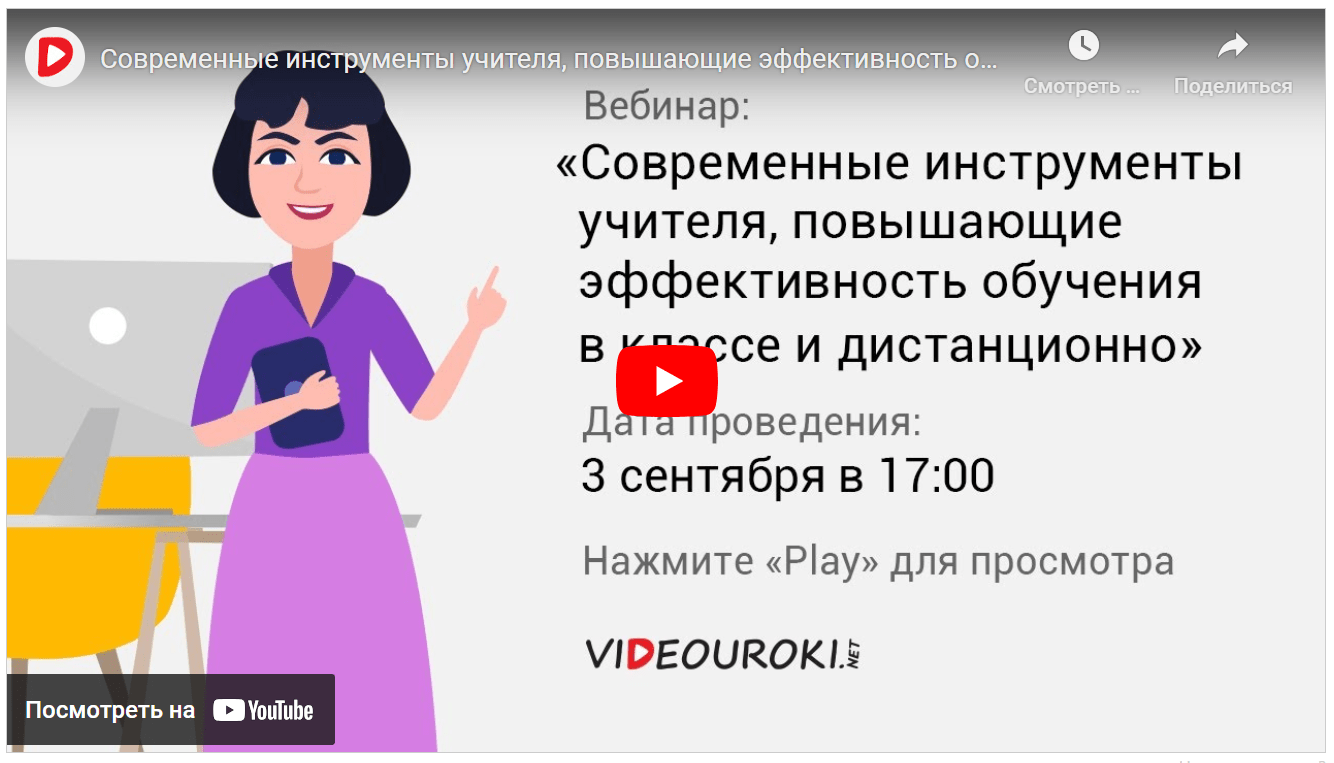
Свидетельство об участии БЕСПЛАТНО!