Кыргызстан, Жалалабат

СДЕЛАЙТЕ СВОИ УРОКИ ЕЩЁ ЭФФЕКТИВНЕЕ, А ЖИЗНЬ СВОБОДНЕЕ
Благодаря готовым учебным материалам для работы в классе и дистанционно
Скидки до 50 % на комплекты
только до
Готовые ключевые этапы урока всегда будут у вас под рукой
Организационный момент
Проверка знаний
Объяснение материала
Закрепление изученного
Итоги урока
Была в сети 18.05.2020 04:53

Малабекова Сонунгул Кадыркуловна
Учитель английского языка
43 года
 618
618
 93 262
Местоположение
Специализация
Past Continuous
Категория:
Английский язык
29.02.2020 12:22

Просмотр содержимого документа
«Past Continuous»
Past Continuous
FORM
[was/were + present participle]
Examples:
You were studying when she called.
Were you studying when she called?
You were not studying when she called.
Complete List of Past Continuous Forms
USE 1 Interrupted Action in the Past

Use the Past Continuous to indicate that a longer action in the past was interrupted. The interruption is usually a shorter action in the Simple Past. Remember this can be a real interruption or just an interruption in time.
Examples:
I was watching TV when she called.
When the phone rang, she was writing a letter.
While we were having the picnic, it started to rain.
What were you doing when the earthquake started?
I was listening to my iPod, so I didn't hear the fire alarm.
You were not listening to me when I told you to turn the oven off.
While John was sleeping last night, someone stole his car.
Sammy was waiting for us when we got off the plane.
While I was writing the email, the computer suddenly went off.
A: What were you doing when you broke your leg?
B: I was snowboarding.
USE 2 Specific Time as an Interruption
In USE 1, described above, the Past Continuous is interrupted by a shorter action in the Simple Past. However, you can also use a specific time as an interruption.
Examples:
Last night at 6 PM, I was eating dinner.
At midnight, we were still driving through the desert.
Yesterday at this time, I was sitting at my desk at work.
IMPORTANT
In the Simple Past, a specific time is used to show when an action began or finished. In the Past Continuous, a specific time only interrupts the action.
Examples:
Last night at 6 PM, I ate dinner.
I started eating at 6 PM.
Last night at 6 PM, I was eating dinner.
I started earlier; and at 6 PM, I was in the process of eating dinner.
USE 3 Parallel Actions

When you use the Past Continuous with two actions in the same sentence, it expresses the idea that both actions were happening at the same time. The actions are parallel.
Examples:
I was studying while he was making dinner.
While Ellen was reading, Tim was watching television.
Were you listening while he was talking?
I wasn't paying attention while I was writing the letter, so I made several mistakes.
What were you doing while you were waiting?
Thomas wasn't working, and I wasn't working either.
They were eating dinner, discussing their plans, and having a good time.
USE 4 Atmosphere
In English, we often use a series of parallel actions to describe the atmosphere at a particular time in the past.
Example:
When I walked into the office, several people were busily typing, some were talking on the phones, the boss was yelling directions, and customers were waiting to be helped. One customer was yelling at a secretary and waving his hands. Others were complaining to each other about the bad service.
USE 5 Repetition and Irritation with "Always"

The Past Continuous with words such as "always" or "constantly" expresses the idea that something irritating or shocking often happened in the past. The concept is very similar to the expression "used to" but with negative emotion. Remember to put the words "always" or "constantly" between "be" and "verb+ing."
Examples:
She was always coming to class late.
He was constantly talking. He annoyed everyone.
I didn't like them because they were always complaining.
While vs. When
Clauses are groups of words which have meaning, but are often not complete sentences. Some clauses begin with the word "when" such as "when she called" or "when it bit me." Other clauses begin with "while" such as "while she was sleeping" and "while he was surfing." When you talk about things in the past, "when" is most often followed by the verb tense Simple Past, whereas "while" is usually followed by Past Continuous. "While" expresses the idea of "during that time." Study the examples below. They have similar meanings, but they emphasize different parts of the sentence.
Examples:
I was studying when she called.
While I was studying, she called.
REMEMBER Non-Continuous Verbs / Mixed Verbs
It is important to remember that Non-Continuous Verbs cannot be used in any continuous tenses. Also, certain non-continuous meanings for Mixed Verbs cannot be used in continuous tenses. Instead of using Past Continuous with these verbs, you must use Simple Past.
Examples:
Jane was being at my house when you arrived. Not Correct
Jane was at my house when you arrived. Correct
ADVERB PLACEMENT
The examples below show the placement for grammar adverbs such as: always, only, never, ever, still, just, etc.
Examples:
You were just studying when she called.
Were you just studying when she called?
ACTIVE / PASSIVE
Examples:
The salesman was helping the customer when the thief came into the store. Active
The customer was being helped by the salesman when the thief came into the store. Passive
Past Continuous
Introduction
The past continuous tense (also called the past progressive tense) is commonly used in English for actions which were going on (had not finished) at a particular time in the past. This page will explain the rules for forming the tense, and how it is used.

1. Forming the past continuous tense
This tense was formed using two components: the verb BE (in the past tense), and the -ING form of a verb. Here are the rules, using the example verb "sing":
| Subject | BE | -ING Form |
| I | was | singing |
| You | were | singing |
| He | was | singing |
| She | was | singing |
| It | was | singing |
| We | were | singing |
| They | were | singing |
2. When to use the past continuous
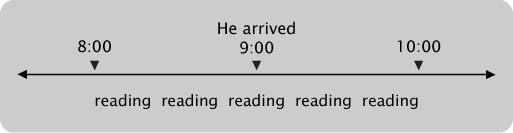
The past continuous is usually used when one action began before another, and finished after it. Consider this sentence:
I was reading when he arrived.
In other words I started reading (maybe at 8 o'clock), then he arrived (maybe at 9 o'clock), then I finished reading (maybe at 10 o'clock). Here is a diagram:
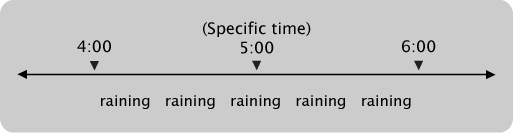
We can also use the tense when we talk about an action that had already started and was still continuing at a particular time:
At five o'clock, it was raining.
In other words it started raining (maybe at 4 o'clock), and finished raining later (maybe at 6 o'clock). Here is a diagram:
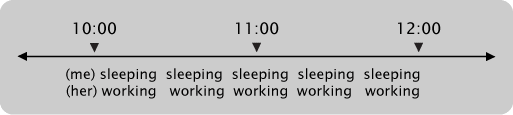
Finally, we can use this tense to describe TWO actions that were BOTH continuing at the same time in the past. In this case, we use the past continuous for both actions:
While I was sleeping, she was working.
In other words I started sleeping and she started working (maybe at 10 o'clock), and we both finished our actions later (maybe at 12 o'clock). Here is a diagram:
Past Continuous Tense
| I was singing |
The past continuous tense is an important tense in English. We use it to say what we were in the middle of doing at a particular moment in the past.
The structure of the past continuous tense is:
| subject | + | auxiliary verb BE | + | main verb |
|
| conjugated in simple past tense |
| present participle | |
| was | base + ing | |||
For negative sentences in the past continuous tense, we insert not between the auxiliary verb and main verb. For question sentences, we exchange the subject and auxiliary verb. Look at these example sentences with the past continuous tense:
|
| subject | auxiliary verb |
| main verb |
|
| + | I | was |
| watching | TV. |
| + | You | were |
| working | hard. |
| - | He, she, it | was | not | helping | Mary. |
| - | We | were | not | joking. |
|
| ? | Were | you |
| being | silly? |
| ? | Were | they |
| playing | football? |
How do we use the Past Continuous Tense?
The past continuous tense expresses action at a particular moment in the past. The action started before that moment but has not finished at that moment. For example, yesterday I watched a film on TV. The film started at 7pm and finished at 9pm.
| At 8pm yesterday, I was watching TV. | |||||
| past | present | future | |||
| |||||
| At 8pm, I was in the middle of watching TV. |
|
| |||

When we use the past continuous tense, our listener usually knows or understands what time we are talking about. Look at these examples:
I was working at 10pm last night.
They were not playing football at 9am this morning.
What were you doing at 10pm last night?
What were you doing when he arrived?
She was cooking when I telephoned her.
We were having dinner when it started to rain.
Ram went home early because it was snowing.
Some verbs cannot be used in continuous/progressive tenses.
We often use the past continuous tense to "set the scene" in stories. We use it to describe the background situation at the moment when the action begins. Often, the story starts with the past continuous tense and then moves into the simple past tense. Here is an example:
" James Bond was driving through town. It was raining. The wind was blowing hard. Nobody was walking in the streets. Suddenly, Bond saw the killer in a telephone box..."
Past Continuous Tense + Simple Past Tense
We often use the past continuous tense with the simple past tense. We use the past continuous tense to express a long action. And we use the simple past tense to express a short action that happens in the middle of the long action. We can join the two ideas with when or while.
In the following example, we have two actions:
long action (watching TV), expressed with past continuous tense
short action (telephoned), expressed with simple past tense
| past | present | future | |||||||||
| Long action. |
|
| |||||||||
| |||||||||||
| Short action. |
|
| |||||||||

We can join these two actions with when:
I was watching TV when you telephoned.
(Notice that "when you telephoned" is also a way of defining the time [8pm].)
We use:
when + short action (simple past tense)
while + long action (past continuous tense)
There are four basic combinations:
|
| I was walking past the car | when | it exploded. |
| When | the car exploded |
| I was walking past it. |
|
| The car exploded | while | I was walking past it. |
| While | I was walking past the car |
| it exploded. |
Notice that the long action and short action are relative.
"Watching TV" took a few hours. "Telephoned" took a few seconds.
"Walking past the car" took a few seconds. "Exploded" took a few milliseconds.
Past Continuous tense
It is used to express a continued or ongoing action in past, an ongoing action which occurred in past and completed at some point in past. It expresses an ongoing nature of an action in past. For example, “he was laughing.” This sentence shows ongoing action (laughing) of a person which occurred in past. Past continuous tense is also called past progressive.
Rules: Auxiliary verb “was or were” is used in sentence. 1st form of verb or base verb + ing (present participle) is used as main verb in sentence.
Structure of sentence
Positive sentences
• Subject + auxiliary verb + Main Verb (present participle) + object
• Subject + was/were + (1st form of verb or base verb +ing) +object
If the subject is “he, she, It, I, singular or proper noun” then auxiliary verb “was” is used. If subject is “you, we, they or plural” then auxiliary verb “were” is used.
Examples.
She was crying yesterday.
They were climbing on a hill.
Negative sentences
• Subject + auxiliary verb + NOT + Main verb (present participle) + object
• Subject + was/were + NOT + (1st form of verb or base verb +ing) +object
Rules for using auxiliary verb after subject are same as mentioned above.
Examples.
She was not crying yesterday.
They were not climbing on a hill.
Interrogative sentences
• Auxiliary verb + Subject + Main verb (present participle) + object
• Was/were + Subject + (1st form of verb or base verb +ing) +object
The interrogative sentence starts with the auxiliary verb. If the subject is “he, she, It, I, singular or proper noun” then the sentence starts with auxiliary verb “was”. If subject is “you, we, they or plural” then the sentence starts with auxiliary verb “were”.
Examples.
Was she crying yesterday?
Were they climbing on a hill?
More Examples
Positive sentences
They were laughing at the joker.
He was taking exam last month
You waiting for him yesterday
She was working in a factory.
It was raining yesterday.
Negative sentences
They were not laughing at the joker.
He was not taking exam last month
You were not waiting for him yesterday
She was not working in a factory.
It was not raining yesterday.
Interrogative sentences
Were they laughing at the joker?
Was he taking exam last month?
Were you waiting for him yesterday?
Was she working in a factory?
Was it raining yesterday?
past continuous
The past continuous is formed from the past tense of be with the -ing form of the verb:
We use the past continuous to talk about the past:
for something which continued before and after another action:
The children were doing their homework when I got home.
Compare:
I got home. The children did their homework.
and
The children did their homework when I got home.
As I was watching television the telephone rang.
This use of the past continuous is very common at the beginning of a story:
The other day I was waiting for a bus when …
Last week as I was driving to work …
for something that happened before and after a particular time:
It was eight o’clock. I was writing a letter.
Compare:
At eight o’clock I wrote some letters.
In July she was working in McDonald’s.
.to show that something continued for some time:
My head was aching.
Everyone was shouting.
for something that was happening again and again:
I was practising every day, three times a day.
They were meeting secretly after school.
They were always quarrelling.
with verbs which show change or growth:
The children were growing up quickly.
Her English was improving.
My hair was going grey.
The town was changing quickly.
sing The Past Continuous Tense:
When and While
|
| The past continuous tense is most commonly used when In such a situation, the connecting words while and when Because "I was driving home" is the longer action and While I was driving home, I ran out of gas. / When I ran out of gas, I was driving home. / _______________________ Because "Jim was working in Chicago" is the longer While Jim was working in Chicago, he bought his When Jim bought his first car, he was working in _______________________
Sometimes two short actions happen at almost the same Julia fell down. Fred helped her get up. --- When Julia fell down, Fred helped her get up. / When Diego lost the race, he almost cried. / _______________________
Sometimes two long actions happen at the same time The chairman was speaking. Everyone was While the chairman was speaking, everyone was Jane was planning her day. Jane was driving to work. --- While Jane was driving to work, she was planning ______________________________________________ Notice that if a sentence begins with when or while, When I ran out of gas, . . . . . While I was driving home, . . . . . Notice that if a sentence has when or while in the middle, I was driving home when . . . . . I ran out of gas while . . . . . |
The Past Continuous Tense
The past continuous tense is most often used for actions happening at some time in the past.
How to form the past continuous
For actions happening at some time in the past
When we want to talk about an action that was happening over a period of time in the past, we use the past continuous tense. Look at these examples:
At this time last week I was lying on the beach in Florida.
My mother was working in the garden so she didn't hear the telephone when I called her yesterday.
I had my car fixed because it wasn't working properly.
Sorry, I wasn't listening. Can you say it again please?
What were you doing at 8 o'clock yesterday?
Why were you talking to John when I saw you in the cafeteria yesterday?
I went to lunch too early. The food was still being cooked. (passive)
The past continuous is very often used with the past simple to say that something happened in the middle of something else. In each of the following examples, the single event (past simple) happens in the middle of a longer action (past continuous).
You phoned while I was having a bath.
When I got home yesterday, a cat was sitting on the roof.
It started to rain just as we were getting ready to have our picnic.
The boy was standing on the table when the principal came into the room.
Many people were shopping in the market when the bomb exploded.
I saw Noriko in town yesterday. She was wearing a pink dress and an orange hat!
When I went to bed last night the sun was already beginning to rise.
It was lucky we weren't sitting under that tree when the lightning hit.
What were you doing when the lights went off last night?
Were you watching me when I showed you how to do it?
How fast was she driving when she had the accident?
PAST CONTINOUS
Past continuous - form
The past continuous of any verb is composed of two parts : the past tense of the verb to be (was/were), and the base of the main verb +ing.
| Subject | was/were | base-ing |
| They | were | watching |
| Affirmative | ||
| She | was | reading |
| Negative | ||
| She | wasn't | reading |
| Interrogative | ||
| Was | she | reading? |
| Interrogative negative | ||
| Wasn't | she | reading? |
Example: to play, past continuous
| Affirmative | Negative | Interrogative |
| I was playing | I was not playing | Was I playing? |
| You were playing | You were not playing | Were you playing? |
| He, she, it was playing | She wasn't playing | Was she playing? |
| We were playing | We weren't playing | Were we playing? |
| You were playing | You weren't playing | Were you playing? |
| They were playing | They weren't playing | Were they playing? |
Past continuous, function
The past continuous describes actions or events in a time before now, which began in the past and was still going on at the time of speaking. In other words, it expresses an unfinished or incomplete action in the past.
It is used:
often, to describe the background in a story written in the past tense, e.g. "The sun was shining and the birds were singing as the elephant came out of the jungle. The other animals were relaxing in the shade of the trees, but the elephant moved very quickly. She was looking for her baby, and she didn't notice the hunter who was watching her through his binoculars. When the shot rang out, she was running towards the river..."
to describe an unfinished action that was interrupted by another event or action, e.g. "I was having a beautiful dream when the alarm clock rang."
to express a change of mind: e.g. "I was going to spend the day at the beach but I've decided to go on an excursion instead."
with 'wonder', to make a very polite request: e.g. "I was wondering if you could baby-sit for me tonight."
More examples
They were waiting for the bus when the accident happened.
Caroline was skiing when she broke her leg.
When we arrived he was having a bath.
When the fire started I was watching television.
The past progressive puts emphasis on the course of an action in the past.
Form
|
| Positive | Negative | Question |
| I / he / she / it | I was speaking. | I was not speaking. | Was I speaking? |
| you / we / they | You were speaking. | You were not speaking. | Were you speaking? |
Exceptions in Spelling
| Exceptions in spelling when adding ing | Example |
| final e is dropped (but: ee is not changed) | come – coming |
| after a short, stressed vowel, the final consonant is doubled | sit – sitting |
| l as final consonant after a vowel is doubled (in British English) | travel – travelling |
| final ie becomes y | lie – lying |
Use of Past Progressive
puts emphasis on the course of an action in the past
Example: He was playing football.
two actions happening at the same time (in the past)
Example: While she was preparing dinner, he was washing the dishes.
action going on at a certain time in the past
Example: When I was having breakfast, the phone suddenly rang.
Signal Words of Past Progressive
when, while, as long as
Using the Past Continuous (or past progessive tense)The past continuous tense in English is used quite often, especially when telling stories.
(Click here to learn about how to MAKE this tense)
| 1 | A continuous action in the past which is interrupted by another action or a time: |
| 2 | Background information, to give atmosphere to a story: |
| 3 | An annoying and repeated action in the past, usually with 'always': |
| 4 | For two actions which happened at the same time in the past: |
NB:Remember you can't use this tense or any continuous tense with stative verbs.
Past Progressive - Use 1) actions were in progress at special time in the pastPeter was reading a book yesterday evening.
Anne was writing a letter while Steve was reading the New York Times.
While we were sitting at the breakfast table, the telephone rang.
Andrew was always coming late.
while
to be (was, were) + infinitive + -ing
| I was playing football. | You were playing football. |
| I was not playing football. | You were not playing football. |
| Was I playing football? | Were you playing football? |
Past Progressive/Continuous - Use
The Past Progressive is used when we talk about something which was happening at a special time in the past. It is also called Past Continuous. Have a look at the following examples:
1) action was in progress at special time in the past
Peter was reading a book yesterday evening.
She was listening to the radio.
2) two actions were happening at the same time (the actions do not influence each other)
Anne was writing a letter while Steve was reading the New York Times.
3) together with the Simple Past
While we were sitting at the breakfast table, the telephone rang.
Note:
Past Progressive: were sitting at the table
Simple Past: the telephone rang.
The action in the Simple Past interrupted the action in the Past Progressive.
4) repeated actions irritating the speaker (with always, constantly, forever)
Andrew was always coming late. (I don't like it.)
Simple Past:
Andrew always came late. (Here I don't give a comment.)
Past Progressive/Continuous - Signal words
Past Progressive/Continuous
Summary
Use
Signal words
Form of affirmative, negative sentences and questions
Spelling
Special verbs
Diagram
Long forms and short forms
Exercises - Past Progressive
Past Progressive/Continuous - Signal words
Signal words tell you what tense you have to use. In the Past Progressive we often use a period of time. A typical signal word is while. The Past Progressive is frequently used in sentences together with the Simple Past.
while (In this part of the sentence we usually use Past Progressive.)
While we were watching TV, Andy was surfing the internet.
when (In this part of the sentence we usually use Simple Past. The Past Progressive is used in the other part of the sentence.)
The ladies were talking when the accident happened.
Past Progressive/Continuous - Form
Form of the Past Progressive/Continuous
We use a form of to be (was or were), the infinitive of the verb and the ending –ing.
to be (was, were) + infinitive + -ing
Affirmative sentences:
I/he/she/it was playing football.
We/you/they were playing football.
NOTE: Use was with I, he, she, it -
and were with all other pronouns.
In affirmative sentences we do not use short forms in the Past Progressive.
Negative sentences:
I/he/she/it was not playing football.
We/you/they were not playing football.
We use short forms in the Past Progressive in negative sentences:
I/he/she/it wasn't playing football.
We/you/they weren't playing football.
Questions:
In the Past Progressive we put the auxiliary (was or were) before the subject
(Auxiliary - Subject - Verb - Rest). see: Questions in Past Progressive
Was I/he/she/it playing football?
Were we/you/they playing football?
Past Progressive/Continuous - Spelling
Past Progressive/Continuous
Summary
Use
Signal words
Form of affirmative, negative sentences and questions
Spelling
Special verbs
Diagram
Long forms and short forms
Exercises - Past Progressive
Past Progressive - Spelling
Be careful with some words when adding -ing to the infinitive.
1) consonant after a short, stressed vowel at the end of the word
Double the consonant.
sit – he was sitting
put - he was putting
If the consonant is not stressed, we do not double it:
benefit - benefiting (Here we stress the first 'e', not the 'i'.)
In British English we double one -l at the end of the word:
travel - travelling
2) one -e at the end of the word
Leave out the -e.
write – he was writing
take – he was taking
BUT:
double –e: add -ing
see – he was seeing
3) verbs ending in -ie
Change 'ie' to 'y'.
lie - he was lying
4) verbs ending in -c
Change 'c' to 'ck'.
picnic - he was picnicking
Special verbs in the Past Progressive
| 1) have as a full verb | ||
| affirmative sentence | negative sentence | question |
| I was having a bath. | I was not having a bath. | Was I having a bath? |
| he, she, it: | ||
| He was having a bath. | He was not having a bath. | Was he having a bath? |
| we, you, they: | ||
| You were having a bath. | We were not having a bath. | Were we having a bath? |
| 2) do as a full verb | ||
| affirmative sentence | negative sentence | question |
| I was doing an exercise. | I was not doing an exercise. | Was I doing an exercise? |
| he, she, it: | ||
| He was doing an exercise. | He was not doing an exercise. | Was he doing an exercise? |
| we, you, they: | ||
| We were doing an exercise. | We were not doing an exercise. | Were we doing an exercise? |
We often use the short forms with these verbs.
Past Progressive/Continuous - DiagramPast Progressive/Continuous
Summary
Use
Signal words
Form of affirmative, negative sentences and questions
Spelling
Special verbs
Diagram
Long forms and short forms
Exercises - Past Progressive
Past Progressive - DiagramWe use the Past Progressive when we talk about something which was happening around a period of time in the past.
We use the Past Progressive (blue) together with the Simple Past (pink). The Past Progressive is used for the action in the past which was in progress when a new action (Simple Past) happened.
Two actions which were in progress in the past do not influence each other.
Long forms and short forms in the Past Progressive
We use short forms of the auxiliaries. The Past Progressive is formed with the auxiliary to be (was, were), so short forms are only possible in negative sentences.
| affirmative | |
| long form | short form |
| I was reading | can't be formed |
| he, she, it: | |
| he was reading | |
| we, you, they: | |
| we were reading | |
| negative (not after to be) | |
| long form | short form |
| I was not reading | I wasn't reading |
| he, she, it: | he, she, it: |
| he was not reading | he wasn't reading |
| we, you, they: | we, you, they: |
| we were not reading | we weren't reading |
How to Teach the Past Continuous Tense
One click!
That's all it takes for you to say 'thank you' for the articles you find useful! Use the buttons above to show us your love, we know you want to!
Close
The past continuous is another tense that is commonly taught to beginners, usually after they’ve learned the past simple. Although it has its nuances, we usually use it talk about actions that were in progress at a specific time in the past. We also use it in conjunction with the past simple when talking about interruptions (I was doing my homework when the phone rang). As students should already be familiar with the present continuous, and the past of the verb to be, this tense usually doesn't pose great difficulties, and students are able to naturally incorporate it into their speech.
How To Proceed
1
Introduce the Past Continuous
Tell students what you usually do late at night, and lead in to the past continuous: I always go to bed at 11pm. So, last night at 11:30 I was sleeping. Write your typical schedule on the board with your usual everyday activities:
7:30 am – breakfast
9 to 12 – classes
12 – lunch
1pm to 5pm – classes
6pm – gym
8pm – dinner
11pm – bedtime
Now, give them examples of what you were doing exactly at a certain time yesterday: At noon, I was having lunch. At 1pm, I was giving a class. Ask students to tell you what you were doing, and have them answer in second person singular: You were sleeping at midnight.
Students jot down their own daily schedules, or what they did yesterday, and then take turns first saying what they were doing at certain time: I was having breakfast at 7am. Then, they switch schedules with a classmate and say what he or she was doing: Juan was having breakfast at 10 am. Then, they make comparisons: I was studying. He was playing video games. Or find similarities: We were all sleeping at midnight.
Here’s a great worksheet to give students so they can practice the past continuous.
2
Introduce the Past Continuous – Negative forms
Use the same daily schedule of activities and make negative statements:
I wasn’t watching TV at 3pm; I was working.
Juan wasn’t having breakfast at 7am; he was sleeping.
Use your students’ schedules as well. Then, ask them to do the same, first with theirs, and then with a classmates’, but always alternating between negative and affirmative statements.
3
Introduce the Past Continuous – Interrogative forms
First, model yes or no questions, then, questions with what, where, which, etc…:
- T: Were you watching TV at midnight last night?
- S: No!
- T: Ask me!
- S: Were you watching TV at midnight last night?
- T: What were you doing at 7am this morning?
- S: I was sleeping.
- T: Ask Juan!
- S: What were you doing, Juan, at 7am?
Continue with more questions from students. Encourage them to ask different types of questions in different singular and plural persons. If they are unsure as to how to ask a question, model it for them first.
4
Introduce the Past Continuous – Short answers
Ask yes or no questions and model the correct way to give short answers:
- T: Were you watching TV yesterday at 10pm?
- S: Yes, I was./No, I wasn’t.
Ask students to ask each other yes or no questions in past continuous, and have them practice replying with short answers.
5
Extended practice and contrast with Past Simple
It is essential at this point, for them to not only practice with as many exercises as necessary, for example, those found at BusyTeacher.org’s Past Continuous worksheets section, but also to learn the difference between the past simple and the past continuous. There are numerous worksheets that deal with this contrast specifically.
Remember that another great way to practice this tense in the classroom is through a variety of resources, like images, photos, cartoons, songs, and videos. For example, this worksheet provides exercises based on the trailer for the second film in the Twilight Saga, New Moon, and these are films that are very popular with teens these days. If you practice any tense with materials that students can relate to, or are interested in, you’ll make learning new tenses so much more fun for them!
The Past Continuous
(or past progressive tense)
How can we make the past continuous? Firstly, check that you know how to make the past simple with 'be' (subject + was / were). Then just add verb-ing.
(Click here for practice on how to USE the past continuous)
Here's the positive form:
I was sleeping
you were working
he was coming
she was reading 'War and Peace'
it was raining
we were shopping
they were watching a film
Next, here's the negative - it's very easy, just add 'not':
I was not (wasn't) sleeping
you were not (weren't) working
he was not (wasn't) coming
she was not (wasn't) reading 'War and Peace'
it was not (wasn't) raining
we were not (weren't) shopping
they were not (weren't) watching a film
Here's an exercise about the positive and negative verb forms
And, just like the past simple with 'be', to make a 'yes / no' question, put 'was / were' in front of the subject:
Was I listening?
Were you working?
Was she working?
Was he living in Paris at the time?
Was it snowing when you arrived?
Were we eating?
Were they studying?
To make a 'wh' question (of course) put the question word at the beginning:
Why was I working?
Where were you living?
How was she travelling?
Where was he going?
Why was it snowing in the summer?
What were we eating?
Why were they studying?
Using the Past Continuous
(or past progessive tense)
The past continuous tense in English is used quite often, especially when telling stories.
(Click here to learn about how to MAKE this tense)
| 1 | A continuous action in the past which is interrupted by another action or a time: |
| 2 | Background information, to give atmosphere to a story: |
| 3 | An annoying and repeated action in the past, usually with 'always': |
| 4 | For two actions which happened at the same time in the past: |
NB:Remember you can't use this tense or any continuous tense with stative verbs.
Advanced Level: Past Continuous Tense
Начало формы
Form
Was/were + present participle
You were reading when I walked in.
Were you studying when I called you?
You were not working when I called you.
The Past Continuous has 4 main uses/functions:
Use 1 – an interrupted action in the past
Here the Past Continuous is used to indicate a long action that was interrupted. Usually the action that interrupts the long action is the Past Simple.
I was studying when Danny called me.
She was answering an important e-mail when I interrupted her.
While I was jogging, it started raining.
What was he doing when you walked into the room?
John was waiting for us when we got off the train.
I broke my leg while I was skiing.
Use 2 – parallel actions
The Past Continuous is used to indicate that two actions were happening at the same time; hence parallel actions.
I was watching TV while the children were playing outside.
Were you listening while Kevin was explaining the new policy?
While Sarah was speaking to Fred, Peter was trying to get her attention.
What were they doing while you were working?
We were discussing the new project and having a good time as well.
Use 3 – describing a mood/atmosphere
We can use the Past Continuous to describe several actions happening at the same time to describe the atmosphere or situation before or as a main action occurs.
When I walked into the bar, Danny and Fred were arguing again. Chris was chatting to the barman with his usual pint. Peter and Sarah were flirting with each other and Liz was telling the rest of the gang one of her outrageous stories about when she was an actress in the West End. The pub was already smelling of pub food and beer and I just felt that it was so good to be home.
Use 4 – repetition – irritation with 'always'
The Past Continuous with words such as 'always' or 'constantly' indicates something repeated or irritating. Words like 'always' should be placed between the auxiliary 'be' and the present participle.
She was always coming late for meetings. No wonder she was never promoted.
He was always boasting about his financial successes. It irritated us all no end.
I was constantly misplacing my glasses. It’s not a problem with contacts now.
While or when
With the Past Continuous sentences have clauses that start with ‘while’ or ‘when’. ‘While’ usually starts the clause with the Past Continuous, ‘when’ usually starts the clause with the Past Simple.
It started raining while I was jogging. / While I was jogging, it started raining.
When it started raining, I was jogging. / I was jogging when it started raining.
Notice that although the meaning of each pair of sentences is the same, 'while' or 'when' shift emphasis.
Now complete the following with the correct form:
1. Last night I _ on my thesis and it took me a while to realise that my phone was ringning.
 worked
was working
2. When you _ I was in a meeting so I couldn’t answer your call.
were calling
called
3. Danny can never agree with Fred. They _ .
are always arguing
always argue
4. Why did you disagree with me at the meeting? _ to make me look incompetent?
Did you try
Were you trying
5. Sarah _ the buffet while I was seeing to the drinks.
was preparing
prepared
6. Peter _ home when the accident occurred.
walked
was walking
7. I _ to work, even when it rained.
always walked
was always walking
8. Anna _ her speech when I walked in.
finished
was finishing
The past continuous tense uses:
was/were + (verb) + ing
was eating or were going
It is used to show something that happened in the past and continued for a while. For example:
From 8:00 to 8:30 I was taking a bath.
We use the past continuous tense with the simple past tense when we want to show that one thing happened in the middle of another thing.
I was taking a bath and the telephone rang.
During a period of time (8:00-8:30) I was taking a bath. At one time (let's say 8:17) someone called on the telephone.
We can also connect the past continuous and simple past together by using the words when,while, and as.
When I was taking a bath, the telephone rang.
The telephone rang when I was taking a bath.
While I was taking a bath, the telephone rang.
The telephone rang while I was taking a bath.
As I was taking a bath, the telephone rang.
The telephone rang as I was taking a bath.
Notice if you use when, while, or as at the beginning of the sentence, you need to put a comma (,) after the phrase.

Past Continuous tense can be introduced at a fairly low level of language acquisition.
There is no shortage of great activities for practicing Past Continuous tense, but it may take some time and review to solidify the point with learners. Here are three great activities to practice Past Continuous tense to get your wheels turning.
Review the Grammar
A quick review of Past Continuous tense will be helpful before you jump into any activities. Ask the students how to construct the tense and have some reminders up on the board. Remind them that the past tense clause expresses some kind of interruption into another activity which is the continuous clause. The interruption didn’t necessarily stop the continuous action, and most likely the continuous action still continued.
| Past tense clause | Past Continuous clause (It doesn’t matter which one comes first.) |
| Your mom called while you were taking a shower. | |
| The president coughed a lot while he was giving his speech. | |
| I drove the car into the gas station just as it was running out of gas. | |
Three Activities for Past Continuous
1
What Were You Doing When…?
Often you can use Past Continuous tense to talk about memories, or for looking back on what was happening at a specific time. With this activity students ask each other questions that they may or may not remember the answer to. For example What were you doing last Tuesday night at dinner time? or What were you doing when xx important thing happened? You can explain that some historical events or other news events leave such an impression on us, we will always remember what we were doing at the time that thing happened. Sometimes our memories are very clear and sometimes they are not. You may want to provide prompts so the students get the idea and then have them generate their own questions. Some ideas for prompts are:
9/11
The earthquake
Last Thursday at dinner time
Princess Diana died
You can also make this into a bluff game by telling students who don’t remember to make something up. For example, I was doing laundry when my mom called or I was driving my car when I heard about 9/11. Their partners can then guess whether the answer is true or not.
2
Alibi
This game is similar to the murder mystery Clue. You can set it up by having the students create the crime they are going to investigate. After that, students are divided into two groups--suspects and detectives. You want to have more suspects and just 2-4 detectives. The suspects each have to create a story of where they were and what they were doing at the time of the crime. They are then questioned by one of the detective students. The detectives must ask questions pertaining to Past Continuous by only asking questions about the time of the murder. For example they could ask questions like: What were you discussing? or Where was the doctor eating? If you want you could set up a jury as well and have the class vote as to who is guilty and why they don’t believe the alibi.
3
Word Cards
Have a stack of cards with random words prepared. Each student will choose two. In rounds have them create a sentence for their pair of words—one word for the past tense clause and one for the past continuous clause. For example, they draw the two words, drive andmonkey. A possible sentence could be: I was driving down the street when I saw a monkey in the road. Or you can tell them to be more creative and allow some nonsense sentences. It does make it more challenging and fun if each of the words has to be used in a different clause. To make this activity even more involved you could have the students create sentences that somehow relate to the last person’s sentence to create a silly sort of story of things that were happening at a given time!
Past Continuous tense is an important one for learners and it may take some time to master it as well as fully understand how to use it.
Providing variable practice activities and tapping into students’ own experiences will provide an experiential way of practicing what could have been just another boring grammar point.
hat Is the Past Progressive Tense? (with Examples)
| The past progressive tense is used to describe an on-going activity in the past. Often, it is used to set the scene for another action. Examples of the Past Progressive Tense The past progressive tense can be used to describe an activity in the past which was interrupted: He was painting the door when a bird struck the window. They were sleeping when the alarm went off. You can also have a negative version: He wasn't painting the door when a bird struck the window. They weren't sleeping when the alarm went off. And, the question version: Was he painting the door when a bird struck the window? Were they sleeping when the alarm went off? The past progressive tense can also be used for describing an action taking place when another occurred. While they were painting the door, I painted the windows. While they weren't painting the door, I painted the windows. Were they painting the door when I painted the windows? Were they painting the door when I painted the windows? And, it can be used for describing an action which was taking place at the same time as another: While they were painting the door, I was painting the windows. Forming the Past Progressive Tense Here is an infographic explaining the past progressive tense: The Other Past Tenses The past progressive tense is one of four past tenses. They are:
Начало формы
Конец формы |





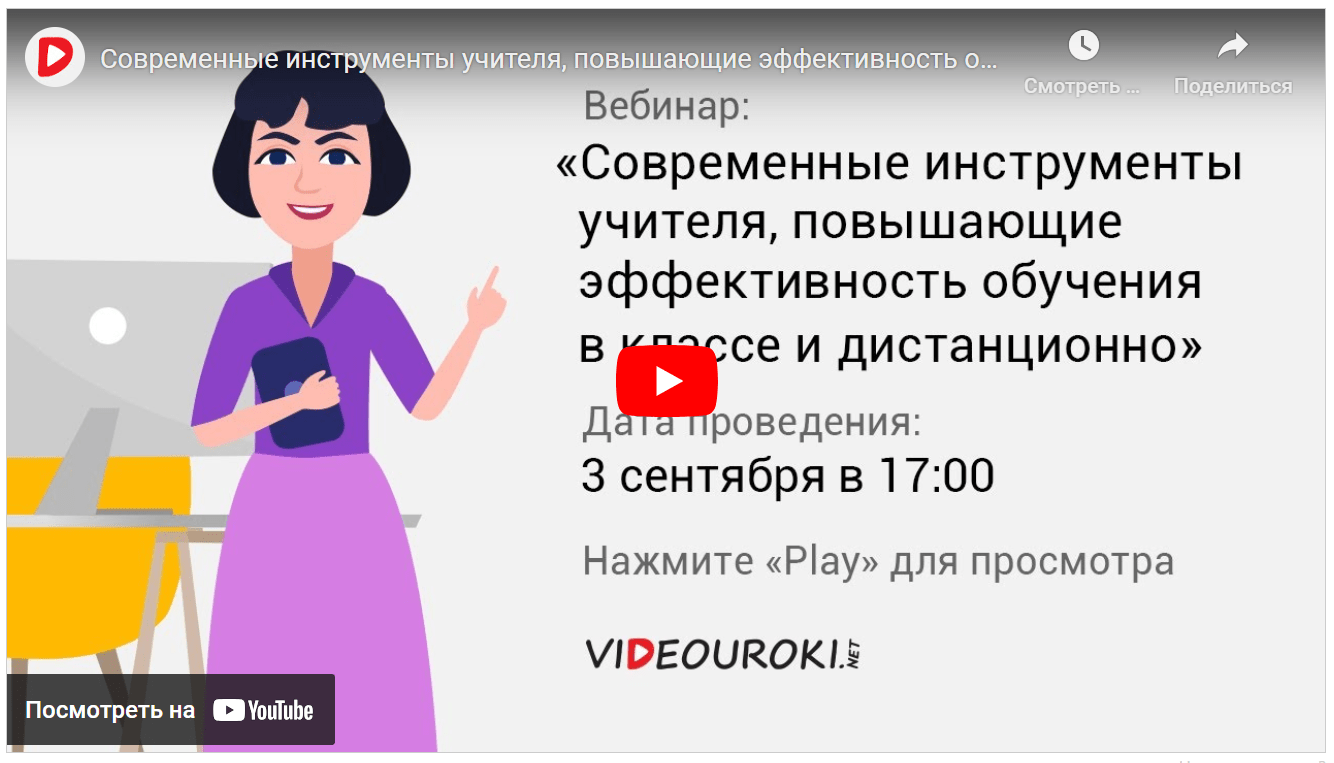
Вебинар для учителей
Свидетельство об участии БЕСПЛАТНО!