Россия, Владимир

СДЕЛАЙТЕ СВОИ УРОКИ ЕЩЁ ЭФФЕКТИВНЕЕ, А ЖИЗНЬ СВОБОДНЕЕ
Благодаря готовым учебным материалам для работы в классе и дистанционно
Скидки до 50 % на комплекты
только до
Готовые ключевые этапы урока всегда будут у вас под рукой
Организационный момент
Проверка знаний
Объяснение материала
Закрепление изученного
Итоги урока
Была в сети 25.02.2024 16:20
Белым Наталья Алексеевна
Учитель английского языка
55 лет
 1 727
1 727
 40 610
Местоположение
Полититеское устройство Великобритании
Категория:
Английский язык
27.06.2020 18:20

Просмотр содержимого документа
«Полититеское устройство Великобритании»
Политическая структура Великобритании
The United Kingdom is a a constitutional monarchy
Executive power :
- the Sovereign, Queen Elizabeth II ,
- Government and Ministers
- Prime Minister and the Cabinet
L egislative power : Parliament
Judiciary power :
- The Supreme Court of the United Kingdom
- Courts of the United Kingdom
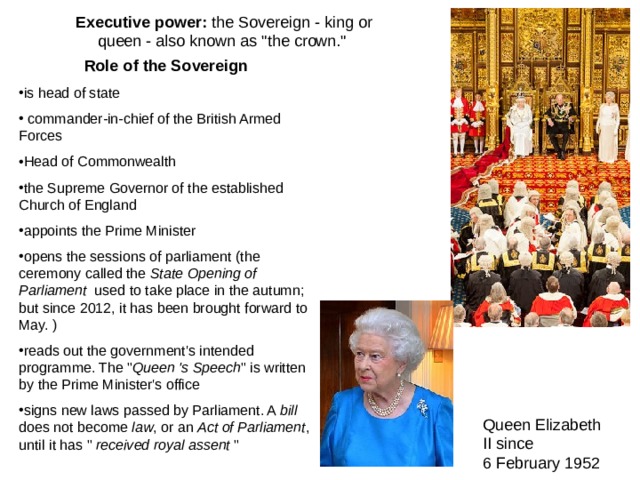
Executive power : the Sovereign - king or queen - also known as "the crown."
Role of the Sovereign
- is head of state
- commander-in-chief of the British Armed Forces
- Head of Commonwealth
- the Supreme Governor of the established Church of England
- appoints the Prime Minister
- opens the sessions of parliament (the ceremony called the State Opening of Parliament used to take place in the a utumn; but since 2012, it has been brought forward to May. )
- reads out the government's intended programme. The " Queen 's Speech " is written by the Prime Minister's office
- sign s new laws passed by Parliament. A bill does not become law , or an Act of Parliament , until it has " received royal assent "
Queen Elizabeth II since 6 February 1952
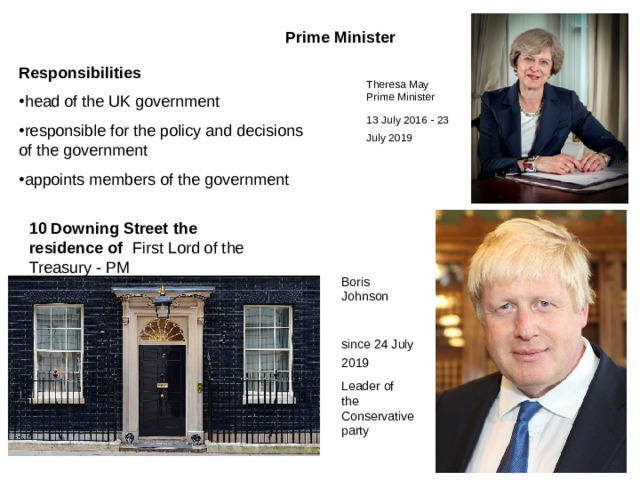
Prime Minister
Responsibilities
- head of the UK government
- responsible for the policy and decisions of the government
- appoints members of the government
Theresa May Prime Minister
13 July 2016 - 2 3 July 2019
10 Downing Street the residence of First Lord of the Treasury - PM
Boris Johnson
since 24 July 2019
L eader of the Conservative party
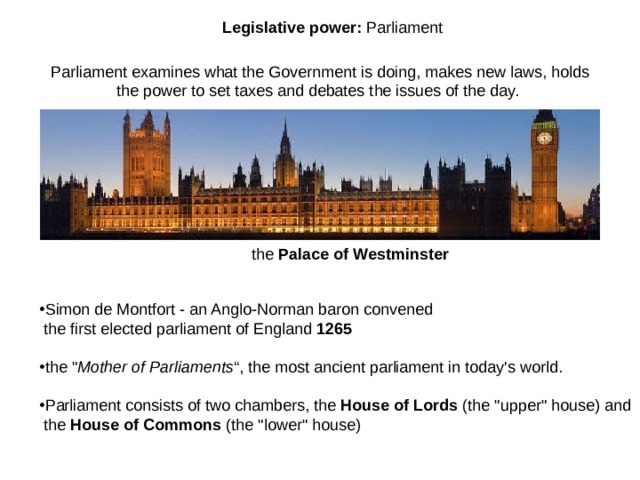
L egislative power : Parliament
Parliament examines what the Government is doing, makes new laws, holds the power to set taxes and debates the issues of the day.
the Palace of Westminster
- Simon de Montfort - an Anglo-Norman baron convened
the first elected parliament of England 1265
- the " Mother of Parliaments “ , the most ancient parliament in today's world.
- Parliament consist s of two chambers, the House of Lords (the "upper" house) and
the House of Commons (the "lower" house)
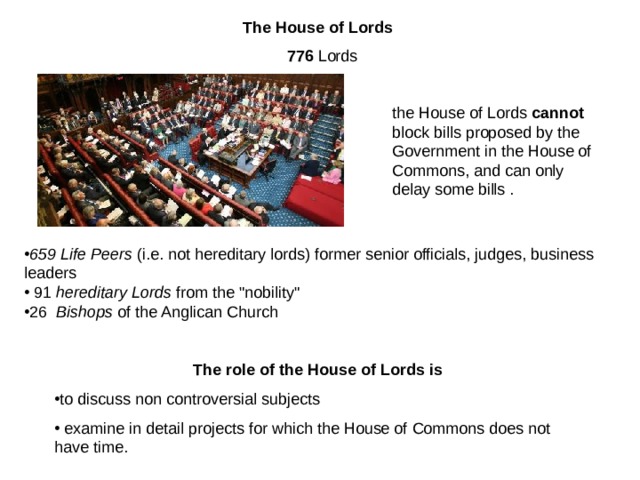
The House of Lords
7 76 Lords
the House of Lords cannot block bills proposed by the Government in the House of Commons, and can only delay some bills .
- 6 59 Life Peers (i.e. not hereditary lords ) former senior officials, judges, business leaders
- 9 1 hereditary Lords from the "nobility"
- 2 6 Bishops of the Anglican Church
The role of the House of Lords is
- to discuss non controversial subjects
- examine in detail projects for which the House of Commons does not have time.
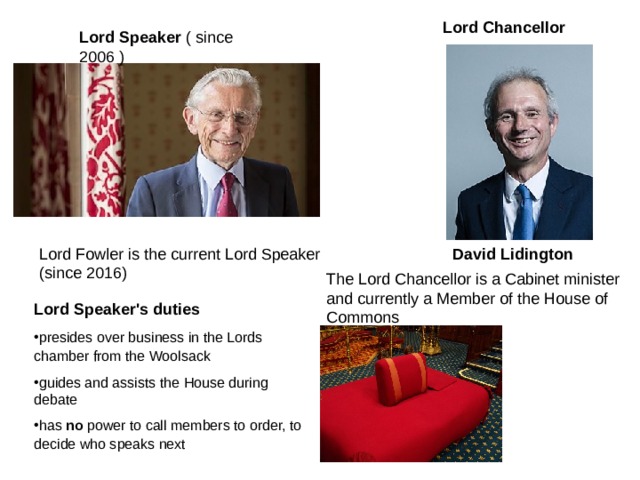
Lord Chancellor
Lord Speaker ( since 2006 )
Lord Fowler is the current Lord Speaker (since 2016)
David Lidington
The Lord Chancellor is a Cabinet minister and currently a Member of the House of Commons
Lord Speaker's duties
- presid es over business in the Lords chamber from the Woolsack
- guides and assists the House during debate
- has no power to call members to order, to decide who speaks next
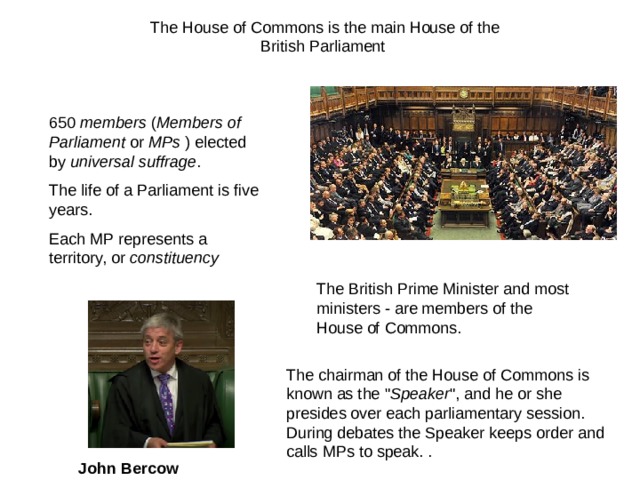
The House of Commons is the main House of the British Parliament
650 members ( Members of Parliament or MPs ) elected by universal suffrage .
The life of a Parliament is five years.
Each MP represents a territory, or constituency
T he British Prime Minister and most ministers - are members of the House of Commons.
The chairman of the House of Commons is known as the " Speaker ", and he or she presides over each parliamentary session . During debates the Speaker keeps order and calls MPs to speak. .
John Bercow
Вебинар для учителей

Свидетельство об участии БЕСПЛАТНО!