
Россия, Нижний Тагил


СДЕЛАЙТЕ СВОИ УРОКИ ЕЩЁ ЭФФЕКТИВНЕЕ, А ЖИЗНЬ СВОБОДНЕЕ
Благодаря готовым учебным материалам для работы в классе и дистанционно
Скидки до 50 % на комплекты
только до
Готовые ключевые этапы урока всегда будут у вас под рукой
Организационный момент
Проверка знаний
Объяснение материала
Закрепление изученного
Итоги урока

Была в сети 31.03.2026 18:09

Фоминых Олеся Геннадьевна
преподаватель английского языка
 25 079
 1 260
1 260 
Местоположение
Специализация
Практическая работа по грамматической теме "Типы вопросов" в английском языке
Категория:
Английский язык
19.03.2026 09:01

Просмотр содержимого документа
«Практическая работа по грамматической теме "Типы вопросов" в английском языке»

ГАПОУ СО «НТГПК им. Н.А. Демидова» Фоминых О.Г. Практическая работа Типы вопросов в английском языке
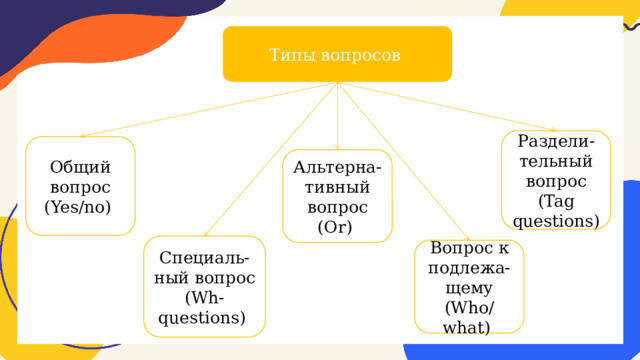
Типы вопросов
Раздели-тельный вопрос
(Tag questions)
Общий вопрос
(Yes/no)
Альтерна-тивный вопрос
(Or)
Специаль-ный вопрос
(Wh-questions)
Вопрос к подлежа-щему
(Who/what)
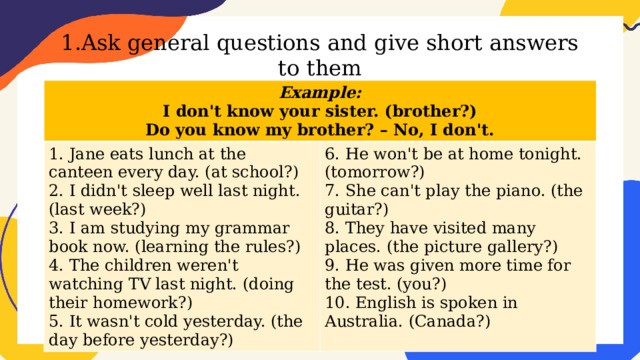
1.Ask general questions and give short answers to them
Example:
I don't know your sister. (brother?)
1. Jane eats lunch at the canteen every day. (at school?)
2. I didn't sleep well last night. (last week?)
6. He won't be at home tonight. (tomorrow?)
Do you know my brother? – No, I don't.
7. She can't play the piano. (the guitar?)
3. I am studying my grammar book now. (learning the rules?)
4. The children weren't watching TV last night. (doing their homework?)
8. They have visited many places. (the picture gallery?)
9. He was given more time for the test. (you?)
5. It wasn't cold yesterday. (the day before yesterday?)
10. English is spoken in Australia. (Canada?)
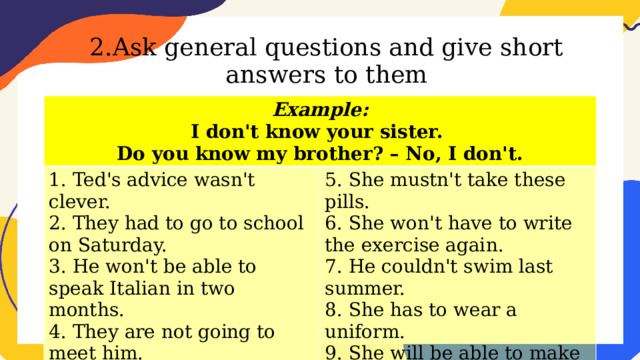
2.Ask general questions and give short answers to them
Example:
I don't know your sister.
1. Ted's advice wasn't clever.
2. They had to go to school on Saturday.
5. She mustn't take these pills.
Do you know my brother? – No, I don't.
6. She won't have to write the exercise again.
3. He won't be able to speak Italian in two months.
4. They are not going to meet him.
7. He couldn't swim last summer.
8. She has to wear a uniform.
9. She will be able to make sandwiches tomorrow.
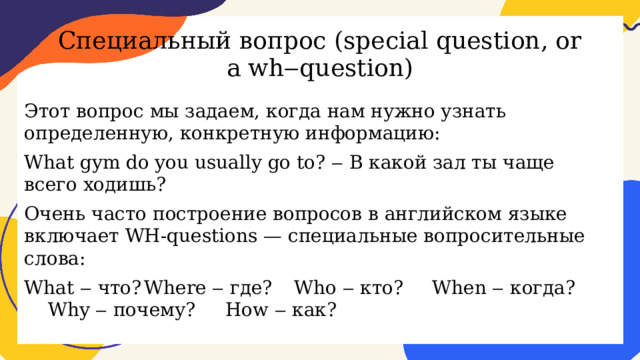
Специальный вопрос (special question, or a wh‒question)
Этот вопрос мы задаем, когда нам нужно узнать определенную, конкретную информацию:
What gym do you usually go to? ‒ В какой зал ты чаще всего ходишь?
Очень часто построение вопросов в английском языке включает WH-questions — специальные вопросительные слова:
What ‒ что? Where ‒ где? Who ‒ кто? When ‒ когда? Why ‒ почему? How ‒ как?
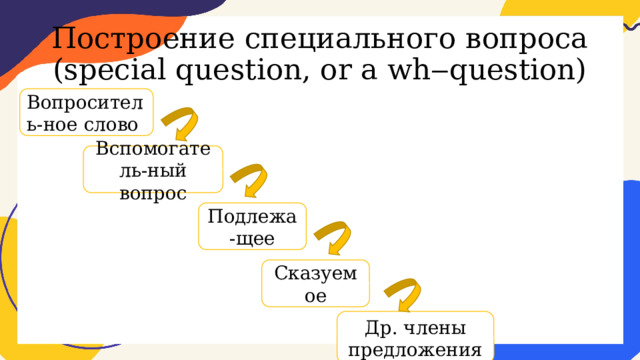
Построение специального вопроса (special question, or a wh‒question)
Вопроситель-ное слово
Вспомогатель-ный вопрос
Подлежа-щее
Сказуемое
Др. члены предложения
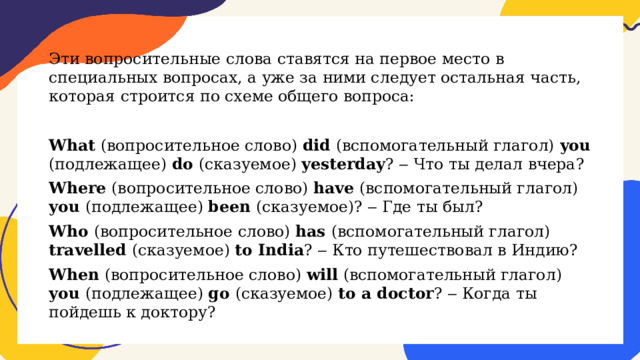
Эти вопросительные слова ставятся на первое место в специальных вопросах, а уже за ними следует остальная часть, которая строится по схеме общего вопроса:
What (вопросительное слово) did (вспомогательный глагол) you (подлежащее) do (сказуемое) yesterday ? ‒ Что ты делал вчера?
Where (вопросительное слово) have (вспомогательный глагол) you (подлежащее) been (сказуемое)? ‒ Где ты был?
Who (вопросительное слово) has (вспомогательный глагол) travelled (сказуемое) to India ? ‒ Кто путешествовал в Индию?
When (вопросительное слово) will (вспомогательный глагол) you (подлежащее) go (сказуемое) to a doctor ? ‒ Когда ты пойдешь к доктору?
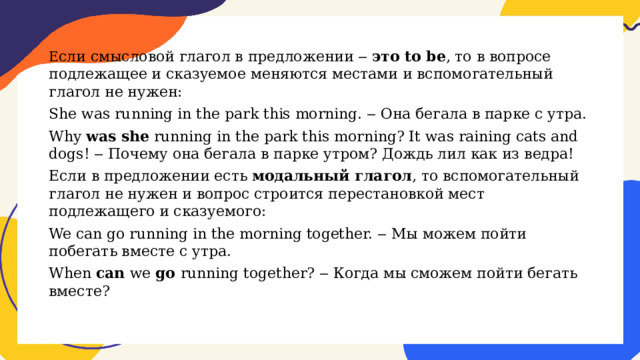
Е сли смысловой глагол в предложении ‒ это to be , то в вопросе подлежащее и сказуемое меняются местами и вспомогательный глагол не нужен:
She was running in the park this morning. ‒ Она бегала в парке с утра.
Why was she running in the park this morning? It was raining cats and dogs! ‒ Почему она бегала в парке утром? Дождь лил как из ведра!
Если в предложении есть модальный глагол , то вспомогательный глагол не нужен и вопрос строится перестановкой мест подлежащего и сказуемого:
We can go running in the morning together. ‒ Мы можем пойти побегать вместе с утра.
When can we go running together? ‒ Когда мы сможем пойти бегать вместе?
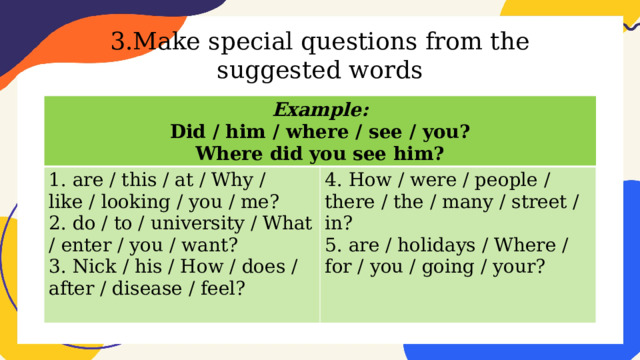
3.Make special questions from the suggested words
Example:
Did / him / where / see / you?
1. are / this / at / Why / like / looking / you / me?
2. do / to / university / What / enter / you / want?
4. How / were / people / there / the / many / street / in?
Where did you see him?
5. are / holidays / Where / for / you / going / your?
3. Nick / his / How / does / after / disease / feel?
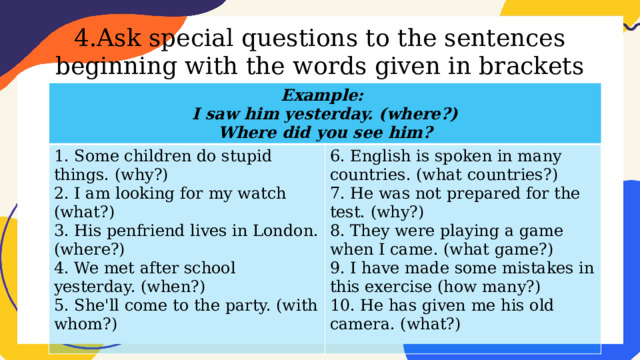
4.Ask special questions to the sentences beginning with the words given in brackets
Example:
I saw him yesterday. (where?)
1. Some children do stupid things. (why?)
2. I am looking for my watch (what?)
6. English is spoken in many countries. (what countries?)
Where did you see him?
7. He was not prepared for the test. (why?)
3. His penfriend lives in London. (where?)
4. We met after school yesterday. (when?)
8. They were playing a game when I came. (what game?)
9. I have made some mistakes in this exercise (how many?)
5. She'll come to the party. (with whom?)
10. He has given me his old camera. (what?)
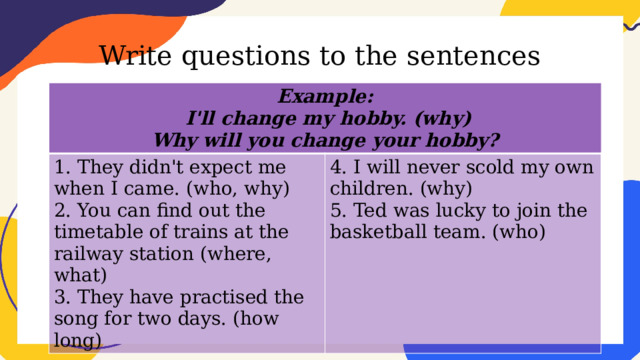
Write questions to the sentences
Example:
I'll change my hobby. (why)
1. They didn't expect me when I came. (who, why)
2. You can find out the timetable of trains at the railway station (where, what)
4. I will never scold my own children. (why)
Why will you change your hobby?
5. Ted was lucky to join the basketball team. (who)
3. They have practised the song for two days. (how long)
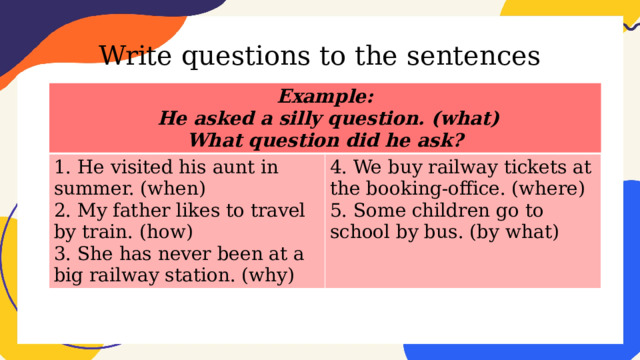
Write questions to the sentences
Example:
He asked a silly question. (what)
1. He visited his aunt in summer. (when)
2. My father likes to travel by train. (how)
4. We buy railway tickets at the booking-office. (where)
What question did he ask?
5. Some children go to school by bus. (by what)
3. She has never been at a big railway station. (why)
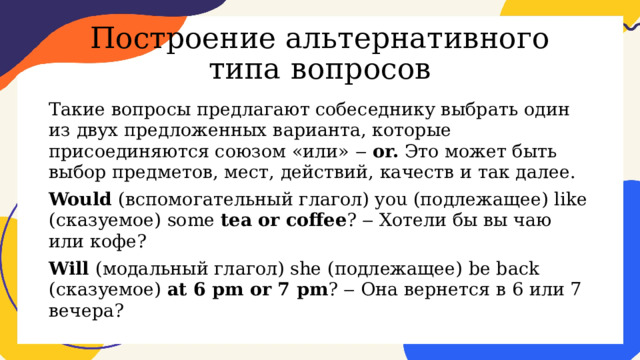
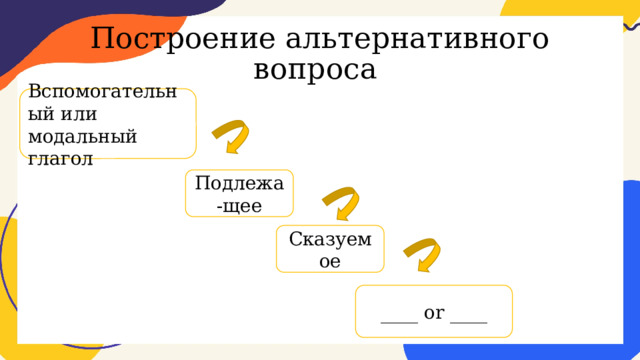
Построение альтернативного типа вопросов
Такие вопросы предлагают собеседнику выбрать один из двух предложенных варианта, которые присоединяются союзом «или» ‒ or. Это может быть выбор предметов, мест, действий, качеств и так далее.
Would (вспомогательный глагол) you (подлежащее) like (сказуемое) some tea or coffee ? ‒ Хотели бы вы чаю или кофе?
Will (модальный глагол) she (подлежащее) be back (сказуемое) at 6 pm or 7 pm ? ‒ Она вернется в 6 или 7 вечера?
Построение альтернативного вопроса
Вспомогательный или модальный глагол
Подлежа-щее
Сказуемое
____ or ____
Make alternative questions from the suggested words
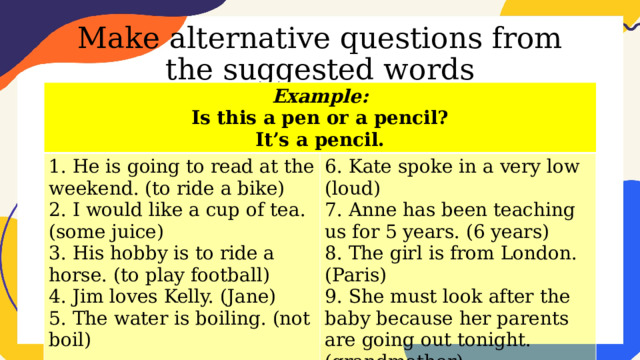
Example:
Is this a pen or a pencil?
1. He is going to read at the weekend. (to ride a bike)
2. I would like a cup of tea. (some juice)
6. Kate spoke in a very low (loud)
It’s a pencil.
7. Anne has been teaching us for 5 years. (6 years)
3. His hobby is to ride a horse. (to play football)
4. Jim loves Kelly. (Jane)
8. The girl is from London. (Paris)
9. She must look after the baby because her parents are going out tonight. (grandmother)
5. The water is boiling. (not boil)
Make alternative questions from the suggested words
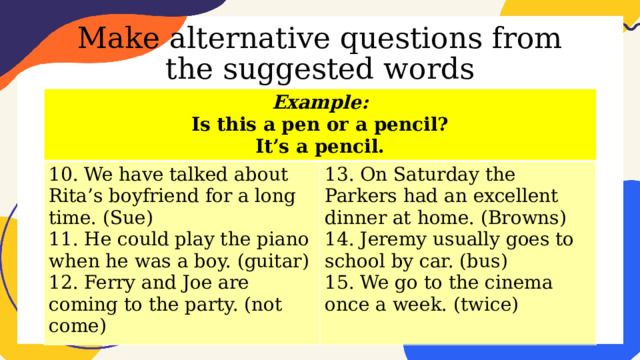
Example:
Is this a pen or a pencil?
10. We have talked about Rita’s boyfriend for a long time. (Sue)
11. He could play the piano when he was a boy. (guitar)
13. On Saturday the Parkers had an excellent dinner at home. (Browns)
It’s a pencil.
14. Jeremy usually goes to school by car. (bus)
12. Ferry and Joe are coming to the party. (not come)
15. We go to the cinema once a week. (twice)
Вопрос к подлежащему и его определению
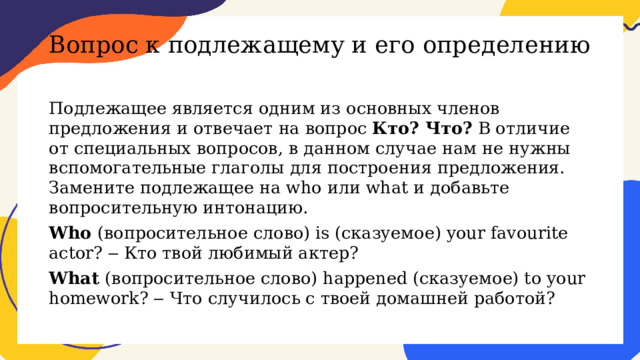
Подлежащее является одним из основных членов предложения и отвечает на вопрос Кто? Что? В отличие от специальных вопросов, в данном случае нам не нужны вспомогательные глаголы для построения предложения. Замените подлежащее на who или what и добавьте вопросительную интонацию.
Who (вопросительное слово) is (сказуемое) your favourite actor? ‒ Кто твой любимый актер?
What (вопросительное слово) happened (сказуемое) to your homework? ‒ Что случилось с твоей домашней работой?
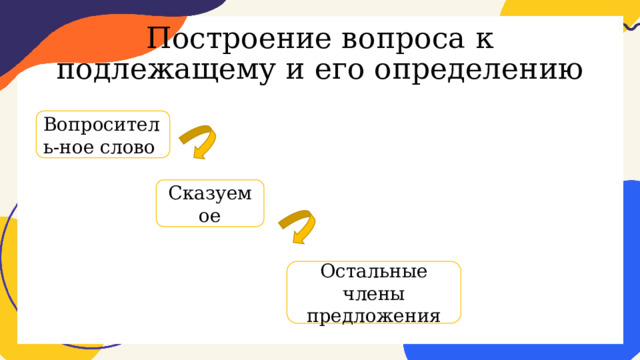
Построение вопроса к подлежащему и его определению
Вопроситель-ное слово
Сказуемое
Остальные члены предложения
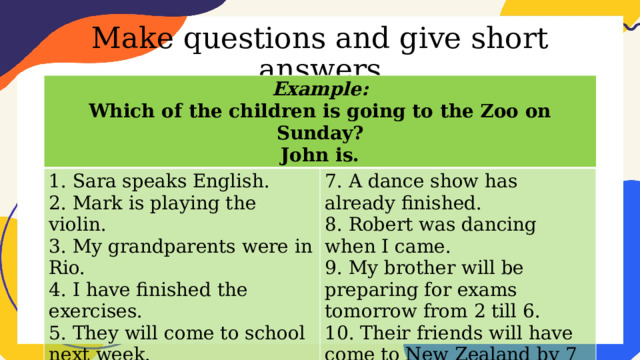
Make questions and give short answers
Example:
Which of the children is going to the Zoo on Sunday?
1. Sara speaks English.
John is.
2. Mark is playing the violin.
7. A dance show has already finished.
3. My grandparents were in Rio.
8. Robert was dancing when I came.
4. I have finished the exercises.
9. My brother will be preparing for exams tomorrow from 2 till 6.
5. They will come to school next week.
10. Their friends will have come to New Zealand by 7 pm the day after tomorrow.
6. He broke her favorite cup yesterday.
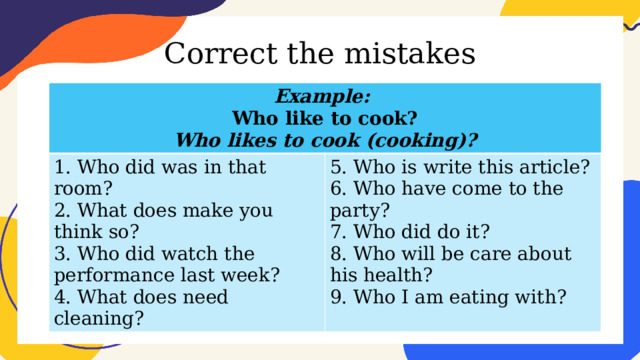
Correct the mistakes
Example:
Who like to cook?
1. Who did was in that room?
2. What does make you think so?
5. Who is write this article?
Who likes to cook (cooking)?
6. Who have come to the party?
3. Who did watch the performance last week?
4. What does need cleaning?
7. Who did do it?
8. Who will be care about his health?
9. Who I am eating with?
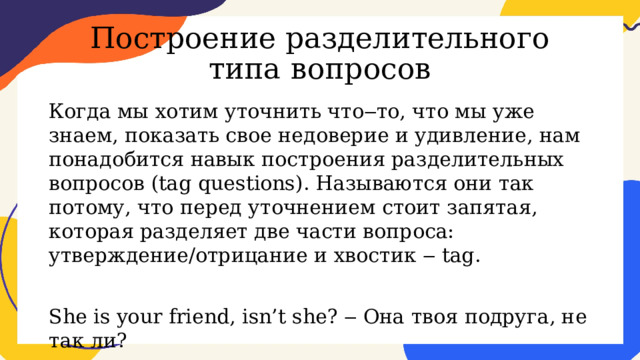
Построение разделительного типа вопросов
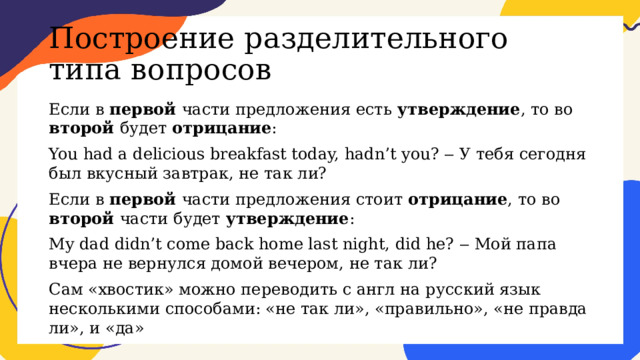
Когда мы хотим уточнить что‒то, что мы уже знаем, показать свое недоверие и удивление, нам понадобится навык построения разделительных вопросов (tag questions). Называются они так потому, что перед уточнением стоит запятая, которая разделяет две части вопроса: утверждение/отрицание и хвостик ‒ tag.
She is your friend, isn’t she? ‒ Она твоя подруга, не так ли?
Построение разделительного типа вопросов
Если в первой части предложения есть утверждение , то во второй будет отрицание :
You had a delicious breakfast today, hadn’t you? ‒ У тебя сегодня был вкусный завтрак, не так ли?
Если в первой части предложения стоит отрицание , то во второй части будет утверждение :
My dad didn’t come back home last night, did he? ‒ Мой папа вчера не вернулся домой вечером, не так ли?
Сам «хвостик» можно переводить с англ на русский язык несколькими способами: «не так ли», «правильно», «не правда ли», и «да»
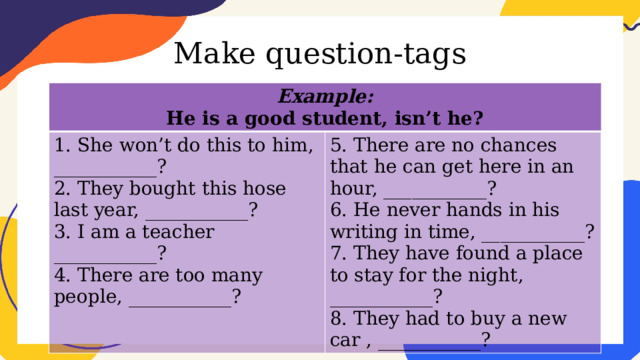
Make question-tags
Example:
He is a good student, isn’t he?
1. She won’t do this to him, ___________?
2. They bought this hose last year, ___________?
5. There are no chances that he can get here in an hour, ___________?
6. He never hands in his writing in time, ___________?
3. I am a teacher ___________?
4. There are too many people, ___________?
7. They have found a place to stay for the night, ___________?
8. They had to buy a new car , ___________?
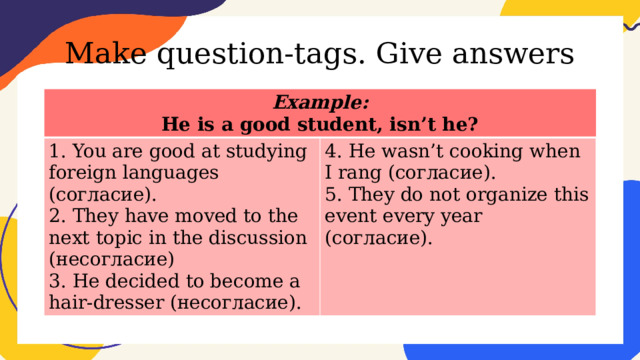
Make question-tags. Give answers
Example:
He is a good student, isn’t he?
1. You are good at studying foreign languages (согласие).
2. They have moved to the next topic in the discussion (несогласие)
4. He wasn’t cooking when I rang (согласие).
5. They do not organize this event every year (согласие).
3. He decided to become a hair-dresser (несогласие).

Вебинар для учителей

Свидетельство об участии БЕСПЛАТНО!