Россия, ЗАТО п.Солнечный Красноярский край

СДЕЛАЙТЕ СВОИ УРОКИ ЕЩЁ ЭФФЕКТИВНЕЕ, А ЖИЗНЬ СВОБОДНЕЕ
Благодаря готовым учебным материалам для работы в классе и дистанционно
Скидки до 50 % на комплекты
только до
Готовые ключевые этапы урока всегда будут у вас под рукой
Организационный момент
Проверка знаний
Объяснение материала
Закрепление изученного
Итоги урока
Была в сети 01.09.2020 10:01

Соколова Галина Ивановна
преподаватель иностранного языка(английский язык).
74 года
 1 420
1 420
 49 341
Местоположение
Специализация
Празднование Рождества
Категория:
Английский язык
06.12.2017 13:13

Просмотр содержимого документа
«Празднование Рождества»
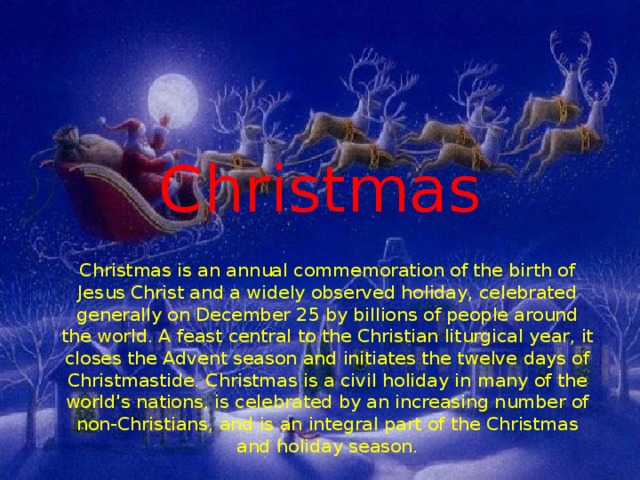
Christmas
Christmas is an annual commemoration of the birth of Jesus Christ and a widely observed holiday, celebrated generally on December 25 by billions of people around the world. A feast central to the Christian liturgical year, it closes the Advent season and initiates the twelve days of Christmastide. Christmas is a civil holiday in many of the world's nations, is celebrated by an increasing number of non-Christians, and is an integral part of the Christmas and holiday season.
Christmas tree
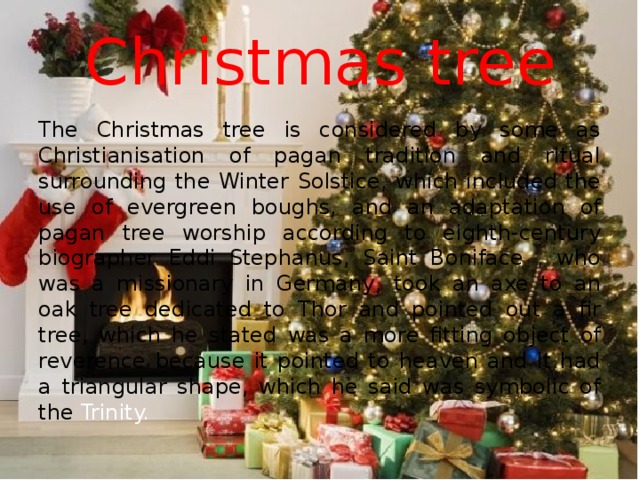
The Christmas tree is considered by some as Christianisation of pagan tradition and ritual surrounding the Winter Solstice, which included the use of evergreen boughs, and an adaptation of pagan tree worship according to eighth-century biographer Eddi Stephanus, Saint Boniface , who was a missionary in Germany, took an axe to an oak tree dedicated to Thor and pointed out a fir tree, which he stated was a more fitting object of reverence because it pointed to heaven and it had a triangular shape, which he said was symbolic of the Trinity.
Santa Claus
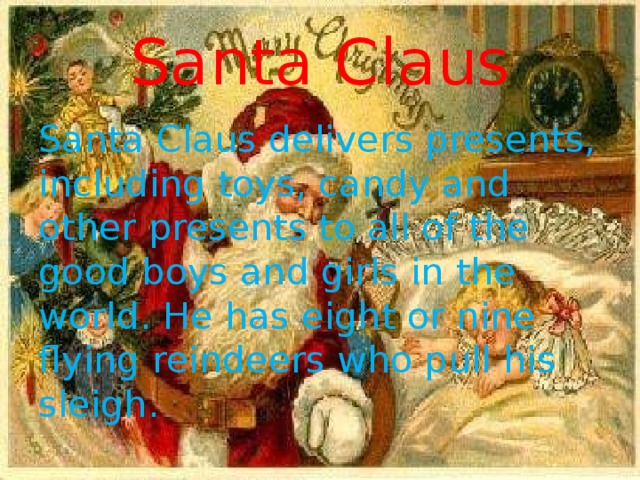
Santa Claus delivers presents, including toys, candy and other presents to all of the good boys and girls in the world. He has eight or nine flying reindeers who pull his sleigh.
Music and carols
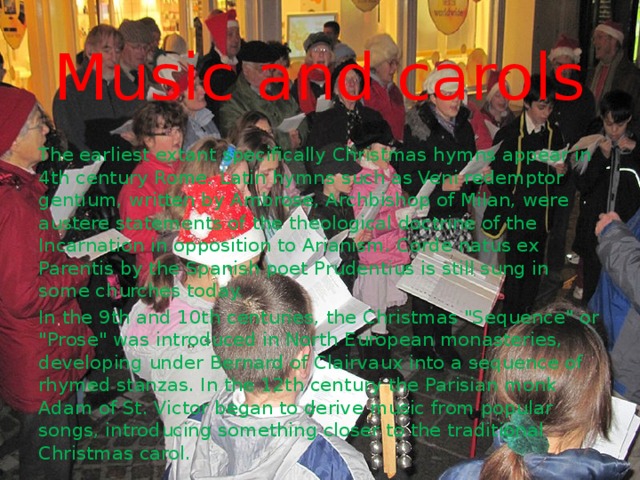
The earliest extant specifically Christmas hymns appear in 4th century Rome. Latin hymns such as Veni redemptor gentium, written by Ambrose, Archbishop of Milan, were austere statements of the theological doctrine of the Incarnation in opposition to Arianism. Corde natus ex Parentis by the Spanish poet Prudentius is still sung in some churches today.
In the 9th and 10th centuries, the Christmas "Sequence" or "Prose" was introduced in North European monasteries, developing under Bernard of Clairvaux into a sequence of rhymed stanzas. In the 12th century the Parisian monk Adam of St. Victor began to derive music from popular songs, introducing something closer to the traditional Christmas carol.
Traditional cuisine
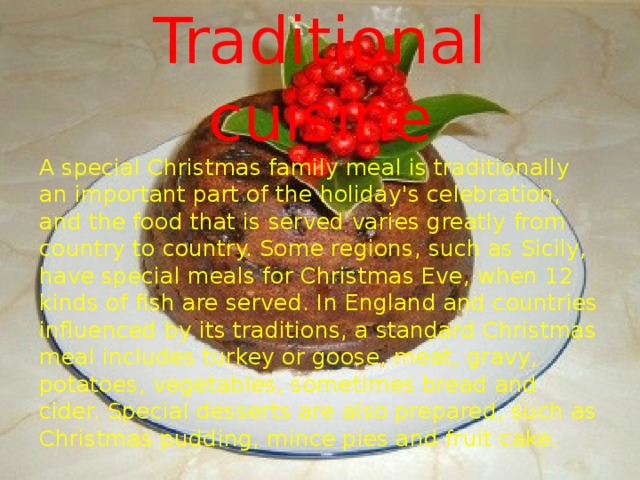
A special Christmas family meal is traditionally an important part of the holiday's celebration, and the food that is served varies greatly from country to country. Some regions, such as Sicily, have special meals for Christmas Eve, when 12 kinds of fish are served. In England and countries influenced by its traditions, a standard Christmas meal includes turkey or goose, meat, gravy, potatoes, vegetables, sometimes bread and cider. Special desserts are also prepared, such as Christmas pudding, mince pies and fruit cake.
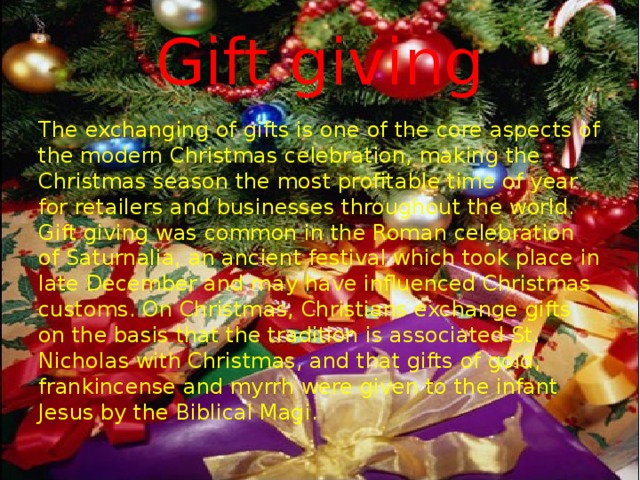
Gift giving
The exchanging of gifts is one of the core aspects of the modern Christmas celebration, making the Christmas season the most profitable time of year for retailers and businesses throughout the world. Gift giving was common in the Roman celebration of Saturnalia, an ancient festival which took place in late December and may have influenced Christmas customs. On Christmas, Christians exchange gifts on the basis that the tradition is associated St. Nicholas with Christmas, and that gifts of gold, frankincense and myrrh were given to the infant Jesus by the Biblical Magi.
Вебинар для учителей
Свидетельство об участии БЕСПЛАТНО!