

 1 009
1 009 65 113








© 2023, id28585054 370 4


СДЕЛАЙТЕ СВОИ УРОКИ ЕЩЁ ЭФФЕКТИВНЕЕ, А ЖИЗНЬ СВОБОДНЕЕ
Благодаря готовым учебным материалам для работы в классе и дистанционно
Скидки до 50 % на комплекты
только до
Готовые ключевые этапы урока всегда будут у вас под рукой
Организационный момент
Проверка знаний
Объяснение материала
Закрепление изученного
Итоги урока

Презентация Attractions in Great Britain
Категория:
Английский язык
14.03.2023 11:30

Просмотр содержимого документа
«Презентация Attractions in Great Britain»
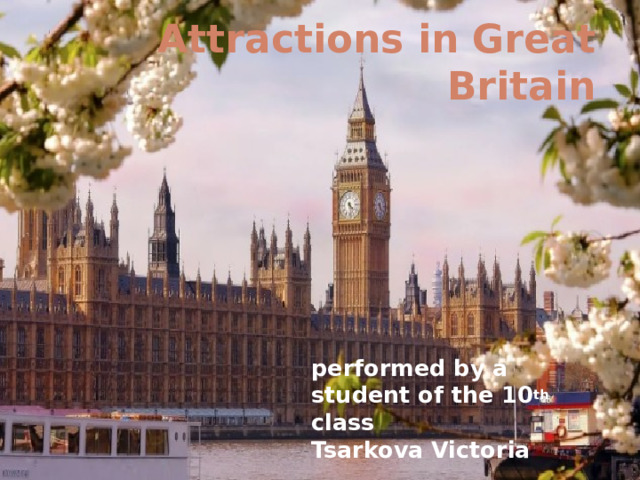
Attractions in Great Britain
performed by a student of the 10 th class
Tsarkova Victoria
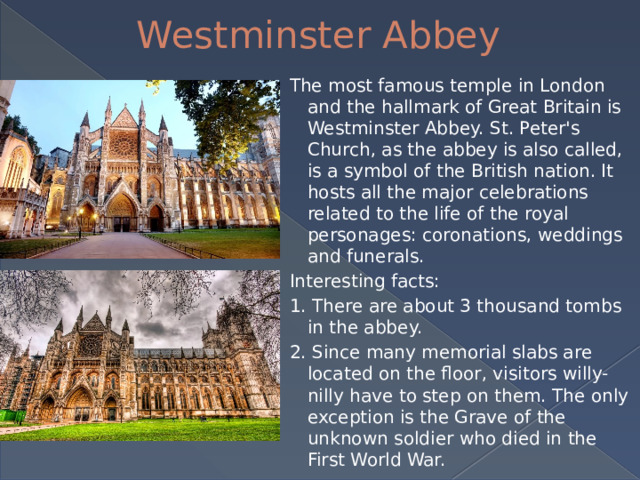
Westminster Abbey
The most famous temple in London and the hallmark of Great Britain is Westminster Abbey. St. Peter's Church, as the abbey is also called, is a symbol of the British nation. It hosts all the major celebrations related to the life of the royal personages: coronations, weddings and funerals.
Interesting facts:
1. There are about 3 thousand tombs in the abbey.
2. Since many memorial slabs are located on the floor, visitors willy-nilly have to step on them. The only exception is the Grave of the unknown soldier who died in the First World War.
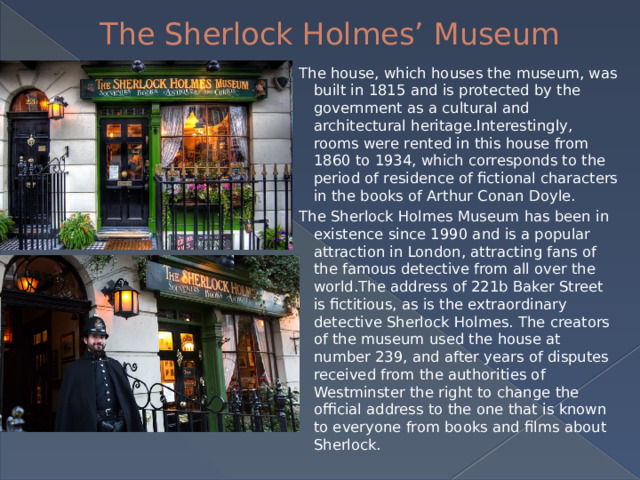
The Sherlock Holmes’ Museum
The house, which houses the museum, was built in 1815 and is protected by the government as a cultural and architectural heritage.Interestingly, rooms were rented in this house from 1860 to 1934, which corresponds to the period of residence of fictional characters in the books of Arthur Conan Doyle.
The Sherlock Holmes Museum has been in existence since 1990 and is a popular attraction in London, attracting fans of the famous detective from all over the world.The address of 221b Baker Street is fictitious, as is the extraordinary detective Sherlock Holmes. The creators of the museum used the house at number 239, and after years of disputes received from the authorities of Westminster the right to change the official address to the one that is known to everyone from books and films about Sherlock.
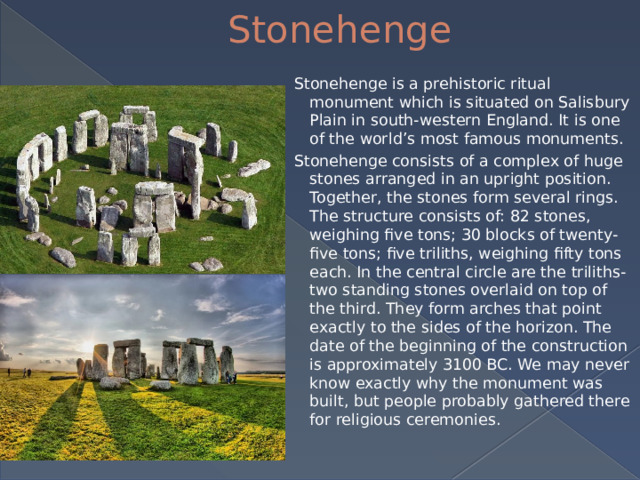
Stonehenge
Stonehenge is a prehistoric ritual monument which is situated on Salisbury Plain in south-western England. It is one of the world’s most famous monuments.
Stonehenge consists of a complex of huge stones arranged in an upright position. Together, the stones form several rings. The structure consists of: 82 stones, weighing five tons; 30 blocks of twenty-five tons; five triliths, weighing fifty tons each. In the central circle are the triliths-two standing stones overlaid on top of the third. They form arches that point exactly to the sides of the horizon. The date of the beginning of the construction is approximately 3100 BC. We may never know exactly why the monument was built, but people probably gathered there for religious ceremonies.
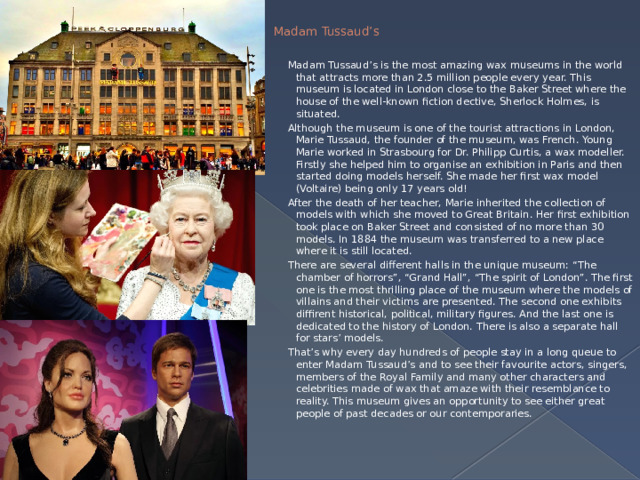
Madam Tussaud’s
Madam Tussaud’s is the most amazing wax museums in the world that attracts more than 2.5 million people every year. This museum is located in London close to the Baker Street where the house of the well-known fiction dective, Sherlock Holmes, is situated.
Although the museum is one of the tourist attractions in London, Marie Tussaud, the founder of the museum, was French. Young Marie worked in Strasbourg for Dr. Philipp Curtis, a wax modeller. Firstly she helped him to organise an exhibition in Paris and then started doing models herself. She made her first wax model (Voltaire) being only 17 years old!
After the death of her teacher, Marie inherited the collection of models with which she moved to Great Britain. Her first exhibition took place on Baker Street and consisted of no more than 30 models. In 1884 the museum was transferred to a new place where it is still located.
There are several different halls in the unique museum: “The chamber of horrors”, “Grand Hall”, “The spirit of London”. The first one is the most thrilling place of the museum where the models of villains and their victims are presented. The second one exhibits diffirent historical, political, military figures. And the last one is dedicated to the history of London. There is also a separate hall for stars’ models.
That’s why every day hundreds of people stay in a long queue to enter Madam Tussaud’s and to see their favourite actors, singers, members of the Royal Family and many other characters and celebrities made of wax that amaze with their resemblance to reality. This museum gives an opportunity to see either great people of past decades or our contemporaries.
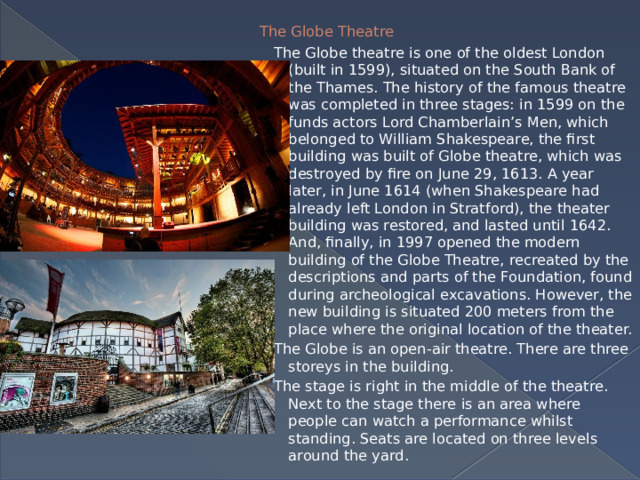
The Globe Theatre
The Globe theatre is one of the oldest London (built in 1599), situated on the South Bank of the Thames. The history of the famous theatre was completed in three stages: in 1599 on the funds actors Lord Chamberlain’s Men, which belonged to William Shakespeare, the first building was built of Globe theatre, which was destroyed by fire on June 29, 1613. A year later, in June 1614 (when Shakespeare had already left London in Stratford), the theater building was restored, and lasted until 1642. And, finally, in 1997 opened the modern building of the Globe Theatre, recreated by the descriptions and parts of the Foundation, found during archeological excavations. However, the new building is situated 200 meters from the place where the original location of the theater.
The Globe is an open-air theatre. There are three storeys in the building.
The stage is right in the middle of the theatre. Next to the stage there is an area where people can watch a performance whilst standing. Seats are located on three levels around the yard.
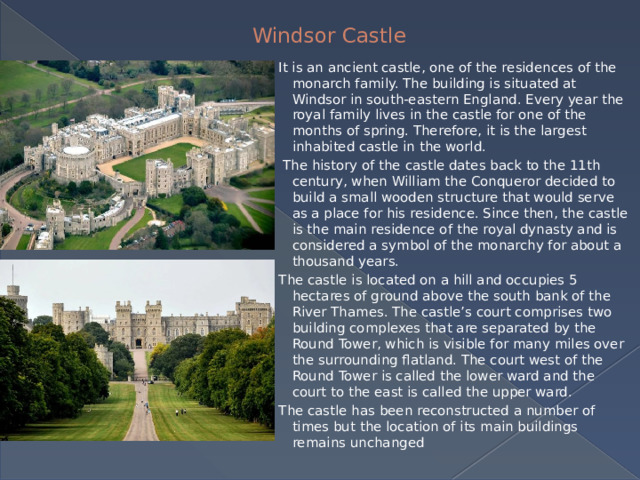
Windsor Castle
It is an ancient castle, one of the residences of the monarch family. The building is situated at Windsor in south-eastern England. Every year the royal family lives in the castle for one of the months of spring. Therefore, it is the largest inhabited castle in the world.
The history of the castle dates back to the 11th century, when William the Conqueror decided to build a small wooden structure that would serve as a place for his residence. Since then, the castle is the main residence of the royal dynasty and is considered a symbol of the monarchy for about a thousand years.
The castle is located on a hill and occupies 5 hectares of ground above the south bank of the River Thames. The castle’s court comprises two building complexes that are separated by the Round Tower, which is visible for many miles over the surrounding flatland. The court west of the Round Tower is called the lower ward and the court to the east is called the upper ward.
The castle has been reconstructed a number of times but the location of its main buildings remains unchanged
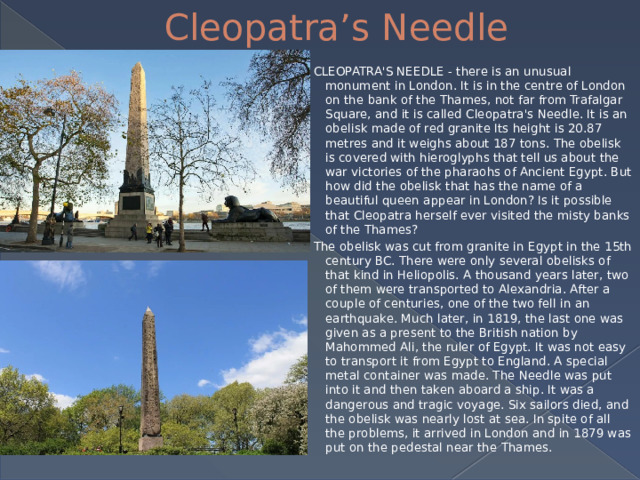
Cleopatra’s Needle
CLEOPATRA'S NEEDLE - there is an unusual monument in London. It is in the centre of London on the bank of the Thames, not far from Trafalgar Square, and it is called Cleopatra's Needle. It is an obelisk made of red granite Its height is 20.87 metres and it weighs about 187 tons. The obelisk is covered with hieroglyphs that tell us about the war victories of the pharaohs of Ancient Egypt. But how did the obelisk that has the name of a beautiful queen appear in London? Is it possible that Cleopatra herself ever visited the misty banks of the Thames?
The obelisk was cut from granite in Egypt in the 15th century BC. There were only several obelisks of that kind in Heliopolis. A thousand years later, two of them were transported to Alexandria. After a couple of centuries, one of the two fell in an earthquake. Much later, in 1819, the last one was given as a present to the British nation by Mahommed Ali, the ruler of Egypt. It was not easy to transport it from Egypt to England. A special metal container was made. The Needle was put into it and then taken aboard a ship. It was a dangerous and tragic voyage. Six sailors died, and the obelisk was nearly lost at sea. In spite of all the problems, it arrived in London and in 1879 was put on the pedestal near the Thames.
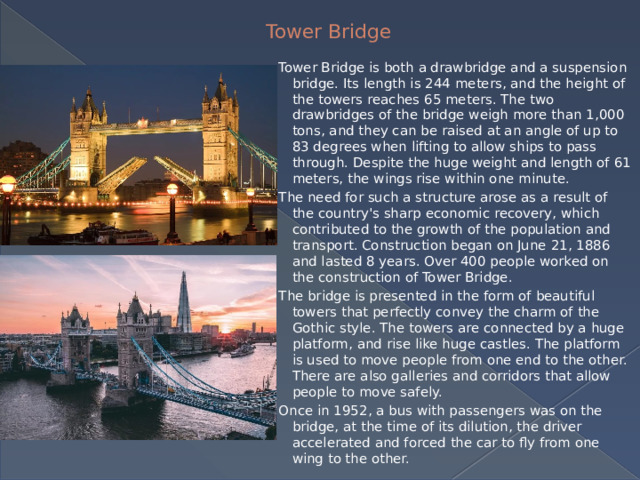
Tower Bridge
Tower Bridge is both a drawbridge and a suspension bridge. Its length is 244 meters, and the height of the towers reaches 65 meters. The two drawbridges of the bridge weigh more than 1,000 tons, and they can be raised at an angle of up to 83 degrees when lifting to allow ships to pass through. Despite the huge weight and length of 61 meters, the wings rise within one minute.
The need for such a structure arose as a result of the country's sharp economic recovery, which contributed to the growth of the population and transport. Construction began on June 21, 1886 and lasted 8 years. Over 400 people worked on the construction of Tower Bridge.
The bridge is presented in the form of beautiful towers that perfectly convey the charm of the Gothic style. The towers are connected by a huge platform, and rise like huge castles. The platform is used to move people from one end to the other. There are also galleries and corridors that allow people to move safely.
Once in 1952, a bus with passengers was on the bridge, at the time of its dilution, the driver accelerated and forced the car to fly from one wing to the other.
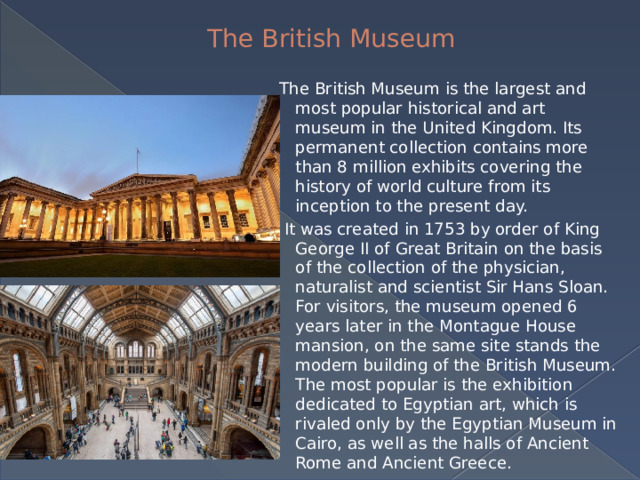
The British Museum
The British Museum is the largest and most popular historical and art museum in the United Kingdom. Its permanent collection contains more than 8 million exhibits covering the history of world culture from its inception to the present day.
It was created in 1753 by order of King George II of Great Britain on the basis of the collection of the physician, naturalist and scientist Sir Hans Sloan. For visitors, the museum opened 6 years later in the Montague House mansion, on the same site stands the modern building of the British Museum. The most popular is the exhibition dedicated to Egyptian art, which is rivaled only by the Egyptian Museum in Cairo, as well as the halls of Ancient Rome and Ancient Greece.
Thank you for your attention!
Вебинар для учителей

Свидетельство об участии БЕСПЛАТНО!