Россия, Воркута


СДЕЛАЙТЕ СВОИ УРОКИ ЕЩЁ ЭФФЕКТИВНЕЕ, А ЖИЗНЬ СВОБОДНЕЕ
Благодаря готовым учебным материалам для работы в классе и дистанционно
Скидки до 50 % на комплекты
только до
Готовые ключевые этапы урока всегда будут у вас под рукой
Организационный момент
Проверка знаний
Объяснение материала
Закрепление изученного
Итоги урока
Была в сети 18.02.2026 12:38

Полуян Оксана Сергеевна
преподаватель английского языка
48 лет
 10 097
 4 928
4 928 
Местоположение
Специализация
Презентация для защиты исследовательской работы "Выявление наиболее лучшего одоранта для одоризации газа"
Категория:
Английский язык
22.11.2018 07:20

Просмотр содержимого документа
«Презентация для защиты исследовательской работы "Выявление наиболее лучшего одоранта для одоризации газа"»

Group 411: «The construction and operation
of oil/gas pipelines and oil/gas storage»
Project «Detection of the most effective odorant for gas odorization»
Work performed: Nikita Uvarov, Stavniychuk Arthur, Urazov Paul, Anton Vikhrov.
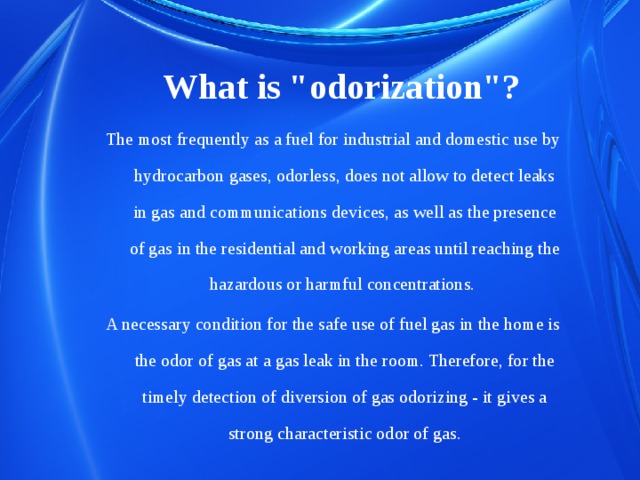
What is "odorization"?
The most frequently as a fuel for industrial and domestic use by hydrocarbon gases, odorless, does not allow to detect leaks in gas and communications devices, as well as the presence of gas in the residential and working areas until reaching the hazardous or harmful concentrations.
A necessary condition for the safe use of fuel gas in the home is the odor of gas at a gas leak in the room. Therefore, for the timely detection of diversion of gas odorizing - it gives a strong characteristic odor of gas.

Agents used for gas odorization must meet the following requirements :
- have a sharp and specific smell that is different from other odors residential and industrial buildings;
- have a physiologically acceptable at the concentrations used;
- Should not act aggressively on the metal material and gas networks and equipment with which the odorized gas is contacted;
- have a sufficiently high vapor pressure;
- should not be absorbed by the soil and create indoor stable, slowly vanishing scent;

Odorants usually used
Specified requirements to a greater extent satisfy some sulfur compounds: ethylmercaptan, methyl mercaptan, propyl, mercaptan, captan, sulfane. The most widely used as an odorant was ethylmercaptan (С 2 Н 5 SH) - A clear, colorless liquid (sometimes has a greenish tint) with a pungent odor and a specific gravity 0.83 кг/м 3 . Specific consumption of odorant depends on the composition and properties of gas odorization, climatic conditions, etc. The content of odorant in the gas should be such that a person with a normal sense of smell felt odor of odorant at a volumetric gas content in the air space equal to 1/5 of its LEL. For ethylmercaptan application rate is 16 g, or 19,1 sm 3 1 thousand. m 3 gas.

Driving odorization installation DMT
1 - stationary tanks
1b - lower level sensor
1с - level sensor overflow protection
2 - catching bath
3 - wire-mesh filter
4 - harcoal filters
5 - dispensing pump
6 - flow sensor
7 - loading pipe
8 - drain pipe of the dosing pump
9 - flexible connection
10 - measuring burette
11 -injection nozzle
12 - gas pipe
13 - valve system air venting
14 - connection for cleaning injectors
15 -Connect cleaning

Universal automatic odorizer UOP-1
1- pressure reducer supply;
2- time relay
3- valve;
4 -regulatory capacity;
5 - batcher;
6 - float chamber;
7 - filter odorant;
8 - metering capacity;
9 – the storage container
10 – underground storage tank odorant

Methods of gas odorization
Odorant may be introduced into the gas flow both in liquid and in vapor phase. In the liquid state the supply of the odorant into the pipeline is performed using a dropper or metering pump. There are 3 ways to enter the odorant :
- Drip input method of odorant in the gas stream;
- Bubble input method of odorant in the gas stream;
- Wick odorizer;
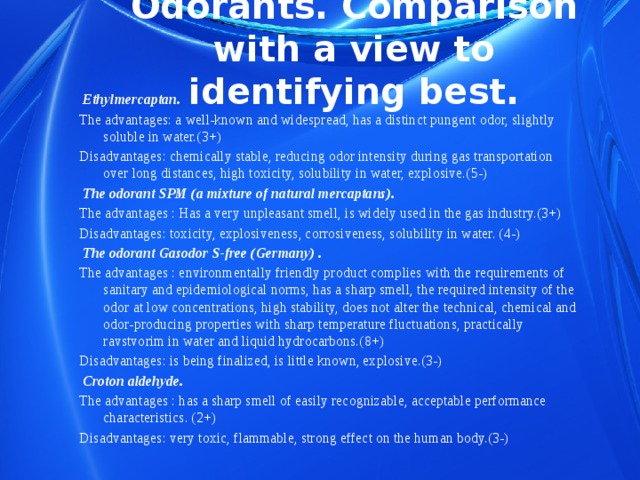
Odorants. Comparison with a view to identifying best.
Ethylmercaptan.
The advantages: a well-known and widespread, has a distinct pungent odor, slightly soluble in water.(3+)
Disadvantages: chemically stable, reducing odor intensity during gas transportation over long distances, high toxicity, solubility in water, explosive.(5-)
The odorant SPM (a mixture of natural mercaptans).
The advantages : Has a very unpleasant smell, is widely used in the gas industry.(3+)
Disadvantages: toxicity, explosiveness, corrosiveness, solubility in water. (4-)
The odorant Gasodor S-free (Germany) .
The advantages : environmentally friendly product complies with the requirements of sanitary and epidemiological norms, has a sharp smell, the required intensity of the odor at low concentrations, high stability, does not alter the technical, chemical and odor-producing properties with sharp temperature fluctuations, practically ravstvorim in water and liquid hydrocarbons.(8+)
Disadvantages: is being finalized, is little known, explosive.(3-)
Сroton aldehyde.
The advantages : has a sharp smell of easily recognizable, acceptable performance characteristics. (2+)
Disadvantages: very toxic, flammable, strong effect on the human body.(3-)

Schedule

Conclusion
We have examined several types of odorants, almost all have similar advantages and disadvantages. Based on the graph, you can see that by a wide margin in the lead odorant Gasodor S-free. This modern and meets the most stringent requirements of the odorant, it is possible that at the time of entry into the production of a list of its advantages will be continued.

Thank you for attention!!!






Вебинар для учителей
Свидетельство об участии БЕСПЛАТНО!