Россия, п.Новосмолинский

СДЕЛАЙТЕ СВОИ УРОКИ ЕЩЁ ЭФФЕКТИВНЕЕ, А ЖИЗНЬ СВОБОДНЕЕ
Благодаря готовым учебным материалам для работы в классе и дистанционно
Скидки до 50 % на комплекты
только до
Готовые ключевые этапы урока всегда будут у вас под рукой
Организационный момент
Проверка знаний
Объяснение материала
Закрепление изученного
Итоги урока
Была в сети 01.06.2023 10:37

Полутова Виталия Владимировна
учитель английского языка
45 лет
 5 516
5 516
 11 023
Местоположение
Специализация
Презентация-кейс Buy Nothing Day
Категория:
Английский язык
26.12.2022 13:59

Просмотр содержимого документа
«Презентация-кейс Buy Nothing Day»

“ To buy, or not to buy, that is the question……”

Shopping
Department store
Flea market
Car boot sale
Bazaar
Shopping mall
Discuss the questions.
- Do you like shopping?
- Where do you like shopping?
- What are your favourite shops?
- Do you like to shop online?
Watch the video

- Have you ever heard about “Black Friday”?
- Is Black Friday popular in your country?
- Do people look forward to this day for big shopping?
- How can you describe the situation presented in the video? What’s your attitude towards this crowd and the way they are shopping?
- Do you think it is worth going shopping despite the queues and the madness?
- Have you ever experienced or witnessed fighting because of shopping?

Watch the video

1. Have you ever heard about Buy Nothing Day?
2. Is Buy Nothing Day popular in your country?
Let’s read the text p.30
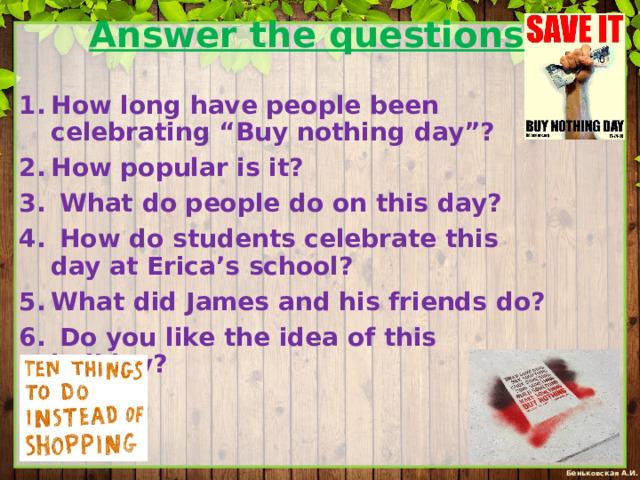
Answer the questions.
- How long have people been celebrating “Buy nothing day”?
- How popular is it?
- What do people do on this day?
- How do students celebrate this day at Erica’s school?
- What did James and his friends do?
- Do you like the idea of this holiday?
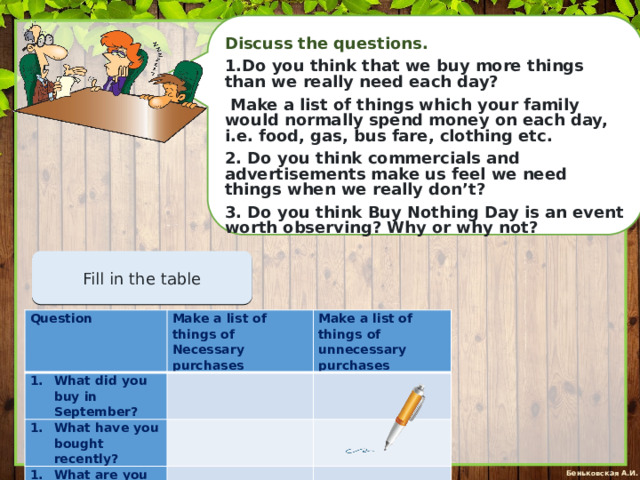
Discuss the questions.
1 .Do you think that we buy more things than we really need each day?
Make a list of things which your family would normally spend money on each day, i.e. food, gas, bus fare, clothing etc.
2. Do you think commercials and advertisements make us feel we need things when we really don’t?
3. Do you think Buy Nothing Day is an event worth observing? Why or why not?
Fill in the table
Question
- What did you buy in September?
Make a list of things of Necessary purchases
- What have you bought recently?
Make a list of things of unnecessary purchases
- What are you going to buy?

Do the task:
- Divide into 2 groups (1. Black Friday/2.Buy Nothing Day)
- Make a survey:
a) whether people know about Black Friday and Buy Nothing Day in your country.
b) What do they usually do during Black Friday or Buy Nothing Day?
3. Read the text and do the tasks for the next lesson.
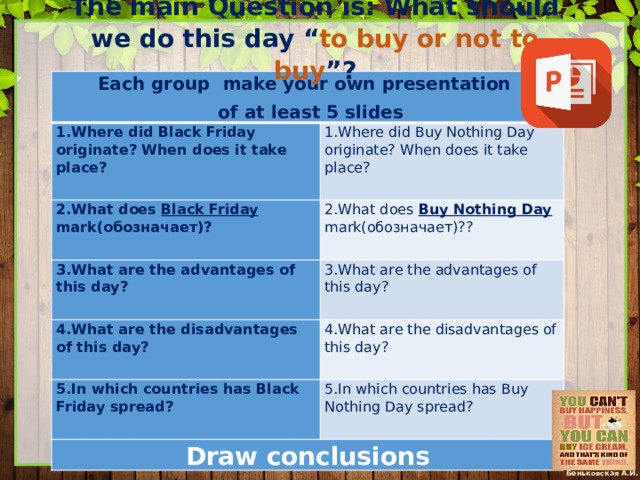
The main Question is: What should we do this day “ to buy or not to buy ”?
Each group make your own presentation
1.Where did Black Friday originate? When does it take place?
of at least 5 slides
1.Where did Buy Nothing Day originate? When does it take place?
2.What does Black Friday mark(обозначает)?
2.What does Buy Nothing Day mark(обозначает)??
3.What are the advantages of this day?
4.What are the disadvantages of this day?
3.What are the advantages of this day?
4.What are the disadvantages of this day?
5.In which countries has Black Friday spread?
5.In which countries has Buy Nothing Day spread?
Draw conclusions

Полезные ресурсы для ОТКАЗА ОТ ПОКУПОК
Полезные ресурсы BLACK FRIDAY:
http://www.buynothingday.co.uk/ ?
https://skyteach.ru/2020/11/24/black-friday-lesson-ideas-for-teens/
https://www.liveworksheets.com/worksheets/en/English_as_a_Second_Language_(ESL)/Stative_verbs/Buy_nothing_day%5Estative_verbs_vx1210453xv
https://youtu.be/viC-uEfZJO0 what is Black Friday
https://dayfinders.com/buy-nothing-day/
https://www.rong-chang.com/eslread/eslread/ss/s159.htm text and tasks
https://www.youtube.com/watch?v=QEBZs4x0Ars
https://eslholidaylessons.com/11/buy_nothing_day.html
https://www.englishclub.com/efl/podcasts/interesting-facts/buy-nothing-day/
https://www.liveworksheets.com/lt2675748fc

Present Perfect
vs
Present Perfect Continuous
I have been flying for 4 hours to deliver this letter.
This heroic bird has delivered the letter!

The gardener has been raking the leaves all morning. He is still raking them.
The gardener has raked all leaves. It took her three hours to do it.
completed action; result
since
for
just
ever
since
for
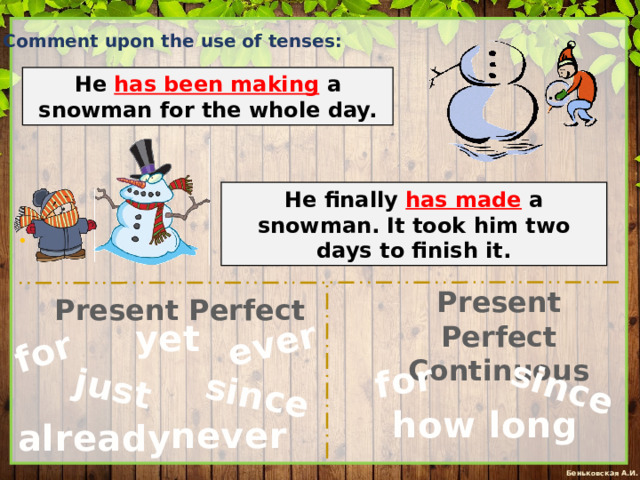
Comment upon the use of tenses:
He has been making a snowman for the whole day.
He finally has made a snowman. It took him two days to finish it.
Present Perfect Continuous
Present Perfect
yet
how long
never
already

Present Perfect Continuous
I / you / we / they have been studying .
Present Perfect
I / you / we / they have studied.
I / you / we / they haven’t been studying .
Have I / you / we / they been studying ?
He / she / it has been studying .
I / you / we / they haven’t studied .
Have I / you / we / they studied ?
He / she / it hasn’t been studying .
He / she / it has studied .
He / she / it hasn’t studied .
Has he / she / it been studying ?
Has he / she / it studied ?
?
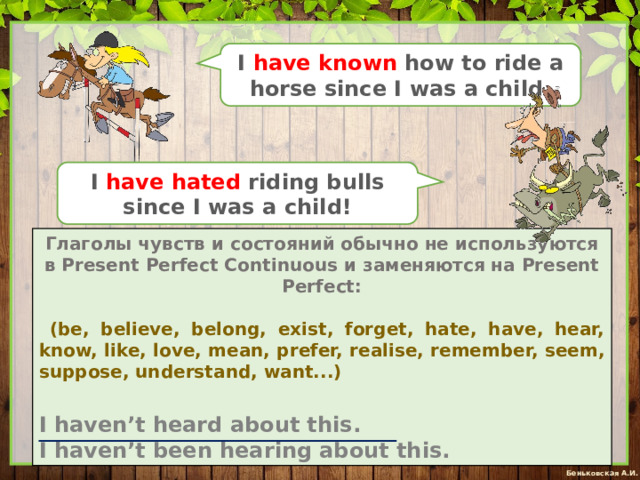
I have known how to ride a horse since I was a child.
I have hated riding bulls since I was a child!
Глаголы чувств и состояний обычно не используются в Present Perfect Continuous и заменяются на Present Perfect:
(be, believe, belong, exist, forget, hate, have, hear, know, like, love, mean, prefer, realise, remember, seem, suppose, understand, want...)
I haven’t heard about this.
I haven’t been hearing about this.

Cross out the wrong sentence:
I have been forgetting the date.
I have forgotten the date.
I have realised that everything is correct.
I have been realising that everything is correct.
I have known her for ages.
I have been knowing her for ages.

Put the verbs in the Present Perfect or the Present Perfect Continuous :
has opened
- Ann __________ (open) two art galleries in Saint-Petersburg so far. She ________________ (collect) paintings from all over the world for it for 10 years.
- She ______ always __________(love) music. She _______________ (learn) how to play the violin for two years already.
- I ______________ (know) Dan since I was a child. He ______ always _______ (be) a good friend for me.
- My father is still sleeping. He ______________ (sleep) since 10 o’clock last night.
- We are so tired because we _______________ (paint) our house for two days. We ______________ (paint) it three times this year.
- Unfortunately, I ___________ (not pass) the test again.
has been collecting
loved
has
has been learning
have known
has
been
has been sleeping
have been painting
have painted
haven’t passed

Where is your husband?
He is not here. He has gone to the shop.
Have been to употребляется когда мы говорим о том, что человек где-то побывал и уже вернулся.
Have gone to подразумевает, что человек куда-то ушел и еще не вернулся.
Have been in уехал и проживает до сих пор там
Where have you been ?
I have been to the shop, dear.
I have been in New for 2 months. I like to be here.

Fill in the gaps with have/has gone to or have/has been to :
have gone
- - Where are your children? – They ____________ to the zoo to look at exotic animals .
- I am alone in the house. My parents _______________ to Turkey.
- __________ you ever ________ to Turkey? It’s a wonderful country.
- I don’t live in out country house. I only ____________ there once.
- My mother has just come home. She ____________ to the restaurant with her friends.
- My aunt _______never _______ to London, but she always wanted to visit this city.
have gone
been
Have
have been
has been
been
has


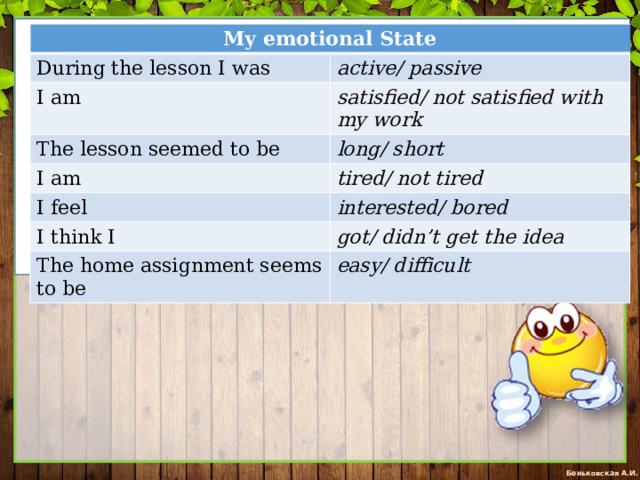
My emotional State
During the lesson I was
active/ passive
I am
satisfied/ not satisfied with my work
The lesson seemed to be
I am
long/ short
tired/ not tired
I feel
interested/ bored
I think I
got/ didn’t get the idea
The home assignment seems to be
easy/ difficult


HOME ASSIGNMENT
Вебинар для учителей
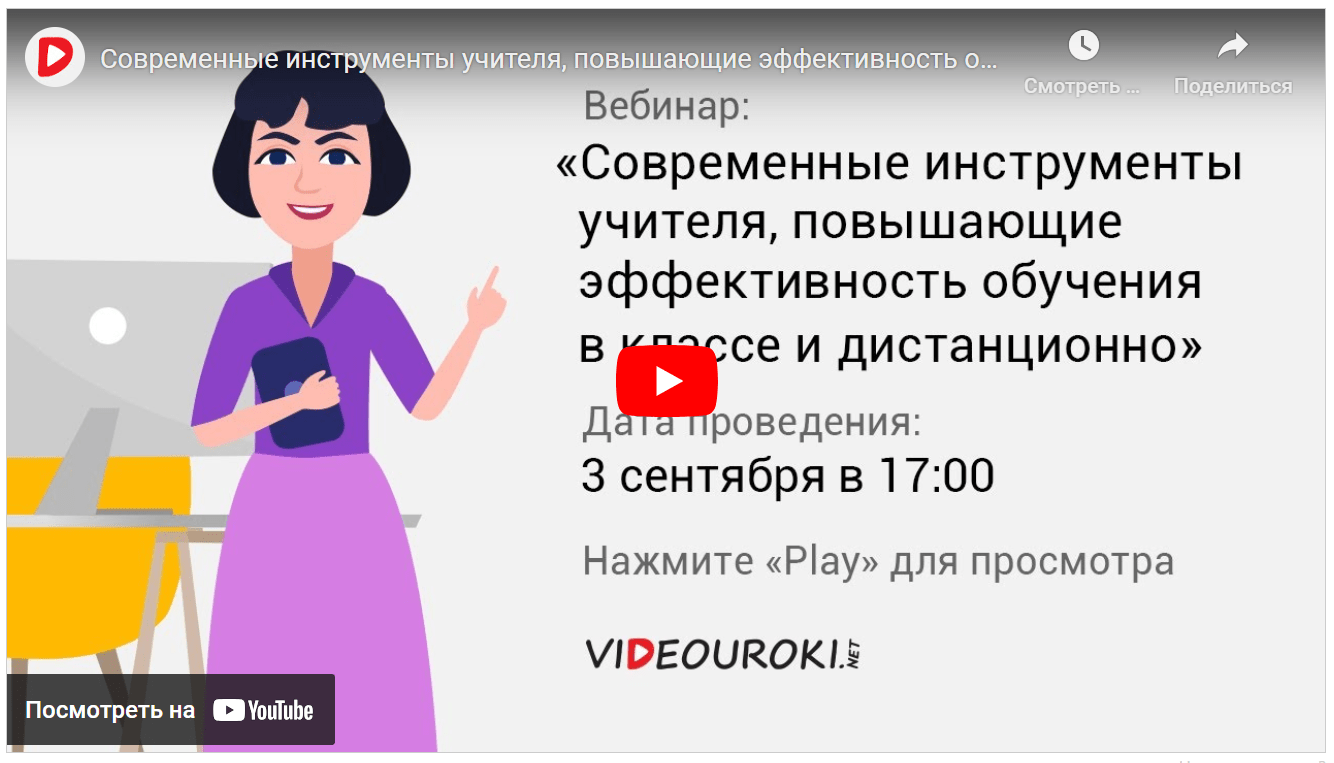
Свидетельство об участии БЕСПЛАТНО!