
СДЕЛАЙТЕ СВОИ УРОКИ ЕЩЁ ЭФФЕКТИВНЕЕ, А ЖИЗНЬ СВОБОДНЕЕ

Благодаря готовым учебным материалам для работы в классе и дистанционно

Скидки до 50 % на комплекты
только до

Готовые ключевые этапы урока всегда будут у вас под рукой

Организационный момент

Проверка знаний

Объяснение материала

Закрепление изученного

Итоги урока

Презентация Mythorealism

Категория: Литература

Нажмите, чтобы узнать подробности

Sergey Telegin (Sergey Maratovich Telegin) is a Russian literary critic and philosopher known for developing the method of mythorestoration (miforestavratsiya). While most commonly associated with Yan Lianke’s 21st-century Chinese literature, some scholars note that the term "mythorealism" (mitorealismo) was used as early as 1994 by Russian academic Sergey Telegin to describe the works of Nikolai Leskov. Telegin's work focuses on identifying and restoring mythical structures within realist literature. Key Concepts in Telegin's Work Mythorestoration: A method created by Telegin in 1990 used to analyze artistic texts by uncovering the underlying myths that shape their narrative and meaning. Life of Myth in Realism: His research, including his doctoral dissertation (1996), explores how myth functions within the works of classic realist writers like Fyodor Dostoevsky and Nikolai Leskov. Mythological Revolution: Telegin argues for the existence of a "mythological revolution" in literature and has published extensively on how myths define national identity and spiritual crisis. Academic and Philosophical Profile Professional Background: He is a Doctor of Philological Sciences and a professor who has lectured at the Gerasimov Institute of Cinematography (VGIK) since 2010. Major Works: Philosophy of Myth: Introduction to the Method of Mythorestoration (1994). The Life of Myth in the Artistic World of Dostoevsky and Leskov (1995). Uprising of the Myth (1997), which discusses the formation of a modern Russian heroic myth. Hyperborea: The Sacred Homeland of Humanity (2011). Interests: His more recent interests include alchemy and the spiritual transformation of the human soul through the "magic of the word".

Просмотр содержимого документа
«Презентация Mythorealism»
MYTHOREALISM Sergey Teleguin
MYTHOREALISM

Sergey Teleguin

Sergey Teleguin was born on January 1, 1964 in Buenos Aires (Argentina) in the family of a Soviet diplomat. He currently lives in Moscow (Russia).
Sergey Teleguin was born on January 1, 1964 in Buenos Aires (Argentina) in the family of a Soviet diplomat. He currently lives in Moscow (Russia).

Sergey Teleguin is a contemporary figure known for his contributions to literature and art. His work often explores complex themes, blending traditional narratives with modern interpretations.
Sergey Teleguin is a contemporary figure known for his contributions to literature and art. His work often explores complex themes, blending traditional narratives with modern interpretations.

Sergey Teleguin is a notable figure associated with various literary and cultural discussions. His work often explores themes related to mythology and literature, particularly in the context of Russian literature.
Sergey Teleguin is a notable figure associated with various literary and cultural discussions. His work often explores themes related to mythology and literature, particularly in the context of Russian literature.

Sergey Teleguin's work often explores themes related to mythology and literature, including references to

Sergey Teleguin's work often explores themes related to mythology and literature, including references to "mythorealism". This idea has been interpreted in various cultural contexts, including literature and revolution.
In summary, Sergey Teleguin's work on mythorealism likely delves into the intersections of myth, literature, and cultural narratives, providing insights into how these themes resonate within the context of Russian literary traditions.
In summary, Sergey Teleguin's work on mythorealism likely delves into the intersections of myth, literature, and cultural narratives, providing insights into how these themes resonate within the context of Russian literary traditions.

Sergey Teleguin is known for developing the method of “mythorestoration“ (1990) and the term “mythorealism,“ “mitorealismo” (1994), which relates to the study of myths and their restoration in literature and culture. His work often explores how myths are created and their significance in society.
Sergey Teleguin is known for developing the method of “mythorestoration“ (1990) and the term “mythorealism,“ “mitorealismo” (1994), which relates to the study of myths and their restoration in literature and culture. His work often explores how myths are created and their significance in society.

Mythorealism is a term coined by Teleguin, which combines elements of myth and realism.  It explores how myths influence contemporary narratives and cultural expressions.

Mythorealism is a term coined by Teleguin, which combines elements of myth and realism. It explores how myths influence contemporary narratives and cultural expressions.
mitorealismo Se puede decir que el trabajo creador de Leskov se caracteriza por el “ realismo mitologico” o “mitorealismo” . Con eso, el escritor, el narrador, los protagonistas de la novela y los lectores, todos ellos interpretan los acontecimientos descritos no como un mito, sino como un hecho real, y es precisamente, en esta presion de la “ situacion mitologica ”, en este “ realismo mitologico ” (“ mitorealismo ”), que estriba todo el misterio del trabajo creador de Leskov. (Teleguin, Sergey. Mitos y Demonios de la Obra de Nikolay Leskov // Cabala – October, 1994 – P. 73-75)
mitorealismo

Se puede decir que el trabajo creador de Leskov se caracteriza por el “ realismo mitologico” o “mitorealismo” . Con eso, el escritor, el narrador, los protagonistas de la novela y los lectores, todos ellos interpretan los acontecimientos descritos no como un mito, sino como un hecho real, y es precisamente, en esta presion de la “ situacion mitologica ”, en este “ realismo mitologico ” (“ mitorealismo ”), que estriba todo el misterio del trabajo creador de Leskov.

(Teleguin, Sergey. Mitos y Demonios de la Obra de Nikolay Leskov // Cabala – October, 1994 – P. 73-75)

The method emphasizes the restoration of myths in modern contexts, examining their relevance and transformation.
The method emphasizes the restoration of myths in modern contexts, examining their relevance and transformation.

Applications of Mythorealism Teleguin's approach can be applied to literature, art, and cultural studies.
Applications of Mythorealism

Teleguin's approach can be applied to literature, art, and cultural studies.

It seeks to understand how ancient myths shape modern storytelling and identity.
It seeks to understand how ancient myths shape modern storytelling and identity.

The concept encourages a deeper analysis of cultural artifacts through the lens of mythological frameworks.
The concept encourages a deeper analysis of cultural artifacts through the lens of mythological frameworks.

This framework offers a unique perspective on the interplay between myth and reality in contemporary culture.
This framework offers a unique perspective on the interplay between myth and reality in contemporary culture.

Sergey Teleguin is known for his work in the field of mythopoetics, which explores the relationship between mythology and poetry. His approach often involves analyzing how mythological themes and structures influence literary creation.
Sergey Teleguin is known for his work in the field of mythopoetics, which explores the relationship between mythology and poetry. His approach often involves analyzing how mythological themes and structures influence literary creation.

Mythopoetics refers to the study or creation of myths within poetry and literature. It emphasizes the significance of mythological elements in storytelling, often reflecting cultural and philosophical ideas.
Mythopoetics refers to the study or creation of myths within poetry and literature. It emphasizes the significance of mythological elements in storytelling, often reflecting cultural and philosophical ideas.

Teleguin's approach to mythorealism may involve reinterpreting classic myths or creating new narratives that resonate with current societal issues.
Teleguin's approach to mythorealism may involve reinterpreting classic myths or creating new narratives that resonate with current societal issues.

Key Themes in Teleguin's Work    Cultural Reflection: Teleguin's work often mirrors the cultural landscape, using myth to comment on contemporary life.
Key Themes in Teleguin's Work

  • Cultural Reflection: Teleguin's work often mirrors the cultural landscape, using myth to comment on contemporary life.
Philosophical Inquiry: His writings delve into existential questions, using myth as a framework for exploring deeper meanings.
  • Philosophical Inquiry: His writings delve into existential questions, using myth as a framework for exploring deeper meanings.
Artistic Innovation: Teleguin blends various artistic forms, creating a unique voice that challenges traditional boundaries.
  • Artistic Innovation: Teleguin blends various artistic forms, creating a unique voice that challenges traditional boundaries.
Teleguin's exploration of mythorealism and mythorestoration contributes to a richer understanding of how myths shape human experience and artistic expression.
  • Teleguin's exploration of mythorealism and mythorestoration contributes to a richer understanding of how myths shape human experience and artistic expression.
Sergey Teleguin is an author known for his unique contributions to the field of alchemy. His works stand out because they are based on both theoretical study and practical experimentation.
Sergey Teleguin is an author known for his unique contributions to the field of alchemy. His works stand out because they are based on both theoretical study and practical experimentation.

Teleguin's approach to alchemy is distinctive because he combines traditional alchemical texts with hands-on experiments. He has engaged in practices such as using alchemical mirrors and exploring historical alchemical methods.
Teleguin's approach to alchemy is distinctive because he combines traditional alchemical texts with hands-on experiments. He has engaged in practices such as using alchemical mirrors and exploring historical alchemical methods.

Teleguin's writings are valuable for anyone interested in the practical and theoretical aspects of alchemy, offering insights that are both scholarly and experiential.
Teleguin's writings are valuable for anyone interested in the practical and theoretical aspects of alchemy, offering insights that are both scholarly and experiential.

С.М. Телегин. Миф, мифореставрация и трансцендентальная филология // Миф – Литература – Мифореставрация. Сб. статей. М.-Рязань, 2000 Он же: Миф // Литература. 1994. № 14  Мифологема // Л итература. 1996. № 37  Мифореализм // Литература. 1995. № 31  Мифореставрация // Литература. 1994. № 28  Мифотворчество // Литература. 1996. № 34
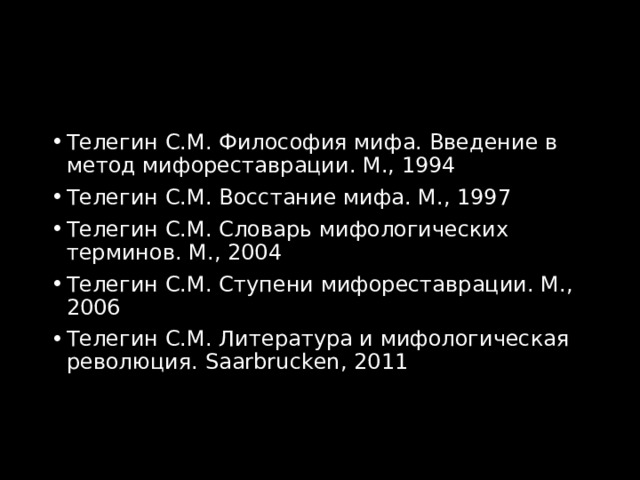
  • С.М. Телегин. Миф, мифореставрация и трансцендентальная филология // Миф – Литература – Мифореставрация. Сб. статей. М.-Рязань, 2000

Он же:

  • Миф // Литература. 1994. № 14
  • Мифологема // Л итература. 1996. № 37
  • Мифореализм // Литература. 1995. № 31
  • Мифореставрация // Литература. 1994. № 28
  • Мифотворчество // Литература. 1996. № 34
Телегин С.М. Философия мифа. Введение в метод мифореставрации. М., 1994 Телегин С.М. Восстание мифа. М., 1997 Телегин С.М. Словарь мифологических терминов. М., 2004 Телегин С.М. Ступени мифореставрации. М., 2006 Телегин С.М. Литература и мифологическая революция. Saarbrucken , 2011
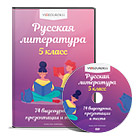
  • Телегин С.М. Философия мифа. Введение в метод мифореставрации. М., 1994
  • Телегин С.М. Восстание мифа. М., 1997
  • Телегин С.М. Словарь мифологических терминов. М., 2004
  • Телегин С.М. Ступени мифореставрации. М., 2006
  • Телегин С.М. Литература и мифологическая революция. Saarbrucken , 2011