
Россия, Екатеринбург

СДЕЛАЙТЕ СВОИ УРОКИ ЕЩЁ ЭФФЕКТИВНЕЕ, А ЖИЗНЬ СВОБОДНЕЕ
Благодаря готовым учебным материалам для работы в классе и дистанционно
Скидки до 50 % на комплекты
только до
Готовые ключевые этапы урока всегда будут у вас под рукой
Организационный момент
Проверка знаний
Объяснение материала
Закрепление изученного
Итоги урока
Была в сети 25.08.2025 13:05

Ильиных Татьяна Викторовна
учитель иностранных языков,высшая категория.
60 лет
 1 730
1 730
 40 460
Местоположение
Специализация
Презентация"Past Perfect"
Категория:
Английский язык
26.03.2020 12:06

Просмотр содержимого документа
«Презентация"Past Perfect"»

Past Perfect Tense
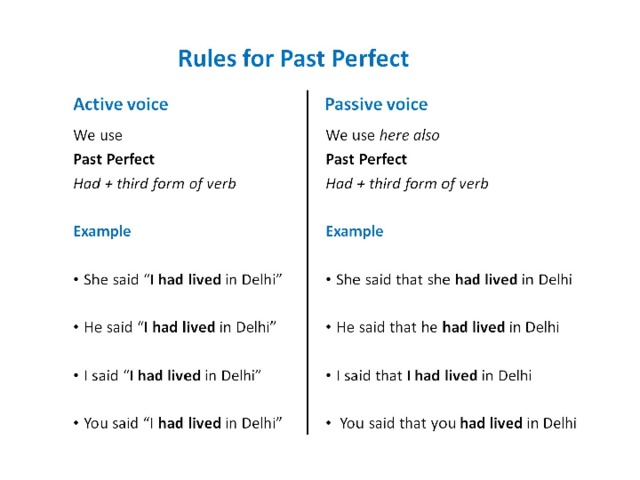
The past perfect , also called the pluperfect, is a verb tense used to talk about actions that were completed before some point in the past.

- When we talk about something that happened in the past we sometimes want to refer back to something that happened before that time. We can use the past perfect tense ( had + past participle ) to do this.
Look at these two sentences.
- John left the house at 7:30 yesterday morning.
- Mary rang John’s doorbell at 8:15 yesterday.
Both actions happened in the past so we use the past simple tense. But look at how we can combine the sentences.
- Mary rang John’s doorbell at 8:15 yesterday but John had already left the house.
We use the past perfect ( had left ) because the action happened before another action in the past ( Mary rang the doorbell. )
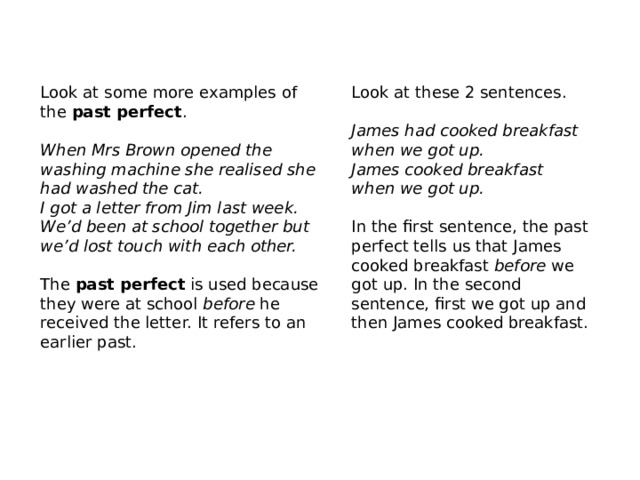
Look at these 2 sentences .
Look at some more examples of the past perfect .
When Mrs Brown opened the washing machine she realised she had washed the cat.
James had cooked breakfast when we got up.
I got a letter from Jim last week. We’d been at school together but we’d lost touch with each other.
James cooked breakfast when we got up.
The past perfect is used because they were at school before he received the letter. It refers to an earlier past.
In the first sentence, the past perfect tells us that James cooked breakfast before we got up. In the second sentence, first we got up and then James cooked breakfast.
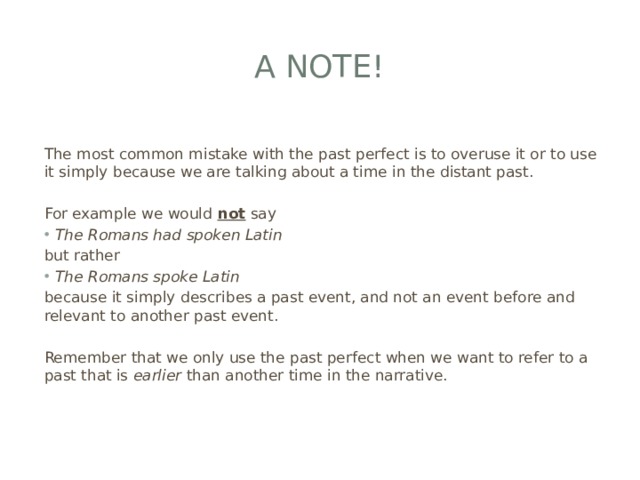
A note!
The most common mistake with the past perfect is to overuse it or to use it simply because we are talking about a time in the distant past.
For example we would not say
- The Romans had spoken Latin
but rather
- The Romans spoke Latin
because it simply describes a past event, and not an event before and relevant to another past event.
Remember that we only use the past perfect when we want to refer to a past that is earlier than another time in the narrative.
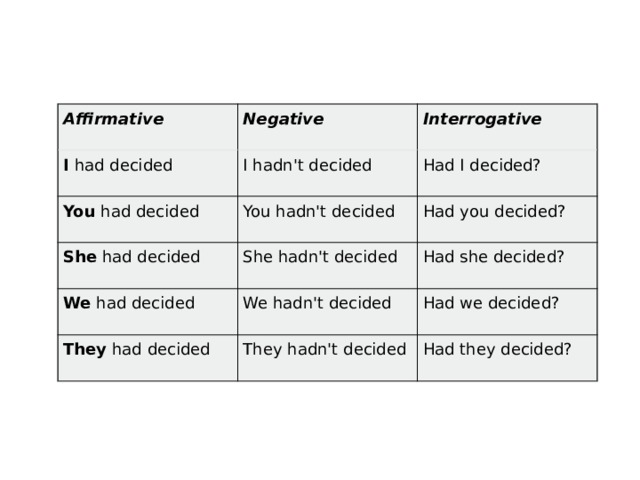
Affirmative
Negative
I had decided
Interrogative
I hadn't decided
You had decided
You hadn't decided
She had decided
Had I decided?
Had you decided?
She hadn't decided
We had decided
We hadn't decided
Had she decided?
They had decided
Had we decided?
They hadn't decided
Had they decided?





Вебинар для учителей

Свидетельство об участии БЕСПЛАТНО!