Казахстан, Караганда

СДЕЛАЙТЕ СВОИ УРОКИ ЕЩЁ ЭФФЕКТИВНЕЕ, А ЖИЗНЬ СВОБОДНЕЕ
Благодаря готовым учебным материалам для работы в классе и дистанционно
Скидки до 50 % на комплекты
только до
Готовые ключевые этапы урока всегда будут у вас под рукой
Организационный момент
Проверка знаний
Объяснение материала
Закрепление изученного
Итоги урока
Был в сети 25.05.2026 06:12
Тимофеев Юрий Александрович
Лаборант ИВТ
33 года
 37 042
 700
700 
Местоположение
Специализация
Презентация по страноведению "Poland"
Категория:
Английский язык
24.08.2019 13:19

Просмотр содержимого документа
«Презентация по страноведению "Poland"»


- Poland (Republic of Poland)- a country located in Central Europe. It is divided into 16 administrative subdivisions, covering an area of 312,696 square kilometres (120,733 sq mi), and has a largely temperate seasonal climate. With a population of approximately 38.5 million people, Poland is the sixth most populous member state of the European Union. Poland's capital and largest metropolis is Warsaw. Other major cities include Kraków, Łódź, Wrocław, Poznań, Gdańsk, and Szczecin.

Kraków
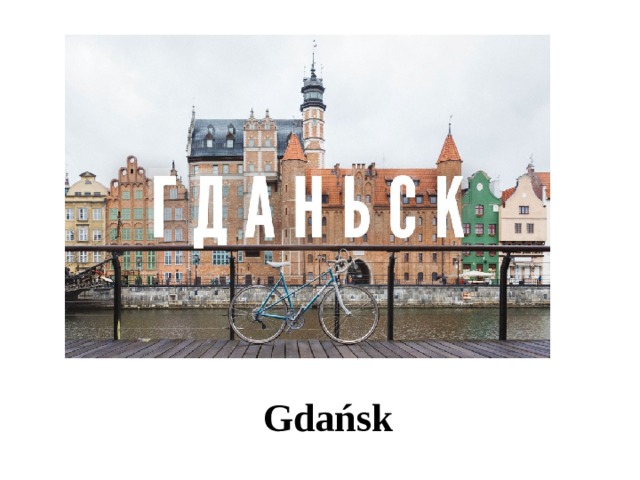
Gdańsk

Etymology
- The origin of the name "Poland" derives from the West Slavic tribe of Polans ( Polanie ), who inhabited the Warta river basin of the historic Greater Poland region starting in the mid-6th century. The origin of the name Polanie itself derives from the Proto-Slavic word pole (field). In some languages, such as Hungarian, Lithuanian, Persian and Turkish, the country's name relates to the Lechites ( Lechici ), [32] and the Lendians ( Lędzianie or Lachy ), a tribe which dwelled on the south-eastern most edge of Lesser Poland and Cherven Grods between the 7th and 11th centuries — lands which were part of the territorial domain ruled over by the Polans.
Nature
- Poland has 70 mountains over 2,000 metres (6,600 feet) in elevation, all in the Tatras The Polish Tatras, which consist of the High Tatras and the Western Tatras, is the highest mountain group of Poland and of the entire Carpathian range. In the High Tatras lies Poland's highest point, the north-western summit of Rysy, 2,499 metres (8,199 ft) in elevation. At its foot lie the mountain lakes of Czarny Staw pod Rysami (Black Lake below Mount Rysy) and Morskie Oko (the Marine Eye).
- The second highest mountain group in Poland is the Beskids, whose highest peak is Babia Góra, at 1,725 metres (5,659 ft). The next highest mountain groups are the Karkonosze in the Sudetes, the highest point of which is Śnieżka at 1,603 metres (5,259 ft), and the Śnieżnik Mountains, the highest point of which is Śnieżnik at 1,425 metres (4,675 ft).

- The longest rivers are the Vistula (Polish: Wisła ), 1,047 kilometres (651 mi) long; the Oder (Polish: Odra ) which forms part of Poland's western border, 854 kilometres (531 mi) long; its tributary, the Warta, 808 kilometres (502 mi) long; and the Bug, a tributary of the Vistula, 772 kilometres (480 mi) long. The Vistula and the Oder flow into the Baltic Sea, as do numerous smaller rivers in Pomerania.
- The Łyna and the Angrapa flow by way of the Pregolya to the Baltic Sea, and the Czarna Hańcza flows into the Baltic Sea through the Neman. While the great majority of Poland's rivers drain into the Baltic Sea, Poland's Beskids are the source of some of the upper tributaries of the Orava, which flows via the Váh and the Danube to the Black Sea. The eastern Beskids are also the source of some streams that drain through the Dniester to the Black Sea.
- Forests cover about 30.5% of Poland's land area based on international standards.Its overall percentage is still increasing. The largest forest complex in Poland is Lower Silesian Wilderness.

High Tatras

Vistula

Politics
- Poland is a representative democracy, with a president as a head of state, whose current constitution dates from 1997. Poland ranks in the top 20 percent of the most peaceful countries in the world, according to the Global Peace Index. The government structure centers on the Council of Ministers, led by a prime minister. The president appoints the cabinet according to the proposals of the prime minister, typically from the majority coalition in the Sejm. The president is elected by popular vote every five years. The current president is Andrzej Duda and the prime minister is Mateusz Morawiecki.

Transport
- Transport in Poland is provided by means of rail, road, marine shipping and air travel. Positioned in Central Europe with its eastern and part of its northeastern border constituting the longest land border of the Schengen Area with the rest of Northern and Central Europe.
- Since joining the EU in May 2004, Poland has invested large amounts of public funds into modernization projects of its transport networks. The country now has a developing network of highways, composed of express roads and motorways. At the end of 2017, Poland had 3421,7 km of highways. In addition to these newly built roads, many local and regional roads are being fixed as part of a national programme to rebuild all roads in Poland.
Languages
- Polish ( język polski , polszczyzna ) is a Slavic language spoken primarily in Poland and the native language of Poles. It belongs to the Lechitic subgroup of West Slavic languages.
- Until recent decades Russian was commonly learned as a second language, but after the Revolutions of 1989 has been replaced by English as the most common second language studied and spoken.
- Languages having the status of national minority's language are Armenian, Belarusian, Czech, German, Yiddish, Hebrew, Lithuanian, Russian, Slovak and Ukrainian.

Symbols of Poland

Polish poets

Вебинар для учителей

Свидетельство об участии БЕСПЛАТНО!