Казахстан, Караганда

СДЕЛАЙТЕ СВОИ УРОКИ ЕЩЁ ЭФФЕКТИВНЕЕ, А ЖИЗНЬ СВОБОДНЕЕ
Благодаря готовым учебным материалам для работы в классе и дистанционно
Скидки до 50 % на комплекты
только до
Готовые ключевые этапы урока всегда будут у вас под рукой
Организационный момент
Проверка знаний
Объяснение материала
Закрепление изученного
Итоги урока
Был в сети 15.05.2026 05:52
Тимофеев Юрий Александрович
Лаборант ИВТ
33 года
 37 029
 699
699 
Местоположение
Специализация
Презентация по страноведению "Spain"
Категория:
Английский язык
26.08.2019 12:11

Просмотр содержимого документа
«Презентация по страноведению "Spain"»
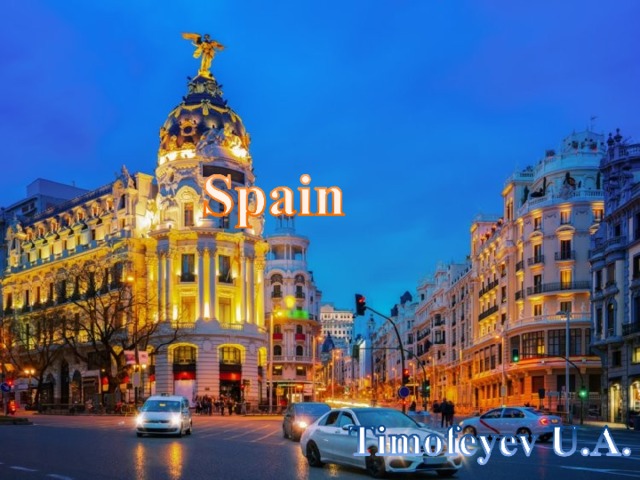
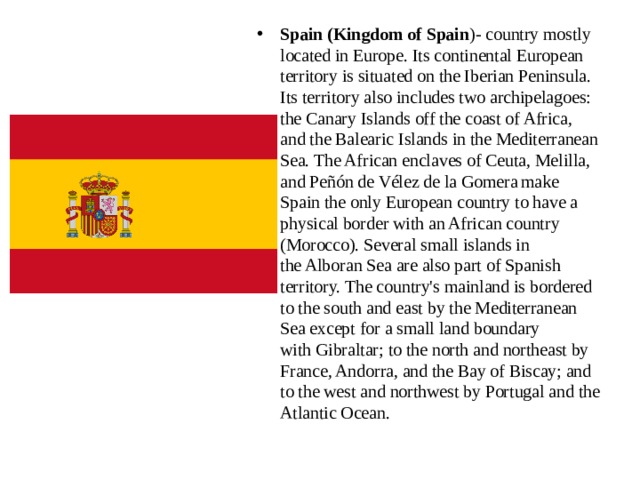
- Spain (Kingdom of Spain )- country mostly located in Europe. Its continental European territory is situated on the Iberian Peninsula. Its territory also includes two archipelagoes: the Canary Islands off the coast of Africa, and the Balearic Islands in the Mediterranean Sea. The African enclaves of Ceuta, Melilla, and Peñón de Vélez de la Gomera make Spain the only European country to have a physical border with an African country (Morocco). Several small islands in the Alboran Sea are also part of Spanish territory. The country's mainland is bordered to the south and east by the Mediterranean Sea except for a small land boundary with Gibraltar; to the north and northeast by France, Andorra, and the Bay of Biscay; and to the west and northwest by Portugal and the Atlantic Ocean.
Etymology
- The origins of the Roman name Hispania , from which the modern name España was derived, are uncertain due to inadequate evidence, although it is documented that the Phoenicians and Carthaginians referred to the region as Spania , therefore the most widely accepted etymology is a Semitic-Phoenician one.
Mountains and rivers
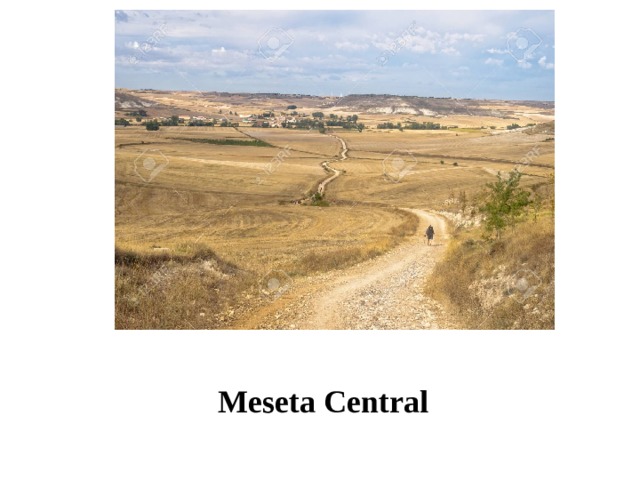
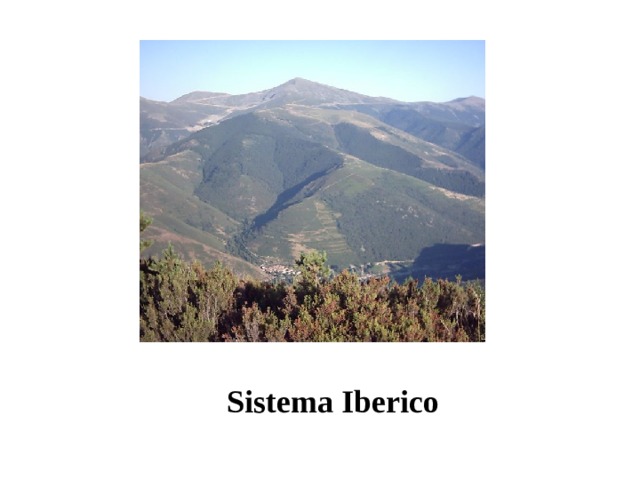
- Mainland Spain is a mountainous country, dominated by high plateaus and mountain chains. After the Pyrenees, the main mountain ranges are the Cordillera Cantábrica (Cantabrian Range), Sistema Ibérico (Iberian System), Sistema Central (Central System), Montes de Toledo, Sierra Morena and the Sistema Bético (Baetic System) whose highest peak, the 3,478-metre-high (11,411-foot) Mulhacén, located in Sierra Nevada is the highest elevation in the Iberian Peninsula. The highest point in Spain is the Teide, a 3,718-metre (12,198 ft) active volcano in the Canary Islands. The Meseta Central (often translated as "Inner Plateau") is a vast plateau in the heart of peninsular Spain.
- There are several major rivers in Spain such as the Tagus ( Tajo ), Ebro, Guadiana, Douro( Duero ), Guadalquivir, Júcar, Segura, Turia and Minho ( Miño ). Alluvial plains are found along the coast, the largest of which is that of the Guadalquivir in Andalusia.
Meseta Central
Sistema Iberico
Flora and fauna
- The fauna presents a wide diversity that is due in large part to the geographical position of the Iberian peninsula between the Atlantic and the Mediterranean and between Africa and Eurasia, and the great diversity of habitats and biotopes, the result of a considerable variety of climates and well differentiated regions.
- The vegetation of Spain is varied due to several factors including the diversity of the relief, the climate and latitude. Spain includes different phytogeographic regions, each with its own floristic characteristics resulting largely from the interaction of climate, topography, soil type and fire, biotic factors.
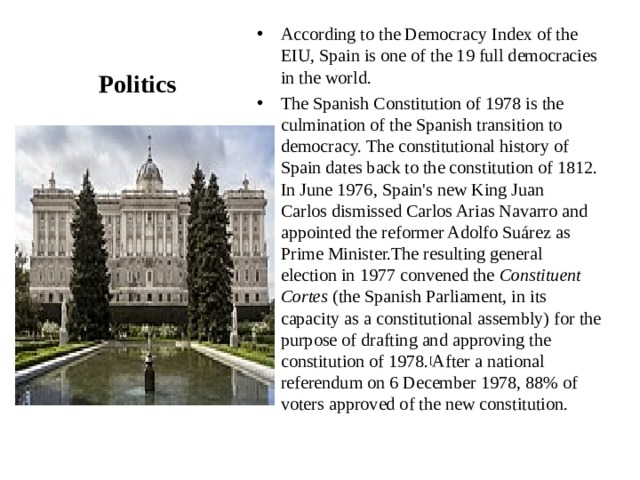
- According to the Democracy Index of the EIU, Spain is one of the 19 full democracies in the world.
- The Spanish Constitution of 1978 is the culmination of the Spanish transition to democracy. The constitutional history of Spain dates back to the constitution of 1812. In June 1976, Spain's new King Juan Carlos dismissed Carlos Arias Navarro and appointed the reformer Adolfo Suárez as Prime Minister.The resulting general election in 1977 convened the Constituent Cortes (the Spanish Parliament, in its capacity as a constitutional assembly) for the purpose of drafting and approving the constitution of 1978. [ After a national referendum on 6 December 1978, 88% of voters approved of the new constitution.
Politics
- Spain is a constitutional monarchy, with a hereditary monarch and a bicameral parliament, the Cortes Generales (General Courts). The executive branch consists of a Council of Ministers of Spain presided over by the Prime Minister, nominated and appointed by the monarch and confirmed by the Congress of Deputies following legislative elections. By political custom established by King Juan Carlos since the ratification of the 1978 Constitution, the king's nominees have all been from parties who maintain a plurality of seats in the Congress.
- Spain is organisationally structured as a so-called Estado de las Autonomías ("State of Autonomies"); it is one of the most decentralised countries in Europe, along with Switzerland, Germany and Belgium; for example, all autonomous communities have their own elected parliaments, governments, public administrations, budgets, and resources. Health and education systems among others are managed by the Spanish communities, and in addition, the Basque Country and Navarre also manage their own public finances based on foral provisions. In Catalonia, the Basque Country, Navarre and the Canary Islands, a full-fledged autonomous police corps replaces some of the State police functions (see Mossos d'Esquadra , Ertzaintza , Policía Foral/Foruzaingoa and Policía Canaria ).
Languages
- Spanish ( español )— recognised in the constitution as Castilian ( castellano )—is the official language of the entire country, and it is the right and duty of every Spaniard to know the language. The constitution also establishes that "the other Spanish languages"—that is, the other languages of Spain—will also be official in their respective autonomous communities in accordance to their Statutes, their organic regional legislations, and that the "richness of the distinct linguistic modalities of Spain represents a patrimony which will be the object of special respect and protection."
The other official languages of Spain, co-official with Spanish are:
- Catalan ( català or valencià ) in Catalonia, the Valencian Community and the Balearic Islands;
- Galician ( galego ) in Galicia ;
- Basque ( euskara ) in the Basque Country and Navarre; and
- Occitan ( aranés ) in Catalonia.
As a percentage of the general population of all Spain, Spanish is natively spoken by 74%, Catalan by 17%, Galician by 7% and Basque by 2% of all Spaniards. Occitan is spoken by less than 5,000 people, only in the small region of Val d'Aran .
In the riojan monastery of San Millán de Suso there were found the first written records of both basque and Spanish languages (Glosas Emilianenses).
Other Romance minority languages, though not official, have special recognition, such as the Astur-Leonese language ( asturianu , bable or llionés ) and Aragonese ( aragonés ) in Aragon.
Music
- Spanish music is often considered abroad to be synonymous with flamenco, a West Andalusian musical genre, which, contrary to popular belief, is not widespread outside that region. Various regional styles of folk music abound in Aragon, Catalonia, Valencia, Castile, the Basque Country, Galicia, Cantabria and Asturias. Pop, rock, hip hop and heavy metal are also popular.
Holidays and festivals
- Public holidays celebrated in Spain include a mix of religious (Roman Catholic), national and regional observances. Each municipality is allowed to declare a maximum of 14 public holidays per year; up to nine of these are chosen by the national government and at least two are chosen locally.Spain's National Day ( Fiesta Nacional de España ) is 12 October, the anniversary of the Discovery of America and commemorate Our Lady of the Pillar feast, patroness of Aragon and throughout Spain.
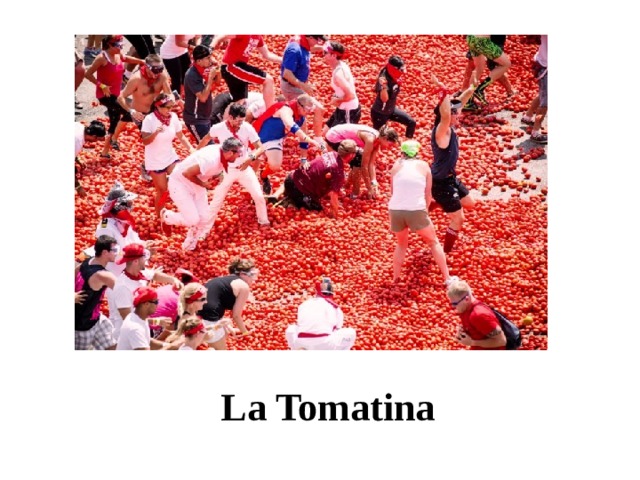
La Tomatina
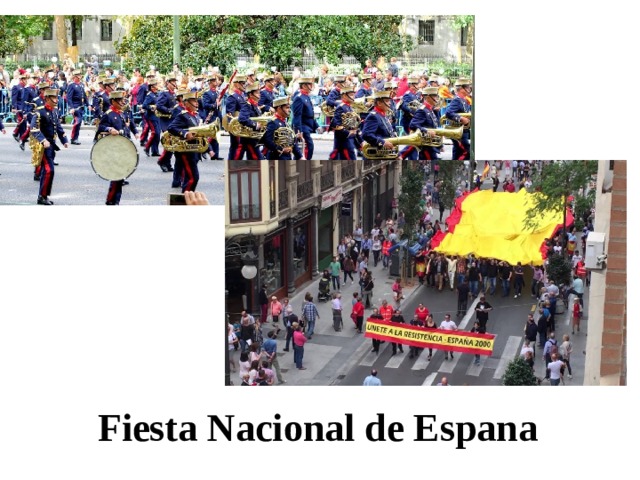
Fiesta Nacional de Espana
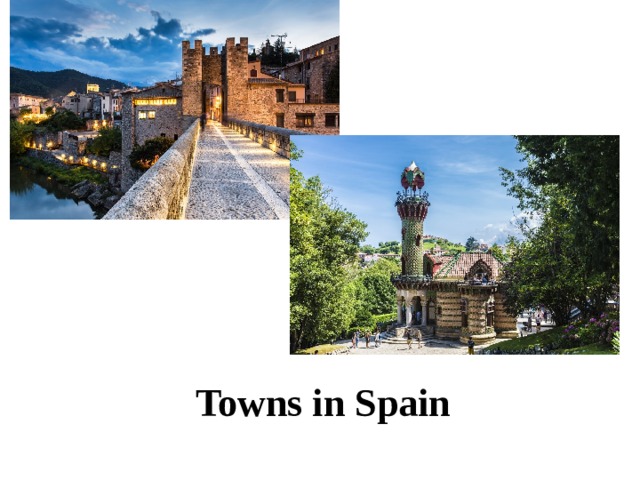
Towns in Spain
Вебинар для учителей

Свидетельство об участии БЕСПЛАТНО!