

Россия, Иркутская область

СДЕЛАЙТЕ СВОИ УРОКИ ЕЩЁ ЭФФЕКТИВНЕЕ, А ЖИЗНЬ СВОБОДНЕЕ
Благодаря готовым учебным материалам для работы в классе и дистанционно
Скидки до 50 % на комплекты
только до
Готовые ключевые этапы урока всегда будут у вас под рукой
Организационный момент
Проверка знаний
Объяснение материала
Закрепление изученного
Итоги урока
Была в сети 02.12.2025 15:05

Аджитарова Лилия Сибагатулловна
Учитель английского языка
 806
806
 78 486
Местоположение
Специализация
Презентация по теме "Кельтское вторжение"
Категория:
Английский язык
05.07.2023 16:26

Просмотр содержимого документа
«Презентация по теме "Кельтское вторжение"»

Celtic Invasion

WHO WERE Κελτοί?
The Celts were a collection of tribes with origins in central Europe that shared a similar language, religious beliefs, traditions, and culture. The Celts spread throughout western Europe — including Britain, Ireland, France, and Spain — via migration. Their legacy remains most prominent in Ireland and Great Britain, where traces of their language and culture are still prominent today.
The existence of the Celts was first documented in the seventh or eighth century B.C. The Roman Empire, which ruled much of southern Europe at that time, referred to the Celts as “Galli,” meaning barbarians.

Where Did The Celts Come From?
What we do know is that the people we call Celts gradually infiltrated Britain over the course of the centuries between about 500 and 100 B.C. There was probably never an organized Celtic invasion;
The Celts were a group of peoples loosely tied by similar language, religion, and cultural expression. They were not centrally governed, and quite as happy to fight each other as any non-Celt. They were warriors, living for the glories of battle and plunder. They were also the people who brought iron working to the British Isles.
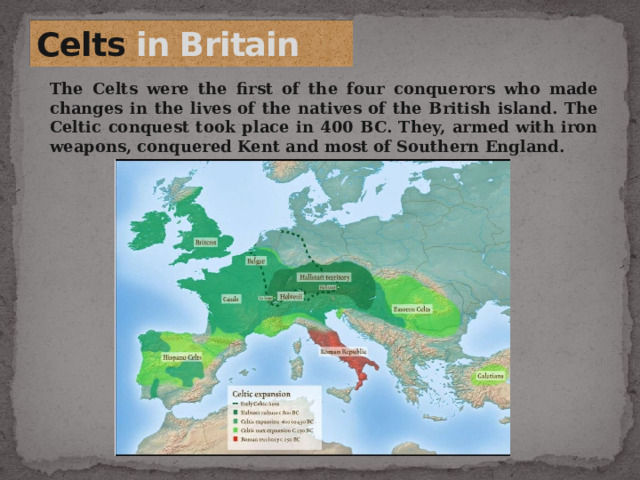
Celts in Britain
The Celts were the first of the four conquerors who made changes in the lives of the natives of the British island. The Celtic conquest took place in 400 BC. They, armed with iron weapons, conquered Kent and most of Southern England.

The first Celtic comers were the Gaels to Wales, Scotland, Ireland and Cornwall taking possession of the south and east. Thus the whole of Britain was occupied by the Celts who merged with the Picts and Scots, as well as with the Alpine part of the population: the latter predominated in the West while the rest of the British Isles became distinctly Celtic in language and the structure of society. The Gaelic form of the Celtic dialects was spoken in Caledonia (modern Scotland) and Ireland, the Brythonic form in England and Wales. The social unit of the Celts, the clan, superseded the earlier family groups; clans were united into large kinship groups, and those into tribes. The clan was the chief economic unit, the main organizational unit for basic activities of the Celts, farming.
This Celt dominated mixture of Picts, Scots and other ingredients came to be called Brythons, or Britts.

The Celts of the British Isles were heathens until later invaders, the Romans, brought Christianity to them. Their religion was a weird mixture of heathenism, that is the worship of certain Gods and Goddesses, with the worship of the Sun and Moon, and of the Serpent, the symbol of wisdom. The priests were called Druids, and their superior knowledge was taken for magic power.

On the eve of the Roman conquest the Brythons were at the stage of decay corroding the primitive community structure; elements of a new, class society were appearing, with patriarchal slavery as a new feature. The rapid economic development of that time led to a weakening of the Celtic clan structure and that to a certain extent may account for the comparative ease with which the conquest was effected.

The influence of the Celts on the English language.
Celtic words in OE come from three identifiable sources – from the continent (usually words associated with conflict and battle – the Celts were often used as ‘armies for hire’), loans taken over after settlement (usually place names), and words from Ireland frequently associated with the Christianization of Britain. The Celtic language group has been categorized as part of the Indo-European group of languages.

Celtic lexical heritage is an important and integral layer of the vocabulary of the modern English language. Celtic lexemes have penetrated deeply into the English language and the English-speaking lingo culture, have become part of phrase logical units, proverbs and sayings, have acquired new meanings – often bright and expressive, have been assigned as names to English literary characters..

On the territory of the British Isles, the ancient Celts used ogham, Oghamic writing. Ogam refers to alphabetic writing, which is a continuous vertical line, with segments adjacent to it or intersecting it.

Some borrowings from the Celtic language
Названия и имена
Другие заимствования
Aberdeen, Allendale, Albion, Alps, Arthur, Avon, Ayres, Ben, Nevis, Brian, Bridget, Buchan, Calais, Cam, Cambridge, Campbell, Casey, Cassidy, Char, Conan, Connor, Cornwall, Danube, Dee, Deirdre, Devon, Donald,
Earn, Fergus, Galahad, Knoll, Lancaster,
bannock, bard, barter, basket, bat, Beltane, Berkshire, bin, beak, beaver,, belt, beet, bicker, bitumen, bludgeon, bobbin, bodkin, boll, bran, briar, brier, brogue, bruit, buck, bun, bung, bunny, burro, cairn, carpenter, clout, cockle, coot, coracle, cowl, cradle, crag, crock, crumpet, cub, dagger, dock. drone, druid, dun, ferrule, frock, gavel, glean, glen, gob, gravel, gull, harness, hog, holly, iron, Keith, Kelpie, lay, lead, loch, mackerel, mantle, mare, mattock, mere, mine, moat, mop, mug, paw, pet, piece, pilchard, pipe, pool, puffin, rat, rill, slogan, slough, tan, wraith.
London, Manchester, Po, Paris, Swan,
Tiber, Thames, Tor, Turin, York

Использованные источники:
- https://ppt-online.org/109411
- https://www.britainexpress.com/History/Celtic_Britain.htm
- https://en.wikipedia.org/wiki/Invasions_of_the_British_Isles
- https :// helpiks . org /4-34552. html
- http://homes.chass.utoronto.ca/~cpercy/courses/6361Lovis.htm
- https://tistoriya.livejournal.com/

Thank you!

Вебинар для учителей

Свидетельство об участии БЕСПЛАТНО!



