Россия, Лабинск


СДЕЛАЙТЕ СВОИ УРОКИ ЕЩЁ ЭФФЕКТИВНЕЕ, А ЖИЗНЬ СВОБОДНЕЕ
Благодаря готовым учебным материалам для работы в классе и дистанционно
Скидки до 50 % на комплекты
только до
Готовые ключевые этапы урока всегда будут у вас под рукой
Организационный момент
Проверка знаний
Объяснение материала
Закрепление изученного
Итоги урока

Была в сети 17.03.2026 18:02

Клюшниченко Наталия Николаевна
преподаватель английского языка
42 года
 2 219
2 219
 32 030
Местоположение
Специализация
Презентация "Famous biologists"
Категория:
Английский язык
17.05.2017 22:04

Просмотр содержимого документа
«Презентация "Famous biologists"»
Famous Biologists
Преподаватель английского языка
ГБПОУ «Лабинский медицинский колледж»
Клюшниченко Наталия Николаевна
Biology is a natural science concerned with the study of life and living organisms , including their structure, function, growth, origin, evolution, distribution, and taxonomy. Biology is a vast subject containing many subdivisions, topics, and disciplines.
Biologists throughout the world have made great finds and discoveries throughout history. Some of these discoveries have helped cure diseases, perform medical procedures, and classify animals. Others have formed the basis of the medical profession as we know it today. Here are some of the famous biologists that have made significant contributions to various areas of life.
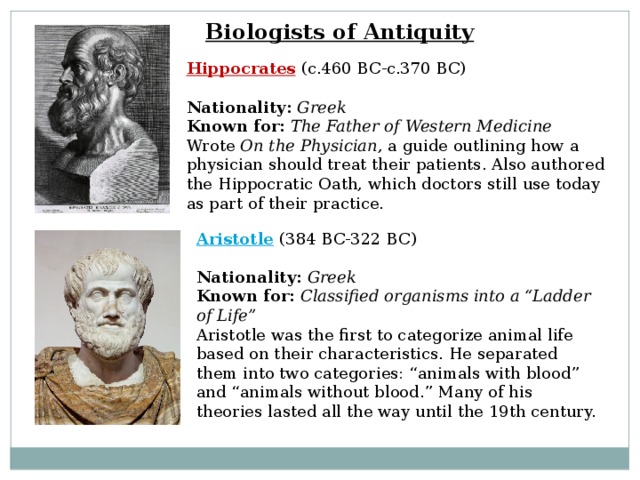
Biologists of Antiquity
Hippocrates (c.460 BC-c.370 BC)
Nationality: Greek Known for: The Father of Western Medicine Wrote On the Physician , a guide outlining how a physician should treat their patients. Also authored the Hippocratic Oath, which doctors still use today as part of their practice.
Aristotle (384 BC-322 BC)
Nationality: Greek Known for: Classified organisms into a “Ladder of Life” Aristotle was the first to categorize animal life based on their characteristics. He separated them into two categories: “animals with blood” and “animals without blood.” Many of his theories lasted all the way until the 19th century.
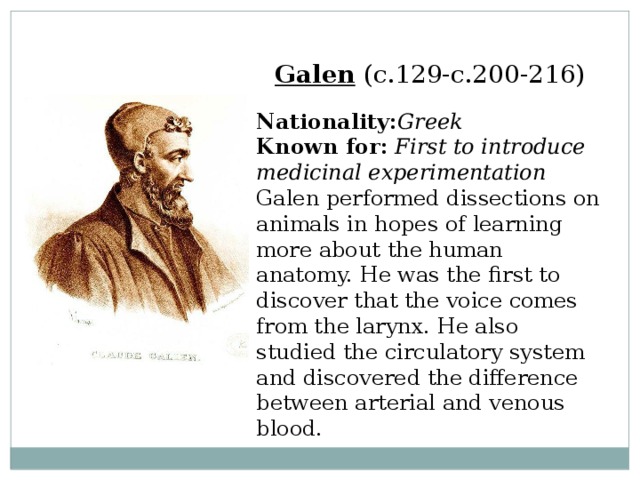
Galen (c.129-c.200-216)
Nationality: Greek Known for: First to introduce medicinal experimentation Galen performed dissections on animals in hopes of learning more about the human anatomy. He was the first to discover that the voice comes from the larynx. He also studied the circulatory system and discovered the difference between arterial and venous blood.
Biologists of the Middle Ages (1500-1700)
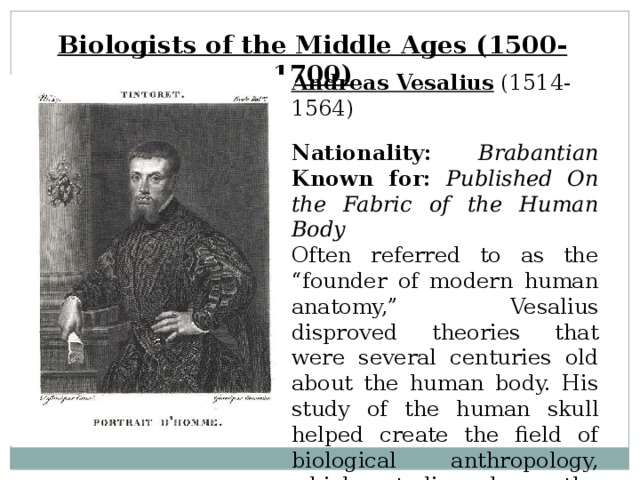
Andreas Vesalius (1514-1564)
Nationality: Brabantian Known for: Published On the Fabric of the Human Body Often referred to as the “founder of modern human anatomy,” Vesalius disproved theories that were several centuries old about the human body. His study of the human skull helped create the field of biological anthropology, which studies how the human species has developed over time.
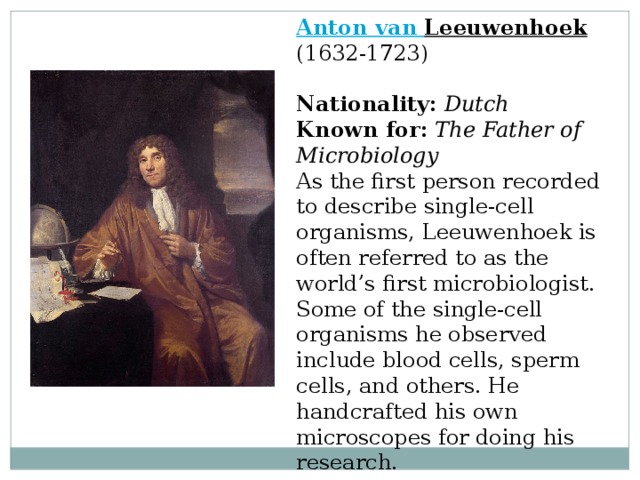
Anton van Leeuwenhoek (1632-1723)
Nationality: Dutch Known for: The Father of Microbiology As the first person recorded to describe single-cell organisms, Leeuwenhoek is often referred to as the world’s first microbiologist. Some of the single-cell organisms he observed include blood cells, sperm cells, and others. He handcrafted his own microscopes for doing his research.
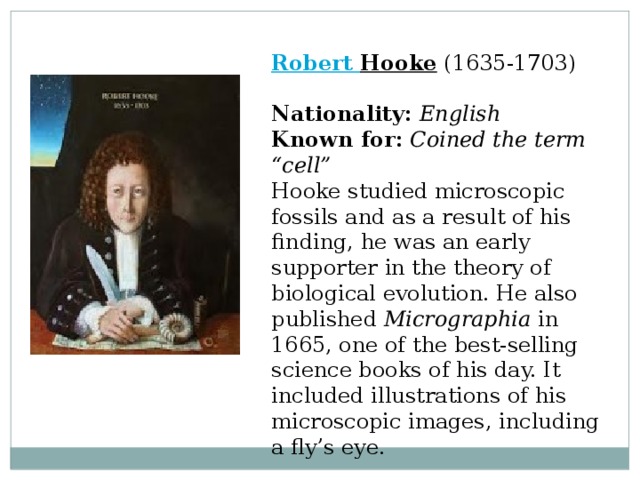
Robert Hooke (1635-1703)
Nationality: English Known for: Coined the term “cell” Hooke studied microscopic fossils and as a result of his finding, he was an early supporter in the theory of biological evolution. He also published Micrographia in 1665, one of the best-selling science books of his day. It included illustrations of his microscopic images, including a fly’s eye.
Biologists of the 1700s
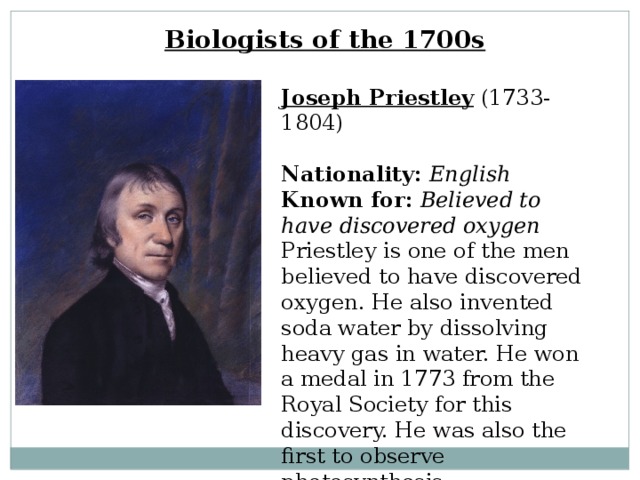
Joseph Priestley (1733-1804)
Nationality: English Known for: Believed to have discovered oxygen Priestley is one of the men believed to have discovered oxygen. He also invented soda water by dissolving heavy gas in water. He won a medal in 1773 from the Royal Society for this discovery. He was also the first to observe photosynthesis.
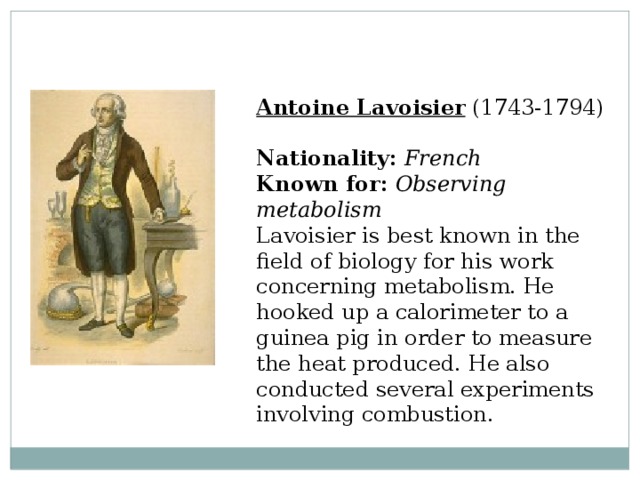
Antoine Lavoisier (1743-1794)
Nationality: French Known for: Observing metabolism Lavoisier is best known in the field of biology for his work concerning metabolism. He hooked up a calorimeter to a guinea pig in order to measure the heat produced. He also conducted several experiments involving combustion.
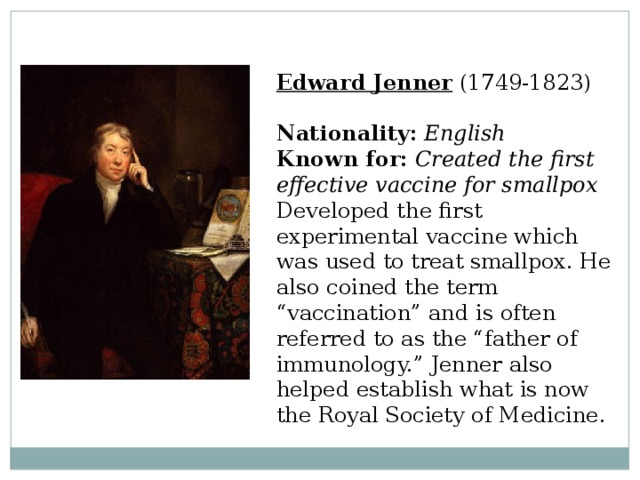
Edward Jenner (1749-1823)
Nationality: English Known for: Created the first effective vaccine for smallpox Developed the first experimental vaccine which was used to treat smallpox. He also coined the term “vaccination” and is often referred to as the “father of immunology.” Jenner also helped establish what is now the Royal Society of Medicine.
Biologists of the 1800s
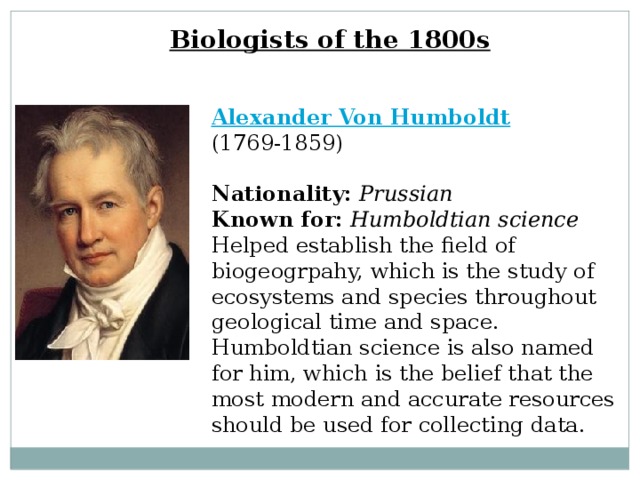
Alexander Von Humboldt (1769-1859)
Nationality: Prussian Known for: Humboldtian science Helped establish the field of biogeogrpahy, which is the study of ecosystems and species throughout geological time and space. Humboldtian science is also named for him, which is the belief that the most modern and accurate resources should be used for collecting data.
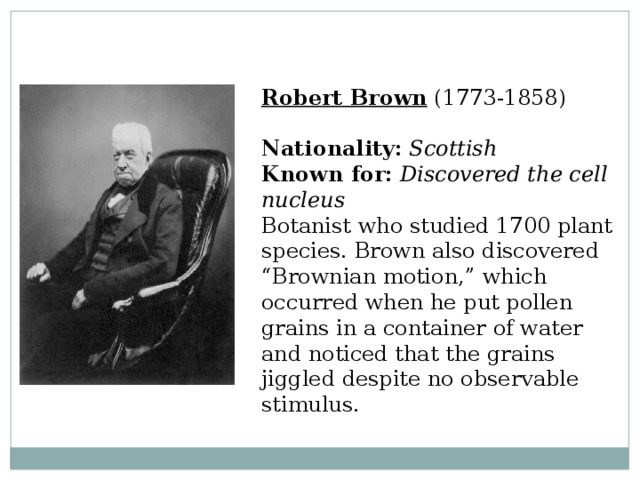
Robert Brown (1773-1858)
Nationality: Scottish Known for: Discovered the cell nucleus Botanist who studied 1700 plant species. Brown also discovered “Brownian motion,” which occurred when he put pollen grains in a container of water and noticed that the grains jiggled despite no observable stimulus.
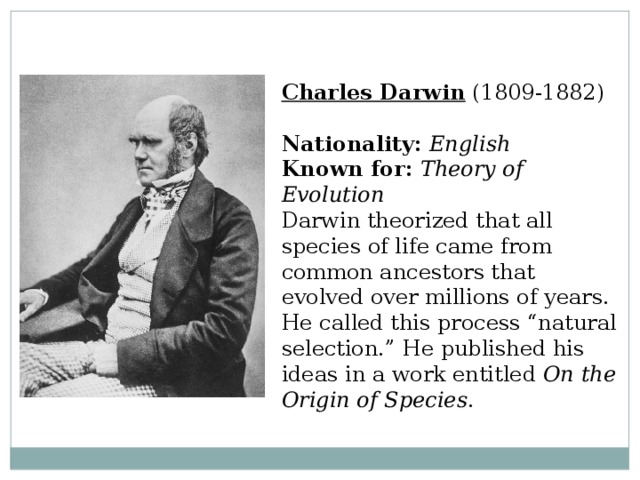
Charles Darwin (1809-1882)
Nationality: English Known for: Theory of Evolution Darwin theorized that all species of life came from common ancestors that evolved over millions of years. He called this process “natural selection.” He published his ideas in a work entitled On the Origin of Species .
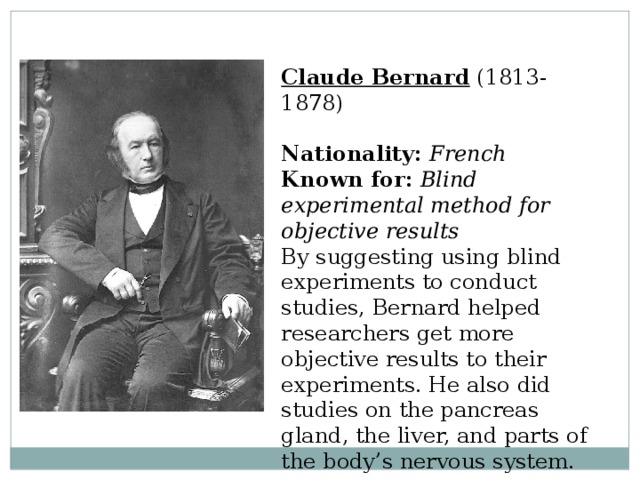
Claude Bernard (1813-1878)
Nationality: French Known for: Blind experimental method for objective results By suggesting using blind experiments to conduct studies, Bernard helped researchers get more objective results to their experiments. He also did studies on the pancreas gland, the liver, and parts of the body’s nervous system.
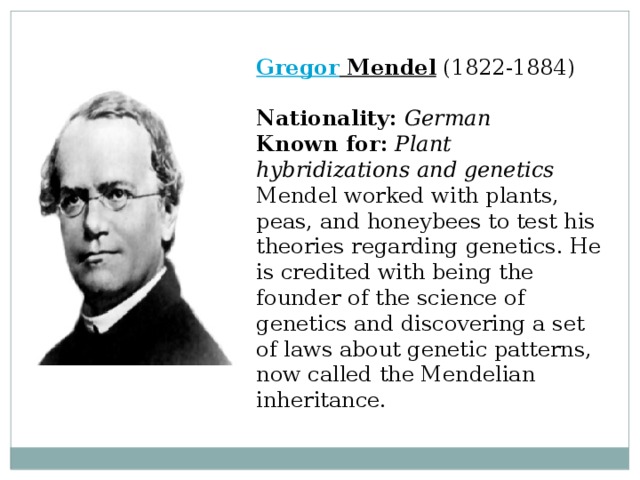
Gregor Mendel (1822-1884)
Nationality: German Known for: Plant hybridizations and genetics Mendel worked with plants, peas, and honeybees to test his theories regarding genetics. He is credited with being the founder of the science of genetics and discovering a set of laws about genetic patterns, now called the Mendelian inheritance.
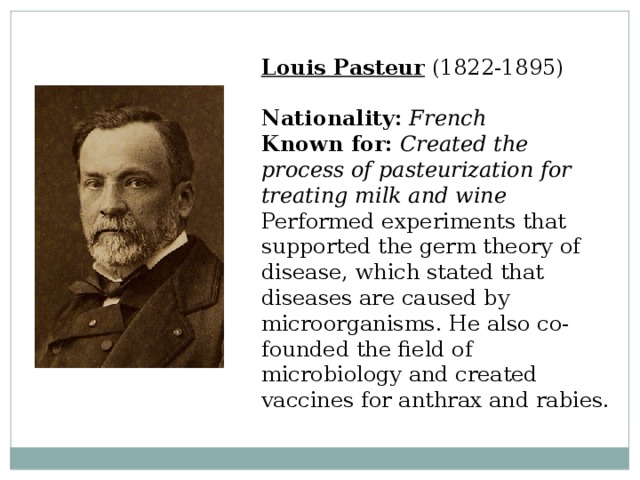
Louis Pasteur (1822-1895)
Nationality: French Known for: Created the process of pasteurization for treating milk and wine Performed experiments that supported the germ theory of disease, which stated that diseases are caused by microorganisms. He also co-founded the field of microbiology and created vaccines for anthrax and rabies.
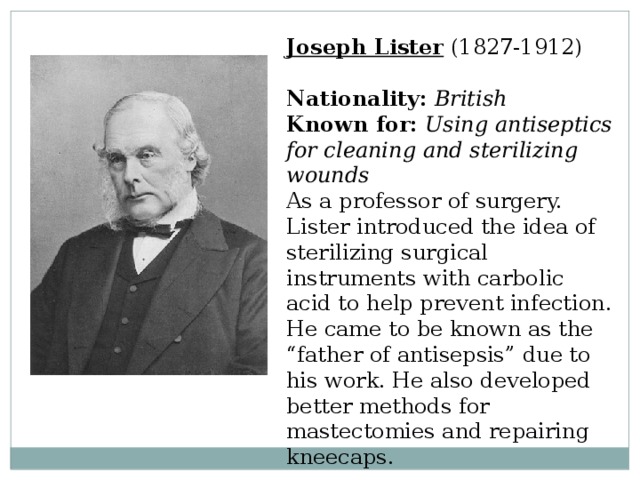
Joseph Lister (1827-1912)
Nationality: British Known for: Using antiseptics for cleaning and sterilizing wounds As a professor of surgery. Lister introduced the idea of sterilizing surgical instruments with carbolic acid to help prevent infection. He came to be known as the “father of antisepsis” due to his work. He also developed better methods for mastectomies and repairing kneecaps.
Biologists of the 1900s
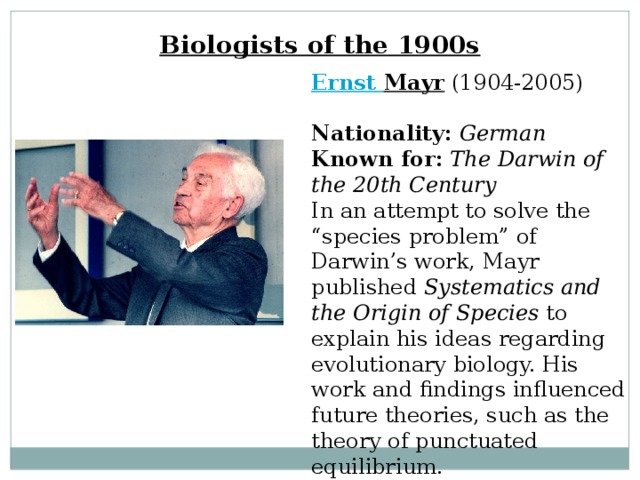
Ernst Mayr (1904-2005)
Nationality: German Known for: The Darwin of the 20th Century In an attempt to solve the “species problem” of Darwin’s work, Mayr published Systematics and the Origin of Species to explain his ideas regarding evolutionary biology. His work and findings influenced future theories, such as the theory of punctuated equilibrium.
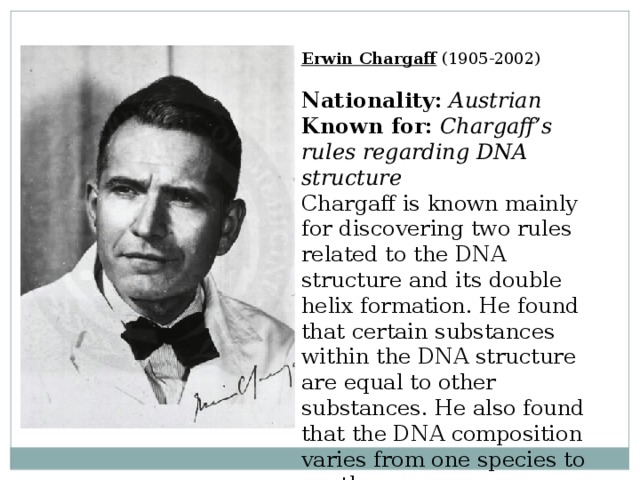
Erwin Chargaff (1905-2002)
Nationality: Austrian Known for: Chargaff’s rules regarding DNA structure Chargaff is known mainly for discovering two rules related to the DNA structure and its double helix formation. He found that certain substances within the DNA structure are equal to other substances. He also found that the DNA composition varies from one species to another.
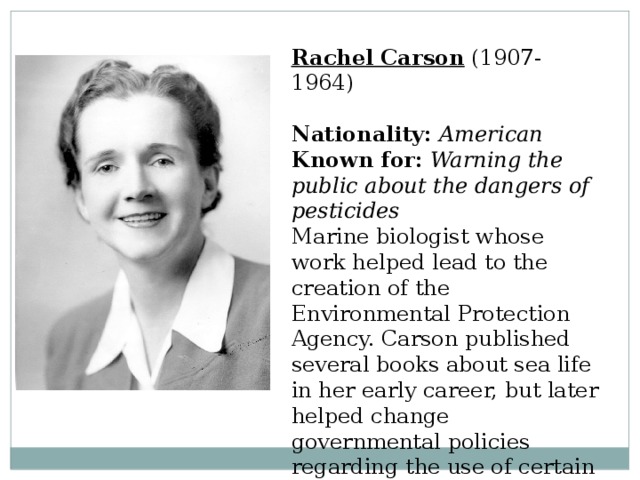
Rachel Carson (1907-1964)
Nationality: American Known for: Warning the public about the dangers of pesticides Marine biologist whose work helped lead to the creation of the Environmental Protection Agency. Carson published several books about sea life in her early career, but later helped change governmental policies regarding the use of certain pesticides.








Вебинар для учителей

Свидетельство об участии БЕСПЛАТНО!