

Россия,

СДЕЛАЙТЕ СВОИ УРОКИ ЕЩЁ ЭФФЕКТИВНЕЕ, А ЖИЗНЬ СВОБОДНЕЕ
Благодаря готовым учебным материалам для работы в классе и дистанционно
Скидки до 50 % на комплекты
только до
Готовые ключевые этапы урока всегда будут у вас под рукой
Организационный момент
Проверка знаний
Объяснение материала
Закрепление изученного
Итоги урока
Была в сети 26.05.2020 12:12

Имамова Назима Бинямудиновна
Учитель английского языка
 68 258
 279
279 
Местоположение
Специализация
Презентация " Rudyard Kipling"
Категория:
Английский язык
28.02.2017 21:18

Просмотр содержимого документа
«Презентация " Rudyard Kipling"»

Joseph Rudyard Kipling (December 30, 1865 - January 18, 1936)

Born Joseph Rudyard Kipling
30 December 1865
Bombay, India
Died 18 January 1936 (aged 70)
Middlesex Hospital, London, England
Occupation Short story writer, novelist, poet, journalist
Nationality British
Genres Short story, novel, children's literature, poetry, travel literature, science fiction
Notable work(s) The Jungle Book, Just So Stories , Kim, If—, Gunga Din
Notable award(s) Nobel Prize in Literature in 1907
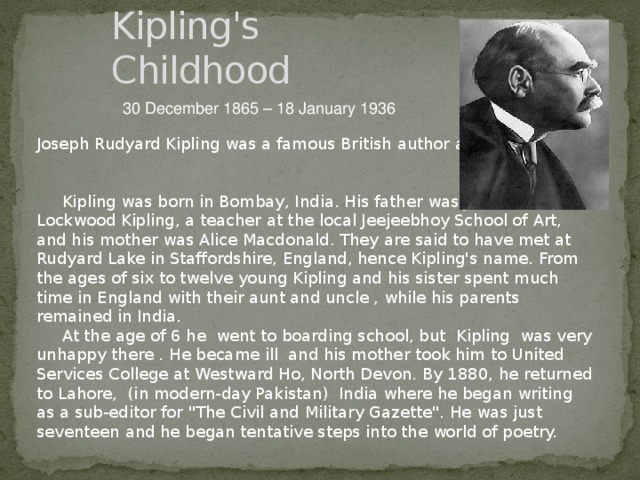
Kipling's Childhood
30 December 1865 – 18 January 1936
Joseph Rudyard Kipling was a famous British author and poet.
Kipling was born in Bombay, India. His father was John
Lockwood Kipling, a teacher at the local Jeejeebhoy School of Art,
and his mother was Alice Macdonald. They are said to have met at Rudyard Lake in Staffordshire, England, hence Kipling's name. From the ages of six to twelve young Kipling and his sister spent much time in England with their aunt and uncle , while his parents remained in India.
At the age of 6 he went to boarding school, but Kipling was very unhappy there . He became ill and his mother took him to United Services College at Westward Ho, North Devon. By 1880, he returned to Lahore, (in modern-day Pakistan) India where he began writing as a sub-editor for "The Civil and Military Gazette". He was just seventeen and he began tentative steps into the world of poetry.

Naulakha, in Dummerston, Vermont ,
Rudyard Kipling's house, as it looks today
The building on Villiers Street off the Strand in London where Kipling rented rooms from 1889 to 1891

Stories for Little Children and Adults
In 1902 his “Just so Stories for Little Children” were published. His fairy-tales from the book were rather unusual for the British literature of that period. One can find the influence of Lewis Carroll’s “Alice in Wonderland” in Kipling’s work. But this influence didn’t prevent Kipling from creating absolutely new, unusual fairy-tales. The unusual effect of his tales is reached by the rhythm and the music of words. Those who were lucky to listen to Kipling reading his fairy-tales noted that they always sounded truthful. Besides, not only children but even adults were very fond of “Just so Stories”. Together with “The Jungle Book” it still enjoys great popularity .

The Jungle Book (1894) is a collection of stories by English author Rudyard Kipling . The stories are fables, using animals in an anthropomorphic manner to give moral lessons. A principal character is the boy or "man-cub" Mowgli, who is raised in the jungle by wolves. Other characters include Shere Khan the tiger and Baloo the bear. The book has been adapted many times for film and other media.


If you can make one heap of all your winnings
And risk it on one turn of pitch-and-toss,
And lose, and start again at your beginnings
And never breathe a word about your loss;
If you can force your heart and nerve and sinew
To serve your turn long after they are gone,
And so hold on when there is nothing in you
Except the Will which says to them: ‘Hold on!’
If you can talk with crowds and keep your virtue,
Or walk with Kings-nor lose the common touch,
If neither foes nor loving friends can hurt you,
If all men count with you, but none too much;
If you can fill the unforgiving minute
With sixty seconds’ worth of distance run,
Yours is the Earth and everything that’s in it,
And-which is more-you’ll be a Man, my son!
If you can keep your head when all about you
Are losing theirs and blaming it on you,
If you can trust yourself when all men doubt you,
But make allowance for their doubting too;
If you can wait and not be tired by waiting,
Or being lied about, don’t deal in lies,
Or being hated don’t give way to hating,
And yet don’t look too good, nor talk too wise:
If you can dream-and not make dreams your master;
If you can think-and not make thoughts your aim,
If you can meet with Triumph and Disaster
And treat those two impostors just the same;
If you can bear to hear the truth you’ve spoken
Twisted by knaves to make a trap for fools,
Or watch the things you gave your life to, broken,
And stoop and build ‘em up with worn-out tools :
Когда вся жизнь разрушена, и снова
Ты должен все воссоздавать с основ.
Умей поставить, в радостной надежде,
Но карту все, что накопил с трудом,
Все проиграть и нищим стать, как прежде,
И никогда не пожалеть о том,
Умей принудить сердце, нервы, тело
Тебе служить, когда в твоей груди
Уже давно все пусто, все сгорело,
И только воля говорит: «Иди!»
Останься прост, беседуя с царями,
Останься честен, говоря с толпой;
БУДЬ прям и тверд с врагами и друзьями,
Пусть все, в свой час, считаются с тобой;
Наполни смыслом каждое мгновенье,
Часов и дней неумолимый бег, -
Тогда весь мир ты примешь во владенье,
Тогда, мой сын, ты будешь Человек!
Завет
(Перевод Лозинского)
Владей собой среди толпы смятенной,
Тебя клянущей за смятенье всех.
Верь сам в себя, наперекор вселенной,
И маловерным отпусти их грех;
Пусть час не пробил, жди, не уставая,
Пусть лгут лжецы, не снисходи до них;
Умей прощать и не кажись, прощая,
Великодушней и мудрей других.
Умей мечтать, не став рабом мечтанья,
И мыслить, мысли не обожествив;
Равно встречай успех и поруганье,
Не забывая, что их голос лжив;
Останься тих, когда твое же слово.
Калечит плут, чтоб уловлять глупцов,









Вебинар для учителей

Свидетельство об участии БЕСПЛАТНО!



