Россия, Ижевск


СДЕЛАЙТЕ СВОИ УРОКИ ЕЩЁ ЭФФЕКТИВНЕЕ, А ЖИЗНЬ СВОБОДНЕЕ
Благодаря готовым учебным материалам для работы в классе и дистанционно
Скидки до 50 % на комплекты
только до
Готовые ключевые этапы урока всегда будут у вас под рукой
Организационный момент
Проверка знаний
Объяснение материала
Закрепление изученного
Итоги урока

Была в сети 21.11.2025 12:49

Каткова Светлана Витальевна
Преподаватель по предметам "Основы проектной деятельности", "Английский язык", "Французский язык"
45 лет
 85 041
 203
203 
Местоположение
Специализация
Презентация "Tomas Alva Edison"
Категория:
Английский язык
14.12.2017 17:11

Просмотр содержимого документа
«Презентация "Tomas Alva Edison"»
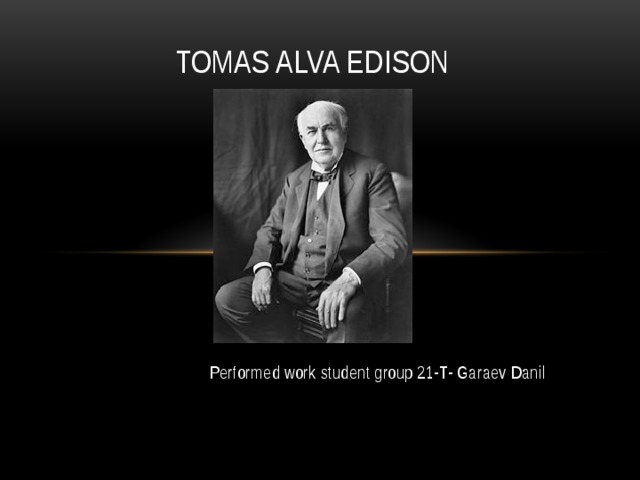
Tomas Alva Edison
Performed work student group 21-T- Garaev Danil
Born
Born 11 February 1847 in Meilen, Ohio
Died
Died 18 Oct 1931 in West orange, new Jersey
Biography
American inventor and entrepreneur, received in the USA 1093 patents and about 3 thousand in other countries of the world; the Creator of the phonograph; he improved the Telegraph, telephone, cinematographic equipment, has developed one of the first commercially successful options of the electric incandescent lamp. He proposed to use in the beginning of the telephone conversation, the word "Hello". In 1928 he was awarded the highest award of the United States — the congressional Gold medal. In 1930 he became a foreign honorary member of the USSR Academy of Sciences .
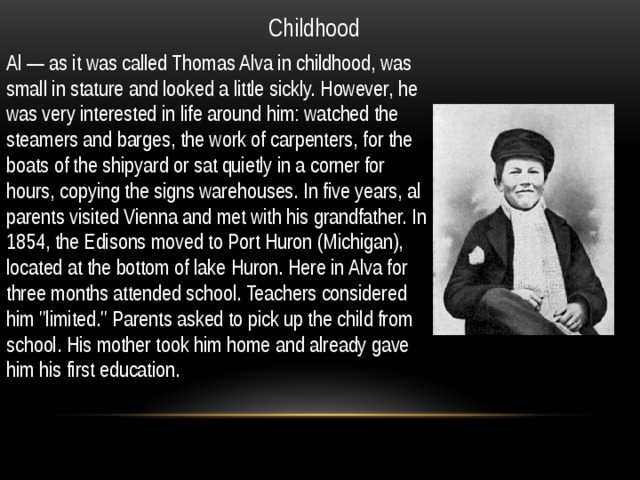
Сhildhood
Al — as it was called Thomas Alva in childhood, was small in stature and looked a little sickly. However, he was very interested in life around him: watched the steamers and barges, the work of carpenters, for the boats of the shipyard or sat quietly in a corner for hours, copying the signs warehouses. In five years, al parents visited Vienna and met with his grandfather. In 1854, the Edisons moved to Port Huron (Michigan), located at the bottom of lake Huron. Here in Alva for three months attended school. Teachers considered him "limited." Parents asked to pick up the child from school. His mother took him home and already gave him his first education.
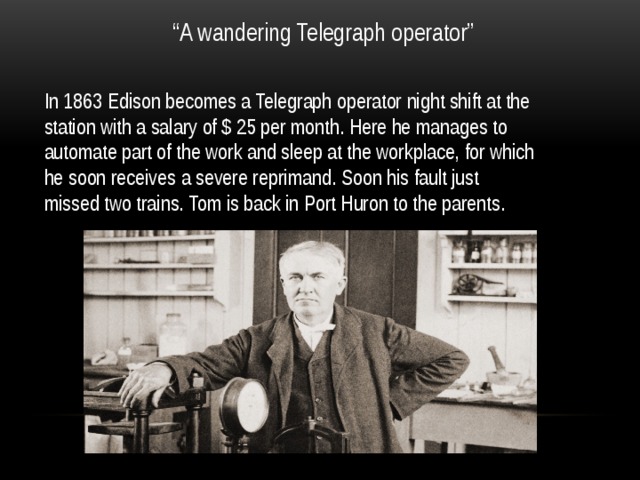
“ A wandering Telegraph operator”
In 1863 Edison becomes a Telegraph operator night shift at the station with a salary of $ 25 per month. Here he manages to automate part of the work and sleep at the workplace, for which he soon receives a severe reprimand. Soon his fault just missed two trains. Tom is back in Port Huron to the parents.
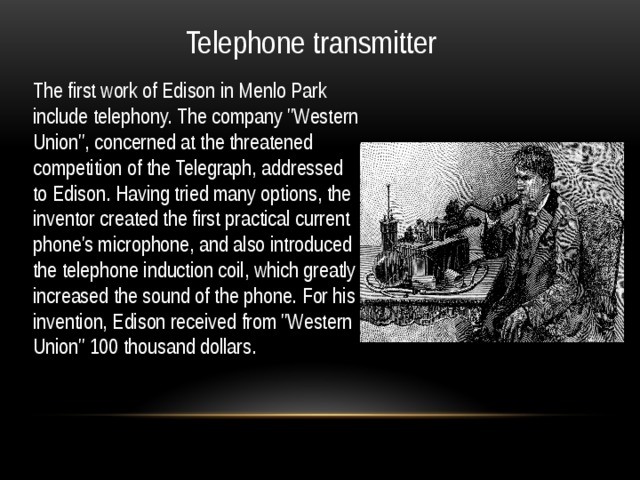
Telephone transmitter
The first work of Edison in Menlo Park include telephony. The company "Western Union", concerned at the threatened competition of the Telegraph, addressed to Edison. Having tried many options, the inventor created the first practical current phone's microphone, and also introduced the telephone induction coil, which greatly increased the sound of the phone. For his invention, Edison received from "Western Union" 100 thousand dollars.
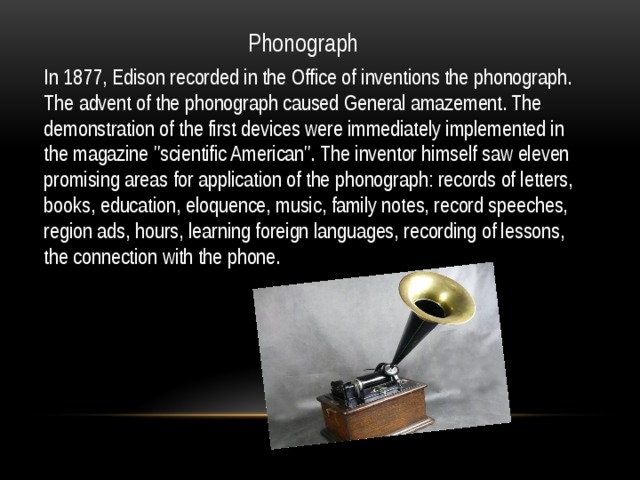
Phonograph
In 1877, Edison recorded in the Office of inventions the phonograph. The advent of the phonograph caused General amazement. The demonstration of the first devices were immediately implemented in the magazine "scientific American". The inventor himself saw eleven promising areas for application of the phonograph: records of letters, books, education, eloquence, music, family notes, record speeches, region ads, hours, learning foreign languages, recording of lessons, the connection with the phone.
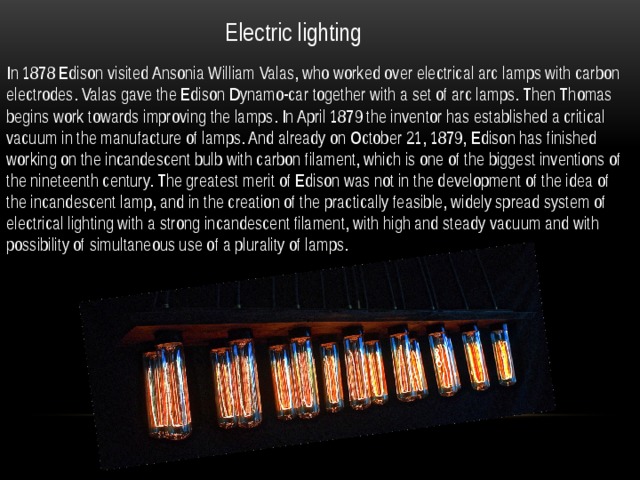
Electric lighting
In 1878 Edison visited Ansonia William Valas, who worked over electrical arc lamps with carbon electrodes. Valas gave the Edison Dynamo-car together with a set of arc lamps. Then Thomas begins work towards improving the lamps. In April 1879 the inventor has established a critical vacuum in the manufacture of lamps. And already on October 21, 1879, Edison has finished working on the incandescent bulb with carbon filament, which is one of the biggest inventions of the nineteenth century. The greatest merit of Edison was not in the development of the idea of the incandescent lamp, and in the creation of the practically feasible, widely spread system of electrical lighting with a strong incandescent filament, with high and steady vacuum and with possibility of simultaneous use of a plurality of lamps.
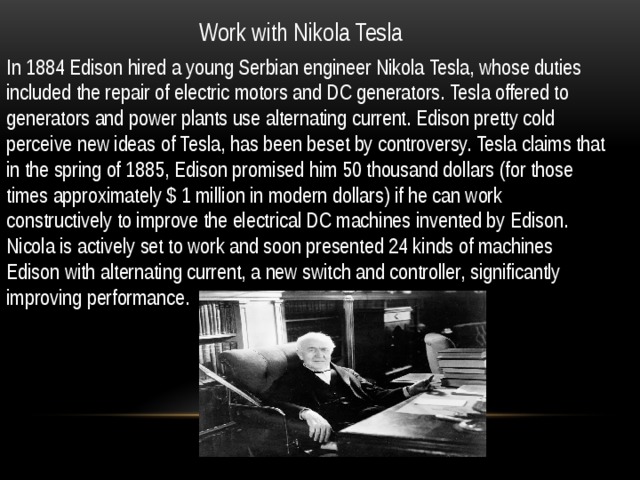
Work with Nikola Tesla
In 1884 Edison hired a young Serbian engineer Nikola Tesla, whose duties included the repair of electric motors and DC generators. Tesla offered to generators and power plants use alternating current. Edison pretty cold perceive new ideas of Tesla, has been beset by controversy. Tesla claims that in the spring of 1885, Edison promised him 50 thousand dollars (for those times approximately $ 1 million in modern dollars) if he can work constructively to improve the electrical DC machines invented by Edison. Nicola is actively set to work and soon presented 24 kinds of machines Edison with alternating current, a new switch and controller, significantly improving performance.
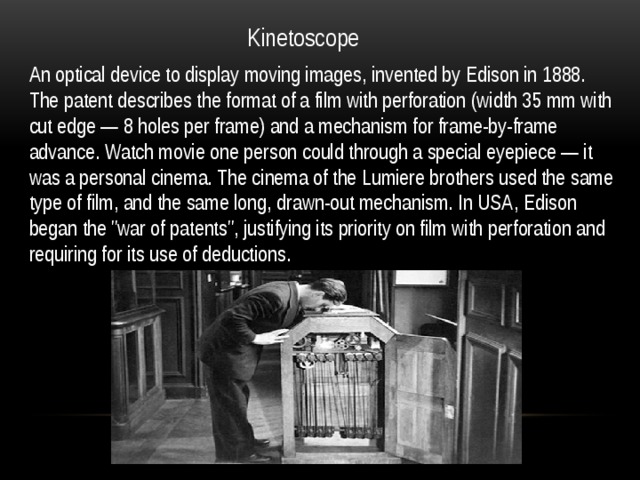
Kinetoscope
An optical device to display moving images, invented by Edison in 1888. The patent describes the format of a film with perforation (width 35 mm with cut edge — 8 holes per frame) and a mechanism for frame-by-frame advance. Watch movie one person could through a special eyepiece — it was a personal cinema. The cinema of the Lumiere brothers used the same type of film, and the same long, drawn-out mechanism. In USA, Edison began the "war of patents", justifying its priority on film with perforation and requiring for its use of deductions.
Dates later in life
1880 — a Dynamo, a device for sorting magnetic ores, an experienced railroad
1881 — three-wire network system of electric lighting
1884 — death of wife Mary
1885 — induction train Telegraph
1886 — the wedding of Edison and Mines Miller
1887 — laboratory in West Orange, the birth of her daughter Madeleine
1890 — birth of son Charles, the improvement of the phonograph
1891 — the kinetoscope
1892 — the factory for ore enrichment, enhancement of the phonograph
1896 — death of father
1898 — the birth of a son, Theodore
1901 cement plant
1912 — cination
1914 — production of phenol, benzene, aniline oil and other chemicals
1915 — Chairman of the Marine Advisory Committee
1930 — the problem of synthetic rubber, Edison's election of an honorary member of the USSR Academy of Sciences
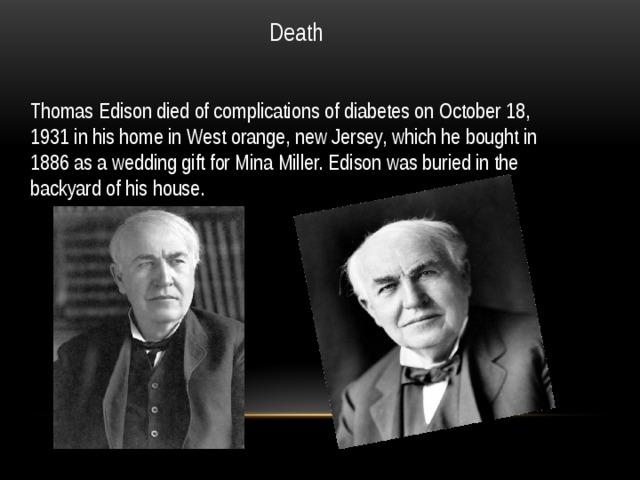
Death
Thomas Edison died of complications of diabetes on October 18, 1931 in his home in West orange, new Jersey, which he bought in 1886 as a wedding gift for Mina Miller. Edison was buried in the backyard of his house.

Thanks for watching
Thanks for watching
Thanks for watching
Thanks for watching
Thanks for watching
Thanks for watching
Thanks for watching








Вебинар для учителей

Свидетельство об участии БЕСПЛАТНО!