

Армения, Арташат

СДЕЛАЙТЕ СВОИ УРОКИ ЕЩЁ ЭФФЕКТИВНЕЕ, А ЖИЗНЬ СВОБОДНЕЕ
Благодаря готовым учебным материалам для работы в классе и дистанционно
Скидки до 50 % на комплекты
только до
Готовые ключевые этапы урока всегда будут у вас под рукой
Организационный момент
Проверка знаний
Объяснение материала
Закрепление изученного
Итоги урока
Была в сети 22.04.2024 09:35

Мелконян Грета Антоновна
учитель английского языка
 1 198
1 198
 57 487
Местоположение
Quantifiers Power point
Категория:
Английский язык
08.06.2020 17:43

Просмотр содержимого документа
«Quantifiers Power point»

PRESENTATION
QUANTIFIERS

Contents
. Introduction
. What are quantifiers?
. Many and much
. Few and a few
. Little and a little
. Too and enough
. Some and any
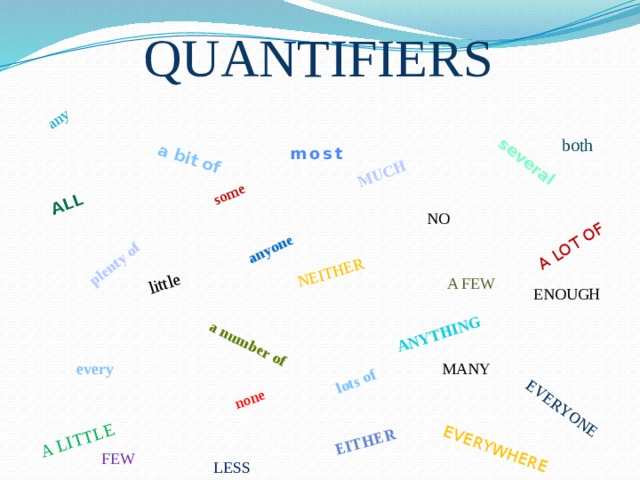
ALL
any
NEITHER
EITHER
some
none
EVERYONE
MUCH
little
A LOT OF
lots of
a number of
several
plenty of
a bit of
ANYTHING
anyone
EVERYWHERE
A LITTLE
QUANTIFIERS
both
most
NO
A FEW
ENOUGH
MANY
every
FEW
LESS
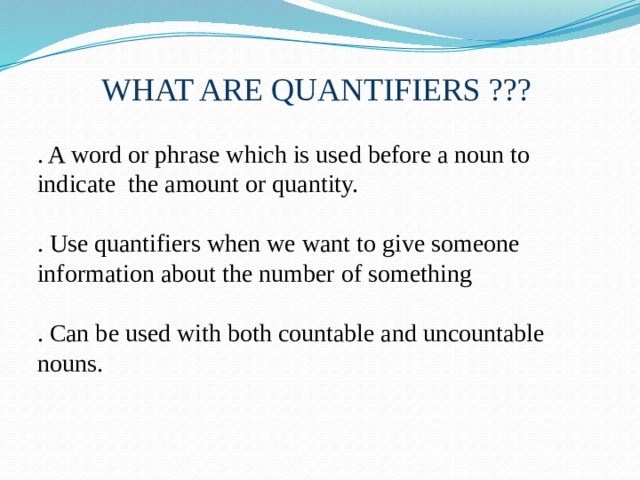
WHAT ARE QUANTIFIERS ???
. A word or phrase which is used before a noun to indicate the amount or quantity.
. Use quantifiers when we want to give someone information about the number of something
. Can be used with both countable and uncountable nouns.

EXAMPLES OF QUANTIFIERS
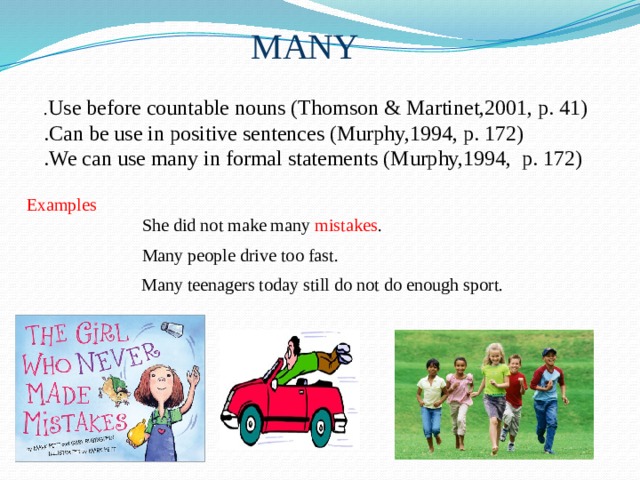
MANY
. Use before countable nouns (Thomson & Martinet,2001, p. 41)
.Can be use in positive sentences (Murphy,1994, p. 172)
.We can use many in formal statements (Murphy,1994, p. 172)
Examples
She did not make many mistakes .
Many people drive too fast.
Many teenagers today still do not do enough sport.
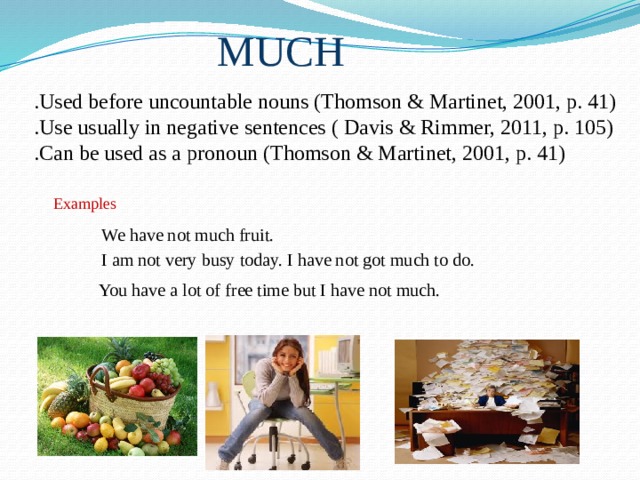
MUCH
.Used before uncountable nouns (Thomson & Martinet, 2001, p. 41)
.Use usually in negative sentences ( Davis & Rimmer, 2011, p. 105)
.Can be used as a pronoun (Thomson & Martinet, 2001, p. 41)
Examples
We have not much fruit.
I am not very busy today. I have not got much to do.
You have a lot of free time but I have not much.
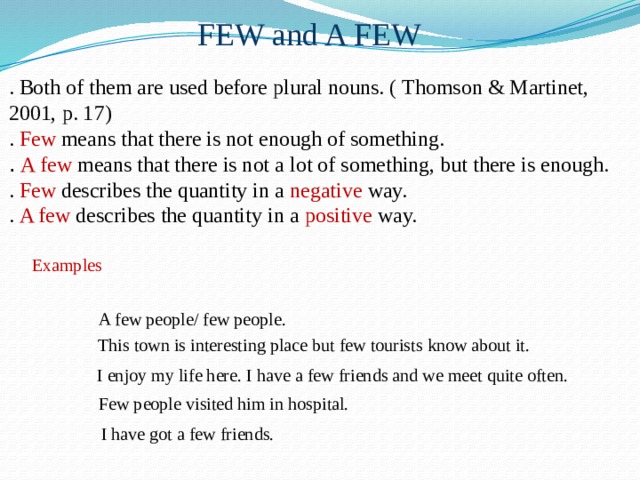
FEW and A FEW
. Both of them are used before plural nouns. ( Thomson & Martinet, 2001, p. 17)
. Few means that there is not enough of something.
. A few means that there is not a lot of something, but there is enough.
. Few describes the quantity in a negative way.
. A few describes the quantity in a positive way.
Examples
A few people/ few people.
This town is interesting place but few tourists know about it.
I enjoy my life here. I have a few friends and we meet quite often.
Few people visited him in hospital.
I have got a few friends.

LITTLE and A LITTLE
. Both are used before uncountable nouns. (Thomson & Martinet, 2001, p. 17)
. Little means ‘ not enough’. ( Davis & Rimmer, 2011 p. 105)
. Little is used chiefly with better or more in fairly formal style: His second suggestion was little (= not much) better than his first. (Thomson & Martinet, 2001, p. 17)
. A little means ‘ not very many/ much, but enough’. ( Davis & Rimmer, 2011, p. 105)
. A little is more positive. A little = some, a small amount.
. A little can be used (Thomson & Martinet, 2001, p. 17)
a. with verbs: It rained a little during the night.
b. with ‘ unfavourable’ adjective or adverbs: a little anxious, a little impatiently…
c. with comparative adjectives or adverbs: The paper should be a little thicker.
Examples
A little salt/ little salt
There is little money. ( you can not buy it)
There is a little money. ( you can just buy it)
Let’s go and have a drink. We have got a little time before the train leaves.
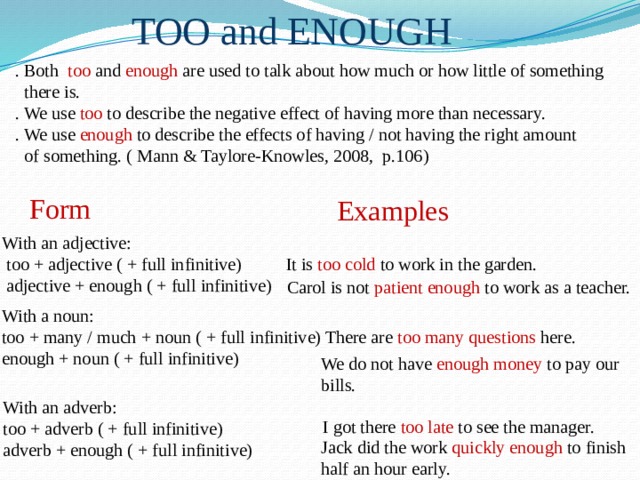
TOO and ENOUGH
. Both too and enough are used to talk about how much or how little of something
there is.
. We use too to describe the negative effect of having more than necessary.
. We use enough to describe the effects of having / not having the right amount
of something. ( Mann & Taylore-Knowles, 2008, p.106)
Form
Examples
With an adjective:
too + adjective ( + full infinitive)
adjective + enough ( + full infinitive)
It is too cold to work in the garden.
Carol is not patient enough to work as a teacher.
With a noun:
too + many / much + noun ( + full infinitive)
enough + noun ( + full infinitive)
There are too many questions here.
We do not have enough money to pay our bills.
With an adverb:
too + adverb ( + full infinitive)
adverb + enough ( + full infinitive)
I got there too late to see the manager.
Jack did the work quickly enough to finish half an hour early.
SOME and ANY
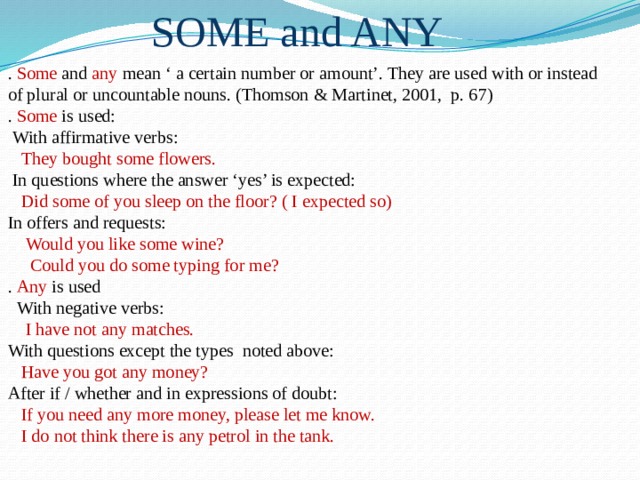
. Some and any mean ‘ a certain number or amount’. They are used with or instead
of plural or uncountable nouns. (Thomson & Martinet, 2001, p. 67)
. Some is used:
With affirmative verbs:
They bought some flowers.
In questions where the answer ‘yes’ is expected:
Did some of you sleep on the floor? ( I expected so)
In offers and requests:
Would you like some wine?
Could you do some typing for me?
. Any is used
With negative verbs:
I have not any matches.
With questions except the types noted above:
Have you got any money?
After if / whether and in expressions of doubt:
If you need any more money, please let me know.
I do not think there is any petrol in the tank.
References
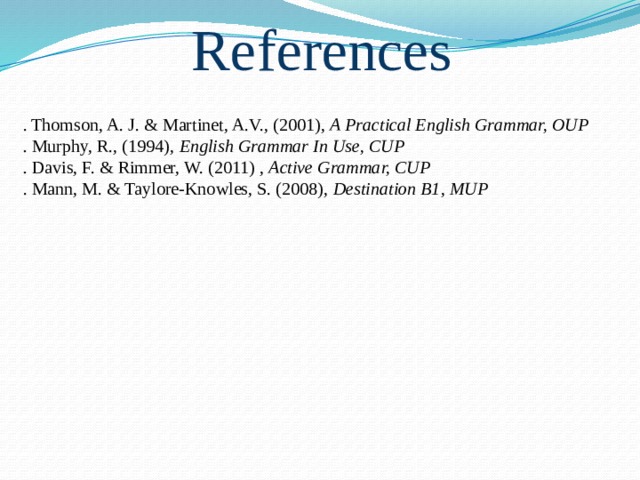
. Thomson, A. J. & Martinet, A.V., (2001), A Practical English Grammar, OUP
. Murphy, R., (1994), English Grammar In Use, CUP
. Davis, F. & Rimmer, W. (2011) , Active Grammar, CUP
. Mann, M. & Taylore-Knowles, S. (2008), Destination B1 , MUP

Thank you for attention…
Вебинар для учителей

Свидетельство об участии БЕСПЛАТНО!



